A sales operating rhythm is the fixed calendar of meetings, reviews and decisions that turns your sales plan into weekly action. It usually has four layers: a short team huddle, a pipeline review, a monthly business review and a quarterly planning session. Each layer has one owner, one set of numbers and one question to answer. This guide shows what belongs in each layer, how long it should run, and how to keep the whole thing from swallowing your selling time.
TL;DR
- A sales operating rhythm is a recurring, structured set of meetings and reviews built to give you pipeline visibility, forecast accuracy and coaching.
- A common starting layout: a weekly team huddle, a weekly pipeline review, a monthly business review and a quarterly business review. Adjust the length to your team size.
- Every meeting needs one job. Pipeline reviews should focus on obstacles to closing and next steps, not general status updates.
- Prevent meeting overload by keeping pipeline reviews separate from one-on-ones and staggering them across the week.
- "Operating system", "operating model" and "management cadence" are neighbors of the rhythm, not synonyms. The rhythm is the part that happens on the calendar.
Table of Contents
- What a sales operating rhythm is
- The four layers of a working rhythm
- How to run the forecast inside the rhythm
- Avoiding meeting overload
- Where coaching fits
- What about the 3-3-3 rule?
- A business rhythm versus a sales rhythm
- How to launch a rhythm in 30 days
- Perspective
- Work with us on your sales rhythm
- FAQ
- Sources
What a sales operating rhythm is
Think of it as the heartbeat of the revenue team. Strategy says where you want to go. The rhythm is how you check, every week and every quarter, whether you are getting there and who has to do what next.
A good rhythm does three things. It makes the pipeline visible to everyone who needs to see it. It gives managers a regular, predictable place to coach. And it gives leadership a forecast it can trust because the same questions get asked in the same way every time.
There is also a systems idea underneath. One practitioner writing on revenue operations explains that operating rhythms create feedback loops: the output of one process becomes the input to the next action, which steadies how the sales system behaves. In plain terms, last week's review should change what reps do this week, and this week's results should change next week's review. If a meeting produces no change in behavior, it is not part of the rhythm. It is just a meeting.

Rhythm, operating system, operating model and cadence
These four terms get mixed up, so here is a working split:
| Term | What it covers | Where it lives |
|---|---|---|
| Sales operating model | How the sales organization is designed: roles, segments, territories, handoffs between SDR, AE and customer success | Org chart and planning documents |
| Sales operating system | The full set of processes, tools, data definitions and routines that run selling day to day | CRM, playbooks, enablement |
| Sales operating rhythm | The recurring meetings and reviews that keep the system running | The calendar |
| Sales management cadence | The manager-level subset: one-on-ones, pipeline reviews, forecast calls | Manager calendars |
The model is the blueprint, the system is the machinery and the rhythm is how often you turn it over and check the gauges. McKinsey describes the best sales operations leaders as the right hand of senior sales leaders, effectively the COO of the sales organization. That role is largely about owning the rhythm: running the weekly, monthly and quarterly reviews and holding peers to their commitments.
The four layers of a working rhythm
The layout below is a practical default, not a law. The time boxes are common starting points that one published guide to sales operating rhythm lays out: weekly stand-ups of 15 to 30 minutes, weekly pipeline reviews of up to 30 minutes per rep, monthly business reviews of 60 to 90 minutes and quarterly business reviews of 90 to 120 minutes. Start there, then trim.
| Layer | Frequency | Time box | Owner | Core question |
|---|---|---|---|---|
| Team huddle | Weekly (or daily for SDR teams) | 15 to 30 min | Front-line manager | What moves this week? |
| Pipeline review | Weekly | Up to 30 min per rep | Manager with each rep | Which deals are stuck and what is the next step? |
| Business review | Monthly | 60 to 90 min | Sales leader | Are we on track against targets, and why or why not? |
| Quarterly business review | Quarterly | 90 to 120 min | Head of sales with leadership | What is the 90-day strategy and what capacity do we need? |
The weekly team huddle
The huddle is for alignment, not for deep deal work. Keep it standing-up short. A useful agenda has three parts: last week's results against the number, the three or four things that matter most this week, and one blocker that someone in the room can remove.
McKinsey describes a lightweight version for B2B teams: seven KPIs every seven days in team huddles, giving action-oriented guidance for acute opportunities. The point is restraint. A short, stable list of numbers beats a dashboard nobody reads.
For SDR and BDR teams, this is also the right place to talk about activity and outreach quality. If you are designing the outreach itself, our sales cadence templates with day-by-day plans give you the sequences the huddle can then inspect.
The weekly pipeline review
This is the meeting that most teams get wrong. It turns into a status read-out where each rep recites what they already typed into the CRM. Salesforce's own guidance on this is clear: a pipeline review should focus on obstacles to closing and on actions for the manager or the rep, not on general status updates.
A tight format looks like this:
- Pick the deals before the meeting. Choose by stage, size or age, not by who talks the most.
- State the next step and its date. If a deal has no dated next step, that is the finding.
- Name the obstacle. Missing champion, no access to budget, competing priority, legal delay.
- Agree on one action and one owner. The manager may own it, for example an executive introduction.
- Record it. The next review starts from that note.
If you want a fast way to find deals that need attention, our sales pipeline diagnostics for stalled deals walks through a 15-minute check. Defining clean exit criteria for each stage makes the review easier too. A CRM-ready pipeline stage guide shows how stage definitions turn review conversations from opinion into evidence, and the idea carries over to any long buying cycle.
Teams that want to speed up preparation can use AI to surface risk before the meeting. We cover that in AI for pipeline reviews. The rule we give leaders is the same with or without AI: diagnose the pipeline first, then add tools.
The monthly business review
The monthly review zooms out. The questions change from "what is happening in this deal" to "what is the pattern across deals." Cover these in order:
- Results against quota and against the forecast you made a month ago
- Conversion rates between stages and where they slipped
- Pipeline coverage for the next two quarters
- Rep and segment performance, with coaching priorities
- Process fixes you will make in the next 30 days
Tracking KPIs by geography, business unit, account or sales team supports timely decisions, according to McKinsey's work on data-driven commercial performance management. Pick the cuts that match how you actually manage: by segment, by territory or by team.
The quarterly business review
The QBR is where you set the next 90 days. It should produce decisions about priorities, hiring, territory changes and the targets each team carries into the quarter. It should also produce a short list of what you will stop doing. A QBR that only adds work will break the weekly rhythm underneath it.
How to run the forecast inside the rhythm
Forecasting is not a separate event. It lives inside the pipeline review and the monthly review. Salesforce describes running a weekly forecasting cadence across the organization, with forecast reviews at different management levels. The same document stresses that successful pipeline management and forecasting depends on consistency in sales stages, required data fields and review cadences.
That consistency is the part you can copy at any company size. Three habits matter most:
- One definition per stage. Everyone agrees what must be true for a deal to enter or leave a stage.
- Required fields that are actually required. Close date, next step, buyer role and amount.
- The same call, same day, same format. Reps learn to prepare because they know what is coming.
Once those basics hold, you can layer in forecasting models. Our AI sales forecasting playbook covers how to do that without trusting a black box.
Avoiding meeting overload
The most common reason a rhythm fails is that it feels like a tax. Reps see five new meetings and quietly stop preparing. Three design rules help.
Separate the pipeline review from the one-on-one. Salesforce recommends keeping them distinct and staggering them so reps are not buried. The pipeline review inspects deals. The one-on-one is for development, motivation and career. Mixing them means the deals win and the person loses.
Give every meeting one question. If you cannot state a meeting's single question in a sentence, cut it or merge it.
Run a quarterly audit. Once a quarter, list every recurring meeting and ask three things: what decision did it produce, who would notice if we dropped it, and could a written update do the job? Remove anything that fails.
A sample week for a front-line manager with six reps might look like this:
| Day | Meeting | Length |
|---|---|---|
| Monday | Team huddle | 20 min |
| Tuesday | Pipeline reviews, reps 1 to 3 | 3 x 30 min |
| Wednesday | One-on-ones, reps 1 to 3 | 3 x 30 min |
| Thursday | Pipeline reviews, reps 4 to 6 | 3 x 30 min |
| Friday | Forecast submission and one-on-ones, reps 4 to 6 | 3 x 30 min plus 30 min |
That is about eight hours of structured time, which sounds like a lot until you compare it with the unplanned time most managers spend chasing updates by message.
Where coaching fits
A rhythm without coaching is only reporting. The weekly pipeline review should end with something the rep does differently. Recorded calls and AI-generated notes can feed this, and we lay out a 90-day approach in turning AI meeting notes into manager coaching. The sequence is simple: review the call, pick one behavior, practice it, then check it in the next pipeline review.

Deal-level tools help too. A mutual action plan gives both the rep and the buyer dated steps, which makes the "next step and date" question in your review far easier to answer. For deals reaching senior buyers, our 90-day C-suite selling playbook shows how managers can support from above.
What about the 3-3-3 rule?
People often ask whether the 3-3-3 rule belongs in a sales operating rhythm. The rule has several versions. A common one asks reps to contact three new prospects a day, follow up with three existing leads and book three meetings a week. It is a personal activity habit, not a management rhythm. A team can use it as a daily floor and review the results in the weekly huddle, but it does not replace the pipeline review, because activity counts say nothing about whether deals are moving.
A business rhythm versus a sales rhythm
A business rhythm is the company-wide version: recurring, structured activities that manage execution against priorities. Sales forecast reviews and joint sales and marketing pipeline reviews are typical examples. Your sales operating rhythm is the sales slice of that larger calendar, and it should plug into it. If marketing reviews lead quality on Thursday and sales reviews pipeline on Tuesday, the two should share definitions so no one argues about whose number is right.
How to launch a rhythm in 30 days
- Week 1: audit. List the meetings you already hold. Mark what each one decides.
- Week 1: define. Write down stage definitions, required CRM fields and the five to seven KPIs you will track.
- Week 2: pilot the pipeline review. Run the new format with one team. Use a one-page template: deal, next step and date, obstacle, action, owner.
- Week 3: add the huddle and the forecast call. Keep both short and at the same time each week.
- Week 4: hold the first monthly review. Compare the forecast with actuals and decide two process fixes.
- After day 30: audit again. Cut anything that did not change behavior.
Expect the first month to feel clunky. The rhythm works because it repeats, not because the first meeting is perfect.
Perspective
Over 25 years of building and scaling sales and business development teams, including at companies such as Informatica, RingCentral and Cisco-WebEx, we have seen the same pattern: the teams that hit their numbers are rarely the ones with the cleverest tools. They are the ones that inspect the same things, in the same way, every week.
Our view is that the rhythm comes before the technology. If the pipeline review is a status read-out, adding AI only produces a faster status read-out. If the review asks what is blocking the deal and who does what by when, AI becomes a real advantage because it surfaces risk before the meeting starts.
This is the thinking behind our books, including AI for Sales 2.0 and Mastering B2B Lead Generation with LinkedIn & AI, and behind the conversations on The AI for Sales Podcast. It is also how we work with leaders who bring us in to build or fix an SDR or BDR function: start with the rhythm, make it light, make it repeatable, then add automation where it earns its place.
Chad
Work with us on your sales rhythm
If your pipeline reviews have drifted into status updates, or you are building an SDR or BDR team and want the cadence right from the start, we can help. We run speaking engagements and workshops for sales teams and leaders, including sessions on diagnosing the pipeline before adding AI. See the speaking and workshop options or read how our AI sales workshops for leaders are structured.
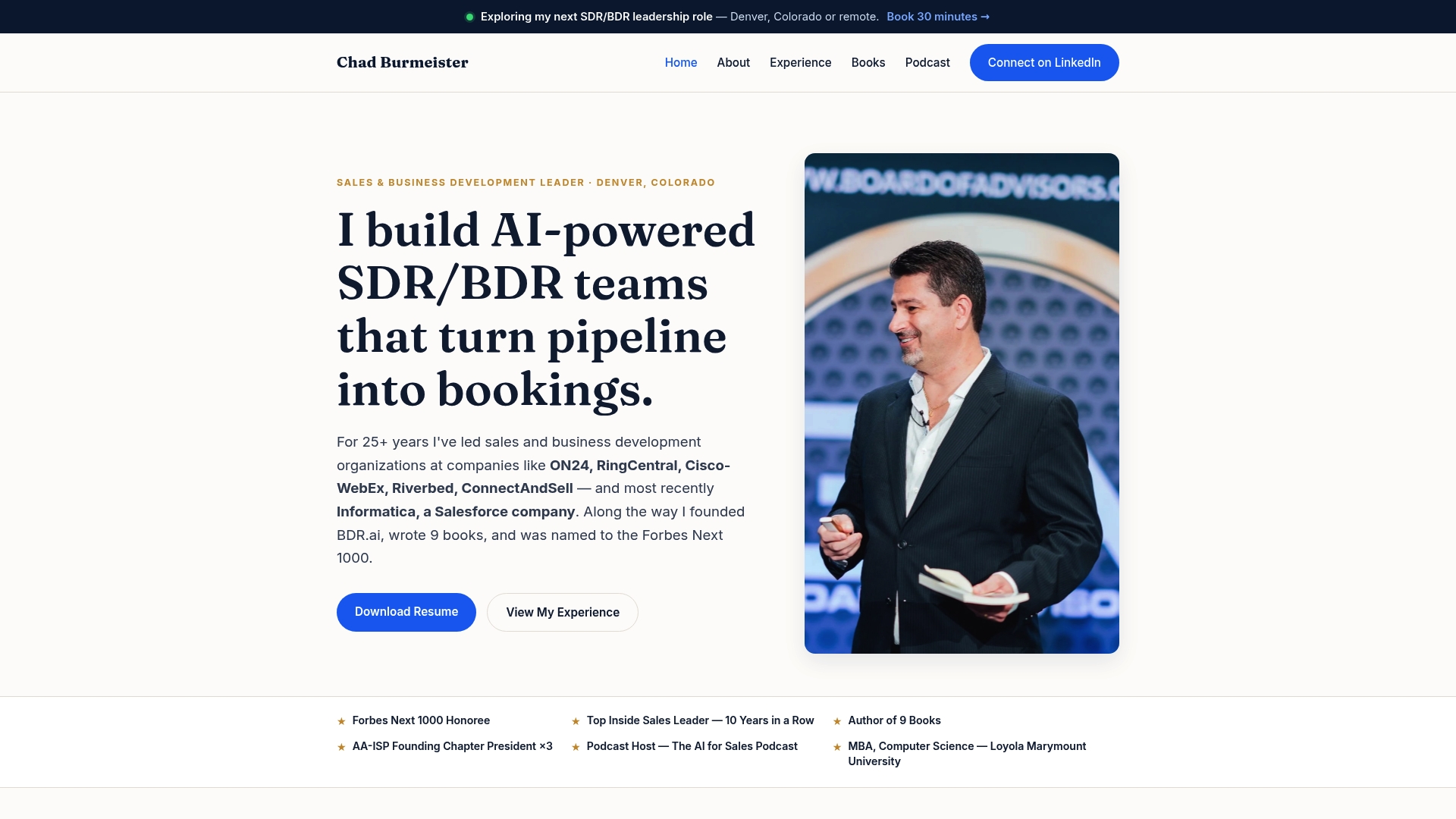
Pricing is not published, so reach out through the site to talk through your team's situation. You can start from chadburmeister.com.
FAQ
How often should a sales team meet as part of its operating rhythm?
Most teams meet weekly for a short huddle and a pipeline review, monthly for a business review and quarterly for planning. SDR teams often add a brief daily check-in. Start light and add only what produces decisions.
What is the difference between a sales operating rhythm and a sales operating model?
The operating model is the design of the sales organization: roles, segments and handoffs. The operating rhythm is the recurring set of meetings and reviews that keeps that design running. You can change the rhythm in a month. Changing the model takes planning.
What should a pipeline review cover?
It should cover the specific deals at risk, the obstacle on each, the next step with a date and who owns the action. Salesforce advises that these reviews focus on obstacles to closing rather than general updates.
How do I stop the rhythm from becoming too many meetings?
Give each meeting one question, keep pipeline reviews separate from one-on-ones, stagger them through the week and audit the calendar every quarter. Cut any meeting that no longer changes what people do.
Is the 3-3-3 rule part of a sales operating rhythm?
It can support it as a daily activity floor, but it is a personal habit rather than a management meeting. Review the results in the weekly huddle and use the pipeline review to judge deal progress.
Sources
- Sales Operating Rhythm: Build One That Works in 2026
- Setting up your Operating Cadences, Jeff Ignacio
- Looking beyond technology to drive sales operations, McKinsey
- Entering a new era of data-driven B2B, McKinsey
- How Salesforce Manages Pipeline and Forecasts
- Make Sales Pipeline Review Meetings Productive, Salesforce
- 90 Day Pipeline Pilot: CRM Ready Stages