
If your team misses quota consistently over multiple quarters, AI sales forecasting is worth piloting now. The single condition that determines success is clean, sufficient historical data: practitioners recommend a minimum amount of historical deal data before any machine learning model will produce reliable results. Organizations that meet that bar and automate activity capture commonly see meaningful improvements in forecast accuracy on aggregated B2B pipeline forecasts.
Three signals that your team is ready:
- Rep-submitted forecasts frequently miss their targets by a substantial margin most quarters
- Pipeline hygiene is inconsistent (missing close dates, stale stages, no activity logging)
- You have over a year of closed-won and closed-lost deal history in your CRM
If none of those apply, fix your CRM hygiene first. AI amplifies the data you have, good or bad.
Table of Contents
- What is AI sales forecasting and how does it differ?
- When does AI forecasting actually help?
- Which modeling approach fits your pipeline?
- How to implement AI forecasting step by step
- How do you validate and measure forecast accuracy?
- How to operationalize AI forecasts week to week
- Limitations and governance you need to plan for
- What to look for when evaluating vendors or building in-house
- Your 30–60–90 day pilot template
- Key Takeaways
- What sales leaders actually do with AI forecasts
- Ready to move from pilot to production?
What is AI sales forecasting and how does it differ?
Traditional forecasting is math on top of opinion. A rep marks a deal 70% likely to close, and the system multiplies that by deal value. The problem is that the 70% came from the rep's gut, not from buyer behavior.
Predictive sales AI changes the input layer entirely. Instead of rep-submitted estimates, the model ingests CRM activity, email frequency, meeting recency, stakeholder engagement, product usage, and marketing signals to produce a continuously updated probability score for every deal. The output is a revenue landing estimate, a pipeline health score, and deal-level win probabilities that update as buyer behavior changes.
"AI continuously updates probability scores using real-time buyer behavior rather than static close dates, enabling earlier risk detection." — Industry CROs on the core value of predictive forecasting
The practical difference: a rep might hold a deal at 70% for six weeks while email response time drops to zero. An AI model flags that deal as high-risk within days. That early warning is where the real value lives.
When does AI forecasting actually help?
AI forecasting adds value when your data is clean, sufficient, and integrated. When it isn't, the model learns your bad habits at scale.
Readiness checklist:
- CRM stages are defined consistently across all reps and territories
- Activity signals (emails sent, meetings held, stakeholder touches) are captured automatically, not manually
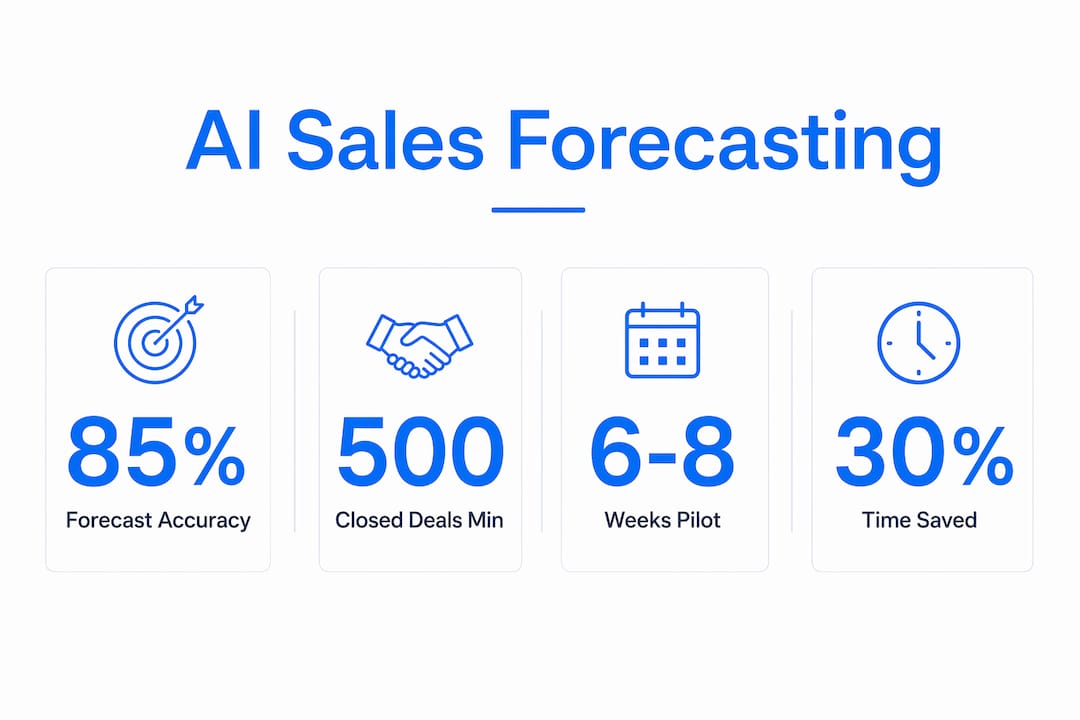
- At least 500 historical closed deals are available with outcome labels
- Close dates, deal values, and owner fields are populated on 90%+ of records
- Product usage or marketing engagement data can be joined to CRM records
| Data dimension | Recommended minimum | Why it matters |
|---|---|---|
| Historical rows | 500 closed deals | Below this, models overfit to noise |
| Activity signals | Email, meeting, call logs | Manual entry creates blind spots |
| Time span | over a year | Captures at least one seasonal cycle |
| Feature fields | 10–15 per deal | Supports tree-based model training |
| Outcome labels | Win/loss on all historical deals | Required for supervised learning |
Automated capture of activity signals is the most commonly overlooked requirement. Manual rep entry creates gaps that degrade model performance in ways that are hard to diagnose after the fact.
Pro Tip: Before touching a model, run a data audit on your last 24 months of closed deals. Fix missing close dates and stage inconsistencies first. That single cleanup typically yields the largest accuracy gain of any step in the process.
Which modeling approach fits your pipeline?
For most B2B pipeline use cases, tree-based ensembles (XGBoost, LightGBM, or CatBoost) are the recommended default. They handle tabular CRM data well, tolerate missing values, and produce feature importance scores that sales leaders can actually interpret.

Model selection depends on your data shape and forecast horizon:
| Model family | Best for | Interpretability | Data minimum | Maintenance |
|---|---|---|---|---|
| ARIMA / ETS | Stable univariate revenue series | High | Low | Low |
| Prophet | Seasonal patterns, holiday effects | Medium | Low | Low |
| XGBoost / LightGBM | Tabular deal-level scoring | Medium | Medium | Medium |
| Deep learning | Very large datasets, complex signals | Low | High | High |
Deep learning is rarely justified for teams under a few hundred thousand deal records. The accuracy gain over a well-tuned XGBoost model is marginal, and the maintenance burden is significantly higher.
Pro Tip: Always benchmark your ML model against a seasonal-naive baseline before declaring success. If your model can't beat "same quarter last year," the feature engineering needs more work, not the algorithm.
How to implement AI forecasting step by step
The goal of a production rollout is automated, explainable forecasts integrated directly into CRM workflows, not a standalone model that lives in a data scientist's notebook.
Implementation checklist:
- Audit your CRM data quality and document gaps (one week)
- Define the target variable precisely: deal win probability, quarterly revenue landing, or both
- Engineer features: lag variables, rolling activity averages, stage velocity, and calendar encodings
- Train a baseline model and a candidate ML model on historical data
- Validate using walk-forward temporal splits, not random splits
- Deploy predictions back into CRM as a scored field visible to reps and managers
- Set up monitoring for model drift and data pipeline failures
Questions to ask vendors or your engineering team:
- How often does the model retrain, and is retraining automated?
- Can a sales manager see which features drove a specific deal's score?
- What happens to predictions when CRM data is missing or stale?
- How does the system handle new reps with no historical data?
A realistic pilot requires one data engineer, one analyst, and a sales ops lead. Plan for six to eight weeks from data audit to first scored predictions in CRM.
Pro Tip: LLMs like GPT-4 can extract risk signals from call notes and emails as feature inputs to your core ML model. They are not a replacement for supervised forecasting, but they add qualitative signal that structured CRM data misses.
How do you validate and measure forecast accuracy?
Use walk-forward validation with temporal test sets. Random train/test splits produce misleadingly optimistic results because they allow future data to leak into training.
Key metrics:
- MAPE (Mean Absolute Percentage Error): Percentage error averaged across periods. Target: 10–20% for well-prepared B2B data.
- WAPE (Weighted APE): Weights errors by deal size, reducing distortion from small deals.
- MAE (Mean Absolute Error): Dollar error in absolute terms, useful for quota planning.
- RMSE (Root Mean Squared Error): Penalizes large misses more heavily than MAE.
- Brier Score: Measures calibration of win-probability predictions (0 = perfect, 1 = worst).
- Bias: Systematic over- or under-prediction across periods.
Simple MAPE example: If you forecast $1M and close $900K, your MAPE for that period is 10%. Across five quarters, average those absolute percentage errors to get your model's MAPE.
Practitioners consistently find that feature engineering and temporal validation are where most accuracy gains are won or lost — not in algorithm selection.
How to operationalize AI forecasts week to week
AI output should change what you discuss in pipeline reviews, not just add a new column to a spreadsheet. Shift the conversation from "what did the rep commit?" to "what does the model say is at risk, and why?"
Manager playbook:
- Flag any deal where the AI score dropped more than 15 points week-over-week for immediate coaching
- Triage the bottom quartile of pipeline scores at the start of each week; assign specific next actions
- Use score trends, not just current scores, to identify deals that are quietly stalling
- Set escalation rules: deals above $50K with a score below 30% get executive review
Mid-quarter risk mitigation:
- Pull all deals with close dates in the current quarter and scores below 40%; build a sprint close plan
- Identify expansion opportunities in accounts where product usage signals are rising but pipeline is flat
- Use calibration data to adjust quota attainment projections before the board call, not after
AI-driven forecasts are designed to augment human judgment, not replace it. The model surfaces the signal; the manager decides the action.
Limitations and governance you need to plan for
The single most important governance rule: monitor for model drift and keep humans in the decision loop. A model that was accurate in Q1 can silently degrade by Q3 if market conditions shift and no one is watching.
| Role | Responsibility | Review cadence |
|---|---|---|
| Data owner | Pipeline data quality, activity capture | Weekly |
| Model owner | Retraining, drift monitoring, feature updates | Monthly |
| Sales ops | CRM integration, score visibility, adoption | Weekly |
| Sales leader | Acting on signals, coaching triggers | Daily/weekly |
Common failure modes:
- Overfitting to a single rep's historical pattern that doesn't generalize
- Feature leakage (using data available only after the outcome is known)
- Seasonal regime shifts that the model was never trained on
- Security gaps when deal-level data flows to third-party vendors
Pro Tip: Set a calibration alert: if your model's predicted win rate diverges from actual win rate by more than 10 percentage points for two consecutive months, trigger a retraining review. Silent drift is the most common reason AI forecasting projects lose credibility.
What to look for when evaluating vendors or building in-house
Build in-house if you have a mature data team and a long-term roadmap for proprietary signals. Buy if you need results within a quarter and your data team is stretched.
Vendor checklist:
- Native CRM integration (Salesforce, HubSpot, Dynamics 365) with bi-directional sync
- Explainability: can a rep or manager see why a deal scored the way it did?
- Automated retraining cadence with drift alerts
- Data residency and security certifications relevant to your industry
- Transparent pricing tied to seats or usage, not opaque enterprise contracts
Questions for vendor demos:
- Show me a deal where the model was wrong. How would I have caught it?
- What is the minimum data volume your model needs to produce reliable scores?
- How does your system handle cold-start for new reps or new product lines?
- What SLA do you offer for prediction latency and uptime?
A boutique implementation partner makes sense when you have the data maturity to build but lack the internal bandwidth to run a disciplined pilot.
Your 30–60–90 day pilot template
The pilot's primary outcome is a measurable reduction in forecast error or improved calibration compared to your current method over one full quarter.
Pilot timeline:
- Days 1–30: Data audit, gap remediation, define target variable, extract historical dataset, establish baseline MAPE using current method
- Days 31–60: Feature engineering, model training, walk-forward validation, first scored predictions in a sandbox CRM environment
- Days 61–90: Live scoring in production CRM, manager adoption, weekly accuracy tracking, go/no-go decision
Acceptance criteria:
| Criterion | Target |
|---|---|
| Forecast MAPE | 10–20% on aggregated quarterly pipeline |
| CRM integration | Scores visible to all pilot reps |
| Workflow adoption | Managers frequently reference AI scores in pipeline reviews |
| Drift monitoring | Automated alert configured and tested |
Dashboard metrics to track weekly:
- Model MAPE vs. rep-submitted MAPE for the same period
- Score distribution across pipeline (are scores clustering unnaturally?)
- Deal-level score volatility week-over-week
- Adoption rate: percentage of managers using scored views
Key Takeaways
AI sales forecasting delivers its strongest results when clean data, automated activity capture, and operational adoption are all in place before the model goes live.
| Point | Details |
|---|---|
| Data threshold matters | At least 500 historical closed deals are needed before ML models produce reliable results. |
| Validate temporally | Walk-forward validation with future-period test sets is the only way to avoid misleadingly optimistic accuracy scores. |
| Tree models are the default | XGBoost and LightGBM outperform more complex architectures on tabular B2B deal data with manageable maintenance. |
| Governance prevents drift | Assign a model owner and set calibration alerts; silent drift is the most common reason pilots lose credibility. |
| Chadburmeister accelerates pilots | Chad Burmeister's consulting and hands-on SDR/BDR leadership help revenue teams move from data audit to live AI scoring within a quarter. |
What sales leaders actually do with AI forecasts
Most articles treat AI forecasting as a technology problem. It isn't. It's a behavior change problem with a technology component.
The teams that get real value from predictive analytics are the ones that change what happens in Monday's pipeline call. They stop asking reps to defend their commit number and start asking: "The model says this deal dropped 20 points this week. What changed?" That one shift in meeting cadence is worth more than any algorithm upgrade.
The honest reality is that AI forecasts are wrong sometimes, and that's fine. What they do consistently is surface the pattern of risk earlier than any rep will volunteer it. A rep who is behind quota has every incentive to stay optimistic. The model has no such incentive. That asymmetry is the actual value proposition, and it's why sales leaders who use these tools well spend less time on forecast theater and more time on deals that can still be saved.
If you're skeptical, start with one metric: track your current forecast miss rate for two quarters, then run the pilot. Let the delta speak. For deeper frameworks on operationalizing AI in sales, the AI for Sales Podcast covers real implementation cases with practitioners who've done exactly this.
Ready to move from pilot to production?
Chadburmeister offers the fastest path from "we should try AI forecasting" to a live, scored pipeline that managers actually use. Unlike a software vendor that hands you a tool and a knowledge base, Chad Burmeister brings 25+ years of hands-on sales leadership to the implementation: auditing your data, designing the pilot, and running the operational change management that makes adoption stick.
Engagements range from a focused one-day data audit and pilot design workshop to a full quarter of embedded SDR/BDR leadership with AI forecasting built into the team's weekly rhythm. Organizations across Colorado and beyond have used this model to cut forecast error and give their CROs a number they can defend. The books and frameworks behind the methodology are published and available, but the fastest next step is a direct conversation.
Book a consultation to map your current data maturity to a 90-day pilot plan.