AI meeting notes earn their place in a sales organization when they turn conversation evidence into validated CRM facts and coachable proof points tied to measurable outcomes, not when they just produce a tidy transcript. The winners here are sales managers who coach with real evidence, SDR and BDR teams who can repeat what works, and hiring managers who onboard faster with a clear performance baseline. Done right, the payoff is more seller time in front of customers and faster, cleaner qualification.
TL;DR:
- Validated meeting facts should be mapped to CRM fields only after human review to ensure accuracy and prevent pollution of records.
- Role-specific summary formats for managers and sellers are crucial for driving adoption and effective coaching behaviors across teams.
- A 60 to 90 day pilot with clear baseline metrics and KPIs helps determine readiness for scaling and informs necessary process refinements.
- Combining conversation summaries with targeted coaching improves pipeline quality and speeds up sales cycles more than admin reduction alone.
- External leadership can speed implementation and establish coaching routines early, especially for teams lacking internal expertise in scaling AI processes.
Table of Contents
- Why AI meeting notes matter for scaling SDR and BDR teams
- A playbook to capture, validate, and act on meeting evidence
- Rubrics and CRM mappings that support coaching and forecast hygiene
- Pilot design, KPIs, and governance for scaling this reliably
- Common pitfalls and the human-in-the-loop guardrails that fix them
- A 0 to 90 day plan for CEOs, CROs, and hiring managers
- When to bring in outside leadership versus building it yourself
- How we help you implement this faster
- FAQ
- Sources
Why AI meeting notes matter for scaling SDR and BDR teams
Conversation intelligence paired with generative AI can produce summaries, next steps, and an analysis of whether a seller's messaging is landing or getting ignored, according to Gartner's sales AI research. That is a meaningfully different capability than a transcript: it tells a manager what to coach, not just what was said.

McKinsey's research on B2B growth makes the case that the highest-value AI sales use cases combine two things at once: removing administrative friction and delivering targeted coaching built on seller performance data. Cutting admin time alone is a modest win. Pairing it with coaching is where pipeline quality improves.
For CEOs and CROs building this into an operating rhythm, a handful of outcomes deserve a permanent spot on the scorecard:
- Qualified pipeline volume and quality, not just raw meeting counts.
- Conversion rate from meeting to next stage.
- Win and loss patterns tied to specific objections or discovery gaps.
- Sales cycle time from first meeting to close.
- Coaching frequency: how often managers actually review evidence with reps.
Gen AI implementations can free up a meaningful portion of sellers' time for customer-facing work when they are built and integrated properly, according to McKinsey's analysis of B2B growth through gen AI. That time only turns into pipeline if someone is coaching with the evidence it frees up.
A playbook to capture, validate, and act on meeting evidence
The operating loop that works looks less like a notetaking habit and more like a management process. Gartner's guidance on sales AI and practitioner experience point to the same core steps.
- Define the fields before you turn anything on. At minimum: decisions made, buyer pains named, objections raised, stakeholders identified, commitments made by either side, next steps, and a confidence flag for anything uncertain.
- Capture the meeting with AI, then route it for validation. A manager or the rep reviews anything flagged low-confidence before it counts as fact.
- Map validated facts to CRM fields. Only approved information gets written; nothing goes in on autopilot.
- Trigger alerts from the mapped data. A stalled commitment or an unresolved objection should kick off a follow-up task or a risk flag, not sit quietly in a note.
- Review patterns weekly, at the rep, team, segment, and pipeline level, to surface what is repeatable.
That weekly review is where the real coaching value shows up. Instead of relying on a manager's memory of a call from three days ago, the team looks at actual evidence: which discovery questions opened up the conversation, which objection-handling language worked, which commitments got honored. Those patterns become the material for role-play and enablement sessions.
Pro Tip: Build the weekly review around three or four real meeting excerpts instead of a slide deck; reps retain specific language far better than general advice.

Rubrics and CRM mappings that support coaching and forecast hygiene
A rubric only helps if it stays small enough that managers actually use it every week. A workable version covers five dimensions:
- Discovery quality: did the rep uncover real pain, not just confirm assumptions.
- Qualification evidence: budget, authority, timeline, or an equivalent framework, backed by what the buyer actually said.
- Business impact: a quantified or at least described consequence of the problem.
- Objection handling: what was raised, and how it was addressed.
- Mutual next step: a specific, dated commitment from both sides.
Each of those maps to a CRM field, and the mapping decision matters as much as the rubric itself. Stakeholder names, commitments, and next steps can often write to CRM automatically once validated. Business impact and objection language usually deserve a human sign-off before they become part of a forecast conversation, since they carry more interpretation risk.
Format also needs to split by role. A sales manager needs a dashboard view that highlights patterns across a team's calls. A seller needs a short, specific checklist of what to do next on that one deal. McKinsey's work on scaling gen AI notes that role-specific integration, rather than one generic summary for everyone, is what drives adoption. A single format trying to serve both audiences usually serves neither well. Our own CRM-first roadmap for AI in sales teams walks through this field-by-field mapping in more detail.
Pilot design, KPIs, and governance for scaling this reliably
A pilot should stay small enough to manage closely but real enough to produce honest data.
- Scope it tight: one team, a 60 to 90 day window, and a documented baseline for pipeline, conversion, and cycle time before you start.
- Track a short KPI list: hours saved per rep per week, the percentage of AI-extracted facts that pass human validation, qualified pipeline lift, conversion change, and how often managers actually run coaching sessions using the evidence.
- Set governance rules up front. Require human review before any AI-extracted fact persists in CRM, keep a version history of notes so nothing gets silently overwritten, and define an escalation path for when two sources of truth disagree about what a buyer said.
- Decide buy versus buy-plus-build early. McKinsey's guidance is direct here: use a turnkey tool for standard summarization, and only invest in custom build when the capability is genuinely tied to competitive advantage.
Our playbook on AI sales forecasting covers how to connect these pilot KPIs to forecast hygiene once the pilot graduates to a standing process.
Common pitfalls and the human-in-the-loop guardrails that fix them
The most common failure mode is treating the AI summary as finished work rather than a draft. Other recurring issues: inconsistent formats across teams that make pattern-spotting impossible, CRM fields getting polluted with unvalidated guesses, and managers getting a report built for sellers instead of one built for coaching.
The fix is procedural, not technical:
- Require manager or rep validation before any fact writes to CRM.
- Keep versioned notes so a correction doesn't erase the original record.
- Set red-flag alerts for stalled commitments or unresolved objections.
- Enforce the rubric every week, not just when things are slow.
Pro Tip: Tie manager performance reviews to coaching frequency, not just quota attainment; what gets measured for managers is what actually gets done.
Change management matters more than the tooling. A manager who sees this as one more report to skim will skim it. A manager whose own incentives include coaching cadence will use it.
A 0 to 90 day plan for CEOs, CROs, and hiring managers
Days 0 to 30:
- Define your meeting fields and the five-point rubric.
- Choose one pilot team and document its baseline metrics.
- Build the capture, validate, and CRM-mapping workflow with clear sign-off ownership.
Days 31 to 60:
- Run the pilot and track the KPI list weekly, not just at the end.
- Refine field mappings and rubric wording based on what managers actually find useful.
- Train managers explicitly on the weekly coaching cadence; don't assume it's intuitive.
Days 61 to 90:
- Expand to additional teams once the pilot's numbers hold up.
- Automate the alerts and reporting that proved valuable in the pilot.
- Embed the rubric and CRM mappings into onboarding and formal performance reviews, so new hires inherit the process rather than reinventing it.
Our CRM-first revenue roadmap and mutual action plan guide both offer templates worth adapting for the mapping and commitment-tracking work in this window.
When to bring in outside leadership versus building it yourself
Most teams can define fields and run a pilot internally. Where outside help earns its cost is speed: a leader who has already scaled SDR and BDR functions at multiple companies can compress months of trial and error into weeks, and can set the coaching cadence as a non-negotiable habit from day one rather than a nice idea that fades by week six. Meeting-evidence practices also double as a fast, objective way to baseline a new hire's performance during the first 90 days. Readers who want the fuller playbook can find it in the published books behind this approach.
— Chad
How we help you implement this faster
We have spent many years building and scaling sales and business development teams, including AI-enabled ones, and we bring that same operating playbook into every engagement.
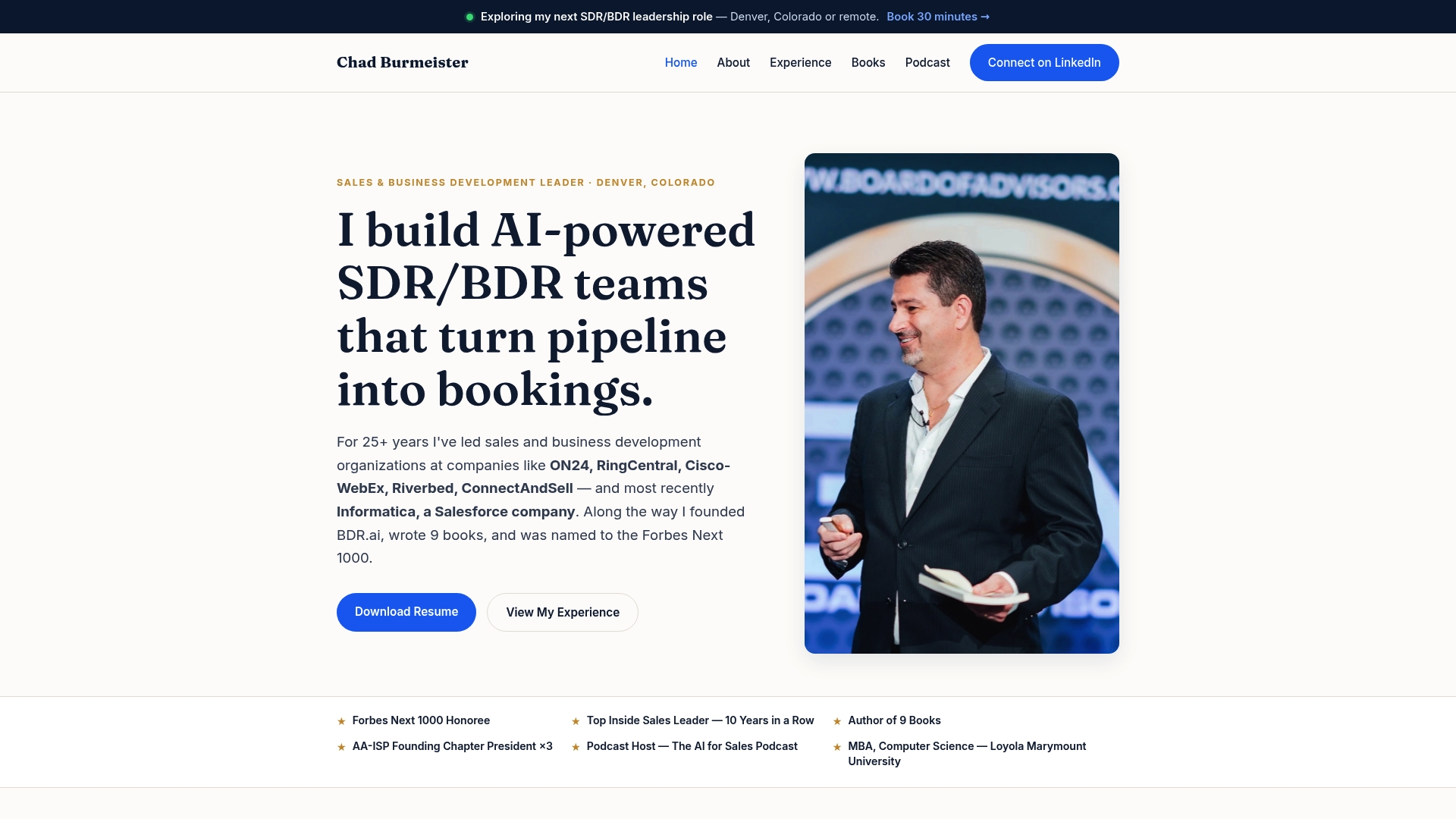
A typical engagement includes:
- A workshop that builds your rubric and field mappings with your actual managers in the room.
- Hands-on implementation support through your first 90-day pilot.
- Interim or fractional leadership when you need someone running the process, not just advising on it.
We offer this through Speaking and Workshops and through our Be Extraordinary Groups for leaders who want ongoing, hands-on support. Reach out through Chadburmeister to talk through what your team needs.
FAQ
What should AI meeting notes actually produce for a sales team?
AI meeting notes should produce validated facts that map cleanly to CRM fields, plus coachable evidence a manager can use in a weekly review. A raw transcript or an unreviewed summary does not meet that bar on its own.
How do we keep AI-generated notes from polluting our CRM?
Require a human sign-off, a manager or the rep, before any AI-extracted fact writes to CRM, and keep versioned notes so corrections don't erase the original record. Gartner's sales AI guidance frames this validation step as part of the standard operating loop, not an optional extra.
Should managers and reps see the same summary format?
No. McKinsey's research on scaling gen AI finds that role-specific formats, a manager dashboard versus a seller checklist, drive meaningfully better adoption than one generic summary for everyone.
How long should a pilot run before we scale this across the team?
A 60 to 90 day pilot with a documented baseline is usually enough to see whether validated facts, pipeline lift, and coaching frequency are moving in the right direction. Expanding before you have that baseline makes it hard to tell what is actually working.
Is it better to buy a tool or build this internally?
McKinsey's guidance recommends buying a turnkey solution for standard summarization needs and reserving custom build for capabilities tied directly to competitive advantage. Most sales teams fall into the first category.
Sources
- The Role of Artificial Intelligence (AI) in Sales (Gartner)
- Five fundamental truths: How B2B winners keep growing (McKinsey)