
Start with one move: run a CRM-first revenue-orchestration pilot targeting a single high-impact selling motion. That one decision separates teams that get measurable results in 6–12 weeks from teams that buy tools and wonder why nothing changed.
Here is what that pilot needs to succeed:
- Pilot objective: Pick one use case (automated prospecting, AI-augmented forecasting, conversation intelligence, or generative content) and define a single success metric before you write a line of code or sign a contract.
- Target metric: Pipeline velocity, win rate lift, or rep hours saved per week.
- Team sponsor: A CRO or VP of Sales who owns the outcome, not just the budget.
- Required systems: A clean CRM, calendar and email activity capture, and unified contact identifiers across marketing and sales.
The assess-to-pilot phase typically runs several weeks; a full pilot-to-measure cycle completes in a few months. If you want to compress that timeline, working with a consultant who has already run this playbook shortens the learning curve considerably. Chad Burmeister has done exactly that for B2B sales organizations, and his AI for Sales consulting is built around this kind of scoped, fast-start engagement.
Table of Contents
- Why AI now matters for sales leaders
- What are the four AI use cases that actually move revenue?
- What data prerequisites does your team need before piloting AI?
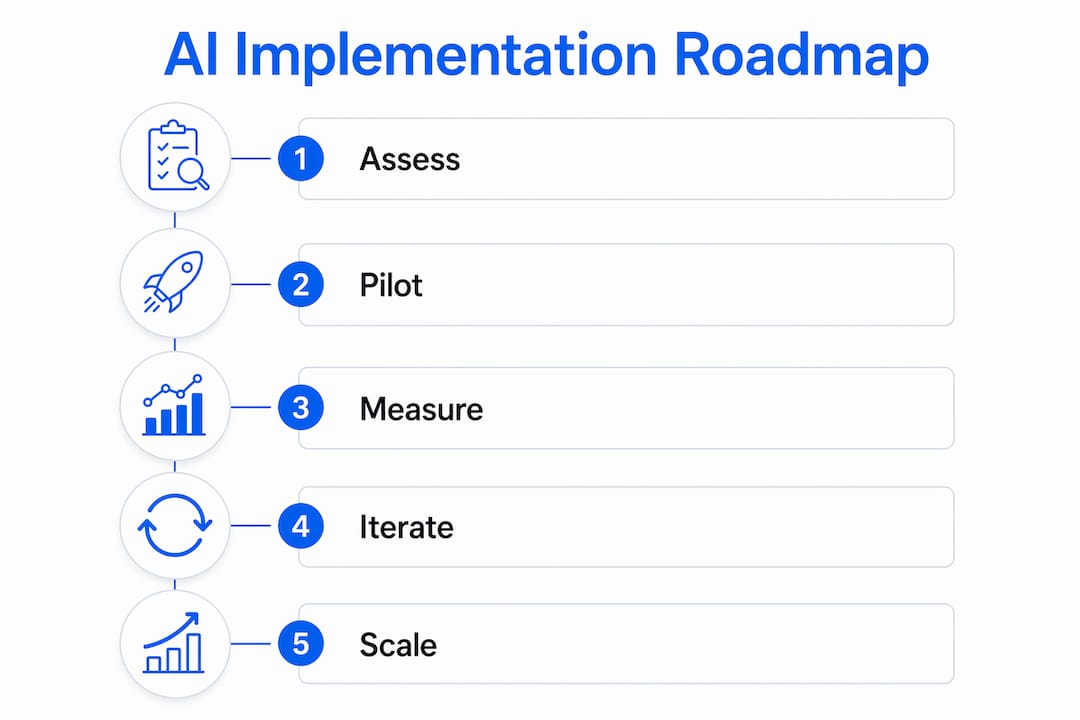
- What does a realistic AI implementation roadmap look like?
- How do you manage GenAI risk without killing adoption?
- How do you measure ROI from an AI pilot in sales?
- Should you build, buy, or hire a consultant for AI in sales?
- Key Takeaways
- The gap between AI hype and what actually works in the field
- Chad Burmeister can help you run this pilot faster
- Further reading and sources
Why AI now matters for sales leaders
The strategic value of artificial intelligence in sales is no longer task automation. It is revenue orchestration: connecting marketing, sales, and operations data into a single source of truth so leaders can forecast accurately and catch deal risk early. That shift changes the conversation from "which tool should we buy?" to "how do we wire our data together?"

Gartner's sales AI research frames this clearly: the teams winning with AI are designing around seller actions, not vendor feature lists. CRM-native integrations drive adoption because they meet reps where they already work.
IBM's AI for sales research reinforces this: generative AI acting as a real-time copilot for reps, drafting emails and summarizing calls, produces time savings that compound across a full team. The productivity gains are real, but they depend on governance and integration quality.
What are the four AI use cases that actually move revenue?
Gartner identifies four productivity drivers that consistently deliver measurable lift for B2B sales teams. Here is what each one does and which metric it moves:
- Automated prospecting and outreach: AI researches leads, scores them, and drafts personalized sequences. The metric is qualified leads per week. A B2B team running AI-driven outreach can increase sequence volume without sacrificing personalization, which is the tradeoff that kills most manual programs.
- AI-augmented forecasting: Machine learning models analyze pipeline signals, historical close rates, and engagement data to produce a forecast that is more accurate than rep-submitted numbers. The metric is forecast variance versus actual.
- Conversation intelligence for coaching: AI transcribes and analyzes calls, flags objection patterns, and surfaces coaching moments. The metric is rep ramp time and win rate by talk-track. This use case also automates CRM data entry after calls, which high-performing teams use to save hours per rep per week.
- Generative AI content assistance: AI drafts emails, one-pagers, and follow-up summaries from source material. IBM notes this acts as a real-time copilot, cutting content creation time significantly.
For most B2B teams at mid-market maturity, conversation intelligence is the best first pilot. It requires the least data prep, delivers coaching value within weeks, and builds the CRM activity data that every other use case depends on later.
What data prerequisites does your team need before piloting AI?
Three things must be in place before any AI pilot produces trustworthy outputs: CRM canonicalization, activity capture, and unified contact identifiers. Without them, the model trains on noise.
| Prerequisite | What "ready" looks like |
|---|---|
| CRM canonicalization | Duplicate accounts merged; required fields filled >15% |
| Activity capture | Email and calendar sync active for all reps in the pilot cohort |
| Unified identifiers | Contact records matched across CRM, MAP, and product usage data |
| Data governance | Role-based access controls and PII fields masked for AI model inputs |
| Workflow mapping | Each AI feature tied to a specific seller action in the existing process |
Salesforce's CRM-native AI approach shows why this matters: unified data, conversation intelligence, and pipeline insights only work when the underlying records are clean and connected. Buying an AI layer on top of a fragmented CRM is the fastest way to waste a budget.
Pro Tip: Before you run a pilot, audit your CRM for the five fields the AI model will use most (account industry, deal stage, close date, last activity date, and contact title). If more than 15% of records are missing any one of them, fix that first.
What does a realistic AI implementation roadmap look like?
The four-phase roadmap below reflects what actually works in practice, not what a vendor's sales deck promises.
| Phase | Duration | Who leads | Key milestone |
|---|---|---|---|
| Assess | Several weeks | CRO + Consultant | Data audit complete; use case selected; success metric defined |
| Pilot | Several weeks | Sales Ops + Rep cohort | AI tool live in CRM; baseline captured; reps trained |
| Iterate | Several weeks to a few months | Sales Ops + Consultant | Model tuned; adoption strong in cohort; first ROI read |
| Scale | A few months | CRO + IT | Full team rollout; governance policy published; QBR reporting live |
Ballpark cost ranges vary by scope. A consulting engagement for the assess and pilot phases typically runs in the range of a few thousand to mid-five figures depending on team size and integration complexity. Licensing for CRM-native AI features is often already included in existing contracts. The biggest cost most teams underestimate is change management time, not software.
Gartner recommends designing every AI feature around a specific seller action. That principle keeps pilots narrow enough to measure and broad enough to matter.
How do you manage GenAI risk without killing adoption?
Governance is not optional. Establish human-in-the-loop rules and data access controls before the first prompt goes live, not after a rep sends a tone-deaf email to a Fortune 500 prospect.
The compliance checklist for a U.S.-based B2B team covers four areas: data minimization (only feed the model the fields it needs), PII handling (mask personal contact data in model inputs), audit logging (track every AI-generated output that goes external), and model explainability (reps should be able to see why a lead scored high or low).
To prevent generic outbound content, build prompt templates that enforce your ICP persona, your tone of voice, and a required personalization field before any email is generated. Set a review SLA: no AI-drafted outbound goes live without a rep reading it first.
Pro Tip: Run AI in "suggestive mode" for the first 60 days. The AI drafts; the rep approves. This builds trust in the outputs and gives you a feedback loop to improve the prompts before you consider any automation.
Research on trust in AI adoption confirms that perceived trust is the primary adoption barrier. Teams that skip explainability and governance see adoption collapse within 90 days.
How do you measure ROI from an AI pilot in sales?
Four metrics tell the story: pipeline velocity, win rate lift, rep productivity (hours saved per week), and forecast accuracy. Measure all four, but pick one as your primary success metric before the pilot starts.
- Pipeline velocity: (Number of opportunities × average deal value × win rate) ÷ sales cycle length. Track week-over-week change in the pilot cohort versus a control group.
- Win rate lift: Compare close rates for AI-assisted deals versus non-assisted deals over a 90-day window.
- Rep productivity: Hours saved per rep per week on admin tasks (CRM entry, email drafting, call summaries). Baseline this in week one with a simple time-audit survey.
- Forecast accuracy: Variance between AI-model forecast and actual bookings at end of quarter. Compare to the prior two quarters of rep-submitted forecasts.
Report results at 30, 60, and 90 days to the CRO and CFO. If win rate lift is flat at 60 days, iterate on the use case or the data inputs before scaling. If rep productivity gains are strong but pipeline velocity is flat, the bottleneck is likely upstream in marketing, not in the AI tool.
Should you build, buy, or hire a consultant for AI in sales?
| Scenario | Recommended path |
|---|---|
| Speed matters, internal eng capacity is low | Hire a consultant for assess + pilot phases |
| CRM is already clean, use case is well-defined | Buy CRM-native AI features (embedded platform) |
| Complex multi-system integration needed | Consultant-led integration + platform licensing |
| Team trust and change management are the blockers | Consultant-led program with coaching component |
The questions to ask any provider: How many CRM-native integrations have you deployed? What does your governance framework look like? Can you show me a before-and-after forecast accuracy comparison from a comparable team? What is your rep adoption rate at 90 days?
Red flags: a vendor who leads with their feature list instead of your use case; no CRM-native path; opaque scoring models with no explainability layer; a proposal that requires replacing your CRM rather than integrating with it.
Pro Tip: Ask for a reference from a team in your industry with a similar CRM setup. A vendor who hesitates on that request is telling you something.
Agentic AI capabilities are advancing fast, but for complex B2B deals today, the pragmatic path is agentic assistance: AI drafts and plans, humans make the final strategic calls.
Key Takeaways
AI for sales teams delivers the fastest, most measurable results when it starts with a CRM-first pilot targeting one high-impact selling motion, governed from day one, and measured against a pre-defined baseline.
| Point | Details |
|---|---|
| Start with one use case | Pick conversation intelligence or automated prospecting; define your success metric before signing anything. |
| Fix your CRM data first | Canonicalize records and activate activity capture before any AI model touches your pipeline. |
| Governance from day one | Human-in-the-loop review and PII controls must be live before the first AI-generated email goes external. |
| Measure at 30/60/90 days | Track pipeline velocity, win rate lift, rep productivity, and forecast accuracy against a pre-pilot baseline. |
| Chadburmeister accelerates pilots | Chad Burmeister's consulting engagements cover assess-to-scale, combining hands-on SDR/BDR leadership with AI implementation expertise. |
The gap between AI hype and what actually works in the field
Most AI sales pilots fail for the same reason: the team bought a platform before they defined a use case. The vendor demo looked impressive, the CRO approved the budget, and six months later adoption is at 20% and nobody can explain why the forecast is still wrong.
The teams that get real results treat AI implementation as an operational program, not a software purchase. They start narrow, measure obsessively, and expand only when the first use case is working. They also invest in change management, which almost nobody budgets for and almost everybody needs.
The other thing most articles get wrong: they frame AI as a rep productivity tool. It is, but the bigger prize is the organizational intelligence layer. When your CRM, your conversation data, and your marketing signals are connected, your CRO can see deal risk two weeks before a rep flags it. That is the revenue orchestration thesis, and it is worth building toward deliberately.
Chad Burmeister can help you run this pilot faster
Most sales leaders know they need AI. The hard part is knowing where to start and avoiding the six-month detour of buying the wrong tool. Chad Burmeister's consulting engagements are built for exactly this moment: a scoped, fast-start pilot that gets your team from assessment to measurable results without replacing your CRM or retraining your entire sales org.
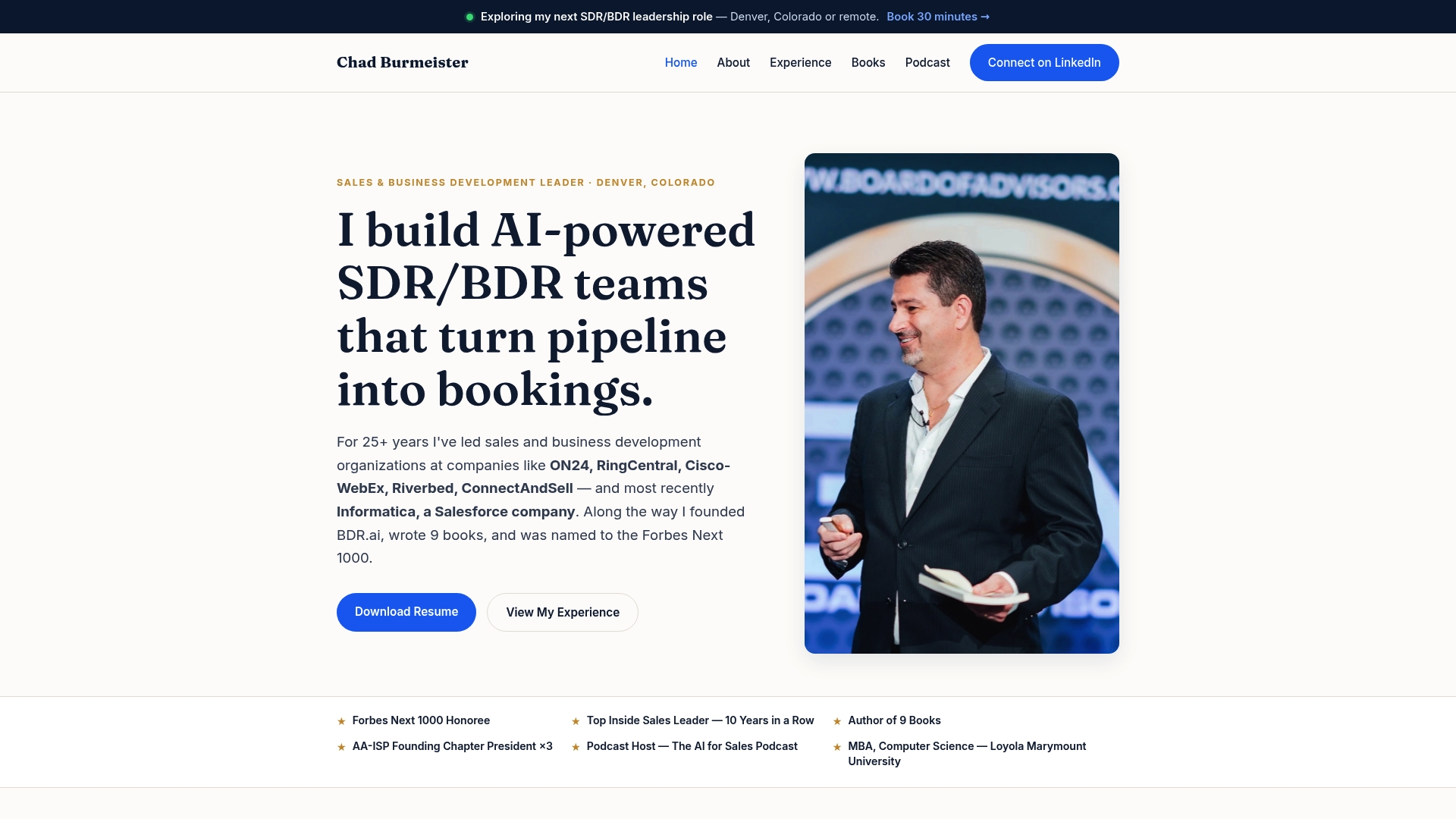
Chad brings 25+ years of hands-on sales leadership at companies like Informatica, RingCentral, and Cisco-WebEx, plus nine published books including AI for Sales 2.0 and Mastering B2B Lead Generation with LinkedIn & AI. His AI for Sales Podcast has featured hundreds of conversations with practitioners who have run these pilots in the real world. Engagements range from a single pilot-scoping workshop to interim SDR/BDR leadership, and the curriculum and workshop formats are built to transfer the playbook to your internal team, not create dependency.
If you are ready to scope a pilot, start the conversation here.
Further reading and sources
| Source | What it contributes |
|---|---|
| Gartner: The Role of AI in Sales (2025) | Seller-action design framework; four productivity drivers; GenAI risk guidance |
| IBM: AI for Sales | Generative AI copilot use cases; time-savings framing for content and call summaries |
| Highspot: AI in Sales Examples | Revenue orchestration thesis; agentic AI use cases; workflow integration best practices |
| Salesforce: AI in Sales | CRM-native AI architecture; human-in-the-loop governance; adoption research |
| Research on trust in AI adoption | Academic research on trust as adoption barrier; productivity and conversion lift data |
| 42Voice: AI-Powered Outreach | Practical examples of conversation intelligence and prospecting automation in B2B |