
An effective AI sales strategy turns one high-impact workflow into predictable pipeline growth by sequencing people, data, and tooling around that workflow — not by deploying every tool at once.
TL;DR:
- Pick one workflow (signal-based prospecting or CRM hygiene) and pilot it before buying anything else.
- Data quality and CRM integration come before model selection.
- BCG's 10/20/70 rule means that 70% of your investment goes to people and process, not algorithms.
- 83% of SMB leaders expect AI to improve operational efficiency over time (Salesforce). The gap between expectation and execution is where most pilots fail.
- Measure conversion lift and time reclaimed per rep before scaling.
Your one-week action list:
- Map your current prospecting or qualification workflow in a single-page doc. Identify the three biggest time sinks.
- Pull a 90-day sample from your CRM. Check field completion rates on company size, industry, and last activity.
- Pick one ICP segment (industry + headcount band) as your pilot population.
- Assign one owner (RevOps or a senior SDR) to the pilot. No owner, no pilot.
- Define your success metric before touching any tool: meetings booked, reply rate, or hours saved per rep per week.
Chad Burmeister has spent 25+ years scaling SDR and BDR teams at companies like RingCentral and Cisco-WebEx, and his books and podcast episodes are built around exactly this kind of sequenced, people-first approach. The playbook below reflects that framework.
Table of Contents
- Why AI matters for your sales team right now
- High-impact AI use cases: which one should you pilot first?
- How to build your AI sales strategy: a 30–90 day playbook
- People, process, and governance: why 70% of the work is not about the technology
- How to evaluate AI sales tools without getting burned
- Playbook templates and prompts you can adapt today
- Common pitfalls that kill AI sales pilots
- How to measure success: KPIs, ROI, and your monitoring dashboard
- Key Takeaways
- What most sales leaders get wrong about AI adoption
- Ready to run your first AI sales pilot with expert guidance?
- Authoritative sources and further reading
Why AI matters for your sales team right now
Sellers are not spending most of their week selling. Research from Topo puts the actual selling time at roughly 28–30% of the workweek once admin, CRM updates, and internal meetings are factored in. That is the core problem AI addresses when it is deployed correctly.
The efficiency case is real and measurable. AI handles repetitive drafting, lead enrichment, CRM logging, and follow-up sequencing so reps can redirect hours toward conversations that actually close deals. Salesforce reports that 83% of SMB leaders expect AI to make operations more efficient over the long term. That expectation is already shaping hiring, budgets, and competitive positioning.
"AI agents will transform B2B sales by enabling three distinct modes of selling: augmented (AI assists the seller), assisted (AI and seller collaborate in real time), and autonomous (AI acts independently on transactional accounts). The sequencing of which mode to deploy first depends on account complexity and deal size."
The JPMorgan case is worth naming directly. Zendesk documents that JPMorgan used AI to improve email campaign click-through rates by testing and refining message variants at a scale no human team could match manually. That is not a moonshot. It is a repeatable application of machine learning in sales that any team with a clean email domain and a CRM can attempt.
The timing argument is straightforward. Agentic AI, native CRM integrations, and purpose-built sales tools have matured enough that a 30-day pilot no longer requires a data science team. The barrier is organizational, not technical.
High-impact AI use cases: which one should you pilot first?
Not all AI use cases deliver equal ROI at the same stage of maturity. The list below is ranked by speed-to-measurable-lift for a team running its first pilot.
1. Signal-based prospecting
Trigger signals (job changes, funding rounds, tech stack installs, hiring patterns) feed a scoring model that surfaces accounts showing buying intent before a rep makes contact. Data requirements: company firmographics, intent data feed, and a minimum of 500 historical closed-won records to train against. Success metric: meetings booked per signal-sourced sequence. Best for: SMB and mid-market accounts where volume matters. This is the recommended first pilot because the feedback loop is short and the lift is visible within 30 days.

2. AI-driven lead scoring
Machine learning models rank inbound leads by conversion probability using both structured CRM fields and behavioral signals (page visits, email opens, content downloads). The model needs at least six months of historical lead data with outcome labels (converted/not converted). Success metric: percentage of MQLs that reach SQL stage. Suits mid-market and enterprise pipelines where qualification bottlenecks are costing AE time.
3. Personalized outreach at scale
Generative AI drafts first-touch emails and follow-up sequences using account-level context pulled from the CRM and enrichment sources. A human-in-loop approval step is non-negotiable here. Without it, you get volume without quality, and your domain reputation suffers. Success metric: reply rate and positive-reply rate (not just open rate). Works across all account types but delivers the clearest lift on long-tail accounts where reps would otherwise send generic templates.
4. Conversational qualification
AI-powered chat or voice agents handle initial discovery questions, qualify against ICP criteria, and route qualified leads to the right rep. Per BCG's agentic selling framework, this is well-suited to autonomous deployment on transactional accounts. Strategic accounts still need a human on the first call.
5. CRM hygiene and auto-logging
Activity intelligence captures emails, calendar events, and call notes and logs them automatically. This directly addresses the 28–30% selling-time problem. Data requirement: connected email and calendar. Success metric: field completion rate improvement and hours saved per rep per week. Low risk, fast win, and it makes every downstream model more accurate.
6. Sales forecasting with predictive models
Machine learning improves forecast accuracy by ingesting both structured CRM fields and behavioral inputs, then retraining as new data arrives. Without continuous retraining and outcome feedback loops, models degrade and generate false confidence. This use case requires at least 12 months of pipeline history and a RevOps owner who can manage model drift.
7. Quote generation and CPQ automation
AI generates draft quotes and pricing configurations based on deal parameters. Reduces AE time on proposals and cuts errors in complex product catalogs. Requires clean product and pricing data. Success metric: time from opportunity to sent quote.
8. AI coaching and call analysis
Conversation intelligence tools analyze recorded calls, flag objection patterns, and surface coaching moments for managers. This is an augmented use case: the AI surfaces the insight, the manager delivers the coaching. Success metric: ramp time for new reps and win-rate improvement on coached deals.
First pilot recommendation: Signal-based prospecting on one ICP segment. It requires the least infrastructure, produces a measurable lift in 30 days, and builds rep trust faster than any other use case.
How to build your AI sales strategy: a 30–90 day playbook
Before automating anything, document the current workflow. Automating a broken process produces broken results faster.
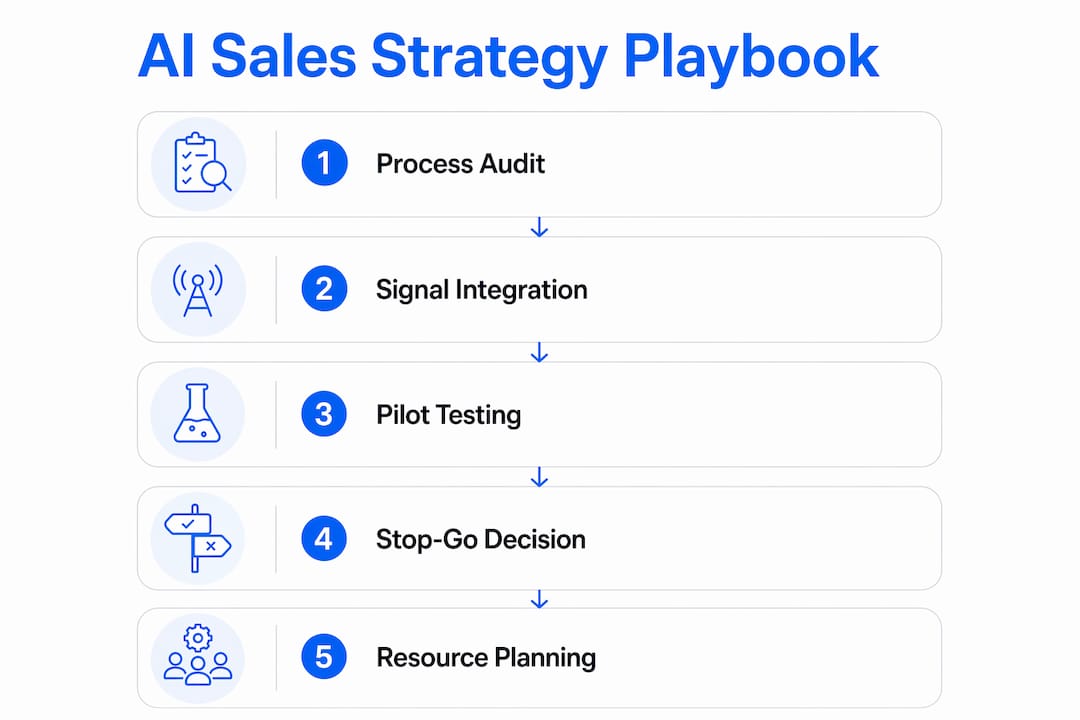
Step 1: Process audit (Days 1–7)
Map the target workflow end-to-end. Identify handoffs, data inputs, decision points, and time spent at each stage. Flag where data is missing or inconsistent.

Step 2: Pilot setup (Days 8–14)
Use this checklist:
- ICP definition: industry, headcount, geography, tech stack signals
- Signal list: at least three trigger types with data sources named
- CRM health check: field completion above 80% on core fields
- Success metrics: defined before any tool is selected
- Owner assigned: one named person accountable for results
- Human-in-loop rules: documented approval steps for AI-generated outputs
- Data privacy checklist: consent, opt-out, and data retention reviewed
- Sandboxing plan: pilot runs on a subset of accounts, not the full database
Step 3: Small-batch testing (Days 15–30)
| Week | Activity | Owner | Output |
|---|---|---|---|
| Week 2 | Instrument CRM fields; connect signal feed | RevOps | Data pipeline live |
| Week 3 | Run first AI-generated sequence (— accounts) | SDR + RevOps | Baseline reply rate |
| Week 4 | Human review of AI outputs; flag errors | AE + SDR | Quality gate passed |
| Week 5 | First metrics review; compare to control group | RevOps | Go/no-go decision |
| Weeks 6–12 | Iterate on signals and messaging; expand batch size | Full pilot team | Lift confirmed |
Step 4: Stop/go criteria
Go if: reply rate or meetings booked shows a statistically meaningful lift over the control group AND rep trust score (a simple 1–5 weekly survey) trends above 3.5. Stop if: data quality issues surface in more than 20% of outputs, or reps are overriding AI suggestions more than 60% of the time (a signal the model is not calibrated to your ICP).
Step 5: Cost and resource planning
A 30-day pilot typically requires 10–15 hours of RevOps setup time, 2–4 hours per week of SDR review time, and a signal data feed license. Engineering involvement is minimal if you use a CRM-native tool. Scale-phase costs rise with seat count and enrichment volume, not with model complexity.
Pro Tip: Run a parallel control group of equal size from the same ICP segment. Without a control, you cannot separate AI lift from seasonal pipeline variation.
People, process, and governance: why 70% of the work is not about the technology
BCG's 10/20/70 rule is the most important framework for sales leaders running AI pilots. Roughly 10% of effort goes to algorithms, 20% to technology and data infrastructure, and 70% to people and processes. Teams that underinvest in the 70% are the most likely to see pilot failure and low adoption. That is not a soft claim. It is the pattern BCG observed across hundreds of AI transformations.
Role matrix for a sales AI pilot:
- SDR/BDR: reviews AI-generated outreach, approves or edits before send, flags false positives in lead scoring
- AE: validates AI-sourced opportunities, provides outcome feedback to the model owner
- RevOps: owns data pipeline, monitors field completion, manages signal feeds, runs metrics reviews
- Data/ML (or GTM Engineer): maintains model, manages retraining cadence, monitors for drift
- Legal/Compliance: approves data sources, reviews opt-out and consent flows, signs off on audit logging
Training plan template:
A three-week enablement sprint works well for most teams. Week one covers what the AI does and does not do (set realistic expectations, not hype). Week two is hands-on: reps work through the approval workflow with real outputs. Week three is a live review session where the team discusses what the AI got right and wrong. Adoption KPIs to track: percentage of reps using the tool weekly, override rate, and time-to-first-edit on AI drafts.
Governance checklist:
- Approved data sources documented and reviewed by Legal
- Guardrails on autonomous actions (no AI sends without human approval in the first 60 days)
- Transparency rules: prospects can identify AI-assisted outreach if they ask
- Audit logging: every AI-generated action is logged with a timestamp and the approving rep's ID
- Escalation path: clear process for reps to flag AI errors without friction
Pro Tip: Identify two or three early adopters before launch and give them a preview. Their peer endorsement inside the team is worth more than any top-down mandate.
How to evaluate AI sales tools without getting burned
The vendor market for AI-driven sales techniques is crowded and the claims are aggressive. The right evaluation framework protects you from buying a solution that looks good in a demo and fails in production.
Vendor scorecard dimensions:
- Data access and integrations: Does it connect natively to your CRM? Can it ingest your signal feeds without custom engineering?
- Model explainability: Can the vendor show you why a lead was scored high? Black-box models erode rep trust fast.
- Security and compliance: SOC 2 Type II, data residency options, and clear data egress policies.
- Human-in-loop controls: Can you require approval before any outbound action? This is non-negotiable for the first 60 days.
- Ease of use: If a rep needs more than 10 minutes of training to use the daily workflow, adoption will stall.
- Support and SLAs: Response time for production issues and a named customer success contact.
- Pricing model: Per-seat, per-action, or platform fee? Watch for usage-based pricing that scales unpredictably with volume.
- Upgrade path: What does the roadmap look like for agentic capabilities? You want a platform that grows with your strategy.
Integration priority order:
- CRM (Salesforce, HubSpot, or your platform of record)
- Email and calendar (for activity intelligence and auto-logging)
- Call recording (for conversation intelligence)
- Enrichment data (firmographics, intent signals)
- Observability layer (for monitoring model outputs and drift)
Procurement tips:
Require the vendor to run a short proof-of-concept on your actual signals, not their benchmark dataset. Insist on exportable results you can evaluate independently. Include two or three reps in the evaluation, not just RevOps. Their feedback on usability will predict adoption better than any feature checklist. Require a documented rollback plan before signing. Watch for contracts that lock you into annual minimums before the pilot is complete.
Limit your core stack to two or three systems. Every additional tool adds integration overhead, data fragmentation risk, and a new vendor relationship to manage. For enterprise orchestration, prefer platforms that expose APIs so you can connect them without rebuilding workflows from scratch. Aligning your AI-powered marketing tools with your sales stack early prevents the signal fragmentation that kills lead scoring models.
Playbook templates and prompts you can adapt today
The following templates are drawn from the frameworks Chad Burmeister covers in AI for Sales 2.0 and across episodes of The AI for Sales Podcast. They are starting points, not finished products. Adapt them to your ICP and signals.
Signal-based prospecting playbook:
- Trigger: Target account posts a VP of Sales job opening (hiring signal)
- Owner: SDR reviews AI-generated draft within 24 hours of signal firing
- Cadence: Day 1 email (AI draft, human-approved), Day 3 LinkedIn connection request, Day 7 follow-up email, Day 14 phone call
- KPIs: Signal-to-reply rate, signal-to-meeting rate, time from signal to first touch
- Human-in-loop step: SDR edits subject line and first sentence before send
CRM hygiene automation playbook:
- Trigger: Activity intelligence detects a logged call with no outcome field updated
- Owner: RevOps monitors daily exception report
- Cadence: AI prompts rep to confirm outcome within 4 hours; auto-logs call summary after 24 hours if no response
- KPIs: Field completion rate (target: above 85%), hours saved per rep per week
- Human-in-loop step: Rep confirms or corrects AI-generated call summary
Sample outreach prompt structure (adapt for your ICP):
"Draft a 75-word first-touch email to a VP of Sales at a 200-person SaaS company that recently posted three SDR job openings. Reference the hiring signal. Lead with a specific outcome we delivered for a similar company. End with one low-friction question. Tone: direct, peer-to-peer, no jargon."
Always include a human approval step before any AI-generated message goes out.
Pilot A/B test design:
| Element | Control | Treatment |
|---|---|---|
| Sequence source | Rep-written templates | AI-generated, human-approved |
| Sample size | 100 accounts per arm | 100 accounts per arm |
| Duration | 30 days | 30 days |
| Primary metric | Reply rate | Reply rate |
| Secondary metric | Meetings booked | Meetings booked |
| Statistical threshold | Lift of 15% or more to proceed | Lift of 15% or more to proceed |
Dashboard metrics to track:
- Pipeline per rep (weekly)
- Meetings sourced from AI sequences (weekly)
- Conversion lift vs. control (monthly)
- Forecast accuracy delta (monthly)
- Rep trust score (weekly survey, 1–5 scale)
Pro Tip: Refresh your dashboard weekly for the first 60 days. Monthly reviews miss early drift signals that are cheap to fix in week three but expensive to fix in week ten.
Common pitfalls that kill AI sales pilots
Most pilots do not fail because the technology is wrong. They fail because the organizational conditions were not ready.
1. Automating a broken process
If your current prospecting workflow produces poor results, AI will produce poor results faster and at higher volume. Fix the workflow first. Red flag: reps cannot describe the current process in under two minutes.
2. Data fragmentation
Lead scoring models trained on incomplete CRM data produce unreliable scores. If your core fields (company size, industry, last activity date) are below 75% complete, fix data quality before running any model. Red flag: enrichment vendor fills more than 40% of your core fields.
3. Over-automation without human oversight
Removing human review from outbound sequences in the first 90 days is the fastest way to damage your domain reputation and lose rep trust. AI functions best as a co-pilot, handling repetitive drafting and summaries while humans own relationship work and high-stakes negotiations. Red flag: no approval step exists in the workflow documentation.
4. Vendor sprawl
Buying five tools to solve one problem creates integration debt and makes it impossible to attribute lift to any single change. Red flag: your sales tech stack has more than eight active tools and no one can name the owner of each.
5. Measurement mistakes
Measuring open rates instead of reply rates, or pipeline created instead of pipeline converted, gives you a flattering but misleading picture. Define your primary metric before the pilot starts and do not change it mid-run. Red flag: the success metric was defined after the first results came in.
6. Misaligned incentives
If reps are compensated purely on closed revenue and AI-assisted activities add steps to their workflow, adoption will stall. Tie at least one adoption metric (meetings from AI sequences, CRM field completion) to a visible recognition program during the pilot. Red flag: no one on the sales floor can name a benefit the AI tool gives them personally.
Ethical and customer-facing risks:
Transparency matters. Prospects have a right to know when they are interacting with an AI-generated message if they ask directly. Build opt-out mechanisms into every AI-driven sequence. Maintain audit logs of every AI-generated action. Review your data sources with Legal before the pilot starts, particularly for any third-party intent data that includes personal contact information. For teams aligning sales and marketing AI, the practical AI implementation guide from Errant Agency covers consent and opt-out frameworks worth reviewing alongside your sales-specific governance checklist.
How to measure success: KPIs, ROI, and your monitoring dashboard
The metrics that matter most depend on which use case you piloted. These definitions and windows apply broadly.
Core KPI definitions:
| KPI | Definition | Measurement window |
|---|---|---|
| Conversion lift | % increase in reply-to-meeting rate vs. control | 30 days |
| Meetings per lead | Meetings booked divided by leads entered | Weekly |
| Time saved per rep | Hours reclaimed from admin per rep per week | Weekly |
| Pipeline per rep | Total pipeline value attributed per rep | Monthly |
| Forecast accuracy | Actual closed vs. forecast at period start | Monthly |
| Pipeline coverage | Total pipeline divided by quota | Weekly |
Sample ROI calculation:
Assume your pilot produces two additional meetings per rep per week across a team of 10 SDRs. Your historical meeting-to-opportunity rate is 25%, and your average deal size is $40,000 with a 20% close rate.
- Additional meetings per week: 20
- Additional opportunities per week: 5 (at 25% conversion)
- Additional closed revenue per week: $40,000 (at 20% close rate)
- Annualized ARR impact: roughly $2,000,000
That math is directional, not a guarantee. But it gives you a defensible number to take to a CRO or board when requesting scale-phase budget.
Dashboard refresh cadence:
- Daily: AI sequence activity, reply volume, error flags from human reviewers
- Weekly: Meetings sourced from AI, pipeline per rep, rep trust score, field completion rate
- Monthly: Conversion lift vs. control, forecast accuracy delta, pipeline coverage, ROI estimate
Data quality checks to embed in the dashboard:
- Population coverage: what percentage of your ICP has the required fields populated?
- Field completion rate: tracked weekly, with an alert if it drops below 80%
- Model drift detection: compare current score distribution to the baseline from pilot launch
For A/B pilots, a sample of 100 accounts per arm over 30 days is the practical minimum for detecting a meaningful lift. Smaller samples produce results that look significant but do not hold at scale.
Key Takeaways
An effective AI sales strategy requires sequencing one high-impact workflow around clean data, a named owner, and a 70% investment in people and process before scaling any technology.
| Point | Details |
|---|---|
| Start with one workflow | Signal-based prospecting or CRM hygiene delivers measurable lift in 30 days without deep infrastructure. |
| Apply the 10/20/70 rule | BCG's framework puts 70% of AI transformation effort on people and process, not algorithms or tools. |
| Define metrics before buying | Set your primary KPI (reply rate, meetings booked, time saved) before selecting any vendor. |
| Run a controlled pilot | A 100-account control group and 100-account treatment group over 30 days is the minimum for reliable lift data. |
| Chadburmeister's playbook | Chad Burmeister's books, podcast, and consulting engagements provide the sequenced, people-first templates this article is built on. |
What most sales leaders get wrong about AI adoption
The conventional wisdom says the hard part of an AI sales strategy is picking the right tool. It is not. The hard part is getting your team to trust the output enough to act on it consistently.
Every pilot I have seen stall out shares the same pattern: the technology worked, the data was good enough, but the reps did not believe the AI-generated leads were better than their own judgment. And in the early weeks of a pilot, they are often right. An untrained model on a small dataset will surface some obvious misses. The mistake is treating those misses as evidence that AI does not work, rather than as calibration data.
The BCG 10/20/70 framing is not just a budget allocation guide. It is a description of where the actual risk lives. A team that spends 90% of its energy on the algorithm and 10% on training, role redesign, and incentive alignment will fail even with a technically excellent model. The teams that succeed treat the first 60 days as a change management project that happens to involve software.
There is also a sequencing trap that catches founders and early-stage sales leaders specifically. They see the full menu of AI capabilities (prospecting, scoring, forecasting, coaching, quote generation) and try to run three pilots simultaneously. The result is that none of them get the attention they need, the data is split across use cases, and no single workflow produces a lift large enough to justify the next investment. Pick one. Win there. Then expand.
The other thing worth saying plainly: AI does not replace the judgment call that closes a complex deal. It frees up the time and attention that judgment requires. That is the right frame for introducing it to a skeptical sales team.
Ready to run your first AI sales pilot with expert guidance?
Building a pipeline growth engine with AI is faster with a proven playbook behind it. Chad Burmeister brings 25+ years of hands-on SDR and BDR leadership at companies like RingCentral and Cisco-WebEx, plus nine published books and hundreds of podcast conversations with practitioners who have already run the pilots you are planning.
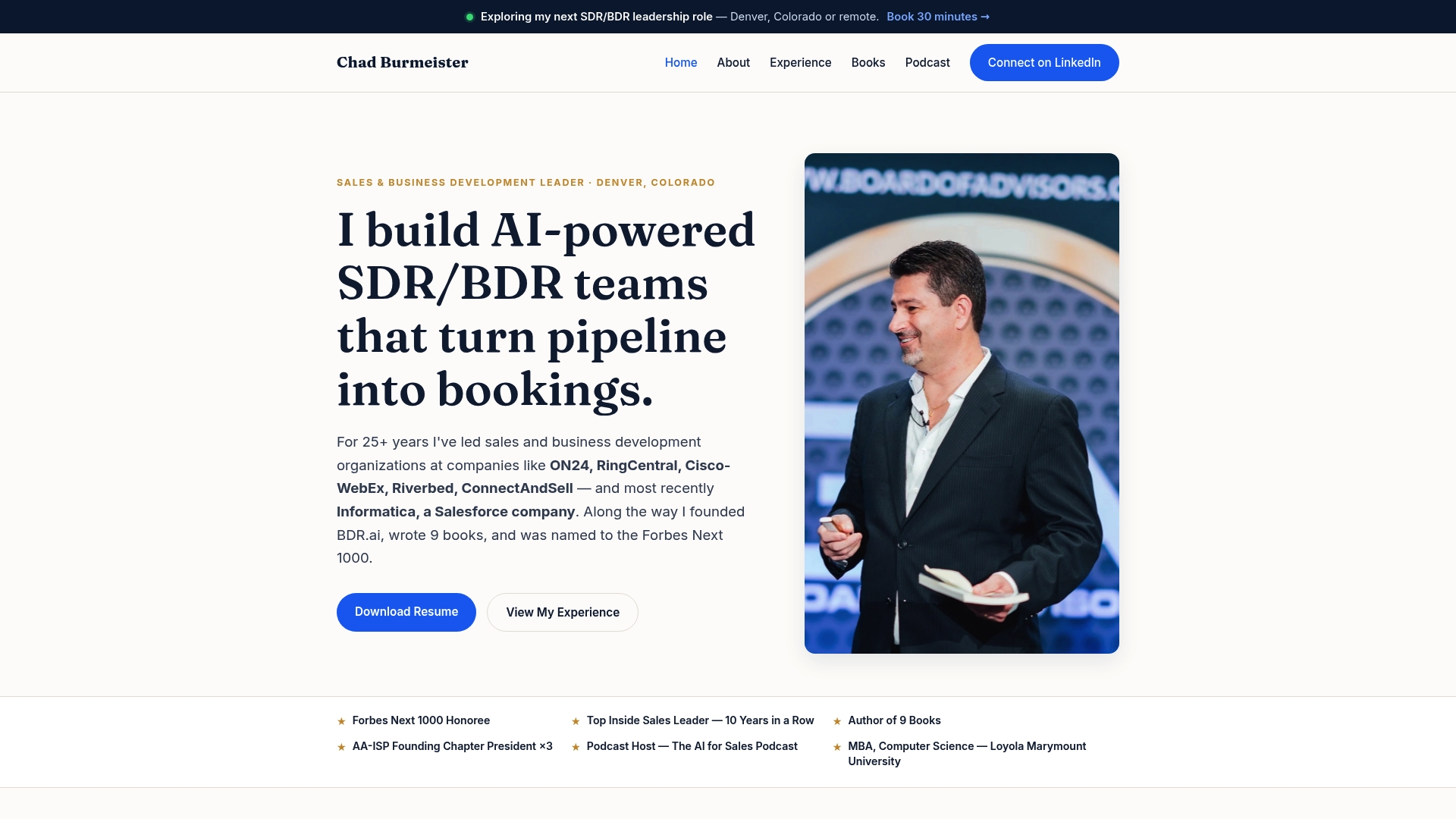
Engagement formats range from a focused 30–90 day pilot design session to full executive placement leading your SDR or BDR team. If you are earlier in the process, AI for Sales 2.0 and Mastering B2B Lead Generation with LinkedIn & AI are available through Chad's books page and give you the frameworks to start immediately. For ongoing learning, The AI for Sales Podcast covers real-world implementations across industries and company sizes.
The highest-ROI moment to bring in outside expertise is before the pilot design is locked, not after the first results disappoint. If you are a CEO, CRO, or founder ready to move from planning to execution, connect with Chad directly to discuss what a structured engagement looks like for your team.
Authoritative sources and further reading
The sources below back the claims in this article and point toward deeper study on specific topics.
-
BCG: How AI Agents Will Transform B2B Sales — The primary source for agentic selling framework and the augmented/assisted/autonomous tier model. Best for conceptual framing and sequencing strategy.
-
Forbes: Why AI's 10/20/70 Principle Should Matter to CEOs and Everyone Else — Accessible summary of BCG's organizational investment framework. Best for building the internal case for people/process investment.
-
Zendesk: The Role of AI and Machine Learning in Sales in 2026 — Covers practical use cases including conversational AI, predictive scoring, and the JPMorgan email example. Best for operational use-case research.
-
Salesforce: 12 AI Sales Strategies for Small Businesses That Actually Work — Source for the 83% SMB efficiency expectation stat and startup-specific implementation guidance. Best for founders and early-stage teams.
-
Topo: AI Sales Playbook — Operational playbook covering seller time allocation and the 28–30% selling-time finding. Best for justifying CRM hygiene and automation pilots.
-
Forecastio: Machine Learning Sales Forecasting — Technical primer on how ML models ingest structured and behavioral data for forecasting. Best for RevOps teams building or evaluating forecasting tools.
-
Gartner: The Role of AI in Sales — Covers agentic AI, the Seller Action Hub framework, and GenAI use cases across the sales function. Best for enterprise teams evaluating tech stack design.
-
Columbia Business School: The Future of Sales — Academic framing of how AI and automation are reshaping go-to-market strategies. Best for conceptual depth and executive presentations.
-
Chadburmeister.com: Books — Practical playbooks including AI for Sales 2.0 and Mastering B2B Lead Generation with LinkedIn & AI. Best for operational templates and self-directed implementation.
-
Chadburmeister.com: The AI for Sales Podcast — Practitioner interviews covering real-world AI sales implementations. Best for ongoing learning and case study depth.