Hiring experienced executive leadership or consulting to design and run your AI cold outreach is the fastest, lowest-risk path to reliable pipeline uplift, and it beats letting individual reps or IT bolt on tools one at a time. Done right, it means sharper lead prioritization, outreach personalization that reads like a person wrote it, and faster movement from first touch to qualified meeting. Chad Burmeister, who has spent 25-plus years building sales and business development teams at companies like Informatica and RingCentral, has watched the same rollout mistakes repeat across dozens of organizations. The fix usually isn't more software. It's better leadership at the point where strategy meets execution.
TL;DR:
- A successful AI cold outreach program requires clear roles, measured deliverables, and a pilot-first approach focused on a single segment to ensure results.
- Organizations should verify CRM cleanliness, define a precise ICP, and establish escalation protocols before scaling AI-driven outreach efforts.
- The typical ROI timeframe for AI outreach pilots is about eight months, with success hinging on data quality, user adoption, and precise measurement of conversions.
- Hiring for AI sales leadership demands candidates with practical AI deployment experience and an ability to fix data and process issues rapidly within the first 90 days.
- Excessive platform procurement and misaligned leadership experience are the main pitfalls preventing effective AI outreach investments.
Table of Contents
- What Does an AI Cold Outreach Leadership Engagement Actually Deliver?
- How Do You Know You're Ready to Hire?
- What Does a 90-Day AI Cold Outreach Pilot Look Like?
- Who Owns What in a Blended Human and AI Outreach Team?
- What Data and Governance Rules Come Before Scaling?
- How Do You Measure ROI From Pilot to Scale?
- Chad Burmeister's Take: Where AI Outreach Hires Go Wrong
- Ready to Build an AI Cold Outreach Program That Actually Converts?
- Sources
What Does an AI Cold Outreach Leadership Engagement Actually Deliver?
A real engagement produces work product, not a vague mandate to "add AI to sales." At the strategy layer, expect ICP refinement, a documented playbook, and a ranked list of buying signals worth acting on. At the operational layer, expect the daily mechanics: sequencing rules, an SDR playbook your team can actually follow, and an escalation framework for when an AI-drafted message needs a human eye before it goes out.
What should be contractable, meaning you can hold someone accountable to it, includes:
- Meetings booked per month against a defined baseline
- SQL conversion lift measured against the prior quarter
- Rep hours reclaimed from manual prospecting and redirected to selling
A pilot-first framework built around a single segment, rather than an org-wide rollout, is what separates engagements that ship results from ones that generate slide decks. If your statement of work doesn't name these deliverables specifically, you're buying hope, not a plan.
How Do You Know You're Ready to Hire?
Three readiness signals matter more than budget size. You need a defined ICP that your team can state in one sentence, measurable pipeline leakage you can point to (deals dying at a specific stage, response rates that have flatlined), and a CRM clean enough that an AI agent won't be reasoning from garbage.
The economic trigger is simpler than most leaders think:
- Your reps are spending the majority of their week on manual prospecting instead of selling
- The fully loaded cost of adding SDR headcount now exceeds what a scoped pilot would cost
- You've already tried point tools and gotten inconsistent adoption because nobody owns the system end to end
If none of that is true yet, you're not ready. Fix CRM hygiene first, document your ICP, and get baseline metrics on your current outreach before bringing in leadership to scale something that doesn't exist yet.
Pro Tip: Before you sign anything, ask your CRM admin to pull a one-page report on duplicate records and missing firmographic fields. If that report takes more than a day to produce, your data isn't ready for agent-driven outreach, no matter how good the hire is.
What Does a 90-Day AI Cold Outreach Pilot Look Like?
Run the pilot narrow, not wide. A single ICP segment, a locked data source, and clear human checkpoints beat a company-wide launch every time.
- Define the use case and segment. Pick one vertical or company size band, not your whole book of business.
- Expose the minimum viable data set. Only the fields the agent actually needs: verified contact, role, and one or two intent signals.
- Set human-in-the-loop rules up front. Decide which messages need review before send and which don't, and write it down.
- Kick off and run initial alpha testing. Two to three weeks of daily review against a small volume.
- Move to controlled scale. Expand volume only after the alpha holds up on quality, not just send count.
- Hit your measurement checkpoint. Compare meeting quality and conversion, not just meeting quantity, against your baseline.
Organizations that prepare data, scope, and escalation paths before scaling tend to see meaningful ROI in roughly eight months, according to a survey of over 2,000 agentic AI decision-makers. That's your planning horizon. Anyone promising results in 30 days is either overpromising or scoping something trivial.
Who Owns What in a Blended Human and AI Outreach Team?
Blended outreach fails when nobody owns the seams between human and machine work. You need clear roles, not a general mandate for "the team to use AI more."
- AI operator: owns prompt logic, message templates, and agent performance monitoring
- SDRs as edge-case handlers: step in when a prospect's reply doesn't fit a scripted path, and handle the judgment calls AI shouldn't make alone
- Account executives: stay focused on qualified conversations, not raw volume
- Data steward: owns CRM hygiene and the canonical fields agents depend on
- Sales ops: owns the sequencing rules and reporting layer that ties it all together
Quota structures need to shift too. If AI handles volume, reps should be measured on conversion quality and deal progression, not activity counts that no longer reflect real effort.
When hiring the executive who runs this, hiring guidance from SaaStr recommends candidates who combine traditional sales fundamentals with real, battle-tested AI deployment experience, not theoretical knowledge. Ask for references that speak specifically to a past AI rollout, not just quota attainment.
What Data and Governance Rules Come Before Scaling?
Don't buy more tools before your data is clean. That's the single most common mistake leadership teams make when they get impatient.
Priorities in order:
- Dedupe your CRM and verify contact records before agents touch them
- Define canonical ICP fields every agent can access consistently
- Set bounded scope for what any AI agent is allowed to do without review
- Build monitoring and audit logs so you can trace every automated action back to its source
- Establish clear human escalation points for anything outside the agent's defined lane
On tooling, favor a CRM-first approach over standalone sidecar tools for your pilot. Survey data shows employees use AI more when it's embedded directly into their existing workflow rather than bolted on as a separate app, and adoption is the whole game here.
Pro Tip: Start with intent signals and an AI research agent before you automate your sequences. Better leads with fewer touches consistently outperform higher volume with weaker targeting.
How Do You Measure ROI From Pilot to Scale?
Track four numbers from day one: meetings booked, SQL conversion rate, rep hours saved, and internal adoption rate. Adoption matters more than most leaders expect, since a technically perfect system that reps ignore delivers zero return.
Use the eight-month ROI window and the 53% adoption rate reported in Salesforce's agentic AI survey as your benchmark, not a guarantee. Build three forecasts instead of one:
- Conservative: modest volume, adoption near the survey floor
- Baseline: matches the survey's reported averages
- Aggressive: assumes strong internal championing and fast data readiness
Present all three to your board. A single number invites false confidence, and a range shows you understand the levers that actually move the outcome.
Chad Burmeister's Take: Where AI Outreach Hires Go Wrong
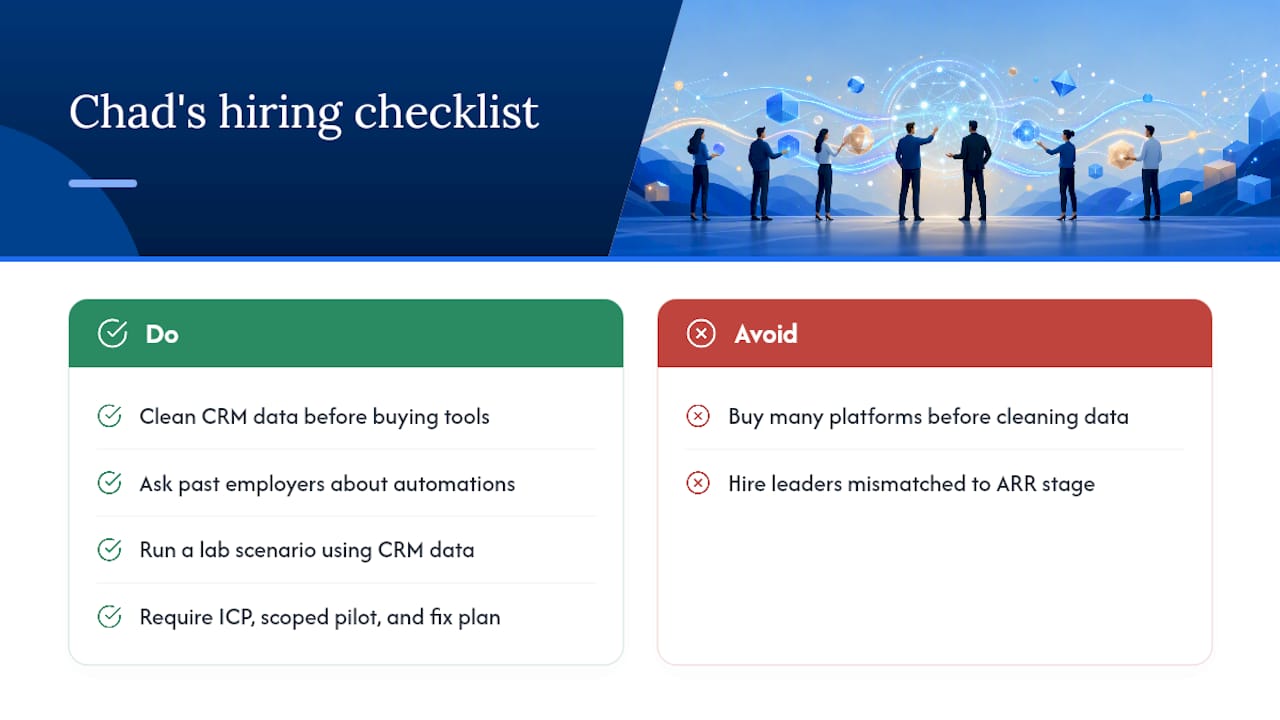
The failure I see most often isn't a bad tool. It's automation bloat: leaders buy five platforms before cleaning one database, then wonder why adoption stalls. A close second is hiring a leader whose experience doesn't match the company's actual ARR stage. A brilliant enterprise operator can flounder running early-stage outbound, and vice versa.
Do the reference work nobody wants to do. Ask past employers specifically what the candidate automated, what broke, and how they fixed it. Better yet, run a lab scenario: hand them a stalled deal and ask them to diagnose it live using CRM data. In the first 90 days, expect a documented ICP, a scoped pilot, and a straight answer about what needs to be fixed before scaling. Anything less is a leader still finding their footing.
— Chad
Ready to Build an AI Cold Outreach Program That Actually Converts?
If you've read this far, you already know the gap isn't tools, it's leadership that has actually run AI-driven outbound before and can show you the scars. Chadburmeister offers executive placement, fractional sales leadership, consulting paired with hands-on pilot execution, and workshops for teams that need to move fast without hiring full-time yet.
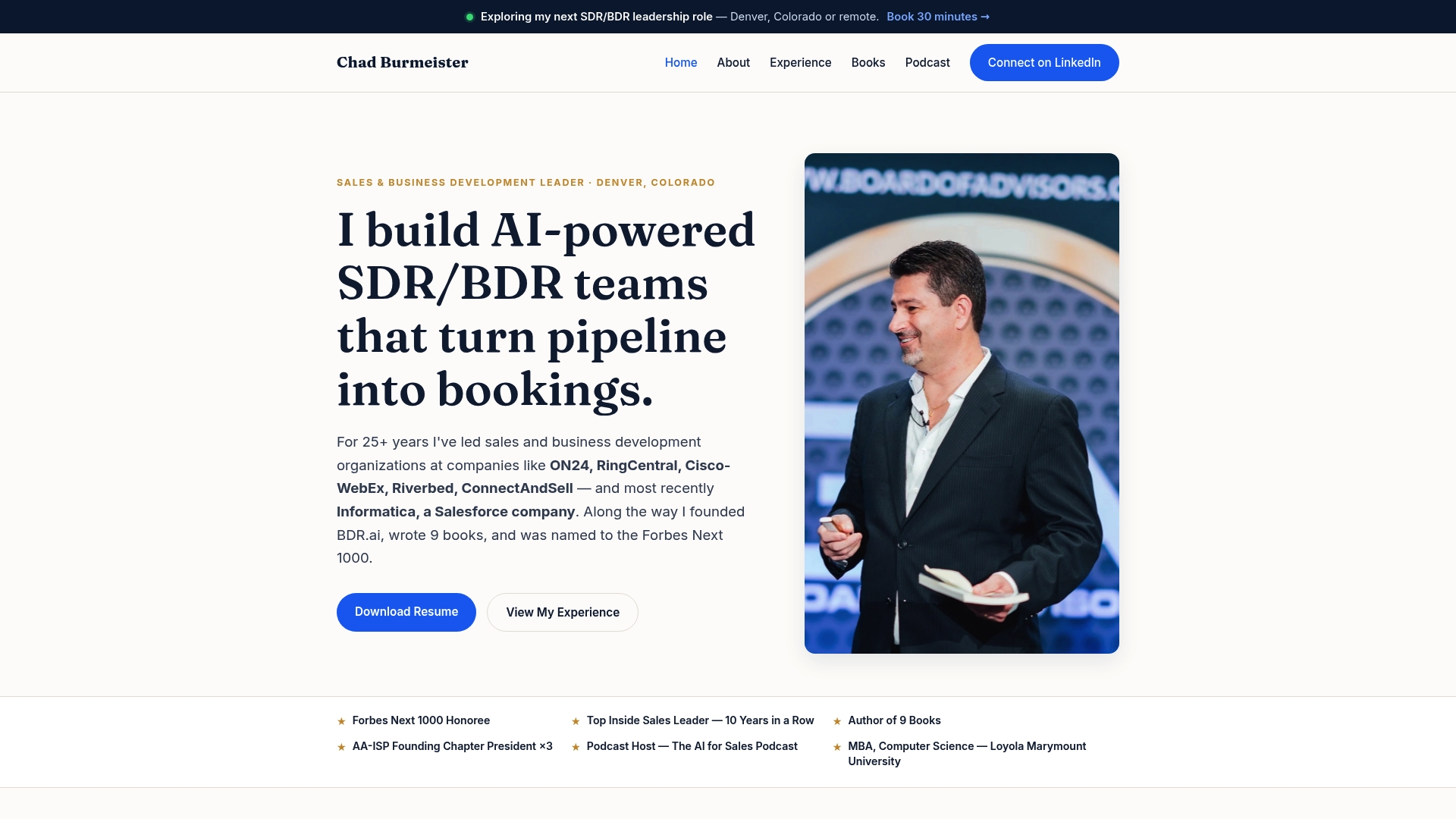
A short engagement typically starts with a scoped audit of your ICP and CRM readiness, followed by a pilot plan with defined milestones, usually delivered within the first two to three weeks. From there, you get the same playbook structure covered above: sequencing rules, escalation guardrails, and a forecast built on real benchmarks instead of vendor promises. Chad's books, including AI for Sales 2.0, give you a deeper look at the frameworks before you commit to an engagement.
Book time with Chad Burmeister to scope your AI cold outreach pilot and get a straight answer on whether your organization is ready to hire now or fix your data first.
Sources
- Agentic AI leaders survey on ROI — Salesforce
- The 10 rules for hiring a VP of Sales in the age of AI — SaaStrAI