C-suite executives buy measurable outcomes and reduced career risk, not features. Lead every outreach message and meeting with a one-sentence business outcome, then ask for something small: a referral or a 15-minute hypothesis test. Chad Burmeister has spent 25-plus years running sales and business development teams at companies like Informatica and Cisco-WebEx, and the drill he coaches reps on first is exactly this one-sentence gate.
TL;DR:
- Meeting success hinges on leading with a clear, business-focused outcome tailored to each executive role, avoiding feature-centric language.
- Trigger events like new executive hires, funding rounds, and earnings revisions significantly increase the likelihood of gaining executive attention.
- Conducting structured pilots with specific success metrics over 90 days reduces organizational risk and accelerates deal closure.
- Building internal champions through multithreading and understanding the decision-making hierarchy prevents deal fragility and delays.
- Ongoing trust depends on proactive updates tied to actual outcomes, maintaining consistent communication long after closing the initial deal.
Table of Contents
- What C-Suite Executives Actually Care About
- How Do You Get a Meeting With a C-Suite Executive?
- How to Run a First Meeting With a C-Suite Executive
- Reducing Risk: Pilots, Proof Points, and Success Criteria
- Multithreading: Building and Enabling Internal Champions
- Navigating C-Suite Decision-Making and Organizational Hierarchies
- Tailoring Your Communication Style to Different Executive Personalities
- Building Trust and Relationships That Outlast the First Sale
- What I Would Tell a Rep Starting This Week
- Coaching Reps to Sell to Executives: A 0-90 Day Plan
- How Chad Burmeister Can Help You Sell to the C-Suite
- Sources
What C-Suite Executives Actually Care About
Executive priorities split cleanly by role, and matching your language to the right one is the difference between a forwarded email and a deleted one. A CFO does not care about your product roadmap. A CTO does not care about your quarterly pipeline number.
Here's how the priorities typically break down and the phrases that signal you understand them:
- CEO: Growth, competitive position, and strategic advantage. Use phrases like "market share" and "category leadership," not feature lists.
- CFO: ROI, payback period, and risk exposure. Translate any feature into a payback timeline: "This cuts onboarding cost, paying back in under five months."
- CTO: Integration effort, security posture, and scalability. Frame technical detail in business terms: "It plugs into your existing stack without a re-architecture, which limits deployment risk."
- CMO/COO: Pipeline velocity, throughput, and operational KPIs. Speak in terms of cycle time and conversion rate, not brand sentiment.
Public filings and earnings call transcripts are underused research tools here. A CFO who spent three minutes of an earnings call explaining margin pressure just told you exactly what phrase to open with. That single data point beats a generic "hope you're doing well" opener every time.
How Do You Get a Meeting With a C-Suite Executive?
Three channels reliably earn executive time: a warm referral, a value-first trigger artifact, and a public footprint that gets you noticed before you ever reach out. Referrals convert fastest because they transfer trust instantly. Trigger artifacts work when you have no warm path but real research. A public footprint, built through content and consistent LinkedIn presence, works over months rather than days but compounds.

The one-page hypothesis is the tool that makes the trigger-artifact channel work. Its first two sentences need to answer two questions immediately: why should this executive change anything, and why now. Something like: "Your last earnings call flagged rising customer acquisition cost as a margin risk. Companies in your segment that fixed this in the last two quarters cut CAC by tightening SDR qualification before the SQL handoff." No pitch, no product name, just a specific, falsifiable claim about their business.
Watch for these trigger events, sourced from funding databases, earnings transcripts, and leadership announcement feeds:
- New executive hire in a relevant function (new CFO, new CRO) within the last 90 days.
- Funding round announced, especially Series B or later.
- Earnings miss or guidance revision on a public call.
- Reorg or new strategic initiative mentioned in a press release.
- Competitor acquisition or market disruption affecting their category.
Email and LinkedIn work well for the initial hypothesis send. Phone works only after a referral or a reply. Direct mail works almost exclusively for high-value accounts where a physical artifact (a printed one-pager, a relevant book) justifies the cost. Sourcing this reliably takes a system, not a spreadsheet. Tools built for B2B intent data flag many of these triggers automatically, and a solid B2B contact database keeps the executive's direct line current.
Pro Tip: Send the one-page hypothesis on a Tuesday or Wednesday morning. Executives triage weekend email in bulk on Monday and rarely re-open anything they already archived.
How to Run a First Meeting With a C-Suite Executive
Open with the business outcome in one sentence, then stop talking. If your opener does not survive a 30-second "so what" test, an executive will mentally check out before you reach slide two, if you even have slides.
A handful of discovery questions do more work than any deck:
- "What does success look like to you in 90 days, specifically?"
- "Who else needs to agree before this becomes a priority?"
- "What have you already tried, and why didn't it stick?"
- "If this stalls, what happens to your number this quarter?"
Follow the 70/30 rule: listen roughly 70% of the time and talk 30%. Avoid slides beyond two minutes total. Leave one physical or digital artifact behind, never a full deck. And close every meeting asking for something concrete: a follow-up with a specific stakeholder, a scoped pilot, or a calendar hold two weeks out.
When an executive pushes back, resist the urge to defend the product. Reframe the objection as a risk conversation instead. Treating the meeting as a hypothesis test rather than a demo keeps the tone collaborative instead of transactional.
Pro Tip: End with a specific ask, not "let's stay in touch." Try: "Can I get 15 minutes with your VP of Ops next week to pressure-test the numbers I just walked you through?"
Reducing Risk: Pilots, Proof Points, and Success Criteria
Executives rarely say no to your product. They say no to the risk of being wrong in front of their board. A pilot structured around a fixed timeline and a small number of hard metrics removes most of that risk, and it's the single fastest lever for converting interest into a signed pilot agreement.
A workable structure looks like this:
- Days 1 to 30: Baseline current performance on two to three metrics (cycle time, cost per unit, conversion rate) and get executive sign-off on what "success" means numerically.
- Days 31 to 60: Run the pilot against baseline, with a weekly one-page update, not a dashboard nobody checks.
- Days 61 to 90: Present results against the agreed criteria and propose the expansion terms before the executive has to ask.
Frame the ask in career terms, not just business terms: a 90-day pilot with clear exit criteria is a low-risk decision an executive can defend internally even if results are mixed. A pilot designed to lower an executive's career risk unlocks sponsorship faster than open-ended ROI promises, because it gives them a clean story to tell their own boss regardless of outcome.
Multithreading: Building and Enabling Internal Champions
A single executive relationship is fragile. If your one contact changes roles or leaves, the deal usually dies with them. Multithreading fixes this, but only when it's sequenced correctly.
Deals that multithread properly win more often than those that stay single-threaded, and the data also shows that looping in senior executives too early, before a champion exists, actually hurts conversion. Champion-first, then expand.
Before investing in a champion, test their influence:
- Have they successfully pushed a cross-functional initiative through before?
- Do they have a direct reporting line or informal access to the economic buyer?
- Are they willing to put their name on an internal business case?
Once you have a real champion, enable them concretely. Draft the meeting request they can forward almost word for word: something like "I've been looking into [specific problem]. I met with a vendor who's solved this for similar companies. Worth 20 minutes with [executive name]?" Co-author the business case with them rather than handing over a generic template, and structure any internal team meeting around problem agreement first, solution second.
Navigating C-Suite Decision-Making and Organizational Hierarchies
Most enterprise deals do not have one decision maker. They have a decision-making structure that looks flat on the org chart and is anything but flat in practice. The person with the title often is not the person whose objection kills the deal.
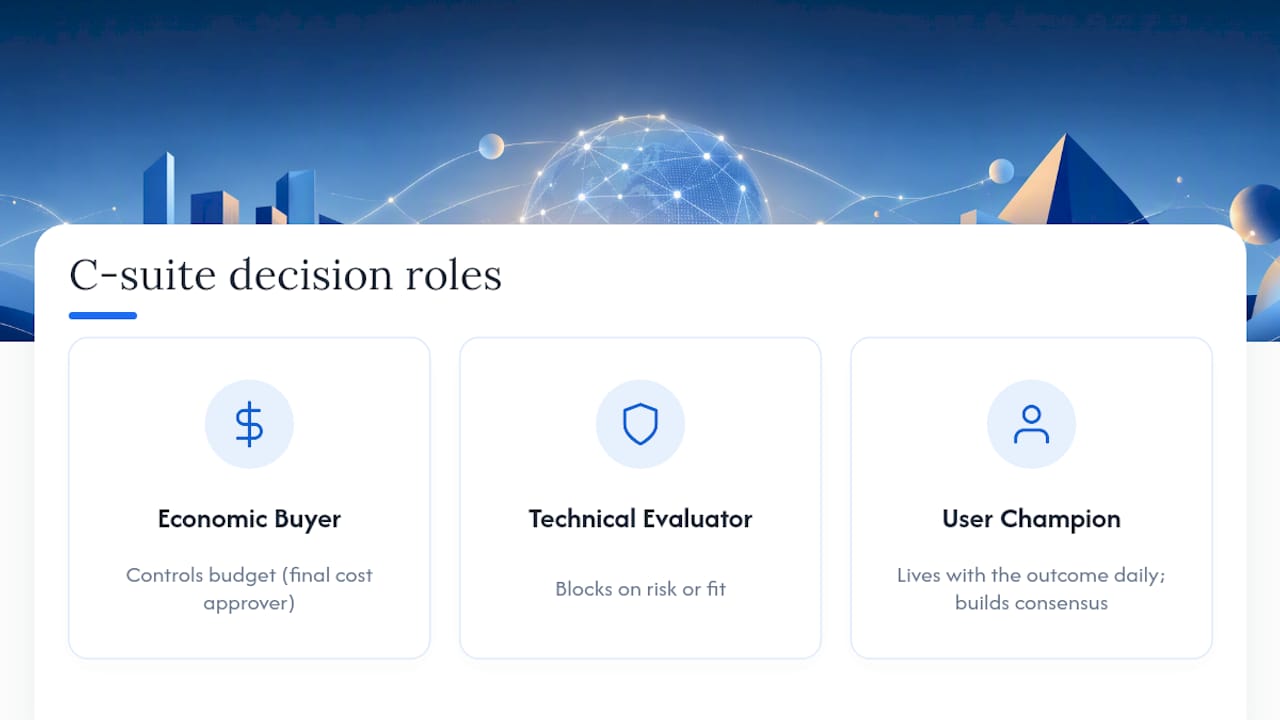
Understanding the actual hierarchy means mapping three roles separately: the economic buyer (controls budget), the technical or functional evaluator (blocks on risk or fit), and the user champion (lives with the outcome daily). A CFO can approve budget and still lose to a CTO's security objection raised in a hallway conversation you never sat in on.
Company size changes this dramatically. In a founder-led company under 200 employees, the CEO often makes the call directly and fast. In a public company or a private equity portfolio company, decisions route through committees, procurement, and sometimes a board-level review for anything above a certain contract value. Ask directly, early: "Walk me through who else needs to weigh in before this moves forward." Most executives will answer honestly if you ask plainly instead of trying to infer it from an org chart.
Sequencing matters here too. Engaging procurement or legal too early, before the executive sponsor has internally validated the problem, tends to slow deals down rather than speed them up. Let the champion and sponsor build internal consensus before the process formalizes.
Tailoring Your Communication Style to Different Executive Personalities
Not every CFO wants the same conversation, and treating executive selling as one script applied uniformly is a fast way to lose a meeting you'd otherwise win. Some executives are data-first and want the spreadsheet before the story. Others are relationship-first and want to understand your judgment before they trust your numbers. A few are visionaries who respond to a bold reframe of the market more than a tight ROI case.
You can usually read this within the first two minutes. A data-first executive interrupts your narrative to ask for the underlying assumption behind a number. A relationship-first executive asks about your background or how you found this account before getting to business. A visionary executive pushes past the immediate problem to ask where this trend goes in three years.
Adjust pacing, not substance. For data-first executives, bring the backup numbers but lead with the headline. For relationship-first executives, spend the first two minutes on genuine context, not small talk for its own sake, then move to substance. For visionaries, connect your specific proposal to the bigger shift they already believe is happening, and let them tell you the vision back.
The mistake most reps make is over-indexing on one style because it is the style they personally prefer to sell in. A rep who loves data will bury a relationship-first CEO in slides. Reading the room in the first ninety seconds and adjusting is a coachable skill, not an innate trait, which is exactly why role-play drills matter more than personality tests.
Building Trust and Relationships That Outlast the First Sale
Winning the first deal with an executive is the easy part compared to keeping their trust through renewal, expansion, and the inevitable rough patch when something breaks. Executive relationships decay fast when the only contact after signature is a renewal reminder email.

The habit that separates reps who keep executive sponsors for years is proactive, unprompted communication tied to outcomes, not check-ins. Send a short note when you notice a result worth flagging, good or bad, before the executive has to ask. If a metric slipped during a rollout, say so before the quarterly business review surfaces it. Executives remember who told them the truth early far more than who avoided an awkward conversation.
Quarterly business reviews should track back to the original success metrics from the pilot, not pivot to a new set of vanity numbers that happen to look better. Consistency in what you measure, quarter over quarter, is itself a trust signal. It tells the executive you are not managing the story, you are managing the outcome.
Long after the contract, referrals are the real payoff. An executive who trusts you will introduce you to peers at other companies, often unprompted, if the relationship has been built on honest reporting rather than a single strong pitch.
What I Would Tell a Rep Starting This Week
A meeting I once saw won came down to one line: a rep opened with the exact metric an executive had flagged on an earnings call, and the meeting extended from 15 minutes to 45. A meeting lost happened because a rep led with a product demo before the executive had agreed the problem was worth solving. A pilot that scaled worked because the rep set the success metric before any technical work began, not after.
Before any executive call, check three things: your one-sentence outcome, two pieces of evidence to back it, and one artifact to leave behind. Chad Burmeister has coached teams on this exact discipline for over two decades, and it still comes down to preparation, not charisma.
— Chad
Coaching Reps to Sell to Executives: A 0-90 Day Plan
Executive selling is teachable when you break it into drills instead of hoping reps absorb it by osmosis; for practical prospecting templates and outreach best practices, see The prospecting masterclass. The foundation is a pre-call gate: no rep books an executive meeting without first stating, in one sentence, the business outcome they're leading with. If they can't say it clearly, they're not ready to sit across from a CFO.
Pair that gate with a 60-second "hook" role-play, where a rep has one minute to deliver the opening line to a manager playing skeptical executive. It sounds simple. Most reps fail it the first five times.
An executive presence scorecard, used consistently in call debriefs, gives managers a shared language for feedback across five fields:
- Outcome opening: did the first sentence pass the "so what" test?
- Pace and pause: did the rep leave silence for the executive to think?
- Question quality: did the questions surface the real buying committee?
- Handling pushback: did objections get reframed as risk discussion?
- Next-ask clarity: did the meeting end with a specific, dated next step?
A 0 to 90 day rollout works in three phases: days 0 to 30 focus on scripting the one-sentence outcomes for each target account, days 31 to 60 shift to live role-play against the scorecard, and days 61 to 90 move to co-selling with a manager before reps run calls independently. Coaching built on a pre-call gate and a short scorecard shows measurable improvement in call outcomes within roughly two to three months, which is fast enough to matter for a quota-carrying team.
Pro Tip: Record the 60-second hook drills. Reps rarely believe how much they ramble until they hear it played back.
How Chad Burmeister Can Help You Sell to the C-Suite
Reading a playbook is one thing. Running it under quota pressure with a team that's never pitched a CFO is another. Chad Burmeister works directly with sales leaders and founders to install this exact system, hands-on leadership for pipeline growth, scripted drills, and manager scorecards, rather than a generic training deck that sits in a shared folder.
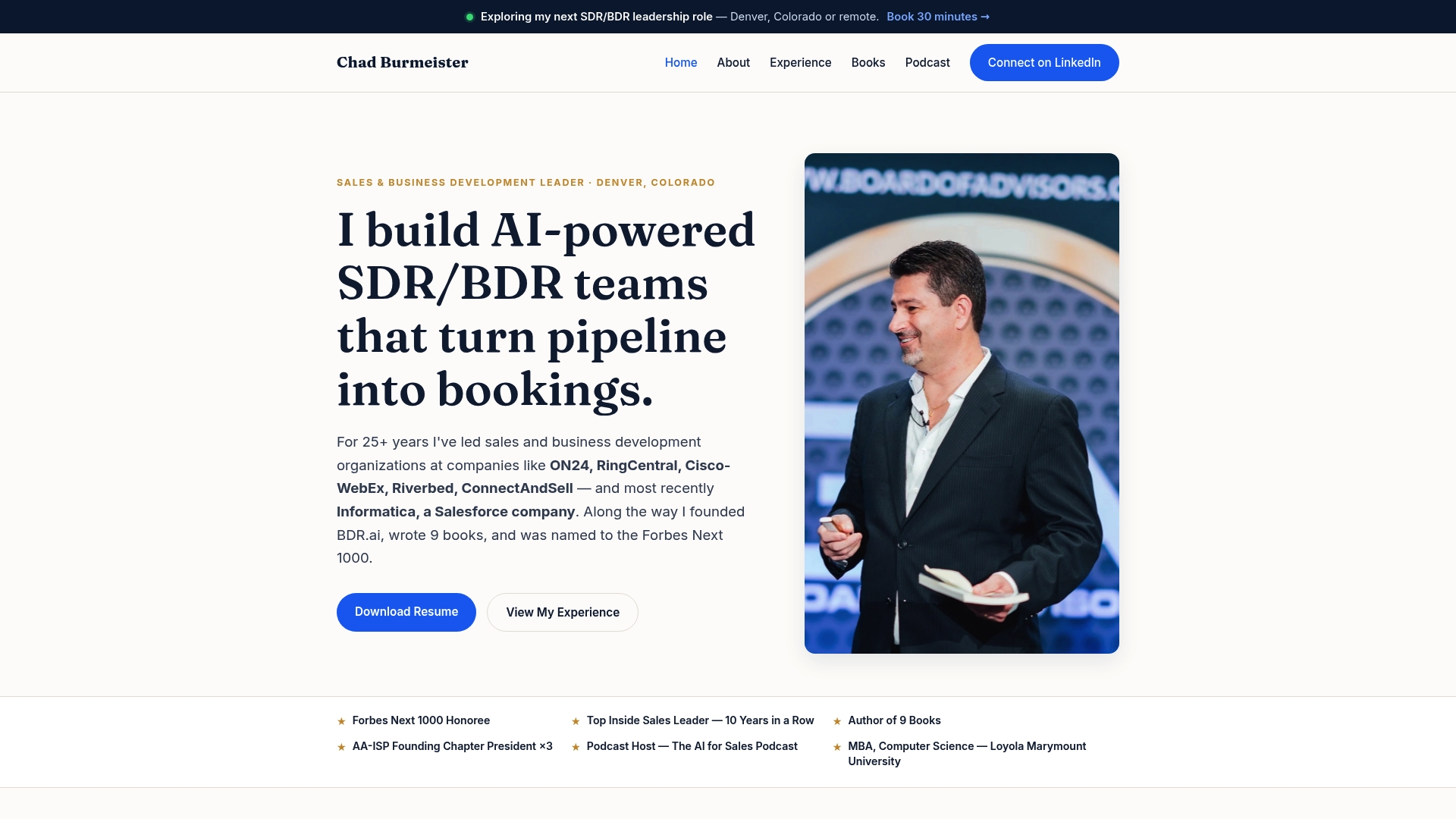
If your team needs this built and coached rather than just read about, a few concrete next steps are available: book a workshop for your sales organization, schedule a consulting engagement focused on executive-level pipeline growth, or start with the books, including AI for Sales 2.0 and Mastering B2B Lead Generation with LinkedIn & AI, for a self-serve version of the same frameworks. Visit Chad Burmeister's site to book a consult, or browse the full book collection to start applying these drills with your team this quarter.
Sources
For readers who want to go deeper on any tactic covered here, these sources informed the frameworks above:
- 12 Tips for Selling to the C-Suite — ZoomInfo
- When (and how) to multi-thread when selling to executives — Gong