A sales cadence is a predefined, repeatable sequence of outreach touches across email, phone, LinkedIn, and video that moves a prospect toward a decision. The strongest examples run multiple touches over several days, mix at least three channels, and always close with a break-up message. Below are five ready-to-use templates, sorted by scenario, plus the rules for picking the right one.
TL;DR:
- Cold outbound cadences should include around ten touches over three weeks, with personalized videos placed mid-sequence to increase reply rates.
- Speed-to-lead sequences require immediate contact within five minutes and should focus on urgency, often completing in six touches over eight days.
- Post-demo follow-ups benefit from multi-touch sequences spanning two weeks, reinforcing value through targeted content and direct questions about decision timelines.
- Cadence selection should be based on account fit, signal strength, owner clarity, and message quality, with longer, multi-threaded sequences reserved for enterprise accounts.
- Effective cadence management involves setting clear exit rules, measuring replies and engagement, and treating sequences as scalable assets rather than one-off efforts.
Table of Contents
- Sales Cadence Examples for Every Stage of the Pipeline
- How to Choose the Right Cadence for Each Account
- Timing Rules and Channel Mix That Improve Reply Rates
- Metrics, Benchmarks, and the A/B Testing Loop
- Copy-Ready Templates You Can Paste Into Your Cadence Tool
- Treat Outbound Like a Product, Not a One-Off Campaign
- What I've Learned Watching Teams Build These Sequences
- Work With Chad Burmeister to Build Cadences That Scale
- Sources
Sales Cadence Examples for Every Stage of the Pipeline
Every effective template shares three traits: multi-channel delivery, front-loaded early touches, and a defined exit point. The five sequences below cover the scenarios most reps actually face, from a cold list to a stalled enterprise deal.
Cold outbound: about ten touches spread over three weeks
This is the workhorse cadence for net-new prospecting, and it's the one most sales teams build first. It front-loads contact attempts, then spaces out to avoid fatigue.
| Day | Channel | Message intent |
|---|---|---|
| 1 | Personalized opener tied to a trigger event or pain point | |
| 1 | Connection request with a one-line reason | |
| 3 | Call | Introduce yourself, leave voicemail if no answer |
| 5 | Share a relevant case study or data point | |
| 7 | Call | Second attempt, reference the earlier email |
| 10 | Video | 60-second personalized video addressing a specific problem |
| 10 to 15 | Social proof or a third-party mention | |
| — | Comment or engage on a post, then send a soft message | |
| — | Call | Final live attempt |
| 21 | Break-up message: close the loop or invite a future reply |
The 60-second video at touch 6 is not decorative. Sendspark's cadence research found that placing a personalized video mid-sequence creates a pattern interrupt that pulls busy prospects out of inbox autopilot, and matching the video to the recipient's specific role tends to lift replies further.
Inbound / speed-to-lead: 6 touches over 8 days
Inbound leads decay fast. A prospect who fills out a demo request expects a response in minutes, not days, and this cadence is built around urgency rather than persuasion.
- Day 0 (within 5 minutes): Call immediately. If no answer, send an auto-triggered email confirming interest.
- Day 0 (same day, second attempt): Second call plus a short SMS or LinkedIn note if available.
- Day 1: Email with a scheduling link and one relevant resource.
- Day 3: Call plus a value-add email referencing their specific use case.
- Day 6: LinkedIn touch, light and conversational.
- Day 8: Final email, direct ask for a 15-minute call or a polite close.
Post-demo follow-up: multiple touches over two weeks
The post-demo window is where deals quietly die from neglect. This cadence assumes the prospect saw value in the demo but needs reinforcement to act.
- Same day: Recap email with the specific points discussed and next steps.
- Day 2: Share a case study matching their industry or use case.
- Day 4: Call to answer lingering questions.
- Day 7: Email addressing a likely objection (budget, timing, competing priorities).
- Day 9: LinkedIn touch, share a relevant piece of content.
- Day 12: Call, ask directly about decision timeline.
- Day 14: Break-up email offering to reconnect when timing is better.
Re-engagement and break-up cadence: a few touches over around ten days
For contacts who went cold, went silent mid-cycle, or churned, the goal shifts from persuasion to prequalification. The Salesforce framework for building email cadences recommends mapping every touch back to a defined goal before writing a single message, which matters most here since the "goal" for a stalled lead is different from a fresh one.
- Day 1: "Still relevant?" email referencing what changed since last contact.
- Day 4: Share new proof (product update, case study, industry shift).
- Day 7: Short LinkedIn message or call.
- Day 10: Final break-up email, explicit about closing the file unless they respond.
Enterprise multi-threaded cadence: more than ten touches over about a month
Enterprise deals rarely close through one contact. This template runs in parallel across two or three stakeholders rather than in a single line.
A typical structure: the economic buyer gets a slower, higher-value cadence (strategic emails, an executive-level call, a LinkedIn engagement), while a technical champion or influencer gets a faster, more tactical cadence (product details, technical proof points, a demo invite). Both tracks converge around Day 20 to 25 with a joint call or proposal review, and the sequence includes a personalized video addressed to the primary stakeholder around Day 12 to 15. Multi-threading isn't optional at this tier. A single-contact cadence into an enterprise account collapses the moment that person changes roles or goes quiet, which happens often enough to plan around.
How to Choose the Right Cadence for Each Account
Picking a template isn't about preference. It's about matching cadence intensity to how much the account is actually worth and how strong the buying signal is. Sonarly's fit-matrix approach proposes scoring an account before it ever enters a sequence, using four checks:
- Account fit: Does the prospect match your ideal customer profile on firmographics (size, industry, tech stack)?
- Signal strength: Is there a trigger event, intent signal, or recent engagement, or is this a cold guess?
- Owner clarity: Is there a single rep accountable for this account, or will it get orphaned mid-sequence?
- Message quality: Do you have enough information to personalize the first two touches, or will it read as generic?
If an account fails two or more checks, it doesn't get a cadence yet. It goes back to research.
ICP tiers and recommended cadence length
Cadence length should scale with deal size, not with how much content your team has on hand. Woodpecker's tiered approach to sales cadences recommends deeper, longer sequences for larger accounts and lighter, faster ones for smaller deals:
- Enterprise: 10 to 15+ touches, 21 to 30 days, multi-threaded across two or more stakeholders.
- Mid-market: 8 to 10 touches, 14 to 21 days, single primary contact with occasional secondary outreach.
- SMB: 5 to 8 touches, 7 to 14 days, email-heavy with one video touch and minimal multi-threading.
Stop rules that keep cadences from becoming noise
A cadence needs an exit condition before it needs a first email. The most common stop rules: pause automatically on any reply, retire after a set number of unanswered touches, and cap total outreach volume per contact per quarter regardless of how many cadences might otherwise apply. Pipedrive's guidance on cadence structure specifically recommends syncing cadence tools with your CRM so a reply, meeting booked, or deal stage change auto-pauses the sequence rather than relying on a rep to remember.
Most teams don't need five cadences. They need one solid cadence per ICP tier and the discipline to stop building new ones out of boredom.*
Timing Rules and Channel Mix That Improve Reply Rates
Spacing determines whether a cadence feels persistent or desperate. The general approach is to front-load early touches tightly, then space out later touches more broadly, shifting from frequent to more occasional engagement.
Channel mix should shift by ICP tier too. SMB cadences tend to be mostly email with some calls and video, while mid-market and enterprise incorporate more phone and LinkedIn touches alongside email and video to match account value.
The video touch has a specific home in the sequence. For cold outbound, place it at touch 3 to 4; for inbound or warmer sequences, touch 2 to 3 works because the prospect already has some context. Outreach's persona-matrix framework pairs touch intensity with buyer persona rather than applying one timing rule to every contact, which is worth building into your own sequence design if your ICP spans multiple buyer types.
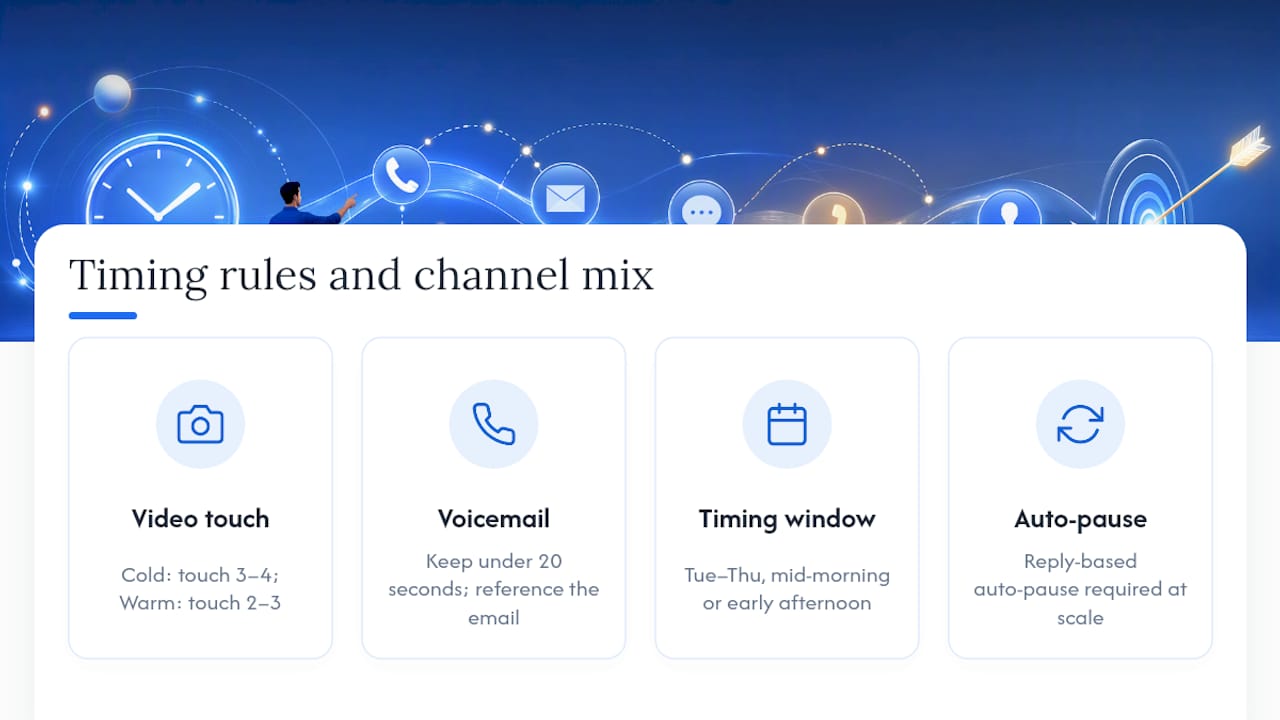
Voicemails should be short, under 20 seconds, and always reference the email that came before or will follow. Scheduling matters more than most reps assume: Tuesday through Thursday, mid-morning or early afternoon, tends to outperform Monday morning blitzes and Friday afternoon sends, largely because prospects are least buried in triage during those windows.
Reply-based auto-pause isn't optional at scale. Pipedrive's operational guidance treats this as a baseline requirement, not an advanced feature, because a rep managing 200 active contacts across five cadences cannot manually track every reply in time to stop the next scheduled touch.
Metrics, Benchmarks, and the A/B Testing Loop
A cadence without measurement is a guess repeated on a schedule. Six metrics tell you whether a sequence is working:
- Open rate: Signals subject line and send-time quality.
- Reply rate: The core health metric for the whole sequence.
- Positive reply rate: Filters out "not interested" replies from genuine interest.
- Meetings booked: The metric that actually ties to pipeline.
- Opt-out rate: A rising opt-out rate usually means the cadence is too aggressive or poorly targeted.
- Sequence completion rate: Shows how many contacts make it through without replying, pausing, or opting out.
Benchmark data from QUOTA Training puts cold outbound reply rates around 8 to 15%, with warm and expansion sequences running meaningfully higher since the prospect already has context on your company.
| Sequence type | Typical reply rate | Notes |
|---|---|---|
| Cold outbound | 8 to 15% | Wide range depending on list quality and personalization |
| Inbound / speed-to-lead | Higher than cold | Prospect already showed intent |
| Post-demo / warm | Higher than cold | Existing relationship carries the sequence |
Run A/B tests one variable at a time, in this order of priority: subject line first, then send time, then video versus no video at the same touch position. Testing everything simultaneously makes it impossible to know what actually moved the number.
Below that threshold, the problem usually isn't the copy. It's the audience.
Copy-Ready Templates You Can Paste Into Your Cadence Tool
Great cadences fail on weak copy more often than weak structure. Here's the raw material.
1. Subject-line formulas that consistently outperform generic openers:
- The question format: "Quick question about [specific process/tool]"
- The trigger-event format: "Saw [company news/event], thought of this"
- The mutual-connection or referral format: "[Name] suggested I reach out"
2. Three short email templates:
Intro email: "Hi [First Name], noticed [specific trigger, like a hire, funding round, or tech change]. Companies in [industry] usually hit [specific pain point] around this stage. Worth a 15-minute conversation to see if [solution category] fits?"
Value-add email: "Following up with something concrete: [company similar to theirs] saw [specific, real outcome] after addressing [pain point]. Happy to share how if it's relevant."
Break-up email: "Haven't heard back, so I'll assume timing isn't right. I'll close this out on my end, but if [pain point] becomes a priority later, just reply and I'll pick it back up."
3. A 30-second voicemail script: "Hi [First Name], this is [Your Name] with [Company]. I sent a note about [specific pain point] and wanted to put a voice to it. I'll follow up by email, but feel free to call back at [number] if it's easier."
4. LinkedIn connection message: "Hi [First Name], I work with [industry] teams on [specific problem]. Saw [specific detail about their role or company] and thought it was worth connecting. No pitch, just want to stay on your radar."
Scale personalization by splitting the work: manual effort goes into the first line of the intro email and the video script, since that's what a prospect notices most. Everything else, the follow-up cadence timing, the CRM syncing, the basic company research pulled from a reliable B2B contact database, can run through automation without losing the personal feel. For LinkedIn specifically, a structured outreach approach keeps connection requests from reading like mass-sent spam. And if you're layering in a broader content motion alongside outbound, a multichannel strategy guide is a useful reference for how content and cold outreach can reinforce each other rather than compete for attention.
Keep video thumbnails simple: your face, not a slide, generates far higher click-through than a branded graphic. And every message, regardless of channel, needs exactly one call to action. Two asks in one email is the fastest way to get neither.
Treat Outbound Like a Product, Not a One-Off Campaign
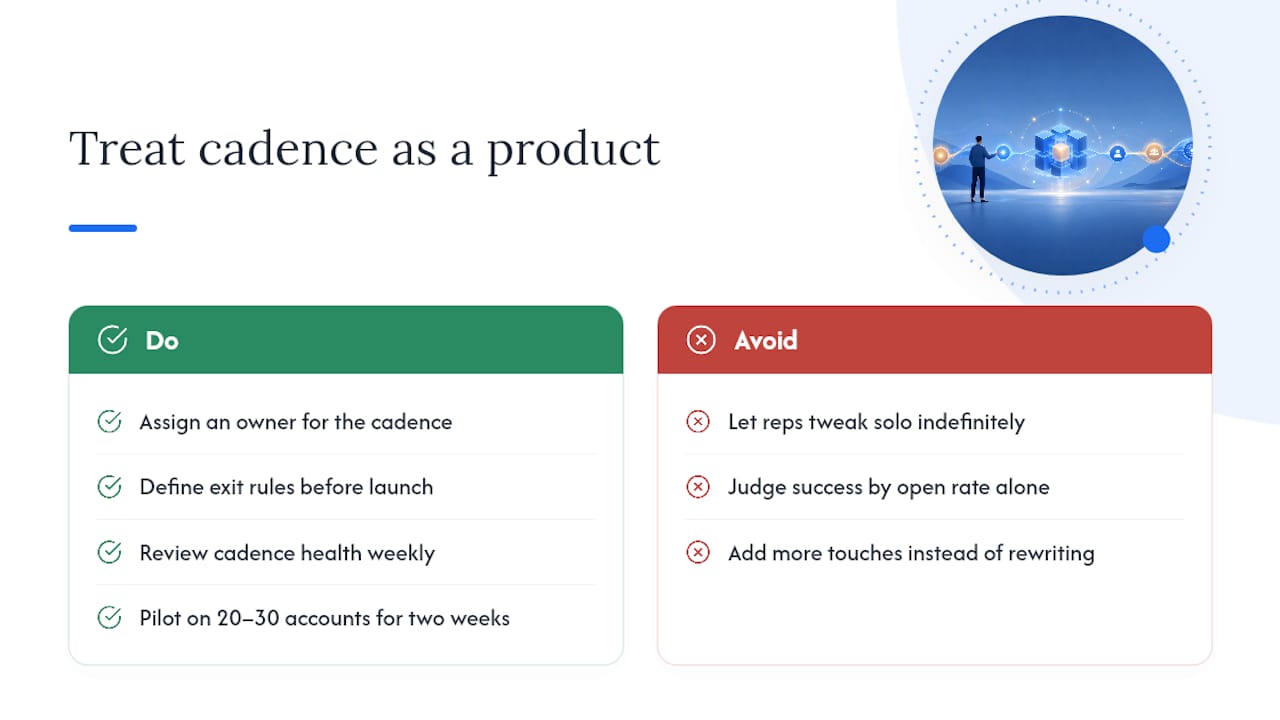
The teams that get the most out of these templates stop treating cadences as something a rep tweaks solo and start treating them as a managed asset. That means assigning an owner, defining exit rules before launch, and reviewing cadence scores weekly rather than quarterly. A governance-first approach to outbound sequences applies this logic directly: someone owns the sequence, someone owns the data feeding it, and both get reviewed on a rhythm.
Coach reps to follow the structure while personalizing the first and third touches themselves, since those are the two moments prospects notice most. Before rolling any new template company-wide, pilot it on 20 to 30 accounts for two weeks and watch reply rate and meeting rate specifically, not vanity metrics like open rate alone.
Pro Tip: Score cadence health the same way you'd score a landing page: reply rate is your conversion rate, and a sequence that isn't converting doesn't need more touches. It needs a rewrite.
What I've Learned Watching Teams Build These Sequences
The most common mistake isn't a bad template. It's running a 12-touch enterprise cadence against SMB accounts because someone liked the copy, or skipping stop rules entirely and letting sequences run past the point of usefulness. Weak account fit kills more cadences than weak writing ever does.
If you're starting from zero, don't build five sequences at once. Pick one template, score your accounts against the fit matrix, run it against 20 to 30 prospects for two weeks, and read the reply rate honestly. Then coach your team on what the data actually shows, adjust, and run it again.
— Chad
Work With Chad Burmeister to Build Cadences That Scale
Templates get you started. Scaling them across a full SDR or BDR team without losing personalization is a different problem, one that usually needs an experienced hand rather than another spreadsheet. An experienced sales leader brings effective outbound team strategies to sales leaders looking to fix underperforming cadences or stand up outbound from scratch. Explore Chad Burmeister's consulting and leadership services to see how a hands-on engagement works, or check out Chad's books on AI for sales and B2B lead generation for a deeper walkthrough of the frameworks behind these templates. For ongoing tactics and interviews with sales leaders putting this into practice, The AI for Sales Podcast covers new angles every episode.
Sources
- Sales cadence examples and outreach strategies
- How to Build an Email Sales Cadence That Converts: Examples and Best Practices
- Sales cadence best practices
- Mastering sales sequences: A practical guide for 2026
- Sales Cadence Examples and Fit Matrix for B2B