A high-impact sales kickoff agenda does three things at once: it points the whole team at one dominant objective, it builds skills reps can use in their next call, and it closes with a protected block where every rep writes down their own Q1 priorities. Skip any one of those, and the SKO turns into an expensive concert instead of a working session.
Here's what that looks like compressed into a single day's worth of structure, the kind you could sketch on a whiteboard before your next planning meeting: Morning opens with a 30-minute keynote setting the year's one message, followed by a product or market update, then role-based breakouts running through lunch. Afternoon shifts to skills practice, role-play certification, and a manager-led huddle that turns breakout notes into individual coaching plans. The final 30 to 45 minutes is silent, individual, and non-negotiable: every rep writes three Q1 priorities before they leave the room.
Three rules make or break that structure, regardless of how many days you have or whether half the room is remote.
- Keep the big stage short. Executive keynotes should be kept short and narrative-driven, with financial deep dives pushed into smaller breakouts where questions actually get answered, a discipline the CRO Report's kickoff planning guide treats as a hard boundary rather than a suggestion.
- Protect practice time like it's revenue. Role-play, certification, and teach-back sessions are where the agenda either changes behavior or just entertains people for two days.
- Recap within 24 to 48 hours. The event's momentum decays fast once reps go back to their desks, and a same-week recap paired with manager 1:1s is what Gather Shot's planning checklist identifies as the single biggest lever for making the content stick.
Pro Tip: Write the outcome statement for every single agenda block before you assign a speaker. "Reps can articulate the new pricing model in a 90-second pitch" is a design brief. "Product update" is not.
Key Takeaways
A high-impact sales kickoff agenda works when it commits to one dominant objective, protects real practice time, and closes the follow-up loop within 48 hours.
| Point | Details |
|---|---|
| Pick one dominant objective | Anchor the entire agenda to a single outcome, product launch, quota reset, or coaching rebuild, instead of splitting focus. |
| Keep keynotes relatively short and focused | Keep main-stage content narrative and short; push financial detail into smaller breakout sessions. |
| Never exceed 90 minutes per format | Rotate session types regularly to prevent attention decay across a multi-day event. |
| Protect the planning block | Reserve 30 to 45 minutes for silent, individual Q1 priority writing before the event ends. |
| Recap within 24 to 48 hours | Send a written recap fast and push manager huddles to convert notes into 1:1 coaching. |
| Get expert help when needed | Chadburmeister offers SKO design, facilitation, and keynote services built on 25 years of sales leadership experience. |
Table of Contents
- What Should a Sales Kickoff Agenda Actually Accomplish?
- How Do You Pick the Right Date, Theme, and Central Message?
- Planning Timeline: What Happens Before, During, and After
- What Does a Full Sample Sales Kickoff Agenda Look Like?
- How Do You Design Sessions That Actually Land?
- What Pacing Rules Keep Attention From Collapsing?
- What Do Hybrid and Virtual SKOs Need to Get Right?
- What Logistics, Venue, and Budget Decisions Come First?
- How Do You Measure Whether the SKO Actually Worked?
- How Should AI and Modern Tools Show Up in the Agenda?
- What Templates and Checklists Should You Copy Right Now?
- What I've Learned Watching SKOs Succeed and Fail
- Need Help Designing or Facilitating Your Sales Kickoff?
- Frequently Asked Questions
- Sources
What Should a Sales Kickoff Agenda Actually Accomplish?
An SKO is the one to three days a year your entire revenue organization gathers to reset direction, rebuild skills, and reconnect as a team before a new selling period begins. It is not a status meeting stretched to two days, and it is not a morale event with a slide deck bolted on. The best ones function as a hinge point between last year's results and this year's execution plan.
Every well-run SKO agenda serves three outcomes, and the ORM sales kickoff template frames these as the filter for whether any given session earns its slot: direction, enablement, and culture. Direction means the team leaves knowing exactly what changed and why. Enablement means they leave with a skill they didn't have Monday morning. Culture means they leave believing the team, and the leadership running it, is worth another year of effort.
Underneath those three outcomes sit the specific objectives that vary year to year:
- Product or portfolio launch — the sales floor needs to sell something new, complex, or repositioned.
- Territory or segment realignment — accounts moved, quotas shifted, and reps need clarity before they start calling.
- Quota-setting and comp rollout — new numbers, new plans, and the anxiety that comes with both.
- Coaching or methodology reset — the team's win rate is flat and leadership wants a shared sales language again.
- Culture and retention repair — turnover has been high, and the org needs a reason to re-commit.
Trying to hit all five in one agenda is how SKOs turn into a scattered 40-slide deck nobody remembers by February. Pick the one objective that, if it fails, hurts the business the most this year. If your comp plan changed materially, that's your dominant objective and everything else supports it. If you're launching a significant product, the product update becomes the core of the event.
How Do You Pick the Right Date, Theme, and Central Message?
Timing constrains almost everything else, so lock it first. Most B2B organizations plan their SKO early in the year, often shortly after the holiday period, right after the holiday lull and before the quarter's pipeline pressure sets in. Companies on a non-calendar fiscal year sometimes shift the SKO to align with their actual fiscal reset instead, which avoids the awkwardness of motivating a team around goals that technically started three weeks earlier without them.
Venue availability for early January books up fast, another reason the Offsite sample SKO agenda advises locking dates and room configuration eight to twelve weeks out at minimum. Wait past that window and you'll be choosing between a mediocre venue and a compressed one-day format you didn't actually want.
Theme selection is not decoration. A theme tied directly to the year's dominant objective gives every session a shared vocabulary, and QuotaPath's research on kickoff themes found that well-chosen themes measurably increase how much of the core message reps actually retain past the event itself. "Rebuild" works if you're recovering from a rough year. "Precision" works if the theme is disciplined execution on a new methodology. A generic theme like "Elevate 2026" tied to nothing specific just becomes wallpaper.
Thread the theme through more than the opening slide. Award category names, breakout titles, the closing video, even the swag, should all echo back to it. That repetition is what turns a one-time phrase into a shared shorthand your managers can reference in March.
Pro Tip: Test your theme by asking one question: can a rep explain, in one sentence, what the theme means for their daily work? If they can only describe the graphic design, the theme is decoration, not direction.
Planning Timeline: What Happens Before, During, and After
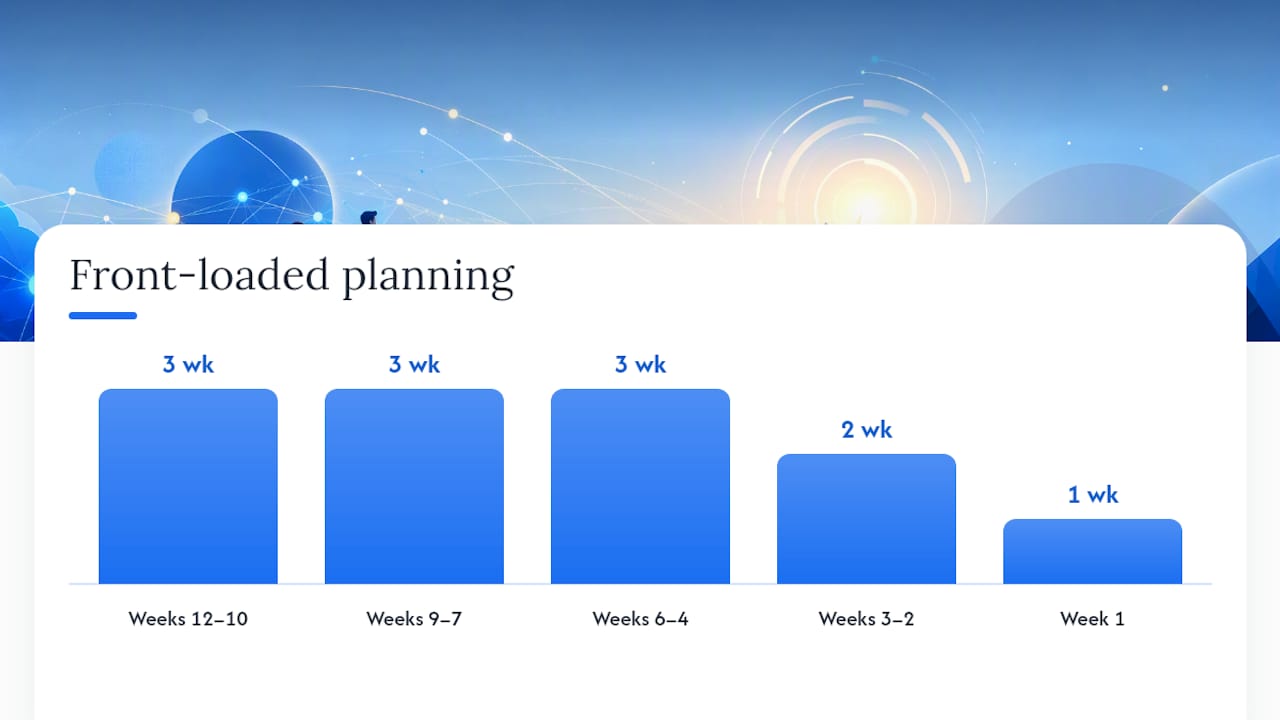
The single biggest planning mistake is starting the run-of-show before the venue and stakeholder alignment are locked. Room configuration determines which session formats are even possible, and most teams underestimate how long the post-event manager cascade actually takes to execute well.
Here's a milestone timeline built around ownership, not just dates:
- Weeks 12 to 10 out: Confirm dominant objective and theme with executive stakeholders. Lock venue, room block, and AV vendor. Owner: event lead plus sales VP sign-off.
- Weeks 9 to 7 out: Draft the run-of-show skeleton. Brief keynote speakers on outcome statements, not just topics. Owner: event lead with input from enablement.
- Weeks 6 to 4 out: Finalize breakout and workshop content. Send prework and role-based assignments to attendees. Owner: enablement lead.
- Weeks 3 to 2 out: Confirm AV run-of-show cues, stage timing, and speaker rehearsals. Owner: stage manager.
- Week 1 out: Final logistics check, registration materials, signage, and Wi-Fi capacity testing. Owner: event lead.
- During the event: Stage manager owns timing discipline, speaker readiness checks happen 30 minutes before each session, and manager huddle leads track which reps need follow-up coaching.
- 24 to 48 hours after: Send the event recap, package session recordings, and push manager huddles to convert breakout notes into 1:1 coaching plans, exactly the cadence the Gather Shot checklist treats as make-or-break for retention.
| Phase | Key Milestone | Primary Owner |
|---|---|---|
| 8 to 10 weeks out | Lock venue, theme, and dominant objective | Event lead + Sales VP |
| 6 to 4 weeks out | Finalize run-of-show and speaker briefs | Event lead + Enablement |
| 2-4 weeks out | Send prework, confirm AV and rehearsals | Enablement + Stage manager |
| Event days | Own timing, speaker readiness, huddles | Stage manager + Huddle leads |
| 24-48 hours after | Send recap, launch manager cascade | Event lead + Sales managers |
What Does a Full Sample Sales Kickoff Agenda Look Like?
Most mid-size sales teams run a two-day SKO, structured so direction lives on Day 1 and skills plus recognition live on Day 2. The ORM run-of-show template sets this split as a baseline, and it works because it matches energy to content: reps arrive alert and ready for strategy, then need active formats by mid-afternoon.
Day 1: Direction
Day 2: Skills and Recognition
For teams under 30 reps or with a single dominant objective, a compressed one-day agenda can work: cut one keynote, combine the two role-play rounds into a single 90-minute block, and shorten manager huddles to 30 minutes. For larger, multi-segment orgs, a three-day format adds room for segment-specific tracks on Day 2, splitting enterprise, mid-market, and SDR/BDR content into parallel workshops rather than forcing everyone through the same generic session.
Remote and hybrid variants need real restructuring, not just a camera pointed at the stage. Shorten every plenary block by roughly a third, since virtual attention spans drop faster than in-room ones, and rebuild role-play certification as smaller video breakout rooms of four to six people rather than a ballroom exercise. Awards and recognition still matter remotely. Send physical swag ahead of the event so remote attendees have something tangible when their name gets called.
How Do You Design Sessions That Actually Land?
Every session type has a failure mode, and most of them are avoidable once you know the pattern.
Keynotes fail when they turn into a 60-slide business review. Cap the main stage at 30 to 45 minutes, structure it as a narrative arc rather than a data dump, and push detailed financial breakdowns into a smaller, optional breakout where the handful of reps who actually want that detail can ask questions. This is the exact discipline the CRO Report guide recommends, and it's the single fastest fix for an agenda that's currently overstuffed.
Workshops and role-play certification need three things to work: prework sent at least a week ahead so live time is spent practicing rather than learning basics, a clear rubric for what "certified" means, and a facilitator who isn't also the person delivering the content. Splitting facilitator and content-owner roles keeps the room's energy on the reps doing the practicing, not on the person at the front.
Panels work best with three to four speakers max and a moderator who has pre-interviewed every panelist, because unscripted panels drift toward generic advice fast. Manager huddles need a specific deliverable, not an open discussion. Give managers a template that converts each rep's breakout notes into two or three concrete coaching topics for their next 1:1.
Awards land harder when the criteria were set before the event, not decided in the room. Tie award categories back to the theme, and if possible, surprise winners with a short video from a customer or a peer rather than just reading a name off a slide.
Every one of these session types should have a written outcome statement before you brief a speaker or facilitator, a habit the ORM template treats as the backbone of a well-run run-of-show.
Pro Tip: Ask every session owner to finish this sentence before the event: "After this session, reps will be able to ___." If they can't finish it in one sentence, the session isn't ready.
What Pacing Rules Keep Attention From Collapsing?
Attention decays predictably across a multi-day event, and the fix is structural, not motivational. No single format should run longer than 90 minutes without a change, a rule the ORM template applies specifically because sitting through back-to-back plenary sessions is where energy dies fastest.
Front-load your hardest content into the first morning slot of each day, when the room is most alert. That's the block for the methodology reset or the toughest quota conversation, not the 4 PM slot when everyone's checking their phone. This sequencing logic, save the light stuff for the afternoon energy dip, comes directly from how the Offsite sample agenda structures its run-of-show.
Engagement design matters as much as content quality. Teach-back exercises, where reps explain a concept back to a small group, surface gaps a passive lecture never would. Peer panels of top performers tend to land better than another executive on stage, because reps trust a colleague's field-tested tactic more than a strategy slide. Short certifications, even ungraded ones, give reps a reason to actually engage with role-play instead of coasting through it.
Before the agenda goes final, run three checks: does any block exceed 90 minutes in one format, does the hardest content sit in a low-energy slot, and does every rep have at least one protected, individual planning block before they leave. If any answer is yes, no, or no, the agenda isn't done yet.
What Do Hybrid and Virtual SKOs Need to Get Right?
A hybrid SKO is not an in-person agenda with a livestream bolted on. It needs its own production team, its own pacing, and its own accessibility plan, or the remote half of the room checks out by lunch.
Technology and roles. You need a dedicated producer running the virtual feed, separate from your stage manager, plus an on-camera MC whose entire job is keeping remote energy alive between segments. A remote facilitation lead should own breakout rooms independently of whoever is running in-room breakouts, because trying to manage both simultaneously guarantees one side gets neglected.
Format adjustments. Cut every plenary block by roughly a third for the remote feed. Build in interactive polls every 10 to 15 minutes to keep virtual attendees active rather than passive. Breakout facilitation for remote groups works better in smaller pods of four to six than in large rooms, and asynchronous prework matters more here than in an all-in-person event, since remote attendees can't lean over and ask a neighbor a quick question.
Accessibility. Live captioning should be standard, not an accommodation request. If your team spans multiple time zones, consider a split schedule with a shorter live block and asynchronous session recordings for anyone outside a reasonable window. Package every session for on-demand viewing afterward. A rep who missed the live keynote because it was 4 AM their time still needs the content by Monday.
- Dedicated remote producer and on-camera MC, separate from in-room roles.
- Shortened plenary blocks with polls or chat prompts every 10 to 15 minutes.
- Live captioning and post-event content packaging as default, not exception.
- Smaller breakout pods (four to six people) for remote role-play and workshops.
Pro Tip: Run a full technical rehearsal 48 hours before the event with your actual AV setup, not a generic Zoom test. Half of hybrid SKO failures trace back to a microphone or camera issue nobody caught until the live keynote.
What Logistics, Venue, and Budget Decisions Come First?
Venue selection has to follow the agenda's session formats, not the other way around. If your Day 2 plan calls for eight parallel workshops, you need eight breakout rooms with reliable AV, not a ballroom with two side conference rooms you're hoping will stretch. Confirm room configuration before you finalize the run-of-show, since the Offsite sample agenda's advice to lock venue details eight to twelve weeks out exists precisely because retrofitting a run-of-show around the wrong room is a painful, late-stage fix.
Budget allocation tends to follow a rough pattern: AV and production typically eat the largest single line item, especially for hybrid events with dual production needs. Facilitation and speaker fees come next, followed by social events, catering, and content capture. Swag and awards budgets are worth protecting even when costs get tight elsewhere, since recognition moments are disproportionately what reps remember months later.
On-site logistics deserve a dedicated checklist owner, not a shared responsibility:
- Registration flow and badge printing tested the day before, not the morning of.
- Signage for breakout rooms clear enough that reps don't wander in late.
- Wi-Fi capacity confirmed for the full room count, with a backup hotspot on hand.
- A backup AV plan (spare cables, a second laptop, a tech contact on speed dial).
- Clear run-of-show ownership so one person, and only one person, calls timing decisions on stage.
Choosing the right sales engagement platform ahead of the event also matters here, since much of your prework, registration, and post-event content distribution will run through whatever tech stack you already use for enablement.
How Do You Measure Whether the SKO Actually Worked?
The real test of an SKO isn't the applause on Day 2, it's whether pipeline behavior looks different in February. Track four categories of signal: session engagement (attendance, poll participation, breakout completion), skill adoption (certification pass rates, role-play scores), manager-assigned Q1 actions (did every rep leave with written priorities, and did managers follow up), and eventually, pipeline movement tied back to the objective you set at the start.
The follow-up sequence matters more than any single metric for Healthcare SaaS customer success. Send the event recap within 24 to 48 hours, a cadence Gather Shot's planning checklist identifies as the critical window before momentum decays. Managers should run huddles that same week, converting each rep's breakout notes and Q1 priorities into specific 1:1 coaching topics rather than a generic "great event, let's get back to it" message.
The SKO's value decays fast without structured follow-up. A recap sent within 24 to 48 hours, paired with manager coaching that references specific session outputs, is what separates an SKO that changes behavior from one that's forgotten by the second week of January.
Package session recordings and workshop materials for on-demand reinforcement. A rep who nailed the role-play certification in the room may still forget half the technique three weeks later without a quick-reference video to revisit. If you want to know which session formats actually drove behavior change versus which just felt good in the room, run a simple A/B check: have half your managers run a specific coaching follow-up tied to one workshop, and compare adoption rates against reps whose managers didn't. It's not a rigorous experiment, but it's enough signal to know what to repeat next year.
How Should AI and Modern Tools Show Up in the Agenda?
Treating AI as a single afternoon slide is the most common mistake still showing up in 2026 kickoff agendas. The Highspot guide to 2026 sales kickoffs is direct about this: effective SKOs build AI readiness into the agenda as hands-on, role-based labs, not a keynote mention.

A workable AI microcurriculum looks like three short labs rather than one long session. A session on drafting outbound messaging with AI assistance, with reps leaving having written and refined three actual messages they'll use that week. Another session practicing objection handling with AI simulations, where reps practice against a generated buyer persona before ever trying it on a live prospect. An additional session on deal scoring using AI to assess opportunities in the pipeline, not a hypothetical one.
Enablement analytics should drive which of these labs gets the most agenda time. If your platform data shows reps are already comfortable with AI-assisted prospecting but struggling with objection handling, that's where the extra 30 minutes goes, not into a topic the team has already mastered. This kind of analytics-driven prioritization is exactly what the Highspot guide recommends for building prework and agenda weight.
Facilitators running these labs should document specific outcomes managers can check on in Q1: did the rep actually use the AI-drafted messaging framework in a real sequence, did the objection-handling practice show up in a recorded call review. Building this kind of AI sales strategy into the agenda, and following up on it structurally rather than hoping it sticks, is the difference between an AI session that changes selling behavior and one that's a novelty demo everyone forgets by February.
Pro Tip: Give every AI lab a single, measurable "bring back to your desk" artifact, a drafted email, a scored deal list, a completed objection script, so managers have something concrete to check on in the first week back.
What Templates and Checklists Should You Copy Right Now?
A few artifacts do most of the heavy lifting once you're in execution mode, and they're worth building once and reusing every year.
Run-of-show snippet for a speaker brief: include the session title, the outcome statement ("attendees will be able to..."), exact start and end time, the transition cue to the next session, and one sentence on what to explicitly exclude (financial detail, product roadmap tangents, and so on).
Prework email template sent two weeks before the event: state the session's purpose in one line, attach any pre-reading or pre-recorded content, and specify exactly what the rep should bring or have completed before arriving.
Certification rubric template for role-play workshops: three to five specific, observable criteria (not "good energy" but "asked at least two discovery questions before pitching"), a pass/fail threshold, and a note field for the facilitator to flag reps who need a follow-up session.
24 to 48 hour recap checklist, the one artifact every planning team should build once and never skip:
- Send a written recap email within 48 hours summarizing the theme, key decisions, and next steps.
- Distribute session recordings and slide decks to a shared, searchable location.
- Push manager huddle guides so every manager runs the same coaching conversation structure.
- Confirm every rep's written Q1 priorities have been logged somewhere managers can reference.
- Schedule a 30-day check-in to measure early adoption of any new skill or tool introduced.
What I've Learned Watching SKOs Succeed and Fail
The biggest mistake I keep seeing isn't a bad speaker or a boring venue. It's an agenda built to satisfy every department that wants stage time instead of one built around a single dominant objective. When finance gets 45 minutes, product gets an hour, and HR gets a benefits update, the team leaves remembering none of it. Cut ruthlessly. If a session doesn't serve this year's one objective, it belongs in a follow-up webinar, not the main agenda.
The choice that pays off most consistently is the protected individual planning block at the very end. Teams that skip it because "we're already running late" lose the single highest-leverage 30 minutes of the entire event. A rep who writes down three specific Q1 priorities while the SKO's energy is still fresh acts on them differently than one who gets handed a follow-up survey a week later.
The gap between agendas that work and agendas that just look good on paper usually comes down to specificity. "Sales enablement workshop" is a placeholder. "Reps leave able to run a five-minute discovery call using the new qualification framework" is a design brief. I've written about this pattern in more depth in AI for Sales 2.0, and it's the same principle whether you're building an SKO agenda or a prospecting sequence: vague objectives produce vague results.
Need Help Designing or Facilitating Your Sales Kickoff?
Building the agenda is one thing. Running it in the room, keeping executives on message, and making sure the AI labs land instead of falling flat is a different skill set, and it's usually where in-house teams run out of bandwidth. Chadburmeister works directly with sales organizations on SKO design, live facilitation, and manager-cascade enablement, backed by 25 years running sales and business development teams for companies like Informatica, RingCentral, and Cisco-WebEx.
Engagement options range from a single consulting session to review your draft agenda, to full-service SKO design and on-site facilitation, to a keynote slot if you need an outside voice to deliver the year's message with credibility the internal team can't replicate on its own. If your agenda still has more department requests than dominant objectives, that's usually the first thing worth a conversation.
Review the full range of speaking and workshop engagements available, or head to the Chadburmeister homepage to book a planning consultation before your venue lock-in date closes your options.
Frequently Asked Questions
How long should a sales kickoff agenda run?
Most mid-size teams run two days, splitting direction-focused content on Day 1 from skills and recognition on Day 2. Smaller teams with a single dominant objective can compress to one day, while larger, multi-segment organizations often extend to three days to fit parallel, role-based tracks.
What's the biggest mistake in sales kickoff planning?
Trying to serve too many objectives in one agenda. When every department gets stage time, no single message survives past the first week. Pick one dominant objective and cut sessions that don't serve it.
How soon after the SKO should you send a recap?
Within 24 to 48 hours. Momentum decays quickly once reps return to their desks, and a fast recap paired with manager-led coaching huddles is what converts event energy into changed behavior.
Should AI sessions be part of every sales kickoff agenda now?
Yes. A short, hands-on AI lab, drafting messaging, practicing objection handling, or reviewing deal scoring, gives reps an immediate use case rather than a theoretical overview, and it's become a standard expectation for 2026 kickoffs.
How do you keep a hybrid sales kickoff from losing remote attendees?
Shorten plenary blocks for the virtual feed, run smaller breakout pods for remote role-play, add interactive polls every 10 to 15 minutes, and package every session for on-demand viewing so nobody misses content due to time zone gaps.
Sources
Several sources shaped the specific recommendations in this guide, and each is worth a closer look if you're building your own planning documents. The Offsite sample SKO agenda is the strongest reference for run-of-show timing and the eight to twelve week planning window. Gather Shot's planning checklist backs the 24 to 48 hour recap timing and manager cascade guidance used throughout the measurement and follow-up sections.
For 2026-specific AI integration, the Highspot guide to sales kickoffs informed the microcurriculum structure and the emphasis on enablement analytics for topic prioritization. The CRO Report's planning guide supports the keynote length and content-exclusion rules used in the session design section, and the ORM run-of-show template shaped the two-day sample agenda's day-by-day split and the 90-minute pacing rule. For theme selection specifically, QuotaPath's research on kickoff themes is worth reading in full before you commit to this year's concept.
- Sales Kickoff Agenda Template and Planning Checklist | Gather Shot
- SKO Agenda: Full Sample Sales Kickoff Meeting Schedule | Offsite
- Guide to 2026 Sales Kickoffs: Themes, Agendas, and Templates | Highspot
- Sales Kickoff Planning: Agenda, Budget, and Outcomes | CRO Report
- Sales Kickoff Agenda Template: A Full SKO Run-of-Show for Revenue Leaders | ORM