A sales turnaround consultant finds out why revenue is slipping, stabilizes the most urgent problems, and leaves you with a team and a process that hit the number without them. The work usually runs in the same order: diagnose the pipeline, fix the system behind the misses (targeting, messaging, handoffs, coaching, metrics), then rebuild or restructure the team if the data says you need to. This guide covers what that looks like in practice, when to call someone, and how to judge a candidate.
TL;DR
- A sales turnaround consultant diagnoses why sales are declining, then installs the process, metrics and coaching that fix it. Diagnosis comes before any hiring, firing or tooling.
- When several reps miss at once, treat it as a system problem, not a people problem. Check target accounts, messaging, handoffs and pipeline hygiene first.
- A workable sales recovery plan has three phases: diagnose (weeks 1 to 3), stabilize (weeks 4 to 8), and rebuild and measure (through day 90 and beyond).
- For SDR teams, measure qualified meetings booked rather than raw call and email volume, and coach weekly.
- Hire for operating experience with SDR, BDR and pipeline teams, a diagnostic method you can see, and a plan that transfers ownership to your managers.
Table of Contents
- What a sales turnaround consultant does
- When you need a sales turnaround consultant
- Start with diagnosis: where is the revenue leaking?
- What a sales turnaround strategy should include
- A sales recovery plan in three phases
- How to turn around an underperforming SDR team
- How to rebuild a sales team after performance declines
- How to implement and measure the plan
- Our perspective
- How to choose a sales turnaround consultant
- Work with Chad Burmeister
- FAQ
- Sources
What a sales turnaround consultant does
The job title sounds like a crisis role, and sometimes it is. More often, it is a focused engagement with a CEO, CRO or founder who sees a pattern: pipeline thinner than it should be, forecast misses, a rep bench that churns, or an SDR team booking meetings that never become deals.
A good consultant does four things.
- Finds the real cause. Declining sales are a symptom. The cause can be a poorly defined ideal customer, weak messaging, a broken handoff between SDRs and account executives, a compensation plan that rewards the wrong behavior, or a manager who does not coach.
- Stabilizes what is bleeding. That might mean cleaning up the pipeline so the forecast can be trusted, protecting the best accounts, or pausing activity that is burning your market.
- Installs the operating system. Weekly pipeline reviews, clear stage definitions, a scorecard, a coaching cadence and a qualification standard.
- Transfers ownership. The measure of success is that your managers run the system on their own.
That last point separates a turnaround from a rescue. If the numbers recover only while the outsider is in the room, you have rented a result.
When you need a sales turnaround consultant
Not every bad quarter calls for outside help. A single missed month with a clear explanation (a lost anchor customer, a seasonal dip) is a management problem you can handle internally. The signals below point to something structural.
- Multiple reps are missing quota at once. When one rep struggles, look at the rep. When many do, look at the system.
- The forecast has lost credibility. Deals sit in late stages for months, and nobody can explain why.
- Pipeline coverage is thin or inflated. There is either not enough pipeline to cover the target, or there is plenty, but little of it converts.
- SDR output looks busy but produces little. Lots of activity, few qualified meetings, and account executives who complain about lead quality.
- Turnover is rising. Reps leave faster than you can ramp them.
- Leadership is stretched. The sales leader left, or is promoted from the top rep and has never run a rebuild.
If you recognize three or more, an outside diagnostic is usually cheaper than another quarter of guessing.
Start with diagnosis: where is the revenue leaking?
Every credible turnaround starts by finding where the funnel fails. Before changing a single rep or tool, you want answers to a short list of questions. One published turnaround playbook describes checking pipeline quality and stage discipline by validating stage accuracy, deal hygiene and conversion ratios, then filling gaps with targeted outbound, account-based programs or partner pushes where needed. That order is sound: clean the data, find the gap, then spend effort on it.
| Symptom | Likely cause | First check |
|---|---|---|
| Plenty of meetings, few deals | Weak qualification or poor AE handoff | Review the last 20 lost deals for the stage where they died |
| Not enough meetings | Targeting, list quality or messaging | Reply rates and meetings booked by segment |
| Deals stall in late stages | Missing buyer, no urgency, or inflated stages | Stage definitions and deal age by stage |
| Forecast keeps missing | Poor deal hygiene | Compare stage labels with actual buyer activity |
| New hires never ramp | No onboarding or coaching | Time to first qualified meeting and first deal |
If your data lives in spreadsheets, a guide on how to automate sales data analysis can save hours of manual cleanup when you are slicing conversion by stage, segment and rep.
We have written separately about running this check quickly. Our guide to sales pipeline diagnostics for stalled deals walks through a short review you can do in a single sitting, and our piece on using AI for pipeline reviews shows how to make the weekly review faster and more honest.
What a sales turnaround strategy should include
A sales turnaround strategy is more than a list of tactics. It has to answer five things in writing.
- Who we sell to. A narrowed ideal customer profile, with the accounts that deserve effort named.
- What we say. Messaging tested against real buyer conversations, not internal opinion.
- How we qualify and hand off. A written standard the whole team uses.
- How we measure. A short scorecard with leading and lagging indicators.
- Who owns what. Roles, territories, compensation and coaching responsibilities.
If a plan skips one of these, the gap is usually where the next miss comes from.
A sales recovery plan in three phases
Here is a practical frame you can use whether you hire help or run it yourself.
Phase 1: Diagnose (weeks 1 to 3)
- Pull conversion rates for every stage, by segment and by rep.
- Audit the open pipeline deal by deal. Remove or downgrade anything without a confirmed next step.
- Listen to a sample of calls from top and bottom performers.
- Interview account executives, SDRs and a handful of recent customers and lost prospects.
- Write one page: what is broken, what evidence shows it, and in what order to fix it.
Phase 2: Stabilize (weeks 4 to 8)
- Reset stage definitions and require evidence to move a deal forward.
- Focus on the accounts most likely to close this quarter and protect them.
- Narrow the target list and rewrite the core messaging.
- Start a weekly pipeline review and a weekly coaching session.
- Publish a one-page scorecard so everyone sees the same numbers.
Phase 3: Rebuild and measure (weeks 9 to 13 and beyond)
- Adjust roles, territories and compensation where the data supports it.
- Fill real pipeline gaps with targeted programs. If you need more inbound demand to support outbound, a guide on using content for lead generation covers the basics.
- Track ramp, attainment, pipeline coverage and attrition, and avoid new changes unless something is clearly broken.
The coverage math matters here. Our walkthrough of the pipeline coverage ratio shows how to calculate it and what to do when it is off.
How to turn around an underperforming SDR team
SDR teams are often where a turnaround starts, because they feed everything downstream. The most common mistake is buying a new tool or replacing reps before checking the system. When more than one rep is underperforming at the same time, the cause is rarely individual effort.
The order below follows the guidance in a published SDR team recovery guide, which advises diagnosing first, then fixing in sequence:
- Clean the ideal customer profile and list quality. Bad lists make good reps look bad.
- Rebuild the messaging. Rewrite for the buyer's problem, and test it.
- Reset the metric to qualified meetings booked. Call and email volume tell you about effort, not results.
- Install weekly call coaching. A short feedback loop stops bad habits from setting.
- Fix the handoff to account executives. Use a written checklist: pain confirmed, authority verified, timeline established, next step agreed.
- Add tools last. Technology amplifies a working process. It does not repair a broken one.
If you need a scorecard, our SDR KPI guide with a copy-ready scorecard lays out three measures worth tracking. For team design, see the SDR org structure playbook and the SDR capacity planning guide, which help you size the team to the pipeline you need. New reps need a defined path too, and our SDR ramp plan covers the first 90 days.
When the ideal customer list is small and the deals are large, account-based outbound is often the faster route. We explain how in account-based outbound for $25K+ deals.

How to rebuild a sales team after performance declines
Sometimes diagnosis shows that structure is the problem: wrong roles, wrong territories, wrong incentives. A published restructuring framework offers a sensible sequence:
- Decide whether performance, growth or strategy is driving the change.
- Model the new structure: roles, segments, territories and reporting lines.
- Align compensation with that structure.
- Communicate in a cascade, from leadership to managers to reps.
- Stabilize, then measure ramp, attainment, pipeline coverage and attrition for 90 days, and resist further changes unless something is clearly broken.
Two practical notes from running teams. First, tell managers before reps, and give them the answers to the questions reps will ask. Second, change compensation at the same time as the structure, not months later. Reps follow the pay plan, whatever the org chart says.
If you are short on headcount while you rebuild, a staged approach can help. Our 60-day nearshore SDR pilot guide covers one way to add capacity without a long commitment.
How to implement and measure the plan
A plan that is not measured is a wish. Set the rhythm before you start.
- Weekly: activity and pipeline measures. Operating-rhythm guidance suggests tracking activity such as dials and conversations, and pipeline measures such as coverage ratio and stage conversion, on a weekly cadence, with outcome measures reviewed on a longer cycle.
- Monthly: qualified meetings, opportunities created, win rate, sales cycle length.
- Quarterly: attainment, forecast accuracy, rep retention, and ramp time for new hires.
Keep the scorecard to one page. If the leadership team cannot say the three numbers that matter this month, the scorecard is too long.
The people who run the system matter as much as the metrics. If you are unsure whether your SDR managers can carry this, see our SDR manager responsibilities simulation and 90-day plan.
Our perspective
After more than 25 years building and scaling sales and business development teams, the pattern I see most often is simple. Leaders reach for a new hire, a new tool or a new slogan before they know where the revenue is leaking.
A turnaround is a leadership job first. Someone has to own the diagnosis, set the standard for what a qualified meeting is, coach every week, and hold the line when the pressure to change everything shows up. That is hands-on work, and it is the work I have done with sales organizations in categories where the stakes were high.
AI now makes the diagnosis faster. Pipeline reviews, call analysis and list building that took weeks can be done in days. But AI does not replace a leader who will sit with the SDRs, listen to calls and fix the handoff. The best results come from pairing the two: practical AI for pipeline visibility, and experienced leadership for the human system around it.
That is why I write about both, in my books and on The AI for Sales Podcast, and why I work directly with CEOs, CROs and founders who want the team to keep the gains after the engagement ends.
Chad
How to choose a sales turnaround consultant
Use criteria that separate operators from presenters.
| Criterion | What good looks like |
|---|---|
| Operating background | Has personally led SDR, BDR or sales teams and carried a number |
| Diagnostic method | Can explain, in plain steps, how they find the cause before proposing fixes |
| Fit with your motion | Understands your sales model, deal size and buyer, such as B2B outbound |
| Coaching ability | Works with your managers and reps directly, not only in slide decks |
| Handover plan | Defines what your team will own by day 90 |
| Clear scope | Written deliverables, a cadence and the metrics that define success |
Ask each candidate to describe a team they inherited, what they found, what they changed first and what happened to the metrics. Specific answers show real experience. Vague ones show a template.
Also decide the model you need. Some companies want an advisor who guides the plan. Others need an executive who leads the SDR or business development function day to day. The second is a leadership hire, not an advisory project, and the right person will say so.
Work with Chad Burmeister
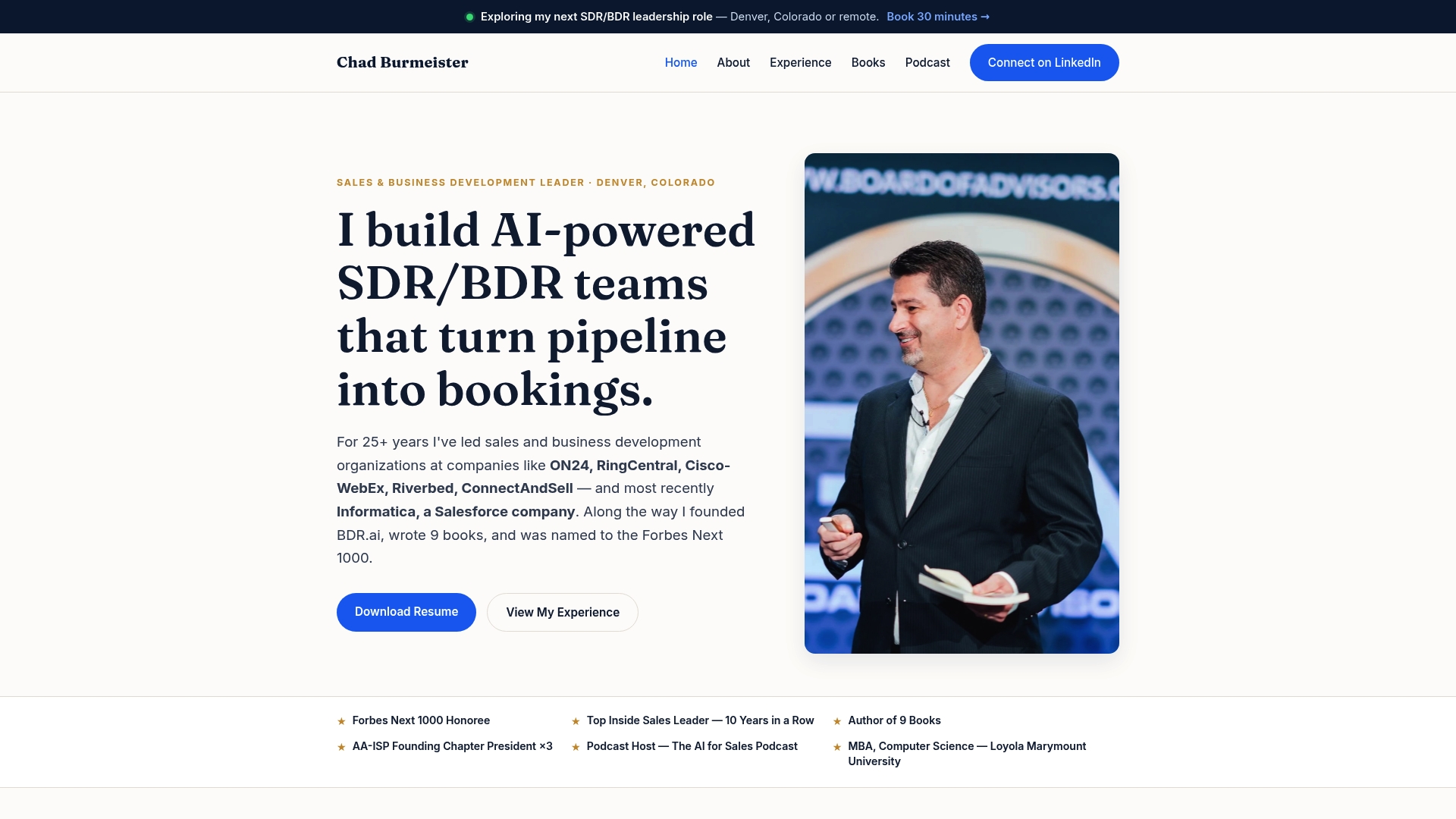
We work with CEOs, CROs and founders who need a sales development or business development leader to stabilize and grow pipeline, with a focus on SDR and BDR teams and AI-powered pipeline growth. Chad is based in Colorado and has led teams at Informatica, RingCentral and Cisco-WebEx. He is the author of nine books, including AI for Sales 2.0, and the host of The AI for Sales Podcast.
If you want your team to learn the playbook directly, we also run speaking and workshop engagements for sales organizations. See the speaking and workshops page for details, or start at chadburmeister.com to get in touch.
FAQ
What does a sales turnaround consultant do?
They identify why sales are declining, stabilize the most urgent problems and install a process that restores predictable results. That usually includes pipeline diagnostics, a rebuilt qualification standard, a coaching cadence, a scorecard and, where needed, changes to team structure. The goal is a team that keeps performing after the engagement.
How long does a sales turnaround take?
A reasonable frame is a 90-day plan: diagnosis in the first few weeks, stabilizing changes through the second month, then rebuilding and measuring. Pipeline takes time to build, and sales cycles vary, so full revenue recovery may lag the process fixes. Watch leading indicators such as qualified meetings and stage conversion early.
Should I fire reps or fix the process first?
Diagnose first. If one rep is far behind peers who work the same territory with the same support, that is a performance conversation. If many reps miss together, the system is the more likely cause, so fix targeting, messaging, handoffs and coaching before making people decisions.
Is a sales turnaround consultant the same as a sales leader?
Not always. A consultant advises and builds the plan, while a sales leader runs the team day to day. Many companies in a turnaround need an experienced SDR or business development leader who can do both: set the plan and coach the team through it.
Sources
- PE Portfolio Company Turnaround Playbook (GTM/Commercial Focus)
- How to Help a Struggling Sales Development Team
- Sales Team Restructuring: When and How to Reorganize for Better Performance
- Sales Operating Rhythm: Build One That Works in 2026
- How to Automate Sales Data Analysis Effectively
- How to Use Content for Lead Generation Successfully