Sales consulting rates typically run $100 to $175 an hour for entry-level work, $175 to $300 for mid-level specialists, and $300 to $600+ for senior or fractional VP talent, with full projects landing between $10,000 and $100,000+ depending on scope. Retainers for fractional sales leadership usually fall within a mid-range monthly fee. Senior consultants who price on results, not hours, command the highest fees. Before signing anything, ask for a scoped proposal that names baseline metrics and how success gets measured.
TL;DR:
- Most sales consulting projects cost between $5,000 and $100,000+ depending on scope, duration, and whether the work is advisory or execution.
- Senior consultants or fractional VPs charge $300 to over $600 per hour, with project costs ranging from $15,000 to over $100,000.
- Fixed-price projects and retainer agreements offer more predictability, but scope creep remains a key risk without clear deliverables and reporting.
- Payment structures should match the desired outcome, with value-based pricing suited for impact-driven results and milestones protecting against scope changes.
- Larger organizations typically invest above $100,000 for enterprise-level transformations, while small businesses may opt for diagnostic or templated engagements under $40,000.
Table of Contents
- Sales Consulting Rates: Benchmarks You Can Budget Against
- Hourly, Project, Retainer, or Value-Based: Which Pricing Model Fits?
- What Actually Moves the Price Up or Down
- What a Real Sales Consulting Budget Looks Like
- How to Choose a Sales Consultant and Structure the Deal
- Measuring ROI: The KPIs That Justify the Fee
- Author Perspective and Real-World Notes
- When Fractional Beats Full-Time (and When It Doesn't)
- How Chad Burmeister Can Help
- Sources
Sales Consulting Rates: Benchmarks You Can Budget Against
Sales consulting fees vary more than most buyers expect, mostly because "sales consultant" covers everyone from a solo contractor auditing your outbound cadence to a former enterprise sales VP redesigning your entire go-to-market motion. The gap between those two isn't a rounding error.
Hourly rates cluster into three tiers. Entry-level consultants, often generalists handling tactical work like call reviews or CRM cleanup, charge $100 to $175 per hour. Mid-level specialists with a specific playbook or vertical focus run $175 to $300. Senior consultants and fractional VPs of sales, the ones who've actually built and scaled a revenue org before, bill $300 to $600 or more per hour.
Project-based work is where most engagements actually land, since few buyers want an open-ended hourly clock. Here's roughly what different project types cost:
- Sales process audit or diagnostic: $5,000 to $15,000, typically two to four weeks.
- Playbook or methodology design: $15,000 to $40,000, often four to eight weeks.
- Full sales team rollout or GTM redesign: $40,000 to $100,000+, usually two to six months.
- Fractional VP of Sales (monthly retainer): $5,000 to $20,000 per month, ongoing.
| Engagement type | Typical price range | Common duration |
|---|---|---|
| Hourly, entry-level | $100–$175/hr | Task-based |
| Hourly, mid-level | $175–$300/hr | Task-based |
| Hourly, senior/fractional VP | $300–$600+/hr | Task-based |
| Diagnostic/audit project | $5,000–$15,000 | 2–4 weeks |
| Playbook/methodology project | $15,000–$40,000 | 4 weeks |
| Full rollout or transformation | $40,000–$100,000+ | 2–6 months |
| Fractional VP retainer | $5,000–$20,000/month | Ongoing |
Fractional retainers buy you something different from a project fee. You're not paying for a deliverable, you're paying for a seat at the table, usually weekly involvement in pipeline reviews, hiring, coaching, and forecasting. A $6,000 monthly retainer might get you eight to ten hours a week of senior oversight. A $18,000 retainer often means near full-time strategic leadership without the salary, equity, or benefits load of a permanent hire.
Hourly, Project, Retainer, or Value-Based: Which Pricing Model Fits?
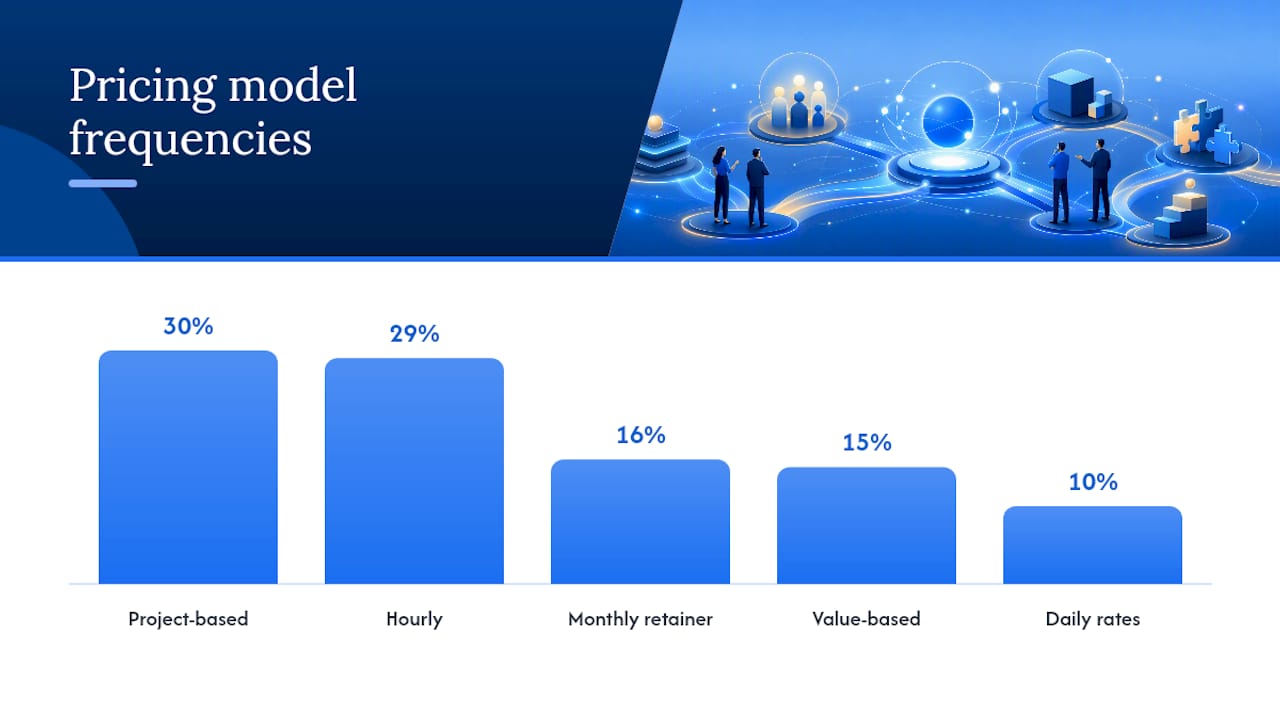
Sales consultants use five pricing structures with roughly this frequency: project-based (30%), hourly (29%), monthly retainer (16%), value-based (15%), and daily rates (10%). Each model shifts risk differently between you and the consultant, and picking the wrong one for your situation is how engagements go sideways.
Hourly pricing is easiest to understand and hardest to budget for. You know the rate, not the total. It works well for narrow, well-defined tasks like a one-time CRM audit, but it punishes ambiguity. If scope isn't nailed down, hourly billing incentivizes more hours, not better outcomes.
Project-based (fixed-fee) pricing trades flexibility for predictability. You agree on a price for a defined deliverable, like a new discovery-call script or a territory redesign, and that's the number regardless of how long it actually takes. This is the most common structure for a reason: it protects your budget and forces the consultant to scope carefully upfront.
Monthly retainers suit ongoing advisory or fractional leadership roles rather than discrete deliverables. You're buying access and continuity, not a finished product.
Value-based or performance-linked pricing ties fees to outcomes: a percentage of new pipeline generated, a bonus tied to quota attainment, or a share of closed revenue. Consultants who price this way land $10,000+ projects more often than those billing hourly, since the fee reflects impact rather than time spent.
Pro Tip: Ask any consultant proposing value-based pricing exactly how they'll measure the baseline before work starts. Without an agreed starting point for pipeline, win rate, or deal size, "performance-linked" becomes a debate, not a calculation.
The biggest operational pitfall across every model is scope creep. A "quick strategy session" becomes a six-week engagement because nobody wrote down what "done" looks like. Before you sign, get billing cadence, deliverable definitions, and reporting frequency in writing, not implied in a kickoff call.
What Actually Moves the Price Up or Down
Two proposals for what looks like the same job can differ by tens of thousands of dollars, and it's rarely arbitrary. Four factors explain most of the spread.
- Track record and demonstrable ROI. A consultant who can point to a specific pipeline lift or quota-attainment jump at a comparable company charges more, and usually earns it back faster than a generalist would.
- Industry specialization and your company's size. Selling into enterprise SaaS requires different muscle than selling into local services businesses. Consultants who've solved your specific problem before charge a premium for that pattern recognition, and buyer company size shifts the number too. A 200-person SaaS company pays differently than a 12-person agency.
- Scope complexity. Designing a playbook is a different job from implementing that playbook across a 15-person team, which is different again from helping you hire and onboard that team. Each layer adds cost.
- Delivery model. Pure advisory work (strategy, coaching, review) costs less than execution work (running campaigns, managing reps, building systems), because execution eats more of the consultant's calendar and often requires additional staff or tools on their end.
Experience and industry fit tend to move price the most, since they're what you're actually paying for when you hire outside a specific playbook.
What a Real Sales Consulting Budget Looks Like
Abstract ranges are hard to plan around. Concrete scenarios help more. Here's how the four common tiers of B2B consulting engagements tend to play out in practice.
| Tier | Price range | Typical buyer | What's included |
|---|---|---|---|
| Tier 1: Productized | $10,000–$40,000 | Small business, single sales problem | Diagnostic, templated playbook, short implementation support |
| Tier 2: Standard project | $15,000–$40,000 | Growth-stage company, defined scope | Custom playbook, training, 2 to 6 month rollout |
| Tier 3: Senior/fractional-led | $40,000–$100,000 | Mid-market, complex GTM | Fractional VP oversight, hiring support, ongoing coaching |
| Tier 4: Enterprise transformation | $100,000+ | Large organization, multi-team rollout | Full GTM redesign, cross-functional alignment, multi-quarter engagement |
A productized sales development engagement at the low end typically means a fixed diagnostic plus a standardized playbook, delivered in two to four weeks with minimal customization. It's the fastest way to get outside expertise without a big commitment, but it won't account for anything unusual about your buyer journey.
At the other end, an enterprise transformation isn't really a "project" at all. It's a multi-quarter partnership involving several stakeholders on your side and often a small team on the consultant's side. Expect internal time commitment of five to ten hours a week from your leadership just to keep the engagement moving.
A $30,000 playbook project that also requires a new sales engagement platform isn't really a $30,000 decision, it's closer to $35,000 to $40,000 once you count the software and the hours your team spends implementing it.
How to Choose a Sales Consultant and Structure the Deal
Picking the right consultant is less about finding the cheapest hourly rate and more about matching scope, proof, and payment structure to what you actually need. Here's the process worth following before you sign anything.
- Define the problem before you shop rates. "We need more pipeline" and "our reps aren't qualifying leads correctly" require different consultants at different price points. Get specific internally first.
- Require a scoped proposal, not a verbal estimate. It should name deliverables, a timeline, a billing cadence, and, critically, the baseline metrics you're starting from (current win rate, average deal size, current pipeline velocity).
- Ask for verification of ROI claims. References from comparable companies matter more than logos on a slide. Ask specifically: what was the metric before, what was it after, and over what time period?
- Request a sample deliverable or redacted report. Anyone who's done this work before has something to show you that isn't confidential client data.
- Negotiate structure, not just price. Milestone payments (a portion at kickoff, a portion at midpoint, a portion at completion) protect you better than a lump sum upfront. For value-based deals, define the success fee formula in writing, including what happens if results fall short of target.
- Add a change-order clause. Scope will shift. Agree in advance on how added work gets priced, whether that's a flat add-on rate or a percentage adjustment to the original fee.
- Clarify what happens post-engagement. Do you own the playbook and materials outright? Is there a follow-up support window included, or does that cost extra?
Pro Tip: If a consultant won't provide any client reference willing to discuss specific before-and-after numbers, treat that as a real signal about how well they've tracked their own results, not just an inconvenience.
One overlooked lever: separating strategy from execution in the contract itself. Buyers often confuse hiring a consultant for methodology versus hiring one for hands-on execution, and that confusion drives most fee disputes. A consultant designing your outbound strategy shouldn't be billed the same way as one running your outbound campaigns day to day. Ask which role you're actually buying.

Measuring ROI: The KPIs That Justify the Fee
A sales consulting engagement should move specific numbers, and you should agree on which numbers before work begins, not after. The core metrics worth tracking:
- Pipeline velocity: how fast deals move from stage to stage.
- Win rate: percentage of qualified opportunities that close.
- Average deal size: whether the consultant's changes are attracting or closing bigger deals.
- Ramp time: how quickly new reps hit quota, especially relevant for playbook and onboarding work.
Setting a baseline matters more than picking the right metric. If you don't know your win rate was 18% before the engagement started, you can't credibly claim it's 24% now because of the consultant's work. Agree on attribution methodology upfront, especially for performance-linked fees, since without pre-agreed baselines, success-based pricing tends to generate disputes rather than alignment.
A simple payback calculation helps frame the decision for your leadership team: divide the total engagement cost by the monthly incremental revenue or pipeline value the consultant's changes generate, and that gives you a rough payback period in months. A $40,000 engagement that adds $15,000 a month in new qualified pipeline pays for itself in under three months, assuming your close rates hold. The average Sales Consultant salary sits around $97,596 a year, or roughly $47 an hour, which is a useful anchor when comparing a full-time hire's fully loaded cost against a consultant's fee for the same outcome.
Author Perspective and Real-World Notes
The most expensive mistake buyers make isn't overpaying for a consultant. It's underscoping the engagement, then blaming the consultant when results don't match expectations that were never written down. I've watched companies hand over $30,000 for a "strategy engagement" with no defined baseline and no agreement on what success looks like, then get frustrated when the consultant can't prove impact six weeks later. That's not a pricing problem. It's a scoping problem that shows up looking like a pricing problem.
For a first engagement, I recommend starting smaller and more diagnostic than most buyers want to. A focused audit, two to four weeks, clear baseline metrics, and a specific recommendation set gives you a low-risk way to evaluate how a consultant thinks before committing to a six-figure transformation. It also gives the consultant a clean way to prove value before you scale the relationship.
[Proprietary case studies and testimonials from sales leaders and SDRs who've worked with Chad Burmeister's engagements will be featured here.]
— Chad
When Fractional Beats Full-Time (and When It Doesn't)
Run the real numbers before deciding whether to hire or contract. A full-time VP of Sales, fully loaded with salary, benefits, equity, and recruiting cost, often runs $250,000 to $350,000 in the first year. A fractional VP retainer at $10,000 to $15,000 a month lands closer to $120,000 to $180,000 annualized, with no severance risk if it doesn't work out.
Fractional leadership shortens time-to-revenue in one specific situation: when you need senior judgment now but don't yet have enough deal volume or team size to justify a full-time salary. It's also the better call when you're testing a new market or motion and want expert guidance without a permanent org-chart commitment.
The signal that it's time to hire full-time instead: when the fractional leader's calendar is maxed out, when your team has grown past what part-time oversight can manage, or when you need someone embedded daily in culture and hiring decisions that a fractional arrangement structurally can't provide.
How Chad Burmeister Can Help
Chad Burmeister offers a direct path to senior sales leadership without the twelve-month hiring process or the full-time salary commitment. Engagements range from fractional VP of Sales leadership and sales strategy consulting to workshops and speaking, built for founders and CROs who need pipeline results now, not after a lengthy executive search.
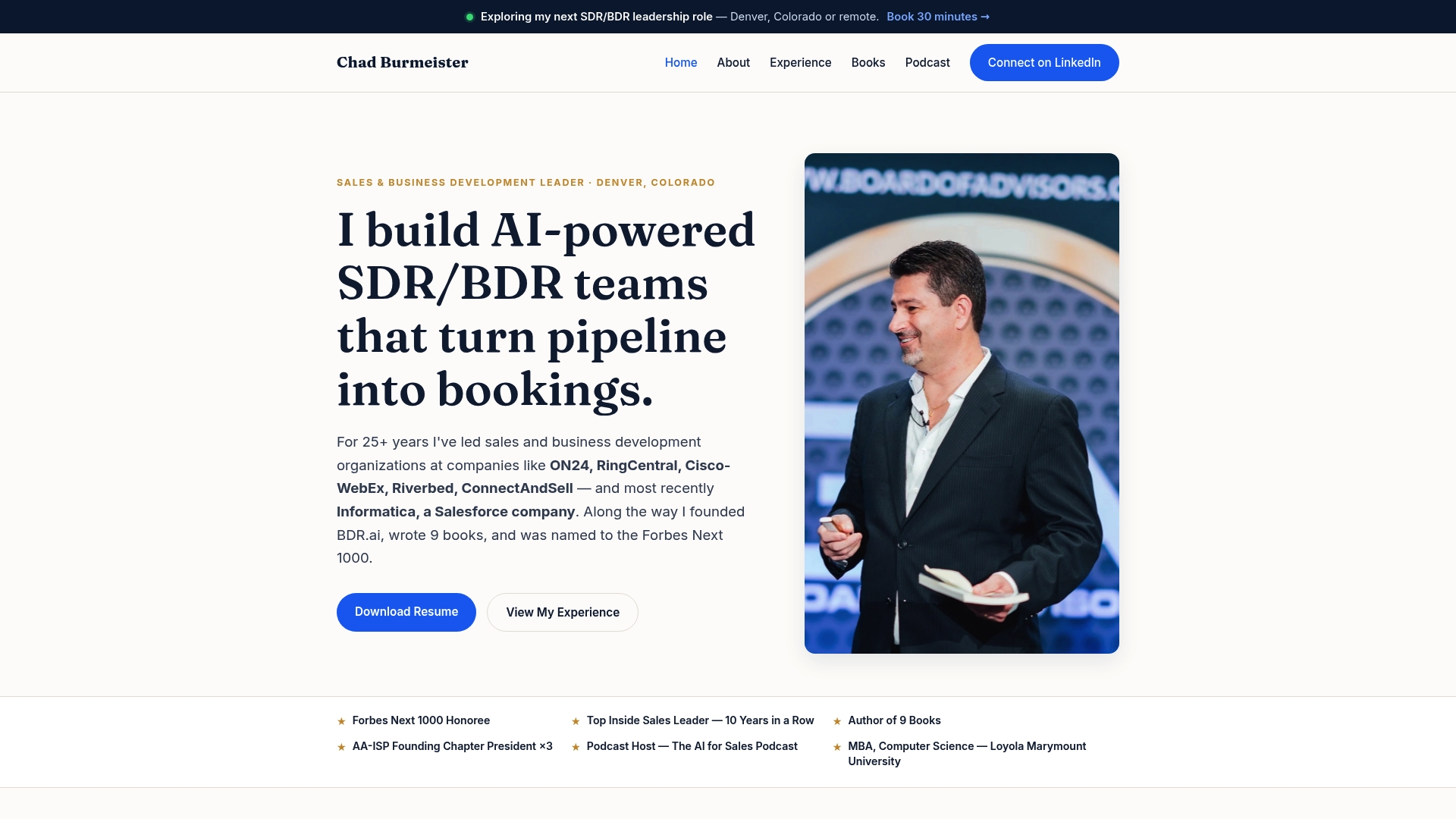
With over 25 years leading sales and business development teams at companies like Informatica, RingCentral, and Cisco-WebEx, plus nine published books including AI for Sales 2.0, Chad brings a track record most independent consultants can't match. His work applies AI-driven pipeline strategies to modern revenue teams, translating what worked at enterprise scale into playbooks that fit growth-stage companies.
Ready to see if a fractional engagement or strategy consulting fits your situation? Start a conversation with Chad Burmeister to discuss scope, timeline, and pricing for your specific revenue goals.
Sources
For readers who want to dig into the raw numbers behind this piece, the Consulting Success pricing study breaks down how nearly 1,000 consultants actually price their work. The Leads Now AI framework offers a deeper look at the four-tier pricing model referenced throughout this piece. For wage comparisons when weighing a hire against a consultant, the BLS Occupational Employment and Wage Statistics provide the government baseline, and pricing model strategy from Deltek explains the shift from hourly to value-based billing in more depth. For a broader look at pricing structures outside sales consulting specifically, Webflow agency pricing models offer a useful parallel comparison.
- How to Set Consulting Fees (And What Most Get Wrong) | Consulting Success®
- How to Price a B2B Consulting Engagement: A Framework Based on 50,769+ Booked Meetings - Leads Now AI
- What Does a B2B Sales Consultant Do? A 2026 Guide | SyncGTM | SyncGTM