Account-based outbound is multi-threaded, research-driven prospecting that treats each target company as its own market instead of a name on a list. It works best when a single closed deal justifies the effort: ACV above roughly $25,000, a buying committee of three or more people, and an ICP narrow enough that every account counts. The trade-off is straightforward. You get higher conversion and bigger deals in exchange for higher cost and time per account.
TL;DR:
- Effective account-based outbound requires a focused list of 100 to 200 companies, with the deepest research reserved for 20 to 50 Tier 1 accounts.
- Prioritize trigger events like funding rounds, executive hires, or strategy shifts to re-score accounts and identify readiness signals.
- Tailor messaging for each stakeholder role, starting with the champion, and use multi-channel, multi-touch sequences lasting 30 to 60 days across different contacts.
- Track engagement, multi-contact involvement, and stages progression weekly, recognizing that buying committees of 6 to 12 members drive longer, more complex sales cycles.
- Limit account ownership to 50 to 75 accounts per person initially, with gradual scaling supported by research, intent data, and automation tools, but invest heavily in research depth over list size.
Table of Contents
- How Do You Choose Target Accounts for Account-Based Prospecting?
- How Do You Score and Prioritize Accounts?
- What Research and Messaging Do You Need Per Account?
- What Does a Multi-Threaded Outbound Sequence Look Like?
- Which Metrics Actually Predict Account-Based Outbound Success?
- How Many Accounts Can One Person Realistically Own?
- What Tools and Automation Should Support the Program?
- What Does 25 Years of Sales Leadership Teach About ABM Outbound?
- A Practitioner's Note on Starting Slow
- Sources
- FAQ
How Do You Choose Target Accounts for Account-Based Prospecting?
Start with your ICP, then filter hard. Most teams pull a list of hundreds of "technically qualified" companies and only realize later that half of them will never buy. Add filters until the list actually reflects urgency and fit, not just industry and headcount.
Useful filtering criteria:
- Industry and sub-vertical, not just broad category
- Revenue band and growth stage (funded, scaling, recently acquired)
- Tech stack signals (what they already run, what's missing)
- Existing customer-profile overlap with your best current accounts
- Org structure that matches your buying-committee assumptions
Account-based outbound typically works with a focused list of 100 to 200 companies, coordinated across multiple contacts and channels. Split that list into tiers. Tier 1 is your tight list, usually 20 to 50 accounts that get the deepest research and the most personalized sequences. Tier 2 runs 50 to 200 accounts with a more templated, scaled approach. When your fit pool balloons past 200, tighten the criteria rather than diluting effort across more names than your team can research well.
How Do You Score and Prioritize Accounts?
Static fit tells you who could buy. Timing tells you who's likely to buy now. The Salesmotion outbound ABM playbook recommends weighting timing and trigger signals heavier than fit when you're deciding which accounts to activate this week, since fit rarely changes but readiness does.
Watch for these trigger events:
- New funding round or executive hire in a relevant function
- Job postings signaling a new initiative or team buildout
- Public statements about strategy shifts or competitive pressure
- Signs of dissatisfaction with an existing vendor
Re-score accounts on a rolling basis rather than once a quarter. A common rule: recycle any Tier 1 account with zero engagement after 90 days, and re-score any account the moment a new trigger event fires, regardless of where it sits in the cycle.
What Research and Messaging Do You Need Per Account?
Generic personalization ("Hi {{FirstName}}, I saw you work at {{Company}}") gets ignored by buyers who evaluate multiple vendors a year. Real account research changes the message, not just the mail-merge field.
Before writing a single sequence, pull:
- Recent news, earnings calls, or funding announcements
- Job postings that hint at team gaps or new priorities
- Current tech stack and likely integration points
- An org chart mapping economic buyer, technical evaluator, and internal champion
- Public statements from execs on LinkedIn, podcasts, or press
Each role needs a different angle. The economic buyer wants ROI and risk reduction. The technical evaluator wants integration proof and implementation detail. The champion, the person who has to live with the tool daily, wants to know it will make their week easier, not harder.
Pro Tip: Write the champion's message first. If you can't explain why this makes their Tuesday better, the ROI pitch to the economic buyer won't land either.
What Does a Multi-Threaded Outbound Sequence Look Like?
A 30 to 60 day sequence should hit multiple stakeholders on different channels, not the same person five times on email. Here's a workable structure:
- Days 1 to 5: Email plus LinkedIn connection to the champion, referencing a specific trigger event or pain point.
- Days 6 to 10: Phone call attempt to the champion, LinkedIn comment or engagement with the economic buyer's recent post.
- Days 11 to 20: Direct outreach to the economic buyer referencing ROI, plus a follow-up email to the champion with a relevant case reference.
- Days 21 to 35: Loop in the technical evaluator with integration-specific content; escalate champion touches to phone.
- Days 36 to 60: Multi-threaded check-in across all three roles, often anchored to a new trigger event or piece of content.
ABM sequences commonly need 8 to 12 touches per account across channels before you see real traction, and coordinated multi-channel outreach that catches multiple stakeholders engaging produces measurably stronger signal than single-channel blasts. Vary the message across touches so the same reference point (a funding round, a competitor move) shows up from different angles rather than the same sentence copy-pasted to three contacts. Build in pause windows, at least a week between touches to the same person, to avoid fatigue and to give internal conversations time to happen. LinkedIn voice messages can break through when email and calls stall, especially with champions who screen calls but check LinkedIn daily.
Which Metrics Actually Predict Account-Based Outbound Success?
Revenue is a lagging indicator in long enterprise cycles, so track account progression through stages: Targeted, Engaged, Meeting Booked, Opportunity, and Recycled. That progression tells you where deals are stalling long before a quarter closes.
Core metrics to report weekly:
- Engagement rate: percentage of targeted accounts with any stakeholder interaction
- Multi-contact penetration: how many distinct people at an account have engaged, not just one
- Account-to-meeting rate: percentage of targeted accounts that convert to a booked meeting
- Pipeline velocity: speed of movement between stages
- Win rate and ACV: outcome metrics tied back to the accounts you actually invested in
Enterprise outbound engages buying committees of 6 to 12 people and commonly runs 180 to 540 day sales cycles, which is exactly why multi-contact penetration matters more than any single reply rate.
Salesmotion's own playbook cites a claimed 208% lift in marketing-generated revenue from deeply personalized outbound ABM. Treat that figure as a vendor benchmark, not a guarantee, but it illustrates the ceiling when execution is tight.
How Many Accounts Can One Person Realistically Own?
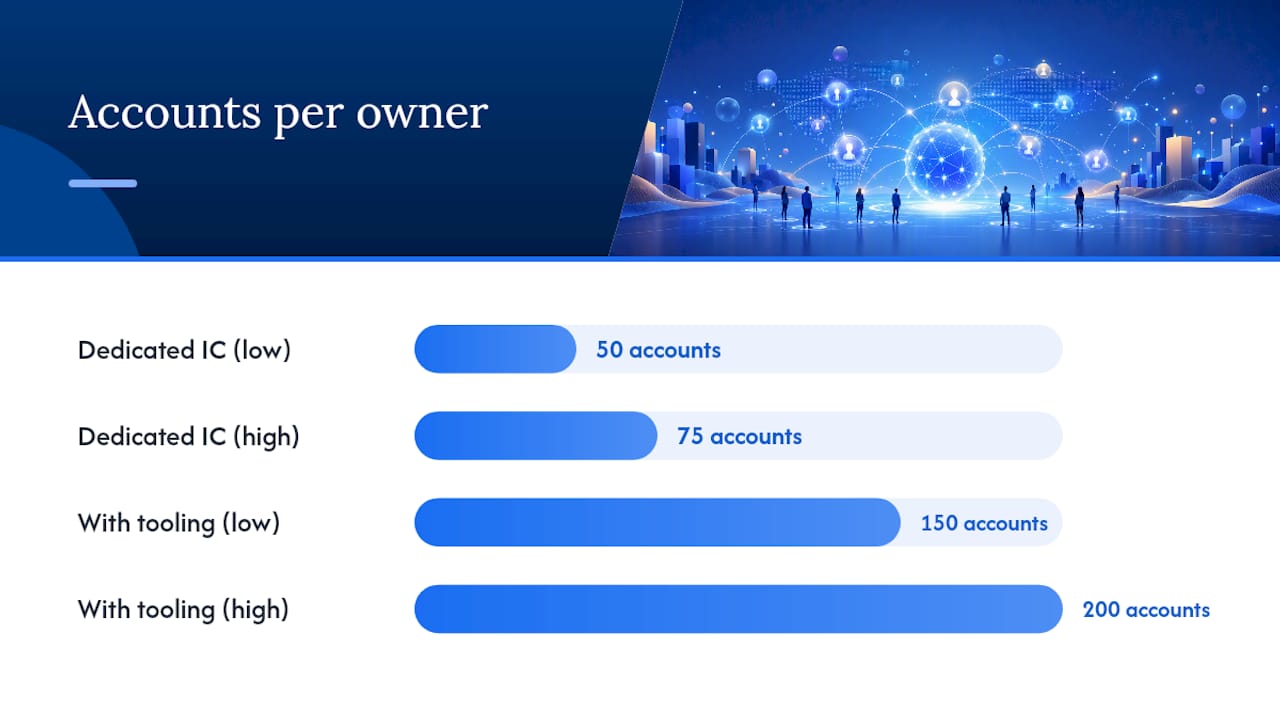
Capacity limits get ignored until pipeline quality collapses. A dedicated individual contributor can actively work 50 to 75 accounts with real research behind each one. With tooling and research support, that can scale to 150 to 200, but quality drops if you push past what the team can genuinely personalize.
Split roles clearly:
- SDRs own outreach execution and initial engagement
- AEs own the buyer relationship once a meeting is booked
- RevOps owns CRM stage definitions and data hygiene
- Marketing owns account-level content and signal sharing
Pro Tip: Define handoff SLAs in writing, SDR to AE within 24 hours of a booked meeting, or accounts stall in the gap between teams. 30/60/90 account mapping is a useful framework for keeping sales and marketing aligned on the same target list.
What Tools and Automation Should Support the Program?
You need account intelligence for research, intent data for timing, an engagement platform for sequencing, and CRM attribution tied to account stages, not just individual leads. B2B intent data providers can flag which accounts are researching solutions right now.
Use AI to draft research summaries and first-pass messaging, then have a human review every message before it sends. Common pitfalls include:
- Over-automating personalization until every message reads the same
- Ignoring email deliverability limits and platform sending policies
- Skipping TCPA compliance on phone and text outreach
- Letting a 60 to 90 day AI prospecting pilot run unsupervised
What Does 25 Years of Sales Leadership Teach About ABM Outbound?
Chad Burmeister has spent 25-plus years building outbound motions inside companies like Informatica, RingCentral, and Cisco-WebEx, and has written extensively on applying AI to pipeline growth. The recurring mistake he sees: teams chase list size instead of research depth, then wonder why engagement stalls. The fix is almost always fewer accounts, worked harder.
A Practitioner's Note on Starting Slow
Start with your Tier 1 list only. Keep scoring and messaging in-house for the first 90 days before automating anything. Account-based outbound rewards patience, measurement in weeks not days, and sales and marketing agreeing on one shared account list before either team sends a single message.
— Chad
Sources
- How to Do Account-Based Outbound | Astra GTM
- Outbound ABM Playbook for Enterprise Revenue Teams | Salesmotion
- Enterprise outbound: long-cycle, multi-stakeholder · ReachIQ
FAQ
What Is an Example of Account-Based Marketing?
A common example is a sales and marketing team jointly targeting 50 named enterprise accounts, running coordinated ads, personalized emails, and LinkedIn outreach aimed at each account's specific buying committee rather than a broad audience.
What Does Outbound Mean in Business?
Outbound means a company initiates contact with prospects, through cold email, calls, or targeted ads, rather than waiting for prospects to find them, which is how inbound marketing works.
What Are Examples of Outbound Activities?
Common outbound activities include cold email sequences, cold calling, LinkedIn outreach, direct mail to named accounts, and paid ads targeted at specific company lists.
What Is Outbound vs. Inbound?
Outbound involves proactively reaching out to prospects who haven't engaged yet, while inbound relies on content, SEO, and marketing that attracts prospects who come to you. Account-based outbound sits firmly on the outbound side, but it borrows research and personalization tactics typically associated with account-based marketing.
When Is Account-Based Outbound Worth the Investment?
It's worth the investment when deal size exceeds roughly $25,000 ACV, buying committees include three or more stakeholders, and your ICP is narrow enough that losing any single target account matters to the business.