
Fractional sales leadership puts a seasoned sales executive inside your company on a part-time basis, typically one to three days per week, at a fraction of what a full-time hire costs. The model exists for one reason: most growing companies need senior sales expertise long before they can justify a $300,000+ executive. A fractional sales leader fills that gap by embedding with your team, owning outcomes, and building the systems your company keeps after they leave.
Here is what that looks like in practice:
- Part-time, embedded operator. Not a consultant who hands you a slide deck. A fractional head of sales runs your pipeline reviews, coaches your reps, and is accountable for the number.
- Immediate impact. Onboarding takes 1–2 weeks versus the 90–120 days a typical executive search requires.
- Cost efficiency. Monthly engagements run significantly less than what you would pay for a full-time VP of Sales.
- Flexibility. Engagements are structured in months, not years, with the ability to scale up, scale down, or exit cleanly.
- Lasting assets. Playbooks, CRM workflows, and hiring profiles stay with your company after the engagement ends.
Chad Burmeister brings more than 25 years of hands-on sales leadership to this model, having scaled teams at Informatica, RingCentral, and Cisco-WebEx, and authored nine books on sales strategy and AI.
Table of Contents
- When does your company actually need fractional sales leadership?
- What a fractional sales leader actually does day to day
- How much does a fractional VP of sales cost?
- How to hire the right fractional sales leader
- Expert perspective: AI, pattern recognition, and the fractional advantage
- Key Takeaways
- Chadburmeister brings senior sales leadership without the full-time cost
When does your company actually need fractional sales leadership?
The clearest signal is this: your product works, but your sales motion does not. Companies with established revenue and product-market fit sit in the most common sweet spot. They have revenue traction, a product that sells in at least one segment, and a founder who is the bottleneck on every deal.
Specific triggers that point toward a fractional sales leader:
- Founder-led sales is breaking down. You are closing deals yourself while also managing product and fundraising. Something has to give.
- No sales process exists. Reps are closing deals, but no one is reviewing pipeline, coaching performance, or building repeatable motion.
- A VP of Sales just left. Deals are stalling and momentum is slipping while you run a proper search for a permanent replacement.
- Pre-funding sprint. Investors want a predictable sales machine, not founder heroics. A fractional VP installs that predictability fast.
- New market entry. You need someone who has run that specific motion before, not someone learning on your dime.
One important boundary: fractional leadership excels at scaling proven offerings, not solving product-market fit. If customers are not buying yet, the problem is not a sales leadership gap.
What a fractional sales leader actually does day to day
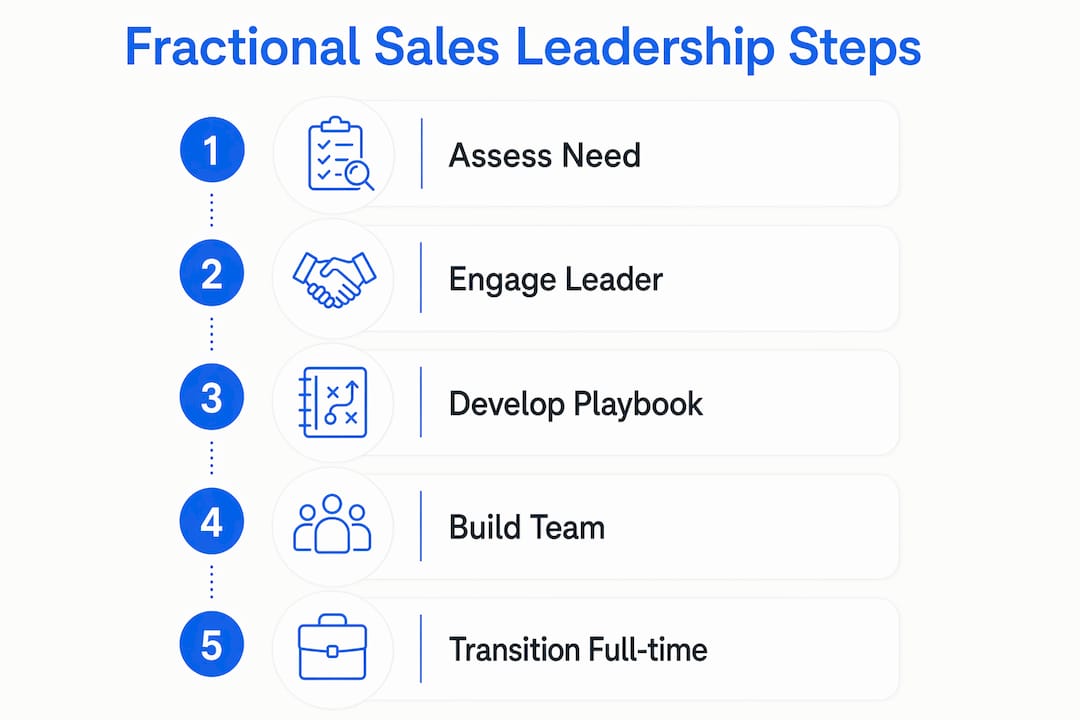
The work is operational, not advisory. Fractional leaders embed with your team and execute, owning strategy and outcomes the same way a full-time VP would, just on a part-time schedule.
Core responsibilities include:
- Running weekly pipeline reviews and forecast calls
- Coaching individual reps on active deals and messaging
- Building or cleaning up CRM infrastructure and workflows
- Writing playbooks, call scripts, and objection-handling guides
- Running the hiring process for new sales reps
- Setting KPIs, quota models, and compensation structures
- Reporting to founders and boards on revenue performance
Pro Tip: Demand a documented playbook as a contractual deliverable, not a nice-to-have. The playbook is what you own after the engagement ends. If a candidate does not mention it unprompted, that tells you something.
The goal of every engagement is for the fractional leader to make themselves redundant. They build the hiring profile for their full-time replacement, document every process, and plan the handoff before the engagement closes.

How much does a fractional VP of sales cost?
The monthly retainer model is standard. Effective hourly rates vary depending on experience, but most fractional leaders do not bill by the hour because retainers provide consistent availability.
| Engagement Type | Estimated Annual Cost | Time Commitment | Primary Deliverable |
|---|---|---|---|
| Sales consultant | Varies, ad-hoc | Project-based | Advice, no execution |
| Fractional VP of Sales | — | 10–15 hrs/week | Strategy and systems |
| Full-time VP of Sales | $300,000+ all-in | full-time | Management and culture |
The full-time number deserves unpacking. Base salary, on-target earnings, equity, benefits, payroll taxes, and a recruiting fee that typically runs 25–30% of first-year cash compensation push the real year-one cost well past the base salary figure. A fractional VP at $10,000 per month runs $120,000 annually, roughly 4–5x cheaper, with no equity dilution, no severance risk, and no six-month ramp period.
Factors that move the price within the $5,000–$15,000 monthly range:
- Days per week committed
- Team size and complexity
- Whether hiring is in scope
- Company stage and ARR
How to hire the right fractional sales leader
Start with written success criteria before you talk to a single candidate. Pipeline growth? Process documentation? A specific new market? Vague goals produce vague results.
What to look for and verify:
- Quota-carrying background. Operators execute. Advisors advise. You want someone who has sat in the seat, carried a number, and missed one occasionally.
- Relevant company stage experience. A VP who spent a decade managing managers at a large enterprise is not the same as someone who built a team from three reps to thirty at a Series A company.
- Coaching track record. Ask specifically how they have developed reps and managers in past engagements. Hands-on coaching ability separates good fractional leaders from great ones.
- Playbook ownership. Confirm in writing that all playbooks, templates, and systems built during the engagement belong to your company.
- Exit strategy. A great fractional leader defines the full-time role, vets candidates, and plans the handoff. If they seem reluctant to discuss their own replacement, pass.
Most engagements run three to twelve months at one to three days per week. Shorter engagements suit specific build phases; longer ones fit ongoing leadership needs. Expect the first two weeks to be diagnostic. Anyone who promises to fix everything in week one has not done this before.
Expert perspective: AI, pattern recognition, and the fractional advantage
The fractional model's edge over a single full-time hire comes from pattern recognition. An experienced fractional VP has scaled multiple organizations and seen the same failure modes repeat across industries. They know which CRM setup causes pipeline rot at 50 reps, which comp structure kills outbound activity, and which onboarding gap explains why new reps miss quota in month four.
Fractional sales leaders bring proven playbooks and cross-industry pattern recognition that reduce the traditional 6–12 month ramp-up risk associated with full-time executive hires. They are embedded operators accountable for outcomes, not consultants delivering recommendations from the outside.
AI is accelerating what fractional leaders can accomplish during short engagements. Tools that automate pipeline analysis, flag stalled deals, and generate coaching insights let a part-time leader cover ground that once required full-time presence. Chad Burmeister, host of The AI for Sales Podcast and author of AI for Sales 2.0, has spent years documenting exactly how AI augments sales leadership, from pipeline management to rep coaching to prospecting at scale.
The combination of experienced judgment and AI-powered execution is why fractional roles accelerate sales leadership onboarding from 90–120 days to 1–2 weeks. You are not waiting for someone to learn your business. You are getting someone who has seen your business before, with tools that compress the diagnostic phase further.

Key Takeaways
Fractional sales leadership gives growing companies access to senior sales expertise at a fraction of the cost of a full-time VP hire, with faster onboarding and no long-term commitment.
| Point | Details |
|---|---|
| Ideal company stage | Companies with proven product-market fit at various revenue stages benefit most. |
| Cost advantage | Monthly retainers compare favorably to the all-in cost of a full-time VP. |
| Speed to impact | Fractional leaders embed in 1–2 weeks versus a 90–120 day executive search and ramp. |
| Engagement length | Most engagements run 3–12 months; the leader's goal is to build systems and hand off cleanly. |
| Chadburmeister | Chad Burmeister offers fractional sales leadership backed by 25+ years scaling teams at Informatica, RingCentral, and Cisco-WebEx, with AI-powered methods documented across nine published books. |
Chadburmeister brings senior sales leadership without the full-time cost
Most founders reading this are already past the point where founder-led sales works. The question is whether to absorb a $300,000+ full-time hire or get the same senior judgment at a fraction of the cost and commitment.
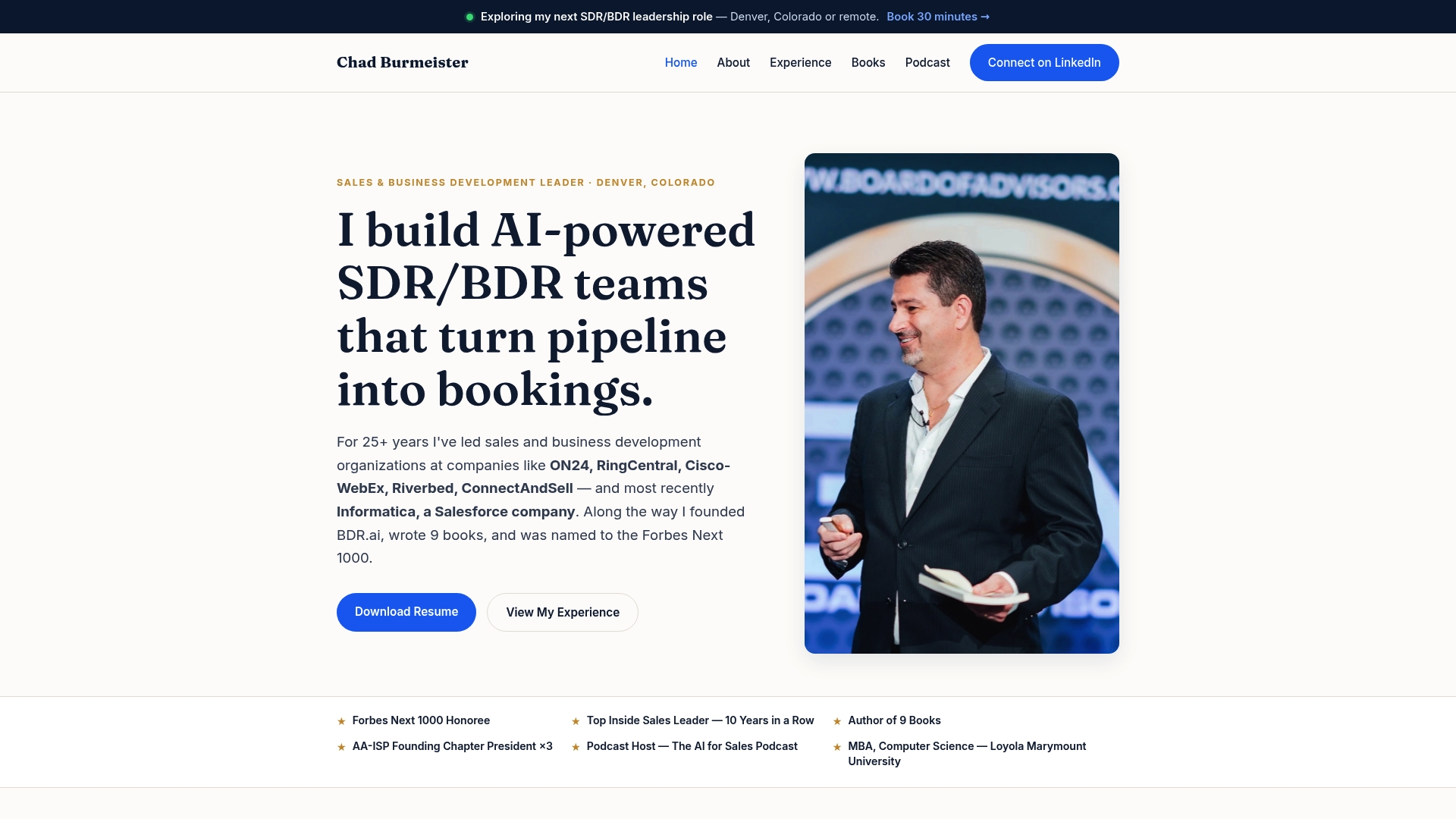
Chad Burmeister has spent more than 25 years doing exactly what a fractional sales leader does: building high-performance teams, installing repeatable processes, and scaling revenue at companies like Informatica, RingCentral, and Cisco-WebEx. His published playbooks on AI-driven sales and B2B lead generation are the same frameworks he brings into engagements. Colorado-based founders and business leaders get direct access to that experience without a permanent headcount commitment. Visit chadburmeister.com to start the conversation.