A sales governance model is the written answer to a simple question: who decides what in your sales organization, by which rules, and what happens when someone wants an exception? It covers compensation, deal crediting, CRM data, the playbook and, increasingly, what AI tools may say to buyers. If you are a CEO or CRO hiring a sales development or business development leader in Colorado, this is the system that leader inherits on day one, and the one they should be able to tighten in the first 90 days.
We wrote this for the executive who senses that pipeline numbers, pay plans and CRM fields no longer agree with each other. It is built from published research and from the operating view of Chad Burmeister, who has spent 25+ years scaling sales and business development teams.
TL;DR
- Governance is the oversight layer that keeps sales decisions aligned with business goals. WorldatWork describes it as management and oversight that links stakeholders, decision rights and escalation paths.
- A workable model has five parts: a steering group, named owners, written rules for crediting and exceptions, a system of record for data, and a review cadence.
- Weak governance shows up as late plan rollouts, too many plan variations, crediting disputes and finger-pointing between functions.
- Start small: one page of decision rights, one exception log, one quarterly review. Measure it by how fast disputes close and how few off-plan deals you carry.
- The leader you hire for SDR or BDR work should own the daily routines inside this model, not just the headcount.
Table of Contents
- What a sales governance model is, and what it fixes
- The five building blocks
- Roles: define by activity, not by label
- Controls: formal rules and the informal culture
- Handling exceptions, playbook changes and AI
- How to implement it in 90 days
- Measuring whether it works
- Why the leader matters as much as the framework
- Bringing this to your team in Colorado
- FAQ
- Sources
What a sales governance model is, and what it fixes
Search results for this phrase are crowded with data governance, marketing governance and CRM governance. They overlap, but they are different jobs. Data governance protects information assets. Sales governance protects decisions: who may change a quota, who approves a discount-linked commission, who settles a dispute over which rep sourced a deal.
WorldatWork, the professional association for compensation specialists, frames governance as the management and oversight of the sales compensation program so that it stays aligned with business expectations, product strategy and leading practices. It also lists what weak governance costs: late rollouts, excessive plan variations, unresolved crediting disputes and finger-pointing between functions. Most CROs recognize at least two of those four.
The same article separates governance from operations. Governance sets the rules and resolves conflicts. Operations is the execution engine of people, processes and tools. When both live in one person's head, the plan drifts. When they are separate and written down, a new hire or a new quarter does not break anything.
The five building blocks
A useful framework is small enough that people actually read it. Here is the structure we recommend for a company with a sales development team feeding account executives.
1. A steering group with real authority
WorldatWork describes strong governance as starting with a steering committee that confirms the pay-for-performance philosophy and resolves cross-functional conflicts, while regional design teams execute inside that framework. For a mid-size B2B company, that translates to three to five people: the CRO or head of sales, a Finance partner, a RevOps or sales operations lead, and the sales development leader. Marketing joins when lead definitions are on the agenda.
The group meets on a fixed schedule, quarterly at minimum, and it has one power that matters: it can say no to an exception.
2. Named owners for each decision
Write a one-page table. Down the left, list the recurring decisions. Across the top, list who decides, who is consulted and who is told. A starting version:
| Decision | Decides | Consulted | Informed |
|---|---|---|---|
| Plan design and measures | CRO | Finance, RevOps | Sales managers |
| Quota and territory changes | CRO | RevOps, sales managers | Reps |
| Crediting disputes | Steering group | Finance, RevOps | Rep and manager |
| Comp exceptions | CRO and Finance | Sales manager | Steering group |
| CRM field definitions | RevOps | Finance, sales leaders | All sellers |
| Playbook changes | Head of sales or enablement owner | SDR and AE managers | All sellers |
| AI messaging rules | CRO | Marketing, legal | Sellers using AI tools |
The point is not the exact cells. It is that no row is blank and no row says "everyone." If you are still deciding whether the operations owner should be a sales ops or RevOps hire, our guide on Sales Ops vs RevOps walks through the choice.
3. Written rules for crediting and pay
Disputes almost always trace back to an undefined term. Before the plan year starts, RevOps and Finance should define what counts as a closed deal, the credit attribution rules for each selling motion, payout timing aligned with financial recognition, and who owns each CRM field. The same source recommends locking pay periods at quarter close with dual Finance and RevOps sign-off.
Keep the plan itself simple. A plan with two or three measures is easier to govern because there are fewer places for disagreement. We cover that in designing sales compensation with 2 to 3 measures, and for the development team specifically in how to build an SDR compensation plan.
4. A system of record that everyone trusts
Governance fails quietly when the pipeline lives in spreadsheets. The CRM should remain the system of record for deal data, close dates, revenue amounts and rep assignments, and commission tooling should connect to it directly instead of through manual exports, according to the same RevOps guidance. If you are weighing tools, see our look at sales compensation software for SDR and BDR teams. Clean inputs matter just as much, and our CRM data hygiene playbook covers the routines.
5. A review cadence
Rules that nobody revisits become the old way of working. Put three dates on the calendar: a monthly operating check by RevOps, a quarterly steering review, and an annual plan-design review before the next fiscal year. Each meeting has a fixed agenda: exceptions granted, disputes opened and closed, data defects, and proposed rule changes.
Roles: define by activity, not by label
A governance model fails if the roles underneath it are vague. Gartner's research on top sales organizations points to what it calls radical role simplification: defining seller roles by how granular activities coordinate across functions, including marketing alignment, legal approval and implementation handoffs, rather than by broad hunter and farmer labels. The goal is to find what to eliminate, deduplicate or support with technology.
For a development team, that means writing down exactly where a lead moves from marketing to an SDR, from an SDR to an account executive, and from the account executive to implementation. Each handoff gets an owner, an entry standard and a time limit. Handoffs also depend on how well other teams are equipped to carry the customer forward; this piece on support teams and profit growth shows why the post-sale side belongs in the same conversation.
Team shape matters too. Span of control, manager ratios and territory balance are governance decisions because they decide who is accountable for what. See SDR org structure at 1:1 to 2:1 and sales territory design that balances workload.
Controls: formal rules and the informal culture
Academic work points to a blind spot. A peer-reviewed synthesis in the Journal of Personal Selling & Sales Management reviewed more than 50 articles over 30 years on sales management control systems. It found an overwhelming focus on formal behavior-based and outcome-based controls compared with informal, input and cultural controls, and called for study of how controls work together as one system.
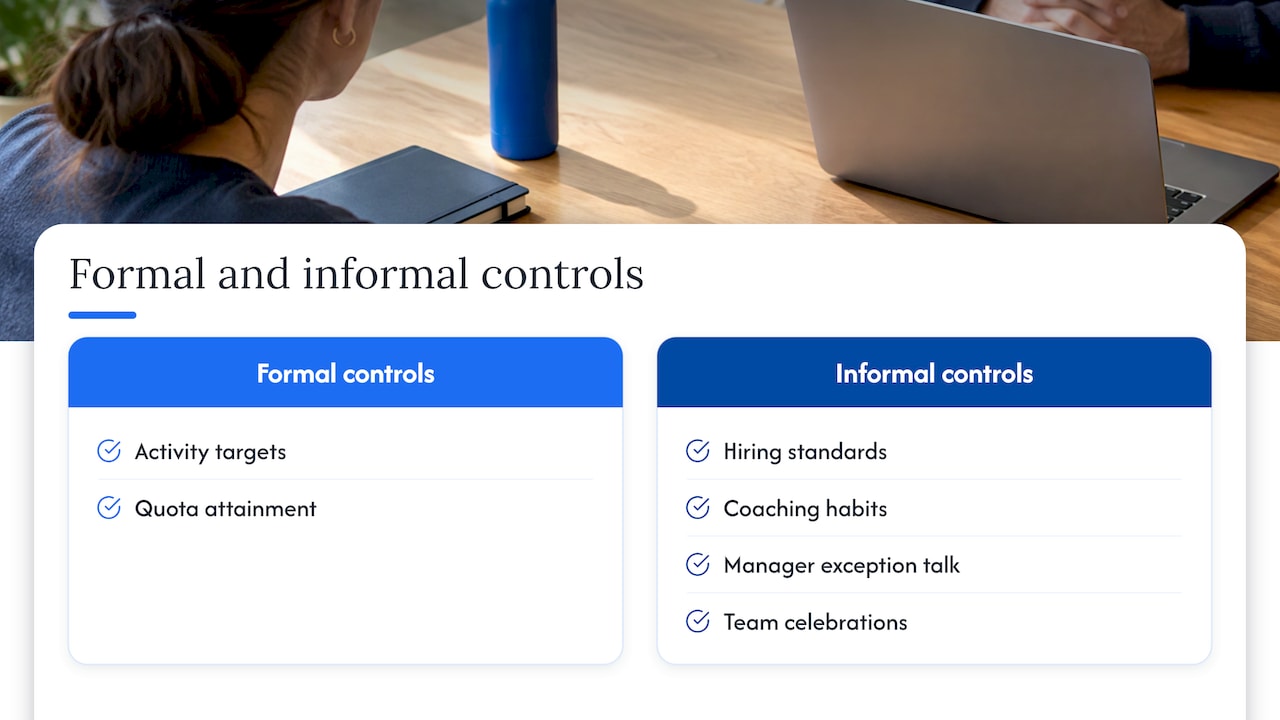
In practice: activity targets and quota attainment are the formal controls. Hiring standards, coaching habits, how managers talk about exceptions and what the team celebrates are the informal ones. A governance model that only writes rules, and ignores how leaders behave, will be bypassed.
Handling exceptions, playbook changes and AI
Three areas break first in most companies.
Compensation exceptions
Every exception is a small amendment to the plan. If the unofficial plan starts overriding the written one, reps stop trusting either. Set an exception policy with four elements:
- Qualifying criteria. What kind of situation can even be considered, such as a mid-quarter territory change or a deal split across two teams.
- Approver. One named role, with Finance as a required second signature above a set dollar amount.
- Documentation. A log with date, rep, amount, reason and approver.
- Precedent test. The approver asks whether they would grant the same exception to the next rep in the same position. If not, it is a bad exception.
Review the log at each quarterly steering meeting. A rising count of exceptions is a signal that the plan design, not the reps, needs work.
Playbook updates
The playbook is the written sales process: qualification criteria, messaging, objection handling, cadence design. Govern it like any other controlled document. One accountable owner approves changes. Defined triggers force an update: a new product, a pricing change, a shift in ideal customer profile, a change in qualification rules. Related materials (onboarding, call guides, email templates) change in the same release so that sellers are not working from two versions. Mutual action plans and loss analysis are good inputs; see our notes on mutual action plans and turning 10 to 20 lost deals into fixes.
AI-assisted selling
Sellers now use AI to research accounts, draft outreach and summarize calls. Governance here means answering a few plain questions in writing:
- Which tasks may AI do without review, and which need a human to approve before anything reaches a buyer?
- What may an AI tool say about pricing, product capability and competitors?
- Which customer data may be pasted into which tool?
- Who owns the approved messaging that AI tools draw from?
Assign the CRO as decision maker, with marketing and legal consulted, and fold the rules into the playbook so they share one change process.
How to implement it in 90 days
You do not need a consulting project to start. A staged rollout works for a team of 10 to 50 sellers.
Days 1 to 30: map and write. Interview managers and a handful of reps. List every recurring decision and who really makes it today. Draft the decision-rights table above. Collect the last four quarters of crediting disputes and exceptions.
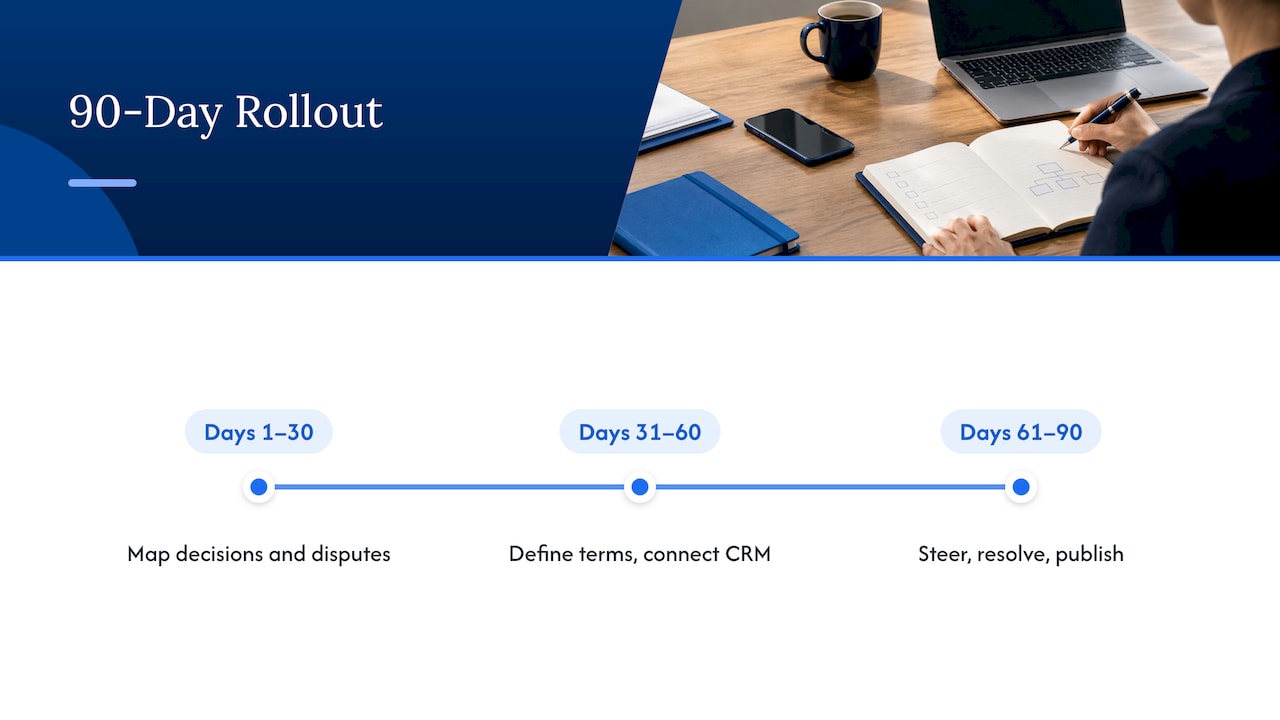
Days 31 to 60: define and connect. Settle the definitions: closed deal, sourced pipeline, qualified lead, credit rules per motion. Assign CRM field owners. Write the exception policy. Confirm the CRM is the only place deal data is edited.
Days 61 to 90: run the cycle once. Hold the first steering meeting with the exception log and a data-quality report. Close open disputes using the new rules. Publish the one-page model to every seller and manager, with a named contact for questions.
Then repeat quarterly. The first cycle will expose gaps, which is the purpose.
Measuring whether it works
Pick a small set of indicators and review them in the steering meeting. These are our suggested measures, not industry benchmarks:
| Indicator | What it tells you |
|---|---|
| Days to resolve a crediting dispute | Whether decision rights are clear |
| Share of closed deals with an exception | Whether the written plan matches reality |
| Plan rollout date versus fiscal start | Whether design and operations are in sync |
| CRM fields missing at stage change | Whether data rules are enforced |
| Playbook changes shipped versus triggers logged | Whether the playbook keeps up with the business |
| Manager time spent on pay questions | Whether governance is saving leadership time |
Set a baseline from your last two quarters, then look for direction, not perfection. If disputes take less time and exceptions fall each quarter, the model is doing its job.
Why the leader matters as much as the framework
A governance model is a document until someone runs it daily. In a development organization, that person sits between the CRO, RevOps and the SDRs. They enforce the handoff standards, coach to the playbook, keep exceptions rare and tell you early when a rule no longer fits. That is why we treat governance as part of hiring a sales development or business development leader, not a separate project.
Our perspective
We have spent 25+ years building and scaling sales and business development teams at companies such as Informatica, RingCentral and Cisco-WebEx, and the pattern holds: teams do not stall for lack of effort. They stall because nobody agreed on what counts, who decides, and when a rule can bend.
Our view is that governance should be lightweight and led from the front. One page of decision rights, a short exception log and a quarterly review beat a thick policy binder every time. The leader of the SDR or BDR team should write those pages with Finance and RevOps, then live by them in every one-on-one and pipeline review.
That is also how we approach AI. In our books and on The AI for Sales Podcast, we talk about using AI to grow pipeline, and we pair that with clear rules about what it may do and who signs off. Speed with ownership is what turns a tool into a repeatable result.
Chad
Bringing this to your team in Colorado
If you want these routines taught to your managers and reps, Chad Burmeister offers speaking and workshop engagements for sales organizations, built on his published playbooks and a career scaling sales development teams. If you are hiring a sales development or business development leader and want that person to own governance from the start, the Chad Burmeister home page is the place to begin.
FAQ
What is the difference between a sales governance model and a sales process?
The sales process describes how reps move a deal from first contact to close. The governance model describes who owns the process, the pay plan and the data, and how changes and exceptions get approved. The process is what sellers do. Governance is how the organization keeps it consistent.
Who should own sales governance?
The CRO or head of sales is accountable, with Finance and RevOps as required partners. WorldatWork describes a steering committee that confirms the pay-for-performance philosophy and resolves cross-functional conflicts. Day-to-day routines belong to the sales development or business development leader and RevOps.
How big does a governance framework need to be?
Small enough to fit on a page for a team under 50 sellers: a decision-rights table, definitions for deal credit, an exception policy and a review calendar. Add detail only when a recurring dispute shows a gap. Length does not make governance work. Clear owners do.
How does governance apply to AI tools used by sellers?
Treat AI like any other source of customer-facing content. Name an owner for approved messaging, list which tasks need human review, state which data may enter which tool, and update the playbook through the same approval process as other changes.
Sources
- Governance and Operations Are Foundational to Sales Comp Success, WorldatWork
- The DNA of Top Sales Organizations, Gartner
- Sales management control systems: review, synthesis, and research directions, Journal of Personal Selling & Sales Management
- Pipeline Data Ownership Between RevOps and Sales
- Empowering customer support teams to fuel profit growth