
Sales Operations supports the sales department. Revenue Operations governs the entire revenue motion, from first marketing touch through renewal and expansion. If your company has one GTM team and a single quota, Sales Ops is probably enough. Once you have separate marketing, sales, and customer success teams generating revenue independently, and those teams are blaming each other for pipeline gaps, you need RevOps.
Two signals tell you which model fits right now:
- Reporting line: Sales Ops reports to the VP of Sales. RevOps reports to the CRO, COO, CFO, or CEO. That single structural fact determines whose priorities the function serves.
- Post-sale ownership: Sales Ops closes at "closed-won." RevOps owns Net Revenue Retention, churn, and expansion. If nobody in your ops function is accountable for what happens after the contract is signed, you have Sales Ops regardless of what the org chart says.
Table of Contents
- What is Revenue Operations, and what does it actually own?
- What is Sales Operations, and when is it the right call?
- The core comparison: scope, reporting, and accountability
- When should you hire Sales Ops vs. build RevOps?
- What does each role actually do day to day?
- Why does the reporting line matter so much?
- Which KPIs does each function own?
- What tools does each function manage?
- Is RevOps a good career, and what does it pay?
- Does renaming Sales Ops to RevOps actually work?
- Key Takeaways
- The structural question most GTM leaders skip
- Ready to build the right ops function for your stage?
- Useful sources and further reading
What is Revenue Operations, and what does it actually own?
Revenue Operations is the cross-functional operating layer that aligns marketing, sales, and customer success into a single, governed revenue system. The job is not CRM administration. It is building and maintaining the architecture that lets every revenue-generating team work from the same data, the same definitions, and the same forecasting model.
The practical scope covers:
- Unified data model: one definition of "lead," "opportunity," "customer," and "churned" that every team uses
- Cross-funnel forecasting: pipeline visibility from first touch through renewal, not just the sales stage
- Lifecycle governance: process ownership across handoffs (MQL to SQL, SQL to closed, closed to onboarding, onboarding to renewal)
- Tech stack strategy: owning the integration layer between CRM, marketing automation, CS platforms, and BI tools
"Analysts characterize RevOps as an operating layer, not a role shoved into CRM admin — the emphasis is on governance, common definitions, and full-funnel measurement."
A concrete example: your marketing team defines an MQL as anyone who downloads a whitepaper. Your sales team ignores those leads because 80% never respond. Your CS team has no visibility into which customer segments churn fastest. RevOps fixes that by owning the lead definition change, updating the scoring model in the MAP, adjusting the handoff criteria in the CRM, and building a CS health score that ties back to the original acquisition source. One decision, three teams affected, one function accountable.
What is Sales Operations, and when is it the right call?
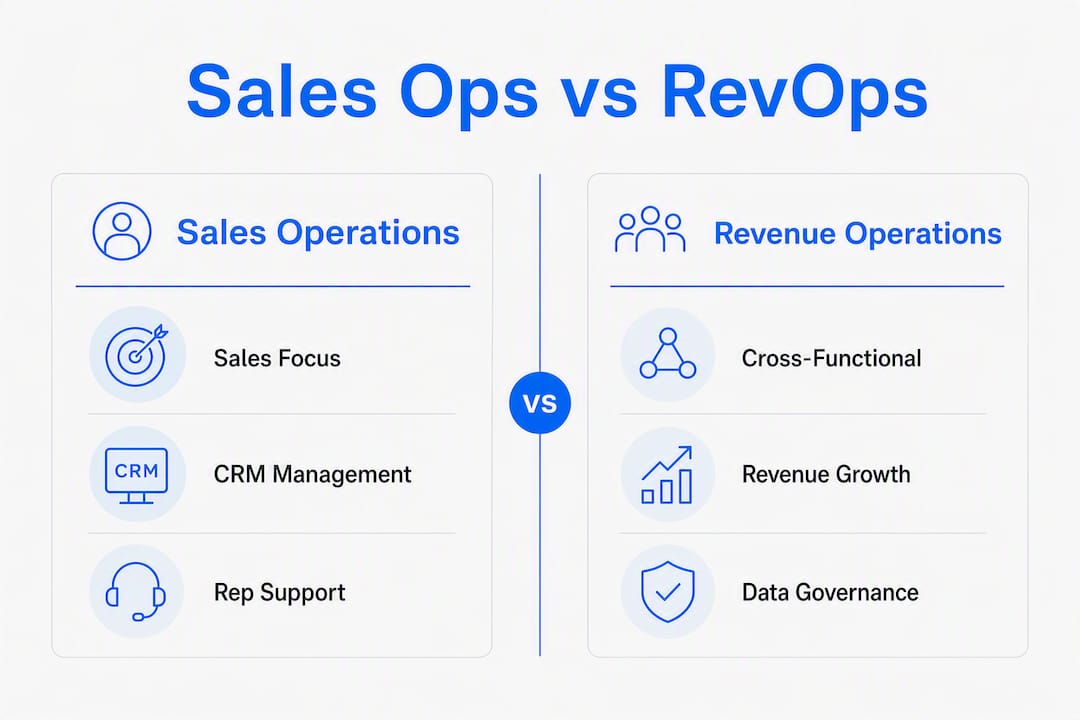
Sales Ops keeps the sales team running. The function is deliberately bounded: it exists to remove friction for quota-carrying reps and their managers, not to redesign the entire revenue motion.
Day-to-day, Sales Ops owns:
- CRM administration: data hygiene, field configuration, pipeline stage definitions, and user access
- Quota and compensation administration: modeling quota plans, tracking attainment, and coordinating with finance on comp plan design
- Territory design: account segmentation, geographic splits, and named account lists
- Deal desk: pricing approvals, discount governance, and non-standard contract support
- Forecasting cadence: weekly call prep, CRM data quality checks, and roll-up reporting to the VP of Sales
Sales Ops is the right, highest-value function when the pain is concentrated in the sales department. Early-stage companies with one revenue team, one product, and one motion do not need cross-functional governance. They need someone who can keep Salesforce clean, run the weekly forecast call, and stop reps from wasting time on admin. That is Sales Ops, and it is genuinely valuable at that stage.
The core comparison: scope, reporting, and accountability

The single biggest difference between sales ops and revops is cross-functional authority and post-sale accountability. Sales Ops optimizes one team's execution. RevOps owns the structural decisions that affect every team's output.

| Dimension | Sales Operations | Revenue Operations |
|---|---|---|
| Scope / teams covered | Sales department only | Marketing, sales, customer success, finance |
| Primary goals | Quota attainment, rep productivity, deal velocity | ARR growth, NRR, CAC efficiency, forecast accuracy |
| Reporting line | VP of Sales | CRO, COO, CFO, or CEO |
| Data ownership | CRM data for sales pipeline | Unified GTM data model across all systems |
| Process ownership | Sales-stage handoffs, deal desk | Full lifecycle: MQL to renewal and expansion |
| Typical tech stack | CRM, sequence tools, comp software | CRM, MAP, CS platform, BI, integration/data sync layer |
| When to hire | 50–150 employees, single GTM motion | 150+ employees or over a certain revenue threshold, multi-team GTM |
A few practical implications worth calling out:
- Forecasting cadence: Sales Ops runs a weekly pipeline review for the sales VP. RevOps builds a unified forecast that includes marketing contribution, pipeline coverage ratios, and renewal risk, all in one model.
- CRM trade-offs: Sales Ops configures the CRM for sales workflows. RevOps has to balance sales usability against the data integrity requirements of marketing attribution and CS health scoring. Those goals conflict, and RevOps has the authority to make the call.
- Team size: RevOps teams grow larger and more specialized as companies scale. A Series A company might have one Sales Ops analyst. A Series C company with a RevOps function might have a data engineer, a marketing ops specialist, a CS ops specialist, and a RevOps director.
When should you hire Sales Ops vs. build RevOps?
The simple rule: under 50 employees, no dedicated ops function is needed. At 50–150 employees, hire Sales Ops. At 150+ employees or $25M+ ARR, evaluate whether cross-functional leakage justifies RevOps.
By company stage:
- Under 50 employees: The founder or a senior AE handles ops tasks. Dedicated ops headcount is premature.
- 50–150 employees: Hire a Sales Ops manager or analyst. Focus is CRM hygiene, quota modeling, and forecasting support.
- 150+ employees or $25M+ ARR: Evaluate RevOps. The trigger is usually one of these: marketing and sales are arguing about lead quality, CS has no visibility into pipeline, or the board is asking for a unified revenue forecast nobody can produce.
- Post-Series C or $50M+ ARR: A full RevOps function with dedicated marketing ops, sales ops, and CS ops specialists under a RevOps director or VP is standard.
Decision checklist — use this before your next hire:
- Do you have separate marketing, sales, and CS teams generating revenue independently? If yes, RevOps signals are present.
- Is your forecast built from CRM data alone, with no marketing pipeline contribution or renewal risk included? That is a Sales Ops gap RevOps would fix.
- Are your MQL-to-SQL conversion rates disputed between marketing and sales? RevOps owns that definition.
- Does your CS team have no visibility into which pipeline segments churn fastest? That is a data architecture problem RevOps solves.
- Is your ops function reporting to the VP of Sales with no mandate over marketing or CS? You have Sales Ops, regardless of the title on the org chart.
Transitional patterns: Many companies embed Sales Ops inside a RevOps structure rather than eliminating it. The Sales Ops analyst continues owning CRM admin and deal desk. The RevOps director owns the data model, integration strategy, and cross-functional forecasting. That structure works well when the Sales Ops hire predates the RevOps build and has strong institutional knowledge.
What does each role actually do day to day?
Daily ticketing and configuration work falls to Sales Ops. Architecture decisions and cross-functional process changes fall to RevOps. In a mature org, the RACI looks like this: RevOps is accountable for the outcome; Sales Ops is responsible for the execution.
Sales Ops daily tasks:
- CRM data entry audits and field cleanup
- Sequence and sales engagement tool configuration (cadence builds, template updates)
- Deal desk approvals and discount tracking
- Quota attainment reporting and comp plan administration
- Weekly forecast roll-up and pipeline review prep
- Territory and account list maintenance
RevOps daily/weekly tasks:
- Data model governance (lead status definitions, lifecycle stage rules, attribution logic)
- Full-funnel forecasting model maintenance and board reporting
- Tech stack integration monitoring (data sync errors, API failures, field mapping drift)
- Cross-functional process design (MQL handoff criteria, renewal playbook governance)
- GTM tech strategy and vendor evaluation
- CS health score modeling and churn risk reporting
When a rep asks why their Salesforce opportunity stage is wrong, that is a Sales Ops ticket. When the CRO asks why marketing-sourced pipeline has a 40% lower win rate than outbound, that is a RevOps investigation. Both questions matter. They require different skills and different authority levels to answer.
For teams building out SDR and BDR functions, Sales Ops typically owns the tooling and sequence configuration while RevOps owns the lead routing logic and attribution model that determines which SDR touches get credit.
Why does the reporting line matter so much?
Reporting structure drives scope and behavior more than any job description. An ops professional reporting to the VP of Sales will, rationally, prioritize whatever makes the VP of Sales look good in the next board meeting. That usually means quota attainment and pipeline coverage, not churn rates or marketing attribution.
Common reporting structures and their practical outcomes:
- Sales Ops → VP of Sales: — Ops focuses on rep productivity, deal velocity, and forecast accuracy for the sales org. Marketing and CS are outside the mandate. This is appropriate and efficient when the company's revenue problem is a sales execution problem.
"Reporting structure is the primary determinant of operational behavior: Sales Ops reporting to VP of Sales prioritizes short-term quota attainment; RevOps reporting to CRO/CFO prioritizes long-term growth and retention."
The most common failure mode is a title change without a reporting change. A company renames its Sales Ops manager to "Head of RevOps," keeps them reporting to the VP of Sales, and gives them no authority over marketing or CS systems. Six months later, the CRO is frustrated that RevOps is not producing cross-functional insights. The problem is not the person. The structure never changed.
Which KPIs does each function own?
The primary metric difference is this: Sales Ops tracks sales productivity and deal execution. RevOps tracks full-funnel revenue efficiency and retention.
Sales Ops KPIs:
- Stage-by-stage conversion rates
- Average deal velocity (days to close)
- Quota attainment by rep and team
- Pipeline coverage ratio
- CRM data completeness scores
- Ramp time for new AEs
RevOps KPIs:
- Annual Recurring Revenue (ARR) and ARR growth rate
- Net Revenue Retention (NRR)
- Customer Lifetime Value (CLTV)
- Customer Acquisition Cost (CAC) and CAC payback period
- Churn and renewal rates by segment
- Unified forecast accuracy (marketing + sales + CS)
- Lead-to-revenue cycle time across the full funnel
Pro Tip: If your ops function cannot tell you the NRR for customers acquired through a specific marketing channel, you have a Sales Ops data model, not a RevOps data model. That single question is a fast diagnostic.
Salesforce research shows sales reps spend a minority of their time actually selling. The rest goes to CRM updates, internal meetings, and administrative work. That figure is why ops functions exist at all: the primary job is to recover selling time by removing friction. Sales Ops does that for the sales team. RevOps does it across every revenue-generating team simultaneously.
What tools does each function manage?
Sales Ops commonly owns the CRM day-to-day. RevOps owns the full GTM stack and the integration layer that connects every system.
Typical tool ownership:
- ABM platforms: RevOps owns attribution and account scoring; marketing ops manages campaign execution
The practical friction point is the CRM. Sales Ops wants the CRM optimized for rep usability: fewer required fields, fast stage progression, minimal friction. RevOps needs the CRM to capture enough data for attribution, forecasting, and CS handoffs. Those goals pull in opposite directions. RevOps has to make the call, which is why the reporting line and authority question matters so much.
For teams evaluating AI-driven forecasting tools, RevOps typically owns the evaluation and integration, while Sales Ops manages the rep-facing workflow changes.
Is RevOps a good career, and what does it pay?
RevOps is a growing, higher-paid career path for ops professionals who build cross-functional skills. The demand is real: companies that once hired a single Sales Ops analyst now need specialists in marketing ops, CS ops, data engineering, and RevOps strategy, all under one function.
Approximate U.S. compensation ranges (vary by geography, company stage, and funding level):
- VP of Revenue Operations: — $175,000–$230,000+ base, with significant equity at growth-stage companies
Sales Ops roles at equivalent seniority tend to pay less. Senior RevOps roles command higher OTE than equivalent Sales Ops roles, with director-level RevOps often exceeding Director of Sales Ops compensation by 15–25%. The premium reflects the broader mandate and the scarcity of professionals who can operate across marketing, sales, and CS systems simultaneously.
"The skills gap that limits RevOps career progression is almost never CRM administration. It is marketing automation, CS platform expertise, and data engineering — the systems Sales Ops professionals rarely touch."
Career path for a Sales Ops professional moving into RevOps: get certified in a marketing automation platform (Marketo, HubSpot), learn a CS platform (Gainsight or ChurnZero), and build at least one end-to-end attribution model that connects marketing spend to closed revenue. Those three skills are what separate a Sales Ops analyst from a RevOps professional in most hiring conversations.
Salary disclaimer: figures above are approximate U.S. ranges based on available market data. Actual compensation varies significantly by metro area, company stage, and total comp structure.
Does renaming Sales Ops to RevOps actually work?
No. Renaming alone does not create RevOps. Mandate and data ownership do.
The most common failure mode in the market right now is a company that promotes its Sales Ops manager to "VP of RevOps," keeps them reporting to the VP of Sales, and gives them no authority to change marketing or CS processes. The title changes. The function does not. The result is dysfunction and unmet RevOps expectations on all sides.
Three structural requirements for genuine RevOps:
- Reporting line above the VP of Sales: The function cannot serve the full revenue motion if it is subordinate to one part of it.
- Data ownership across all GTM systems: If marketing ops and CS ops report elsewhere and do not share a data model with RevOps, the function cannot produce unified forecasting or lifecycle governance.
- Post-sale accountability: If the RevOps leader is not measured on NRR, churn, and expansion, the function will drift back toward sales-only priorities regardless of the org chart.
Gartner frames RevOps as an operating system for predictable growth, not a rebranded CRM admin team. The emphasis is on governance, common definitions, and full-funnel measurement. Companies that treat it as a title upgrade rather than a structural change consistently report that their RevOps function underdelivers.
Key Takeaways
RevOps and Sales Ops are structurally different functions: Sales Ops optimizes sales execution, while RevOps governs the full revenue lifecycle across marketing, sales, and customer success.
| Point | Details |
|---|---|
| Reporting line is the test | Sales Ops reports to VP of Sales; RevOps reports to CRO, COO, or CFO — that single fact determines scope. |
| Post-sale accountability | If your ops function is not measured on NRR and expansion, it is Sales Ops regardless of the title. |
| Hiring trigger by stage | Hire Sales Ops at 50–150 employees; evaluate RevOps when the company is larger and revenue reaches a substantial scale. |
| Renaming is not restructuring | Changing a title without shifting reporting lines and data ownership produces dysfunction, not RevOps. |
| Chadburmeister for GTM leaders | Chad Burmeister offers consulting and workshops to help CROs and VPs of Sales audit their ops structure and build the right function for their stage. |
The structural question most GTM leaders skip
Most of the debate around sales ops vs revops gets stuck on job descriptions and tool lists. That is the wrong level of analysis. The question that actually matters is: who in your organization is accountable for what happens to revenue after the contract is signed?
If the honest answer is "nobody in ops," you do not have a RevOps problem. You have a governance problem, and no amount of renaming will fix it. The companies that get the most out of RevOps are the ones that give the function real authority to change processes in marketing and CS, not just clean up the CRM.
There is also a timing mistake worth flagging. Many founders build RevOps too early, before they have enough GTM complexity to justify the overhead. A 60-person company with one sales team and one product does not need a unified data model across three functions. It needs a good Sales Ops hire who can keep the pipeline clean and the forecast honest. RevOps at that stage is a distraction.
The practical advice: if your marketing and sales teams are arguing about lead quality, or your CS team has no visibility into pipeline health, that is the moment to start the RevOps conversation. Not before.
Ready to build the right ops function for your stage?
If you are a CRO, VP of Sales, or founder trying to figure out whether to hire Sales Ops, build RevOps, or convert one into the other, the fastest path to clarity is a structured audit of your current reporting lines, data ownership, and post-sale accountability gaps.
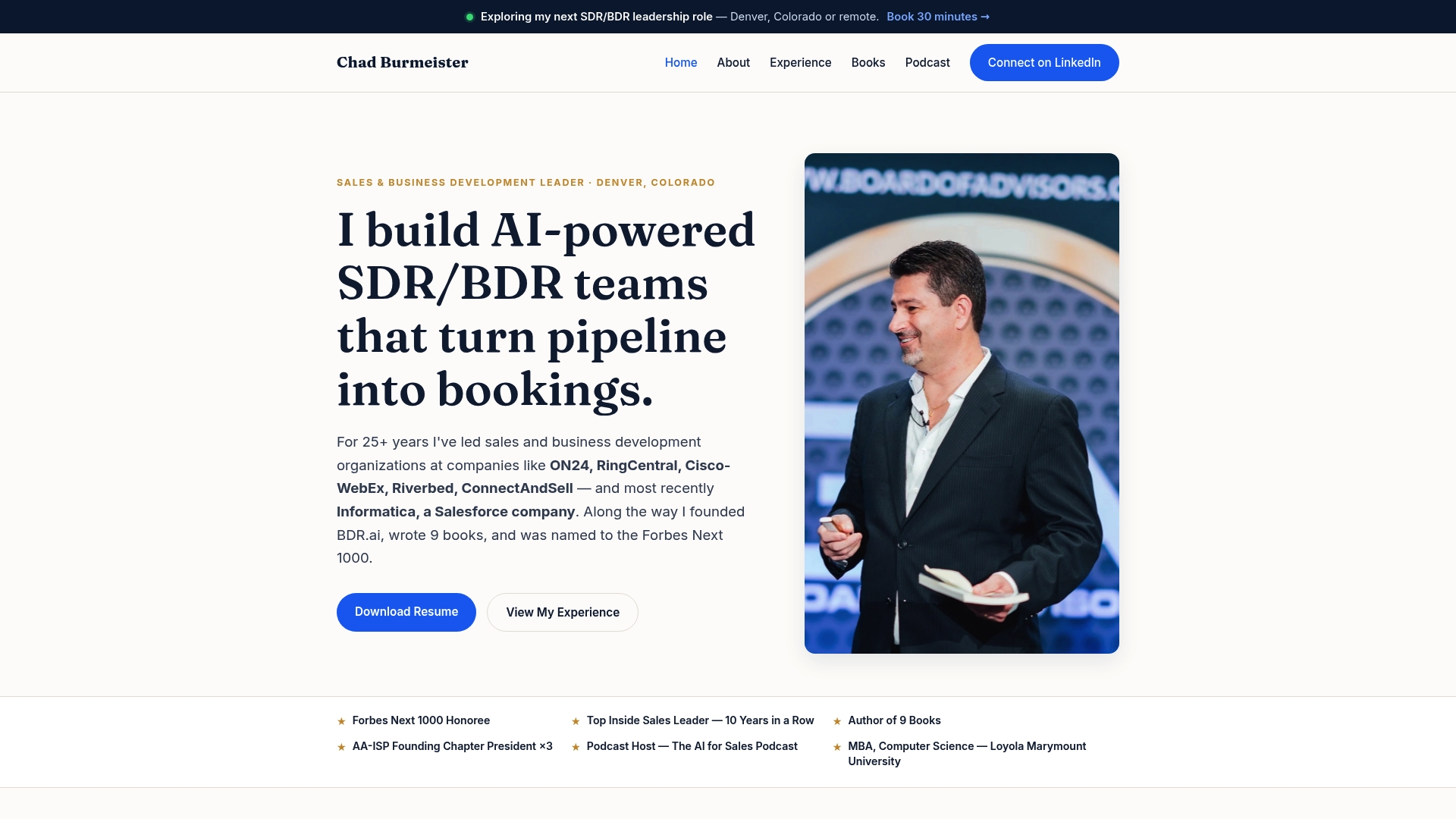
Chadburmeister offers hands-on consulting engagements and workshops built specifically for GTM leaders at this decision point. With 25+ years scaling high-performance sales and business development teams at companies like Informatica, RingCentral, and Cisco-WebEx, Chad Burmeister brings the org-design experience to help you get the structure right before you make the hire. If you prefer to start with a self-paced resource, the books on sales strategy and AI cover the operational frameworks in depth. To explore a consulting engagement or speaking workshop, visit chadburmeister.com and reach out directly.
Useful sources and further reading
- Gartner: Revenue Operations — Analyst framing of RevOps as a strategic operating layer, useful for internal proposals and board conversations.
- RevOps vs. Sales Ops: What's the Difference? — Covers reporting structures, hiring triggers by company size, and team scaling patterns.
- What Is Revenue Operations? The Operating System for Predictable Growth — Covers the Salesforce rep productivity data and the analyst framing of RevOps as an operating system.
- RevOps vs Sales Ops: What Changed and Why — Compensation benchmarks and career trajectory analysis for ops professionals evaluating the RevOps path.
- Rev Ops vs Sales Ops — Practical breakdown of scope boundaries and the skills gap between Sales Ops and RevOps career paths.