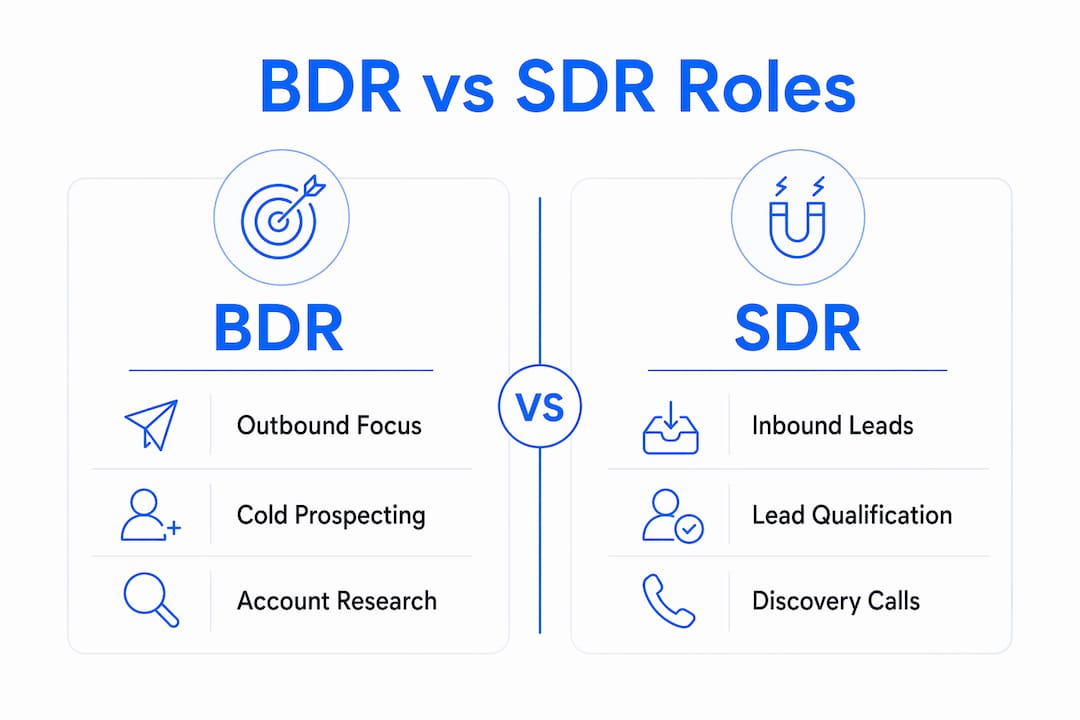
The core distinction between a BDR and an SDR comes down to one thing: where the pipeline starts. Business Development Representatives (BDRs) generate net-new pipeline through outbound prospecting, targeting accounts that have never heard of you. Sales Development Representatives (SDRs) work the other direction, qualifying inbound leads that marketing already warmed up and routing the best ones to Account Executives.
Table of Contents
- How BDR vs SDR roles actually differ
- What BDRs and SDRs do every day
- When should you hire a BDR versus an SDR?
- Why the BDR-to-AE handoff defines your pipeline quality
- What Chad Burmeister's 25+ years of sales leadership teaches about these roles
- How BDRs and SDRs grow into senior sales roles
- Key Takeaways
How BDR vs SDR roles actually differ
Both roles exist to fill an AE's calendar with qualified meetings. That shared goal is where the similarity ends.
- BDRs research cold accounts, build prospect lists, write personalized outreach sequences, and initiate multi-channel contact across email, phone, and LinkedIn. They are hunters working territory that has no playbook yet.
- SDRs respond to demo requests, content downloads, and trial sign-ups. Speed matters above everything else: the faster an SDR contacts an inbound lead, the higher the conversion rate.
- Lead source is the cleanest dividing line. BDRs self-generate; SDRs inherit leads from marketing.
- Reporting lines often reflect this split. SDRs frequently report to Marketing because their work is downstream of campaigns, while BDRs typically sit under Sales or a Growth function.
- Both roles hand off to Account Executives once a lead is qualified. Neither closes deals.
- Titles vary wildly by company. Only about 25% of companies formally separate the two roles; many use the labels interchangeably. The motion, not the title, is what actually matters.
What BDRs and SDRs do every day
The daily reality of each role is different enough that hiring the wrong profile for the wrong motion is a fast path to turnover.
BDR daily workflow
BDRs focus on outbound prospecting in untapped markets, which demands research skills and a tolerance for rejection that most inbound-focused reps simply do not have. A typical BDR day includes account research, ICP mapping, crafting personalized cold emails, LinkedIn outreach, and cold calls. They often work more closely with leadership and product teams to validate new market segments before a full playbook exists.
Key BDR performance metrics:
- New pipeline segments opened
- Cold email reply rates
- Calls-to-meeting ratio
- Accounts researched and sequenced per week
SDR daily workflow
SDRs are reactive processors by design. Their job is to move fast on existing interest, not create it. A strong SDR workflow is built around speed-to-lead, structured qualification frameworks like BANT or MEDDIC, and CRM hygiene that keeps AEs informed.
Key SDR performance metrics:
- MQL-to-meeting conversion rate
- Speed-to-lead response time
- Meetings booked per week
- Inbound lead contact rate
Tools both roles rely on
| Tool Category | Common Examples | Primary User |
|---|---|---|
| CRM | Salesforce, HubSpot | Both |
| Sequencing | Outreach, SalesLoft | Both, especially BDRs |
| Contact data | Apollo, ZoomInfo | BDRs primarily |
| Account research | LinkedIn Sales Navigator | BDRs primarily |
| Inbound routing | HubSpot, Drift | SDRs primarily |
Pro Tip: BDRs who skip account research before cold outreach consistently underperform. Reading a prospect's recent LinkedIn posts or press releases before the first call significantly improves reply rates.
When should you hire a BDR versus an SDR?
Misaligning the role to the pipeline need is one of the most common and expensive mistakes in early-stage sales hiring. The right hire depends on where your pipeline actually comes from, not on what title sounds better.
Hire an SDR first when:
- Marketing is generating consistent inbound volume (50-plus leads per month is a common threshold)
- Your AEs are spending time on unqualified leads that should never reach them
- You have a validated ICP and proven messaging sequences
- Your product has a shorter sales cycle and lower average contract value
Hire a BDR first when:
- You are entering a new market, vertical, or geography with no established playbook
- Brand awareness in your target segment is low or nonexistent
- Your growth strategy depends on enterprise accounts or strategic partnerships
- You need someone to build and test outreach sequences from scratch, not execute existing ones
Hybrid SDR/BDR roles tend to weaken both motions because split focus dilutes effectiveness in both directions. Many companies find it worth separating the functions once they scale beyond three AEs. If you genuinely need both functions running at full capacity, combining them into one role usually means both get done poorly. That is understaffing dressed up as strategy, not a real hybrid model.
For account based prospecting and ABM prospecting specifically, BDRs are almost always the right fit. Account based sales development requires the research depth, personalization, and strategic patience that BDRs are built for.
Why the BDR-to-AE handoff defines your pipeline quality
The handoff from SDR or BDR to Account Executive is where deals are won or lost before the AE ever enters the picture. A qualified meeting with incomplete context, wrong-fit buyer, or no agreed-next-step is not a qualified meeting. It is a wasted hour for your AE.
Teams that inspect qualifications at handoff hit quota significantly more than those that do not. That figure alone should settle any debate about whether handoff rigor is worth the process overhead.
Common handoff failure points:
- No consistent qualification framework (BANT, MEDDIC, or equivalent) applied before passing the lead
- AE receives no context on the prospect's pain points, timeline, or decision-making authority
- No feedback loop from AE back to the BDR or SDR on meeting quality
- Qualification standards that exist on paper but are never inspected in practice
A clean handoff requires the development rep to document budget, authority, need, and timing before the meeting is booked, not after. The AE should be able to walk into the call already knowing why this prospect is worth their time. When that context is missing, conversion rates drop and AEs start ignoring the pipeline their reps worked hard to build.
For the sdr vs bdr vs ae relationship to function, all three roles need shared definitions of what "qualified" actually means. That definition should be written down, reviewed regularly, and updated when conversion data says it is wrong.
What Chad Burmeister's 25+ years of sales leadership teaches about these roles
Chad Burmeister has spent more than 25 years scaling SDR and BDR teams for companies including Informatica, RingCentral, and Cisco-WebEx. That experience across category-defining organizations gives him a perspective on these roles that most hiring guides simply cannot replicate.
Chad's view on AI integration in these roles is equally direct. AI tools now handle much of the research and list-building work that once consumed a BDR's morning. That shift means BDRs can spend more time on the high-judgment work: crafting genuinely personalized outreach and navigating complex multi-stakeholder accounts. SDRs benefit from AI-assisted lead scoring that surfaces the highest-intent inbound leads first, cutting response time and improving MQL-to-meeting rates.
His sales and AI strategy books, including Mastering B2B Lead Generation with LinkedIn & AI, offer practical playbooks for leaders building or restructuring development teams in 2026. The AI for Sales Podcast covers these themes in depth through conversations with practitioners who have run both motions at scale.
For sales leaders in Colorado and beyond who are deciding between BDR and SDR hires, or trying to fix a broken handoff process, the core principle holds: match the rep's profile to the sales motion your business actually needs right now, not the one you hope to have in six months.
How BDRs and SDRs grow into senior sales roles
Neither role is a dead end. Both are recognized entry points into B2B sales careers, and SDRs and BDRs progress to AE roles on similar timelines. The functional difference between the roles shapes where each tends to land next.

SDRs, having spent their time qualifying inbound leads and running discovery conversations, naturally develop the listening and qualification skills that AE work demands. Many move directly into closing roles, and some pivot toward revenue operations or marketing alignment given their visibility into what inbound content actually converts.
BDRs build a different muscle. The research depth, market mapping, and resilience required for cold outbound prospecting translates well into field sales, territory management, and strategic account roles. Some of the strongest sales managers working today started as BDRs because the role forces a kind of self-reliance that inbound work simply does not require.
Salary differences between the two roles are minimal at the entry level. Variations are driven more by industry, geography, and performance than by whether the role is inbound or outbound focused. Colorado's tech and SaaS market, particularly along the Front Range, offers competitive comp for both functions, with BDR roles at enterprise-focused companies sometimes carrying a slightly higher variable component given the longer ramp and higher strategic autonomy required.
For guidance on selecting between BDR and SDR roles based on your specific business stage and pipeline structure, the frameworks that work in practice are simpler than most guides suggest: know your pipeline source, define qualified, and hire the motion that closes the gap.
Key Takeaways
BDRs generate outbound pipeline from cold accounts while SDRs qualify inbound leads from marketing, and the handoff quality from either role to Account Executives is the single biggest driver of pipeline conversion.
| Point | Details |
|---|---|
| Motion over title | Only about 25% of companies formally separate BDR and SDR roles; the sales motion defines the function, not the job title. |
| Hire to the pipeline source | Hire SDRs when inbound volume is high and unqualified; hire BDRs when entering new markets or building outbound from scratch. |
| Handoff quality is decisive | Teams that inspect qualifications at handoff hit quota significantly more than those that do not. |
| Hybrid roles carry risk | Combining BDR and SDR functions in one role typically weakens both inbound and outbound performance. |
| Career paths diverge by motion | SDRs tend to move into AE or revenue operations roles; BDRs often progress into field sales or strategic account management. |
Ready to build or restructure your SDR or BDR team with a leader who has done it at scale? Explore Chad Burmeister's sales leadership services and find out how 25+ years of hands-on experience can accelerate your pipeline.