
The right ABM platform depends almost entirely on your buyer motion and your existing CRM investment. If you run complex enterprise deals with large buying committees, you need AI-driven orchestration. If your team lives in HubSpot or Salesforce, start there before buying anything new. If you're running a lean SDR team, a sales-led tool with contact enrichment will outperform a suite costing $60,000 or more per year that you'll use at 20% capacity.
TL;DR: Enterprise teams with budget and headcount should evaluate 6sense or Demandbase. Mid-market teams running Salesforce or HubSpot should start CRM-native. Ad-first programs fit Terminus or RollWorks. Sales-led or SMB teams get the fastest ROI from Apollo.io or HubSpot ABM features.

According to Gartner, core ABM platform capabilities span account discovery, engagement, personalization, and reporting. Most teams don't need all four from one vendor.
Pro Tip: Before you evaluate a single vendor, map your sales motion: are you selling to committees of 6+ stakeholders, or running a high-velocity SDR sequence? That answer eliminates half the market immediately.
- Enterprise AI-driven orchestration: 6sense, Demandbase
- CRM-native / low-friction: HubSpot ABM, Apollo.io
- Multi-channel advertising: Terminus, RollWorks
- Sales-led / SMB-friendly: Apollo.io, MarketBetter
Table of Contents
- What are the best ABM platforms side by side?
- Platform profiles: strengths, weaknesses, and who each one fits
- How do you choose the right ABM platform for your team?
- Your 90-day ABM pilot playbook
- Which platform should you pick by org size and tech stack?
- Key Takeaways
- What the field actually looks like right now
- Chad Burmeister can help you run a smarter ABM pilot
- Useful sources and next reading
What are the best ABM platforms side by side?
ABM platforms split into three functional layers: data and intent, orchestration, and advertising activation. The strongest programs combine tools across layers rather than expecting one platform to do everything well.
| Platform | Best For | Pricing Band | Primary Strength | Key Integrations | Setup Time | Intent Data | Support Model |
|---|---|---|---|---|---|---|---|
| 6sense | Enterprise | Custom ($60k–$200k+/yr) | AI buying-stage prediction | Salesforce, HubSpot, Marketo | months | first-party only | Managed + CSM |
| Demandbase | Enterprise | Custom ($60k–$200k+/yr) | Website de-anonymization + scoring | Salesforce, HubSpot, LinkedIn | months | first-party only | Managed + CSM |
| Terminus | Mid-market/Enterprise | Custom (high) | Multi-channel ad orchestration | Salesforce, HubSpot | weeks | third-party | Self-serve + managed |
| RollWorks | Mid-market | $12k–$60k/yr | Ad-focused ABM | Salesforce, HubSpot | two to four weeks | third-party | Self-serve |
| Apollo.io | SMB/Sales-led | $890/month | Prospecting + sequences + visitor ID | HubSpot, Salesforce | Days | Contact-level | Self-serve |
| HubSpot ABM | CRM-native | $890/month (Marketing Hub) | Native CRM account scoring | Native HubSpot, Salesforce | Days–1 week | 1st party | Self-serve + support |
| MarketBetter | Mid-market | Varies | Intent-led account targeting | Salesforce, HubSpot | two to four weeks | third-party | Self-serve |
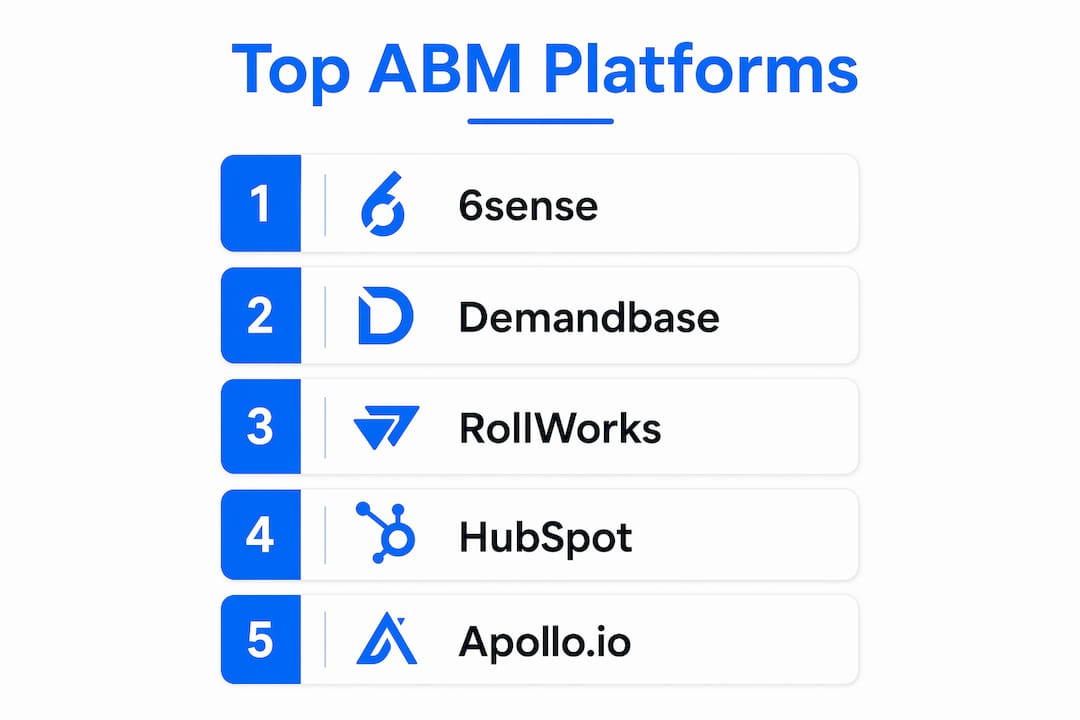
Enterprise platforms commonly start at $60,000 per year and require several months of implementation. RollWorks is more accessible and priced for mid-market teams.
Both 6sense and Demandbase offer native integrations with Salesforce and HubSpot, and typically price between $60,000 and $200,000 per year. HubSpot ABM and Apollo.io connect natively to their own CRM ecosystems, which cuts setup time dramatically.
Pro Tip: Audit your internal resources before selecting an enterprise orchestration platform. A $100k contract without a dedicated ABM manager and clean CRM data is money wasted.
Platform profiles: strengths, weaknesses, and who each one fits
6sense
6sense leads on AI-driven buying-stage prediction, surfacing accounts showing in-market behavior before they fill out a form. The depth of its intent data and predictive scoring is genuinely hard to match at the enterprise level. The trade-off: implementation takes months, and the contract size requires executive buy-in from day one.
- Pros: Best-in-class intent signals, strong orchestration across channels, deep Salesforce/HubSpot integration
- Cons: High cost, long ramp, requires dedicated internal ownership
- Ideal buyer: Enterprise
Demandbase
Demandbase excels at website de-anonymization and account-level scoring, making it a strong fit for enterprise teams that want to know exactly which companies are on their site and what they're reading. Its AI layer ties firmographic data to behavioral signals for prioritization.
- Pros: Powerful de-anonymization, rich account intelligence, solid LinkedIn integration
- Cons: Premium pricing, complex setup, not built for lean teams
- Ideal buyer: Enterprise
Terminus
Terminus is built for multi-channel advertising: display, LinkedIn, connected TV, and chat. It doesn't orchestrate email or sales sequences the way 6sense does, but for teams whose ABM motion is primarily ad-driven, it covers the channels that matter.
- Pros: Strong multi-channel ad reach, good sales-marketing alignment features
- Cons: Limited non-ad orchestration, custom pricing at the high end
- Ideal buyer: Mid-market to enterprise, ad-first programs
RollWorks
RollWorks is the most accessible ad-focused ABM platform for mid-market teams, with entry pricing bands typically cited as $12,000 to $60,000 per year in market comparisons, well below the enterprise tier. It integrates with Salesforce and HubSpot and gets teams running in two to four weeks.
- Pros: Lower price floor, fast setup, solid LinkedIn and display targeting
- Cons: Lighter intent data than enterprise platforms, less orchestration depth
- Ideal buyer: Mid-market
Apollo.io
Apollo.io is the go-to for sales-led ABM. It combines a large contact database, AI-powered sequencing, and website visitor identification at a price point that makes sense for SMBs and lean SDR teams. It won't replace an enterprise orchestration suite, but for teams that need to build pipeline fast, it's hard to beat.
- Pros: Fast setup, strong prospecting database, affordable per-seat pricing, free tier available
- Cons: Lighter on intent data depth, not built for complex multi-channel orchestration
- Ideal buyer: SMB, sales-led teams
HubSpot ABM
HubSpot's ABM tools sit inside Marketing Hub and Sales Hub, which means zero integration friction for teams already on the platform. Account scoring, target account lists, and LinkedIn campaign integration are all native. At $890/month for Marketing Hub, it's the most cost-effective entry point for CRM-native ABM.
- Pros: No integration lift, fast time-to-value, strong reporting, collaborative by design
- Cons: Intent data is first-party only, less predictive depth than 6sense or Demandbase
- Ideal buyer: CRM-native, HubSpot shops
MarketBetter
MarketBetter positions itself as a mid-market ABM tool with intent-led account targeting and a focus on practical fit over feature bloat. It integrates with Salesforce and HubSpot and is designed for teams that want ABM results without enterprise-level complexity.
- Pros: Mid-market pricing, practical feature set, good integrations
- Cons: Smaller brand footprint, less third-party validation than larger platforms
- Ideal buyer: Mid-market teams avoiding enterprise overhead
How do you choose the right ABM platform for your team?
Start with account selection and sales-marketing alignment, not platform features. A platform won't fix a misaligned go-to-market. Get agreement on your Ideal Customer Profile and target account list before you open a single vendor demo.
Questions to ask vendors:
- How does your data model map to our existing CRM fields, and what does the sync look like in practice?
- What does a typical pilot scope cover, and what KPIs do you track in the first 90 days?
- Is managed services included, or is it a separate line item?
- What's the total cost including implementation, data add-ons, and activation credits?
- What internal headcount do you recommend for a successful deployment?
Red flags to watch for:
- Opaque pricing with no pilot path before a six-figure commitment
- Integrations that require custom middleware rather than native connectors
- Vendors who can't name a specific time-to-value benchmark for your use case
- Contracts that lock you into annual minimums before you've validated fit
A practical fit checklist for procurement teams: alignment to your sales motion, realistic TCO estimate including hidden fees, time-to-pilot under 60 days for mid-market, and confirmed native CRM integration. Prioritize native CRM integration over best-in-class tools that create data silos.
Pro Tip: Many teams overbuy. If your sales cycle is under 90 days and your deal size is below $50k, advanced predictive scoring is probably not your bottleneck. Contact enrichment and sequencing will move the needle faster.
For go-to-market teams thinking through organizational design alongside platform selection, aligning your internal process before buying software pays dividends.
Your 90-day ABM pilot playbook
Days 1–14: Kickoff and alignment
- Finalize ICP and target account list (500–1,000 accounts for a pilot)
- Map CRM fields, assign data governance owner, confirm ad account access
- Install tracking pixel and validate data sync
Days 15–30: Activation
- Launch first account-targeted campaigns (LinkedIn + display minimum)
- Activate contact-level sequences for SDR outreach on priority accounts
- Confirm intent signal feeds are populating correctly
Days 31–60: Measure and iterate
- Track account engagement lift, meetings booked, and pipeline influenced
- Review cost per engaged account and compare to pre-ABM baseline
- Identify top 10% of accounts by engagement score for SDR prioritization
Days 61–90: Scale or pivot
- Present pilot results to leadership with pipeline attribution data
- Decide: expand to full account list, adjust ICP, or switch platform tier
- Document integration gaps and data quality issues before full rollout
Pilot KPIs to track: account engagement lift, meetings booked per 100 target accounts, pipeline influenced (dollar value), and cost per engaged account.
Pro Tip: Budget for a dedicated ABM manager or allocate at least 50% of one SDR's time to the pilot. Platforms don't run themselves, and under-resourced pilots produce misleading results.
Which platform should you pick by org size and tech stack?
| Org Size / Stack | Recommended Category | Why |
|---|---|---|
| Enterprise, Salesforce-first | 6sense or Demandbase | Deep intent data, native Salesforce sync, full orchestration |
| Mid-market, HubSpot-first | HubSpot ABM or RollWorks | Low friction, fast setup, CRM-native reporting |
| SMB / lean SDR team | Apollo.io | Affordable, fast, strong prospecting database |
| Ad-first program | Terminus or RollWorks | Multi-channel ad reach without orchestration overhead |
| Mid-market, avoiding complexity | MarketBetter | Practical feature set, mid-market pricing |
Total cost of ownership extends well beyond the license fee. Implementation services, data add-ons, activation credits, and the internal headcount required to run the platform can double the sticker price for enterprise tools. A $60,000 platform with a $40,000 implementation and a full-time ABM manager is a $160,000+ annual commitment.
- Budget for hidden fees: data enrichment credits, API call limits, and managed service tiers are common upsells
- Smaller teams should start with CRM-native features before adding a dedicated ABM platform
- Validate pilot ROI before committing to a multi-year enterprise contract
Key Takeaways
The single most important decision in ABM platform selection is matching the tool to your sales motion, not chasing the most feature-rich option on the market.
| Point | Details |
|---|---|
| Match platform to sales motion | Enterprise buying committees need orchestration; lean SDR teams need contact enrichment and sequencing. |
| CRM integration is the priority | Native Salesforce or HubSpot integration cuts time-to-value and prevents data silos. |
| Enterprise TCO is high | Platforms commonly run $60,000–$200,000+ annually; factor in implementation and headcount costs. |
| Pilot before you commit | A 90-day pilot with defined KPIs (meetings booked, pipeline influenced) validates fit before full rollout. |
| Chadburmeister as your guide | Chad Burmeister offers ABM pilot design, SDR/BDR leadership, and sales consulting to help teams select and run the right platform. |
What the field actually looks like right now
Most articles on ABM platforms read like vendor comparison matrices. The real procurement mistake I see repeatedly is teams buying the most impressive demo, not the best fit.
The platforms with the deepest intent data, 6sense and Demandbase, are genuinely powerful. But they require a level of internal readiness that most mid-market teams underestimate. Clean CRM data, a dedicated ABM manager, and a locked-in ICP are prerequisites, not nice-to-haves. Without them, you're paying enterprise prices for a tool running at 30% capacity.
The contrarian view: for most B2B teams under 200 employees, starting with HubSpot ABM features or Apollo.io and running a disciplined 90-day pilot will outperform a rushed enterprise deployment. Speed of iteration beats depth of features at that stage.
Chad's AI for Sales Podcast has covered this tension directly, featuring practitioners who've run both approaches. The pattern is consistent: alignment and account selection quality matter more than platform sophistication. His published books on AI for sales cover the strategic layer that no platform can replace.
Chad Burmeister can help you run a smarter ABM pilot
Picking the right platform is step one. Running it well is where most teams leave pipeline on the table.
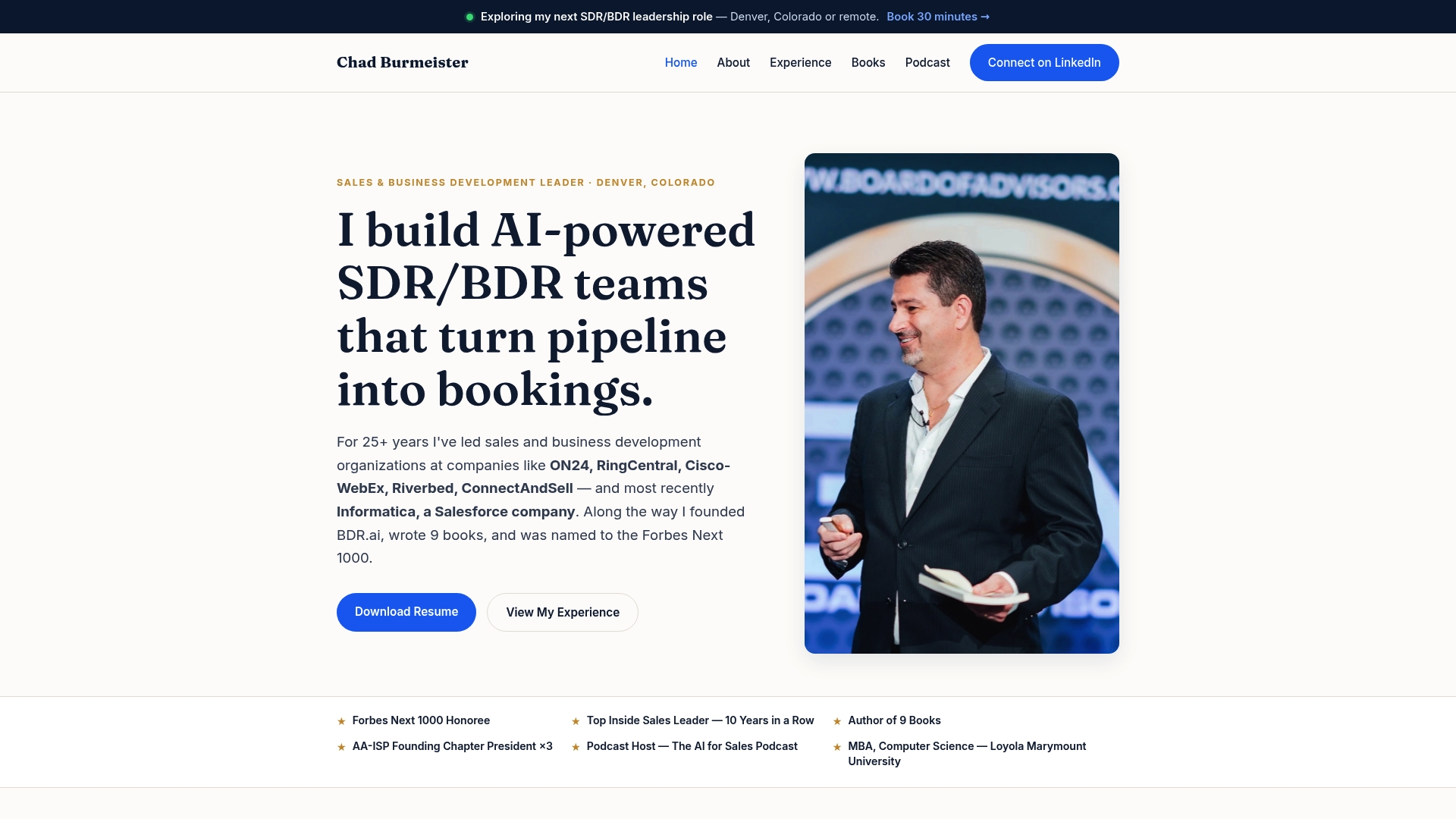
Chad Burmeister brings 25+ years of B2B sales leadership, hands-on SDR/BDR team building, and a track record at companies like Informatica, RingCentral, and Cisco-WebEx to help you move from platform selection to a running ABM program. The work covers ICP definition, CRM alignment, pilot KPI design, and SDR team leadership so your investment actually produces pipeline. No six-month ramp before you see results.
If you're evaluating platforms and want a second opinion grounded in real-world deployment experience, or if you need someone to lead the ABM function while your team gets up to speed, connect with Chad to discuss your situation. You can also explore the sales curriculum and workshop offerings for team enablement that runs alongside your platform rollout.
Useful sources and next reading
- Gartner Peer Insights: Account-Based Marketing Platforms — Peer reviews and capability definitions for enterprise ABM platforms
- TechnologyAdvice: Best ABM Software — Category breakdown covering orchestration, advertising, and data layers
- ContactLevel: ABM Software Honest Comparison — Pricing benchmarks and implementation time expectations for enterprise platforms
- MarketBetter: Best ABM Tools 2026 — Mid-market focused rankings with practical fit guidance
- Influ2: ABM Platforms Integration Guide — Analyst guidance on CRM-native integration and data silo risk
- HubSpot ABM Software — Native ABM features inside HubSpot Marketing Hub and Sales Hub
- Chad Burmeister: AI for Sales Podcast — Practitioner interviews on ABM strategy, AI-driven pipeline, and SDR leadership
- Chad Burmeister: Books on AI for Sales and B2B Lead Generation — Published playbooks covering account-based strategy and AI-powered prospecting