
The right sales compensation software matches your operational stage and puts plan changes in Sales Ops hands, not a consultant's. Based on G2 review trends, ASC 606 compliance requirements, and Chad Burmeister's extensive experience scaling SDR/BDR teams, the top picks are:
- CaptivateIQ — best no-code flexibility for growth-stage teams
- Salesforce Spiff — best for Salesforce-native orgs
- Xactly Incent — best for enterprise audit and compliance
- Varicent — best for complex global rules
- Performio — best for 70+ commissionable reps with AI modeling
- SAP Commissions — best for SAP-stack enterprises
For SDR/BDR teams, the non-negotiables are fast time-to-value, rep-facing earnings transparency, and ops-owned administration.
Table of Contents
- What's the best sales compensation software right now?
- How do you choose the right platform for your stage?
- Which features actually matter for SDR and BDR teams?
- Which platform fits your company stage?
- SDR/BDR compensation templates you can use today
- Implementation checklist: from data prep to full rollout
- How these picks were evaluated
- Key Takeaways
- What most CROs get wrong about compensation software
- Expert leadership that makes your comp software actually work
What's the best sales compensation software right now?
| Platform | Best For | Complexity | Admin Experience | CRM/Payroll Integrations | Reporting & Analytics | Implementation | Pricing Model | Security | Support |
|---|---|---|---|---|---|---|---|---|---|
| CaptivateIQ | Growth-stage teams | Moderate | No-code, ops-first | Salesforce, HubSpot, payroll | Strong scenario modeling | 2 weeks–3 months | Per-payee | SOC 2 | Customer success + docs |
| Salesforce Spiff | Salesforce-native orgs | Moderate–High | Admin-friendly, no IT needed | Native Salesforce, ERP, HCM | Real-time dashboards | Days to weeks | Per-user | SOC 2 | Salesforce ecosystem |
| Xactly Incent | Enterprise compliance | High | Requires configuration expertise | Broad CRM/ERP/HRIS | ASC 606/IFRS 15 audit-ready | Months | Enterprise contract | SOC 2, ISO | Dedicated CSM |
| Varicent | Complex global orgs | Very High | Consultant-assisted | Broad, multi-system | Advanced analytics | Months | Enterprise contract | SOC 2 | Implementation partners |
| Spiff (standalone) | Mid-market ops teams | Moderate | Ops-friendly | Salesforce, HubSpot, payroll | Good visibility | Weeks | Per-payee | SOC 2 | Self-serve + CSM |
| Anaplan | Enterprise planning | Very High | Requires specialists | ERP, HRIS, CRM | Highly configurable | Long | Enterprise contract | SOC 2, ISO | Partner ecosystem |
| Performio | 70+ rep orgs scaling | High | AI-assisted admin | CRM, payroll | AI modeling | Weeks to months | Per-payee | SOC 2 | Dedicated support |
| SAP Commissions | SAP-stack enterprises | Very High | IT-dependent | Deep SAP integration | Enterprise-grade | Long | Enterprise contract | SOC 2, ISO | SAP partner network |
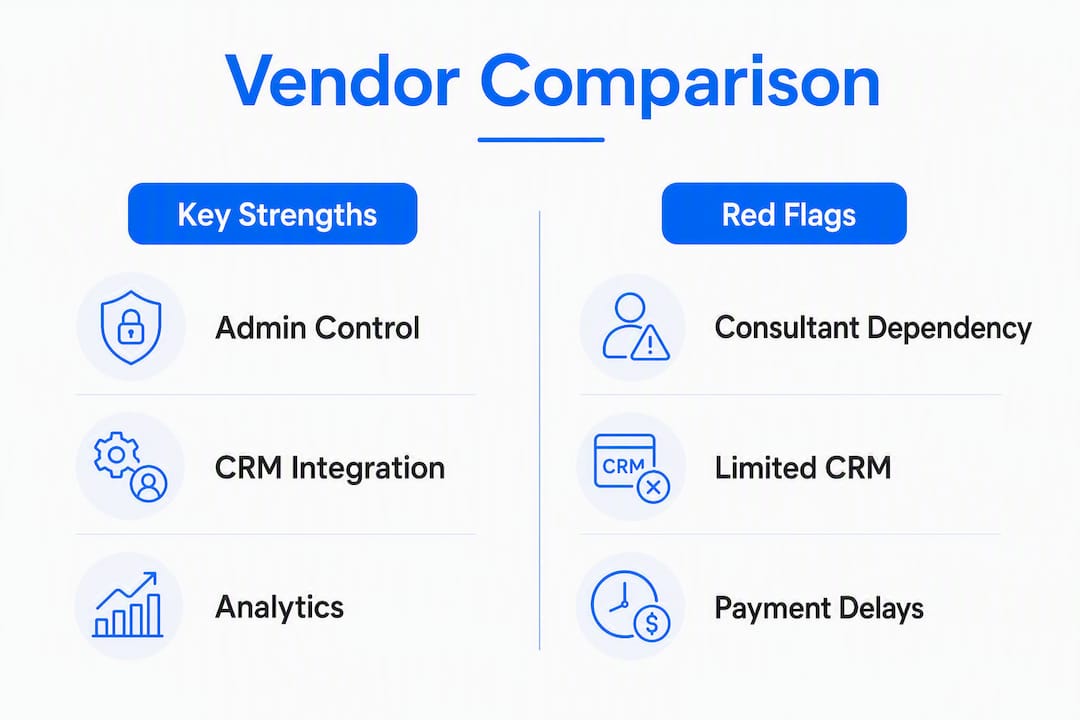
Three red flags to watch in vendor demos: a platform that requires a consultant for any plan change, limited native CRM integration beyond Salesforce, and no built-in audit trail for finance reconciliation. These factors can increase overall costs beyond the license fee.
How do you choose the right platform for your stage?
Choosing based on feature lists rather than operational stage is the single most common mistake CROs make. A growth-stage team that buys enterprise-grade tooling spends months on implementation instead of selling. An enterprise that buys a no-code tool hits a wall the moment it needs multi-currency or global tax logic.
Match platform agility to your rate of change. Consider these questions before you shortlist:
- Who will own daily plan changes: Sales Ops, IT, or an outside consultant?
- How fast do your comp plans change quarter-to-quarter?
- Which CRM and payroll systems must integrate on day one?
- Do you need multi-currency or cross-border territory logic?
- Does Finance require ASC 606 or IFRS 15 audit-ready reporting?
- What's your acceptable time-to-live: days, weeks, or months?
- Is the vendor's services model self-serve, customer success, or consultant-dependent?
G2 review patterns consistently show higher satisfaction when Sales Ops runs the platform day-to-day rather than routing every change through IT or a vendor consultant. SOC 2 certification is the baseline security requirement; treat any vendor without it as a risk.
Pro Tip: Shortlist only platforms where a Sales Ops admin can make a plan change, test it, and push it live without filing a ticket. That single criterion eliminates most enterprise tools for fast-moving SDR/BDR orgs.
Vendor case studies show that ops-owned platforms reduce support tickets and payment disputes significantly compared to consultant-dependent models.
Which features actually matter for SDR and BDR teams?
Real-time earnings visibility is the feature that moves rep behavior most directly. When an SDR can see projected commission before a deal closes, they prioritize the right opportunities without a manager nudging them.

| Feature | Business Outcome |
|---|---|
| Live pipeline commission forecast | Fewer pay disputes; reps self-prioritize high-value deals |
| Split credits (SDR/AE handoff) | Fair attribution; eliminates post-close arguments |
| Dispute workflow automation | Reduced ops time; faster resolution cycle |
| Simple accelerators | Clear motivation above quota; easy to audit |
| Territory logic | Accurate crediting across overlapping coverage |
| ASC 606 audit trail | Finance closes faster; no manual reconciliation |
CaptivateIQ's no-code calculation engine and live scenario modeling make it particularly well-suited for SDR/BDR teams that change plans frequently. Salesforce Spiff delivers commission tracing directly in the rep's workflow, which cuts the "why did I get paid X?" questions that eat ops time.
On integrations: Salesforce or HubSpot connectivity is table stakes. Payroll and HRIS sync matters for accurate headcount and proration. If your org uses CPQ or a billing system, confirm the platform handles revenue recognition splits before you sign.
Which platform fits your company stage?
Select for speed and ops control at startup, configurability and governance at scale, and compliance-grade auditability at enterprise. Over-investing in platform complexity early is a tax on your velocity.
Startup (under 20 reps, simple plans)
- Prioritize: per-payee pricing, fast implementation, plan simplicity
- Avoid: enterprise contracts with long onboarding, consultant-required admin
- Scenario: An outbound SDR team of eight needs base + per-qualified-lead rate + accelerator. A no-code platform live in two weeks beats a six-month enterprise rollout every time.
Growth/Scale (20–70 reps, evolving plans)
- Prioritize: ops-owned admin, scenario modeling, CRM depth, audit readiness
- Avoid: tools that can't handle split credits or territory overlaps as you add AEs
- Scenario: A scaling team adding BDRs alongside AEs needs clean handoff credit rules. CaptivateIQ's modeling lets Ops prototype the new split before it goes live, catching errors before payroll.
Enterprise (70+ reps, global or regulated)
- Prioritize: multi-currency, global tax logic, ASC 606/IFRS 15 native reporting, data residency
- Avoid: no-code tools that hit configuration ceilings on complex global rules
- Scenario: A global sales org with reps in five countries needs Performio's AI-assisted admin or Xactly's compliance depth to handle currency conversion, local tax, and audit export without manual workarounds.
SDR/BDR compensation templates you can use today
Simple plans drive better behavior than over-engineered ones. Avoid building complexity early; clear accelerators and split-credit rules are easier to audit and easier for reps to understand.
-
Outbound SDR: Base + per-qualified-lead rate + accelerator Base: $50,000/year. Qualified lead bonus: $150 per SQL. Accelerator: 1.5x rate above 120% of monthly SQL quota. Example: Example calculation of monthly earnings based on qualified leads exceeding quota.
-
Inbound BDR: Base + meeting-set bonus + quota attainment kicker Example calculation of monthly earnings based on meetings held and quota attainment
-
SDR/AE handoff split credit Example of split credit where SDR receives a share of AE's commission on sourced deals Requires clean opportunity source tracking in CRM.
Pro Tip: Define clawback rules in writing before you automate them. A clawback without a clear recoup timeline creates disputes that no software can resolve. Set an appropriate recoupment window, document it in the plan, then encode it.
Implementation checklist: from data prep to full rollout
Implementation success comes down to two things: ops ownership and clean upstream data. Even the most intuitive no-code UI struggles against disconnected CRM records or mismatched opportunity stages.
-
Data preparation (weeks 1–2): Audit CRM opportunity data, payroll records, and territory assignments. Map fields to the platform's data model. Fix duplicates and missing close dates before importing anything. This phase takes longer than most teams expect.
-
Pilot (weeks 3–6): Run one or two SDR/BDR teams on the new platform in parallel with existing calculations. Gate criteria: payout reconciliation within 1% of manual calculations for two consecutive pay periods.
-
Validation (weeks 6–8): Finance and Sales Ops sign off on audit trail exports. Test payroll sync end-to-end. Run dispute workflow with a sample dispute to confirm resolution path works.
-
Org-wide launch (week 8+): Communicate plan changes to all reps before go-live. Assign a named ops owner for day-one questions. Implementation timelines range from weeks for simple plans to months for complex multi-system integrations.
Migration pitfalls to control:
- No dispute workflow designed before launch: reps escalate to managers, not the system
- Payroll sync untested until go-live: late payments destroy trust fast
- Audit trail not verified before Finance sign-off: creates reconciliation debt
- Stakeholder comms skipped: reps distrust a new system they weren't briefed on
Ownership: Sales Ops owns plan configuration and daily changes. Finance owns audit trail sign-off and ASC 606 reporting. HR owns HRIS sync and headcount accuracy.
How these picks were evaluated
Selections were based on evaluation against complexity supported, integration depth, admin experience, auditability, and time-to-value, cross-referenced against G2 review signals and vendor documentation for SDR/BDR-specific fit.
Evidence sources include vendor product documentation, G2 and customer review patterns, and industry analysis from SalesCompLab. Evaluation filters prioritized ops-owned administration, stage-appropriate complexity, and native CRM integration.
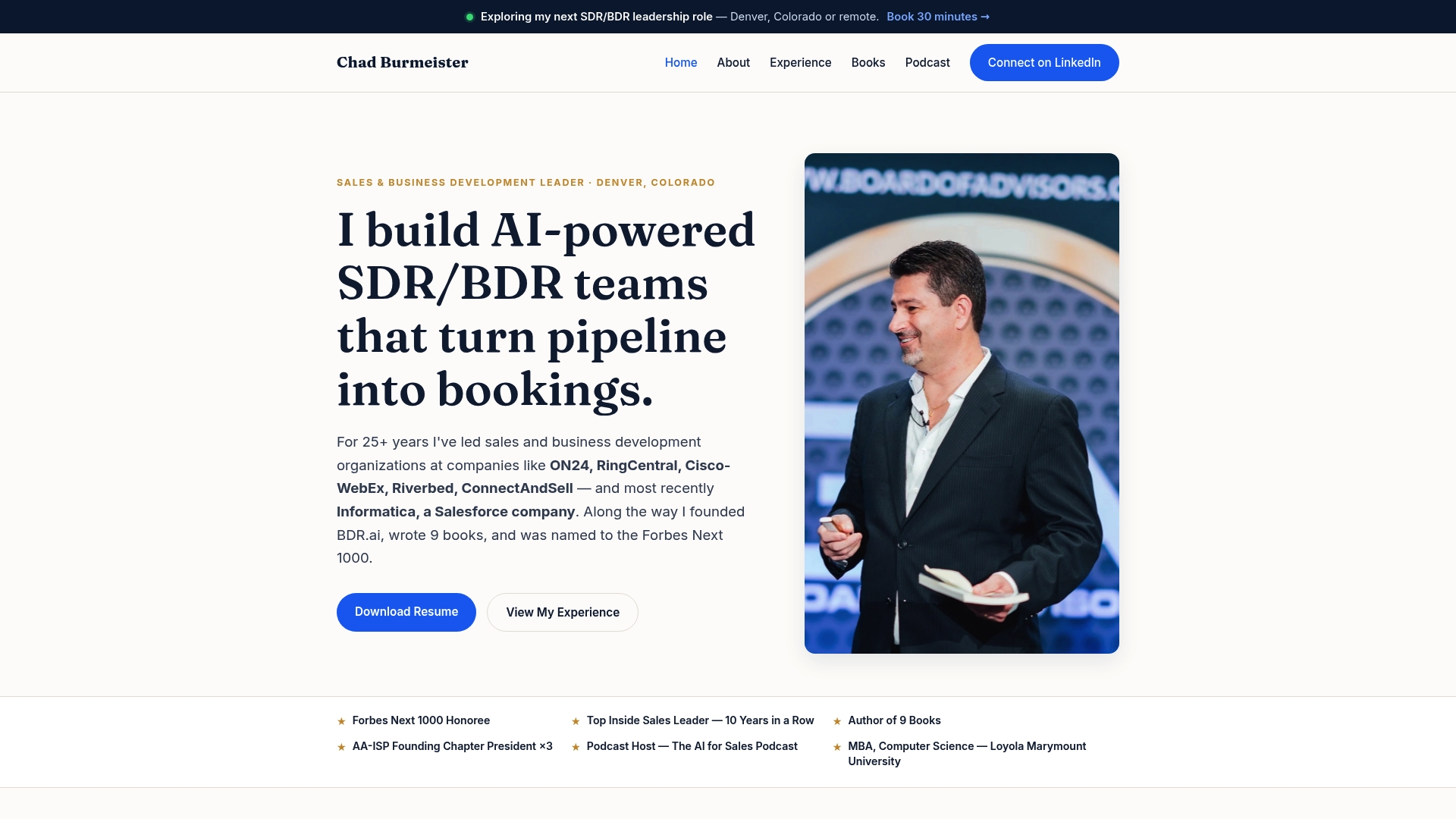
Chad Burmeister is the author of nine sales books including AI for Sales 2.0, host of The AI for Sales Podcast, and has led SDR/BDR teams at Informatica, RingCentral, and Cisco-WebEx. His published playbooks and consulting work inform the stage-first framework applied here.
Key Takeaways
Match your sales commission management software to your operational stage: ops-owned, no-code platforms win at startup and growth; enterprise-grade compliance tools earn their cost only when your complexity demands them.
| Point | Details |
|---|---|
| Stage-first selection | Choose platform complexity that matches your current team size and plan change rate, not your aspirational roadmap. |
| Ops ownership is the differentiator | Platforms where Sales Ops runs daily changes without IT or consultants show higher G2 satisfaction and fewer disputes. |
| Clean CRM data before go-live | Data hygiene in your CRM and payroll systems determines implementation success more than platform choice. |
| Auditability for finance | ASC 606/IFRS 15-ready audit trails are a hidden cost when missing; treat them as a requirement, not a nice-to-have. |
| Chadburmeister's approach | Chad Burmeister's fractional SDR/BDR leadership and ops playbooks help teams design the right plan before selecting or implementing any platform. |
What most CROs get wrong about compensation software
The software doesn't fix a broken plan. That sounds obvious, but I watch CROs buy a platform expecting it to solve rep motivation problems that are actually plan design problems. Automated platforms execute whatever you encode, good or bad, with equal efficiency.
The first 90 days after go-live reveal whether you solved the right problem. If reps are still confused about how they get paid, the issue is plan clarity, not the software. If ops is still fielding daily commission questions, the issue is rep-facing visibility, not the vendor.
My honest recommendation: before you buy anything, spend two weeks simplifying your comp plan on paper. If you can't explain the payout math in under three minutes to a new SDR, no software will make it clearer. Fix the plan, then automate it.
Do: pilot with one team, measure dispute volume before and after, and give Sales Ops full admin rights from day one. Don't: buy enterprise-grade tooling for a 15-person SDR team, or let IT own the platform when Sales Ops needs to move fast.
When a founder or CRO calls me about compensation software, half the time what they actually need is fractional sales leadership to design the plan first. The tool comes second.
Expert leadership that makes your comp software actually work
Buying the right platform is step one. Getting reps to trust it, ops to own it, and finance to close cleanly on it is where most rollouts stall. Chadburmeister offers fractional SDR/BDR leadership and implementation playbooks that get your team aligned on plan design before a single line of configuration is written.
Chad Burmeister has scaled high-performance SDR and BDR teams at companies like RingCentral and Cisco-WebEx, and his practical playbooks cover everything from plan design to dispute workflow setup. Whether you need a sales development consulting engagement to design the right incentive structure or a workshop to align your ops and finance teams before go-live, the work starts with the plan, not the platform.
Book a consult or explore services at chadburmeister.com to get your comp strategy right before you commit to a vendor.