
The best B2B contact database for SDR/BDR teams is not a single vendor. It is a waterfall-first contact intelligence approach: verified contact records cascaded through multiple enrichment providers, layered with real-time buying signals, and pushed natively into your CRM. Here is what "best" actually means in practice:
- Verified match rate to ICP: Confirmed email and direct-dial accuracy against your specific buyer profile, not aggregate database size.
- Signal integration: Intent data and trigger events (funding rounds, job changes, tech installs) attached to each record before it enters a sequence.
- Native CRM/API integrations: Records flow directly into Salesforce, HubSpot, or your sequencing tool without manual exports.
Waterfall enrichment typically runs multiple providers per record and produces 30–60% higher hit rates than any single-source tool. That gap is why the vendor-first question ("Which platform should we buy?") is the wrong starting point.
Table of Contents
- Why your contact data strategy drives SDR/BDR outcomes
- What quality metrics should you require from any contact database?
- How does waterfall enrichment actually work?
- How do you evaluate and select a contact database vendor?
- What does contact data actually cost, and what is the real TCO?
- Implementation playbook: from pilot to full rollout
- Key Takeaways
- What most teams get wrong about contact data
- Skip the DIY vendor maze with Chadburmeister's sales consulting
- Useful sources and further reading
Why your contact data strategy drives SDR/BDR outcomes
Data quality is not an ops problem. It is a revenue problem. When SDRs dial stale numbers or email addresses that bounce, they lose the two things they cannot recover: time and sender reputation.
The downstream KPIs that suffer most are reply rate, connect rate, meeting rate, and SQL volume. Each one is directly sensitive to whether the record was verified, whether the contact is still in the role, and whether the outreach arrived at the right moment. Teams that pair contact data with buying signals see 20–40% higher conversion rates versus static contact lists.

Two quick scenarios illustrate the stakes. A U.S.-focused outbound team running 500 dials a week on unverified data might generate 20 connects. The same team on a verified, signal-enriched list often doubles that, because they are calling people who are actively in-market. For teams selling internationally, the calculus shifts further: GDPR-compliant, phone-verified data is not optional for EMEA outreach — it is a legal and deliverability requirement.
What quality metrics should you require from any contact database?
Raw database size is the most misleading number in vendor pitches. A provider claiming 500 million records means nothing if 30% of those are personal Gmail addresses or contacts who left their roles two years ago. Large aggregate counts often include outdated or personal addresses with little B2B value.
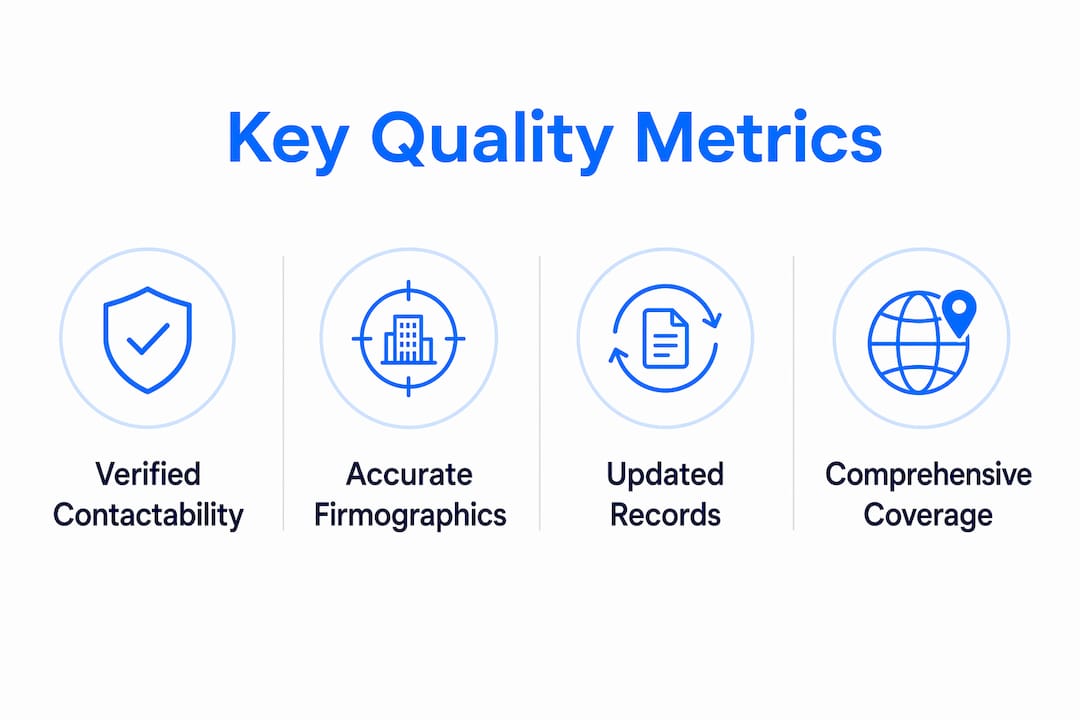
| Metric | Why It Matters | Realistic Benchmark |
|---|---|---|
| Verified contactability | Confirms email/direct-dial reaches the right person | High accuracy guarantee |
| ICP match rate | Measures how many exported records fit your buyer profile | Strong match rate expected on a pilot export |
| Data freshness/decay | B2B contact lists decay at a rate of 22–30% per year | Quarterly re-verification minimum |
| Role/industry coverage | Ensures depth in your specific verticals and titles | Validate with a sample export |
| API/CRM sync reliability | Determines if enriched records reach reps without manual work | Very high uptime expected in contract |
Verification approaches vary widely: real-time email validation, phone verification, human spot checks, and AI cross-referencing are all common. Ask vendors specifically which methods they use and in what order.
Pro Tip: Run a blind pilot export of 200–300 records matched to your ICP. Send the emails through a dedicated subdomain, spot-check 25 phone numbers manually, and measure bounce rate and connect rate before signing any contract. A vendor who refuses a structured pilot is a red flag.
How does waterfall enrichment actually work?
Waterfall enrichment runs a cascade of data sources against each record until a verified result is returned. The sequence matters: you query your highest-confidence provider first, fall back to the next if no match is found, and continue until the record is either enriched or marked as unresolvable.
A practical workflow looks like this: define your ICP filter, export a target account list, query Provider A for email and direct dial, pass unmatched records to Provider B, deduplicate and confidence-score all returned records, attach intent signals from a separate signal layer, then push the enriched record to your CRM or sequencing tool.
Here is a step-by-step checklist for building your own waterfall:
- Define provider order by verified accuracy rate for your ICP segment, not by contract value.
- Set deduplication rules before enrichment runs so the same contact does not get written twice with conflicting data.
- Assign confidence scores to each returned record based on verification method (real-time validation scores higher than scraped/aggregated).
- Add fallback tiers for records that fail the top two providers; a pay-for-valid provider works well here since you only pay when a verified result is returned.
- Attach buying signals as a final enrichment layer: intent topics, job-change alerts, and funding triggers.
- Push to CRM with a timestamp so RevOps can track data age and trigger refresh workflows.
Pro Tip: Place pay-for-valid, usage-based steps at tiers 3–5 of your waterfall, not at the top. You will pay only for records your primary providers missed, which caps cost per enriched contact and aligns vendor incentives with actual quality.
How do you evaluate and select a contact database vendor?
Start with these questions before any demo:
- Where does your data originate, and how often is it re-verified?
- What is your average email deliverability rate and direct-dial connect rate for accounts in [specific vertical]?
- Do you offer native integrations with Salesforce, HubSpot, and Outreach/Salesloft, or only CSV exports?
- What are your CCPA compliance controls for U.S. data, and do you support GDPR for international outreach?
- What are your contract minimums, and do you offer a structured pilot before annual commitment?
Red flags to walk away from:
- Opaque sourcing ("we aggregate from multiple sources" with no specifics)
- No verification guarantee or credit replacement for bounced contacts
- No native CRM push, only manual exports
- Inflexible annual contracts with no pilot option
- High annual minimums and long onboarding timelines before you can test real performance
Pilot plan template:
- Objective: Validate vendor match rate and deliverability against your ICP.
- Sample size: A few hundred target accounts, filtered to your exact buyer profile.
- Success criteria: High ICP match rate, low hard bounce rate, measurable reply/meeting lift versus your current baseline.
- Timeline: 4 weeks from data delivery to first measurement.
- Deliverables: Bounce report, connect rate log, and a meeting-booked count tied to pilot records.
A realistic ICP-based pilot with defined success criteria is the single best way to reduce procurement risk before committing budget.
What does contact data actually cost, and what is the real TCO?
Vendors sell four pricing shapes: subscription seats (flat monthly/annual per user), credit/consumption models (pay per record exported), pay-for-valid (pay only when a verified result is returned), and enterprise contracts with volume minimums.
| Pricing Model | Best For | Watch Out For |
|---|---|---|
| Subscription seats | Predictable budgets, high-volume teams | Paying for unused credits or stale records |
| Credit/consumption | Variable outbound volume | Credit expiration and rollover policies |
| Pay-for-valid | Waterfall tiers, cost control | Higher per-record cost offset by zero waste |
| Enterprise contract | Deep enrichment + intent bundles | High minimums and long-term lock-in |
A simple TCO calculation for a 10-person SDR team:
- Data subscription cost (annual)
- Plus integration/engineering time to connect to CRM and sequencing tool
- Plus cost of bad data: re-sends, domain reputation repair, and SDR time wasted on dead records
- Minus avoided cost from pay-for-valid tiers replacing flat-rate waste
Budget guardrail: for a team of 5–10 SDRs running 1,000–2,000 outbound touches per week, allocate roughly 15–20% of your total sales tech budget to contact data and enrichment. Skimping here costs more in pipeline loss than it saves in subscription fees.
Implementation playbook: from pilot to full rollout
Setup and pilot (weeks 1–4):
- Select a 300–500 account ICP sample and export from your chosen provider.
- Validate records: run email verification, spot-check 25 direct dials, confirm job titles against LinkedIn.
- Integrate enriched records into your CRM and sequencing tool via API or native connector.
- Train SDRs on signal interpretation: what a funding trigger or job-change alert means for their opening line.
- Launch sequences on pilot records only; track separately from existing outbound.
Measurement KPIs to track from day one:
- Hard bounce rate (target: below 5%)
- Connect rate on direct dials (benchmark against pre-pilot baseline)
- Reply rate to email sequences
- Meeting rate per 100 contacts touched
- SQLs generated from pilot records
- Cost per SQL (total pilot spend divided by SQLs)
Ownership: RevOps owns data integration and hygiene cadence. SDR leadership owns sequence performance and rep training. Engineering owns API reliability and CRM field mapping.
| Phase | Timeline | Key Activity |
|---|---|---|
| Pilot | Weeks 1–4 | ICP export, validation, CRM integration, first sequences |
| Roll-out | Weeks 5–10 | Expand to full ICP, train full SDR team, refine waterfall order |
| Steady state | Ongoing | Quarterly data refresh, monthly bounce audits, signal layer review |
Key Takeaways
A waterfall-first contact intelligence approach, combining verified records with buying signals and native CRM integrations, consistently outperforms any single-vendor B2B contact database for SDR/BDR teams.
| Point | Details |
|---|---|
| Waterfall beats single-source | Running multiple providers per record produces notably higher hit rates than any single-source tool. |
| Signals multiply conversion | Pairing contact data with buying signals drives 20–40% higher conversion versus static lists. |
| Pilot before you commit | A 300–500 account ICP pilot with defined success criteria is the lowest-risk procurement path. |
| TCO includes bad-data costs | Factor in integration time, re-sends, and domain reputation repair, not just subscription fees. |
| Chadburmeister accelerates this | Chad Burmeister's AI-powered sales consulting covers waterfall setup, vendor selection, and SDR implementation. |
What most teams get wrong about contact data
The conventional wisdom says: pick the biggest database with the best brand name, sign the enterprise contract, and let the SDRs loose. Every CRO I have spoken with who took that path eventually ran into the same wall: high spend, mediocre match rates on their specific ICP, and SDRs burning time on records that should never have been in the sequence.
The shift that actually moves the needle is treating contact data as an infrastructure decision, not a software purchase. That means owning the waterfall architecture, not outsourcing it entirely to one vendor's black box. It means measuring cost per SQL from the data layer, not just cost per seat. And it means pairing every verified contact with at least one signal that tells your rep why to call now.
For Colorado-based teams scaling outbound into national markets, the signal layer is especially valuable. A Denver SaaS company selling into enterprise accounts in New York or Chicago cannot rely on relationship proximity. The data and the signal have to do the work that geography used to do.
Chad's experience leading SDR/BDR teams at companies like RingCentral and Cisco-WebEx, and the frameworks in AI for Sales 2.0, are grounded in exactly this shift: from list-buying to contact intelligence architecture.
Skip the DIY vendor maze with Chadburmeister's sales consulting
Most executive teams spend three to six months evaluating contact data vendors, running pilots, and debugging CRM integrations before their SDRs see a single quality lead. Chadburmeister cuts that timeline significantly by bringing 25+ years of hands-on SDR/BDR leadership directly into your stack decisions.
The engagement covers vendor selection and waterfall design, pilot execution against your ICP, CRM and sequencing tool integration, and SDR team training on signal-based outreach. The result is a pipeline-ready contact intelligence system, not a software subscription your team has to figure out alone. Founders and CROs who want faster ramp times and measurable SQL lift can start a discovery conversation or review Chad's full leadership background before booking.
Useful sources and further reading
- Waterfall enrichment and hit rate benchmarks — SyncGTM
- B2B contact data providers compared, signal integration ROI — Salesmotion
- Pay-for-valid pricing and data quality analysis — Veerview
- Verification methods and data accuracy — Lusha
- Enterprise contract considerations and TCO — ZoomInfo Pipeline
- Best B2B contact databases compared — Leadfeeder
- Chad Burmeister — AI for Sales Podcast — episodes on AI-driven pipeline and SDR team strategy
- AI for Sales 2.0 and other sales playbooks — Chadburmeister