
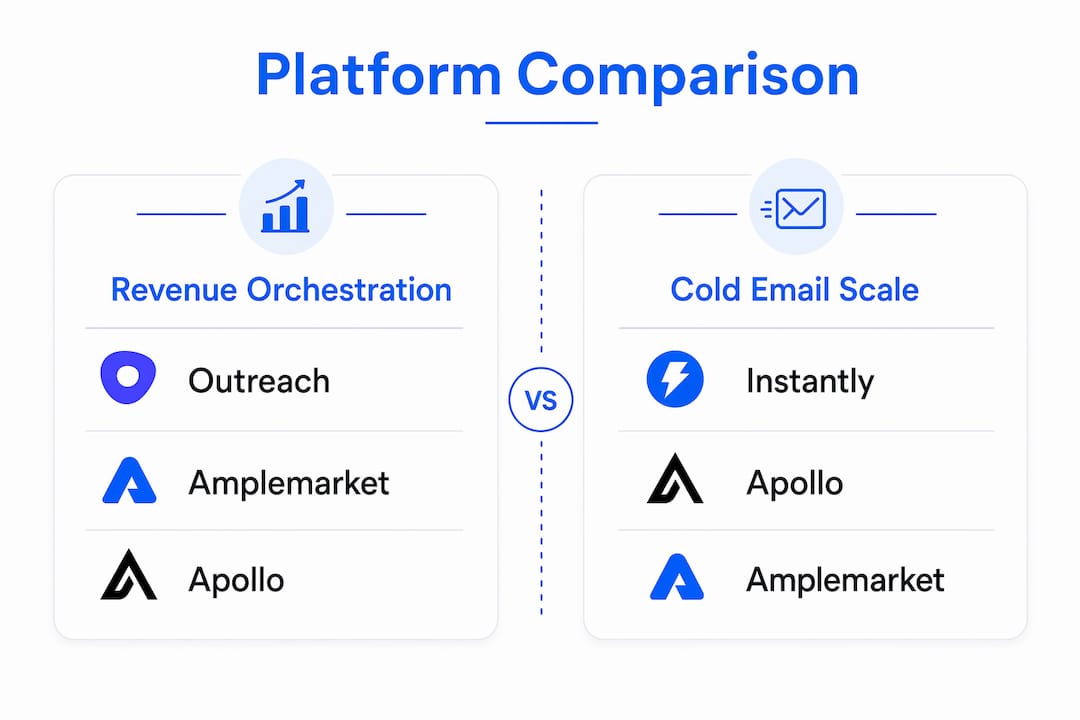
For enterprise revenue teams, Outreach is the strongest pick for AI-powered revenue orchestration. For multichannel coverage with true agentic research, Amplemarket closes the gap fast. Apollo wins on budget data plus email. Instantly is the right call for high-volume cold email at minimal cost. The deciding dimensions across all four: agentic AI depth, native deliverability controls, and CRM automation that writes back without manual intervention. Chad Burmeister, author of AI for Sales 2.0 and host of The AI for Sales Podcast, has extensive experience building SDR/BDR teams at companies like RingCentral and Cisco-WebEx. The shortlist below reflects how revenue orchestration platforms are separating from pure outreach automation tools in 2026.
- Outreach — enterprise orchestration with agentic AI and deep Salesforce integration
- Amplemarket — true multichannel orchestration with built-in deliverability scoring
- Apollo — budget-friendly data plus email sequencing for growing teams
- Instantly — high-volume cold email with deliverability tooling at low cost
Table of Contents
- Which sales engagement platforms should you actually compare?
- How do you pick the right platform for your sales motion?
- What does agentic AI actually do in a sales platform?
- What does implementation actually cost in time and money?
- Which platform fits your buyer archetype?
- Key Takeaways
- When should you hire an expert instead of buying another platform?
- Get a faster return from your next platform investment
- Useful sources
Which sales engagement platforms should you actually compare?
The market in 2026 splits cleanly into two tiers: revenue orchestration platforms that act as an operating layer across coaching, forecasting, and buyer-signal intelligence, and email-first tools built for volume and speed. Executives evaluating sales engagement software need to know which tier fits their motion before they book a single demo.
Evaluation criteria used here: orchestration depth (multi-channel plus workflow automation plus coaching), agentic AI capabilities, native deliverability stack, CRM automation (Salesforce/HubSpot write-back), implementation friction, and time-to-value.
| Platform | Best For | Orchestration Depth | Agentic AI | CRM Integration | Pricing Model | Implementation |
|---|---|---|---|---|---|---|
| Outreach | Enterprise revenue orgs | Full multi-channel + coaching + forecasting | Account research, meeting prep, next-best-action | Salesforce (deep), HubSpot | Custom / per seat | 6 weeks |
| Amplemarket | Mid-market multichannel | Multi-channel + deliverability scoring | Auto-research, sequence triggers | Salesforce, HubSpot, others | Per seat, tiered | 3–6 weeks |
| Apollo | Budget data + email | Email + basic sequences | AI writing assistant, research intelligence | HubSpot (strong), Salesforce | Freemium to ~$49/user/mo | 1–2 weeks |
| Instantly | High-volume cold email | Email-only + deliverability tooling | AI Copilot, AI Reply Agent | Limited native CRM sync | Sender-based from ~$30/mo | Days |
Outreach
Outreach positions itself as an agentic AI platform for revenue teams, not just a sequencing tool. The platform's AI researches accounts, prepares meeting briefs, and surfaces next-best-action guidance inside rep workflows. The trade-off: it requires a mature RevOps function to configure properly, and custom pricing means budget conversations start late. Trial it if you need enterprise-grade pipeline governance and Salesforce is your system of record.

Amplemarket
Amplemarket earns its place on enterprise shortlists by combining multichannel orchestration with a built-in deliverability score, a distinction most platforms skip entirely. It fits mid-market teams that have outgrown email-only tools but aren't ready for Outreach's implementation weight. Trial it if you need multichannel coverage and want deliverability managed natively rather than bolted on.
Apollo
Apollo's strength is the combination of a large B2B contact database with built-in email sequencing and deliverability controls including automatic warm-up and SPF/DKIM/DMARC support. At a freemium entry point scaling to roughly $49 per user per month, it's the clearest budget pick for teams that need data and outreach in one place. The orchestration ceiling is lower than Outreach or Amplemarket. Trial it if you're a growing team that needs leads and sequences without a six-figure contract.
Instantly
Instantly is purpose-built for cold email at scale. Its sender-based pricing model starting around $30 per month makes it accessible for founder-led or early-stage outbound. The AI Copilot and AI Reply Agent handle basic personalization and response management. CRM sync is limited compared to the orchestration platforms. Trial it if raw email volume and inbox placement are the only metrics that matter right now.
How do you pick the right platform for your sales motion?
Sales motion fit matters more than any feature checklist. A high-velocity email tool dropped into an enterprise account-based motion creates more chaos than pipeline.
Decision criteria, ranked for executive buyers:
- Sales motion fit (enterprise multi-stakeholder vs. velocity outbound)
- CRM maturity (Salesforce, HubSpot, or custom stack)
- Native deliverability management (warm-up, SPF/DKIM/DMARC, inbox reputation)
- Orchestration and workflow depth (multi-channel, coaching, forecasting)
- Agentic AI capabilities (what the AI does autonomously vs. what it only suggests)
- Reporting tied to forecast accuracy
- Security and compliance (SOC 2, data residency, audit trails)
Demo questions worth asking every vendor:
- How does your AI surface next-best-action, and where does it write back to the CRM?
- What happens to sequence data if a contact's email bounces three times?
- Show me your deliverability dashboard. What controls does a rep have vs. an admin?
- How does your platform handle multi-stakeholder buying at an enterprise account?
- What's your average time-to-first-sequence for a new rep after onboarding?
Red flags to watch:
- No native deliverability controls (warm-up, authentication) — the deliverability tax lands on your team
- CRM sync that requires a Zapier bridge or custom engineering to write activity back
- AI features that are purely suggestive with no autonomous execution capability
- Opaque AI training data with no update cadence disclosed
Pro Tip: If your motion is enterprise plus multi-stakeholder buying, default to platforms built for revenue orchestration. If it's high-volume email outreach on a tight budget, an email-first tool with native deliverability tooling is the faster, cheaper path.
What does agentic AI actually do in a sales platform?
Most platforms now claim AI. The meaningful distinction is between suggestive AI and agentic AI.
Suggestive AI recommends copy, flags a stalled deal, or scores a lead. You still act. Agentic AI researches an account, drafts the outreach, schedules the sequence, and logs the activity to the CRM without a rep touching it. That gap in operational leverage is why agentic AI has become the primary differentiator in 2026 platform evaluations.
Concrete agentic behaviors to look for: automated account research agents that pull firmographic and intent signals before a rep touches a prospect; meeting-prep agents that generate a brief from CRM history and recent news; proactive inbox actions that respond to common objections or route replies without rep involvement; and workflow agents that reduce cycle time by enforcing next-step completion.
Governance requirements to build into your vendor contract: data provenance disclosure (where account research data originates), AI model update cadence, human-in-the-loop approval gates for autonomous sends, and a full audit trail of AI-initiated actions.
Pro Tip: Ask vendors to demo an agentic workflow end-to-end, from account research trigger to CRM write-back. If they can't show it live, it's a roadmap feature, not a production capability.
What does implementation actually cost in time and money?
Pricing models vary by tier. Orchestration platforms (Outreach) use custom per-seat contracts typically starting in the five-figure annual range. Mid-market platforms (Amplemarket) run tiered per-seat subscriptions. Apollo scales from free to roughly $49 per user per month. Instantly prices by sender account from around $30 per month.
| Phase | Duration | Key Stakeholders |
|---|---|---|
| Pilot (1 team, 1 sequence type) | 2–4 weeks | Sales ops, 2–3 reps, IT security |
| Phased rollout (2–3 teams) | 4 weeks | RevOps, enablement, CRM admin |
| Full production | 8 weeks total | All GTM stakeholders, security sign-off |
Metrics to track during pilot:
- Reply rate (baseline vs. pilot week 3)
- Meetings booked per rep per week
- CRM activity completeness (% of touches logged automatically)
- Pipeline velocity (days from first touch to opportunity creation)
- Forecast accuracy delta before and after native CRM automation
Procurement levers worth using: negotiate deliverability and IP management commitments into the contract, not just uptime SLAs. Require a minimum number of onboarding and enablement hours. Set a data-handling SLA that covers how long prospect data is retained. For AI-first platforms, require disclosure of the training data sources and update schedule before signing.
Platforms that automate CRM activity capture natively reduce the manual entry failures that undermine forecast accuracy. That single capability often determines whether a platform delivers ROI or just adds another tool to the stack.
Which platform fits your buyer archetype?
- Enterprise revenue org (100+ reps, Salesforce): Outreach. Run a 30-day pilot with one AE team, measure CRM activity completeness and pipeline velocity, include sales ops and security in the evaluation.
- Mid-market scaling team (20–75 reps, HubSpot or Salesforce): Amplemarket. Pilot multichannel sequences across two segments, track reply rate and meetings booked, loop in RevOps for CRM sync validation.
- High-velocity outbound function (SDR-heavy, budget-conscious): Apollo or Instantly. Start with a two-week deliverability audit, measure inbox placement rate, keep the CRM admin in the loop for activity logging.
- Startup or founder-led growth (sub-20 reps): Apollo or Instantly plus a local prospecting tool for targeted outreach. Set a 14-day trial, track reply rate and cost per meeting booked.
Structure every trial around three non-negotiables: a deliverability benchmark (inbox placement rate above 90%), a CRM activity completeness target (above 85% of touches logged automatically), and a defined training deliverable from the vendor before go-live.
Key Takeaways
The right sales engagement platform is determined by sales motion, CRM maturity, and whether the AI acts autonomously or only suggests — not by feature count alone.
| Point | Details |
|---|---|
| Orchestration beats automation | Prioritize platforms that enforce process, coaching, and forecasting, not just email sequences. |
| Agentic AI is the real differentiator | Look for AI that researches accounts and logs CRM activity autonomously, not just copy suggestions. |
| Deliverability is a contract item | Require native warm-up, SPF/DKIM/DMARC, and inbox reputation controls before signing. |
| Match platform to motion | Enterprise multi-stakeholder buying needs orchestration depth; high-volume outbound needs deliverability tooling. |
| Chadburmeister as next step | When platform change alone isn't moving the needle, Chad Burmeister's executive sales consulting addresses the leadership and process gaps underneath. |
When should you hire an expert instead of buying another platform?
The honest answer most vendors won't give you: a new platform rarely fixes a broken sales motion. It accelerates whatever is already happening, good or bad.
The signal that a platform swap is the right move is specific: your current tool lacks agentic AI, your CRM sync is manual, or your deliverability is degrading at scale. Those are infrastructure problems a better platform solves.
The signal to bring in external help is different. Low adoption despite two platform investments. Forecast accuracy that hasn't improved after automating activity capture. No repeatable sales motion that a new rep can follow without a senior rep shadowing them for six weeks. Those are leadership and process problems. A new license doesn't fix them.
Practical steps for engaging a consultant: define a pilot scope of 90 days with a specific outcome (a documented sales motion, a deliverability audit, an SDR ramp playbook). Require deliverables, not just advisory hours. The best consulting engagements run parallel to platform selection, not after it, because the consultant helps you ask the right demo questions before you sign.
Get a faster return from your next platform investment
Most revenue teams leave 40–60% of their platform's value on the table because the process and leadership layer underneath was never built. Chadburmeister offers executive sales leadership and AI adoption consulting that turns a platform purchase into a working revenue motion, not just another tool in the stack.
A discovery engagement covers trial design, an adoption playbook for your SDR/BDR team, and a deliverability audit before your contract goes live. Chad's 25+ years scaling teams at Informatica, RingCentral, and Cisco-WebEx means the playbook is built from production experience, not theory. If you're evaluating platforms now or already own one that isn't performing, book a discovery call to scope the engagement.
Useful sources
- Outreach — Agentic AI platform for revenue teams — vendor documentation on agentic AI capabilities, account research agents, and meeting-prep features referenced in the AI and comparison sections.
- Amplemarket — Best multichannel sales outreach tools 2026 — multichannel orchestration scoring and deliverability metrics used to frame the enterprise vs. email-first split.
- Apollo.io — Sales engagement platform features and pricing — deliverability controls (warm-up, authentication) and pricing model details cited in the comparison and implementation sections.
- Sybill — Best sales engagement tools (industry analysis) — analyst framing on revenue orchestration vs. outreach automation and the sales-motion-fit argument.
- Salesloft Rhythm — Sales automation and workflow agents — workflow agent metrics (cycle time reduction, close rate uplift) cited in the agentic AI section.
- Gong Engage — AI sales engagement software — CRM activity automation and agentic AI operational leverage evidence.
- Lemlist — Deliverability guidance — deliverability tax concept and native warm-up/authentication recommendations.
- Gartner Peer Insights — Revenue Action Orchestration 2026 — market category framing for revenue orchestration platforms.
- G2 — Best sales engagement software — platform rankings and buyer use-case segmentation.
- Chad Burmeister — AI for Sales books and podcast — author proof points and published playbooks on AI-driven pipeline growth referenced throughout.