Effective sales leaders share a short list of competencies: coaching, strategic and tactical planning, accountability, decisive judgment, hiring and talent building, and emotional intelligence. Selling skill alone does not produce them. A top seller who is promoted without these skills often stalls, and the team stalls with them. This guide defines each competency and shows how to assess it in an interview. It also covers how to build it through coaching and how to apply it to SDR and BDR teams.
TL;DR
- Sales leadership is a different job from selling. The core competencies are coaching, planning, accountability, decision-making, talent building and empathy.
- Research from Harvard Business School points to three areas where top sales managers stand out: rhythm, roles and conversations.
- Assess leaders with behavioral evidence: past results at a comparable company stage, scored interview answers, and real examples of coaching.
- Coaching is the competency that compounds. Measure it through leading indicators first, then pipeline and quota outcomes.
- For SDR and BDR teams, the same competencies apply, but the cadence is faster and the coaching is closer to the call.
Table of Contents
- Why sales leadership competencies differ from selling skills
- The core sales leadership competencies
- A quick reference table
- How to assess sales leadership competencies
- A sales leadership coaching model you can run
- Applying these competencies to SDR and BDR teams
- How to measure whether coaching is working
- Work with Chad on your sales leadership
- FAQ
- Sources
Why sales leadership competencies differ from selling skills
A strong seller wins deals personally. A strong sales leader wins through other people. That shift changes almost every daily habit: where you spend time, what you measure and what "good" means.
A Harvard Business School study of more than 1,000 sales managers and sellers found that managers have an outsized impact on performance. It outlined what top managers do differently in three areas:
- Rhythm: a steady coaching cadence instead of ad hoc check-ins.
- Roles: a clean transition from salesperson to manager, without hovering over deals or taking them over.
- Conversations: how the manager discusses opportunities and customer interactions with the team.
Those three areas are a useful lens for everything below. Each competency in this guide shows up as a rhythm, a role choice or a type of conversation.
The core sales leadership competencies
Lists of competencies vary by source, but the same themes recur in the leading frameworks and in what we see on real teams. Here are the ones that matter most, with what each looks like in practice.
Coaching and developing people
Coaching is the competency that separates managers who run a forecast from leaders who grow a team. A leader who coaches well asks more than they tell. They review real calls, name one behavior to change and follow up the next week.
Keith Rosen's LEADS Coaching Framework, described in his book Sales Leadership, lays out a chronological path to a coaching culture. Its stated goal is to ask more questions, give less advice, and build trust and accountability.
Academic work backs the payoff. A study in the International Journal of Productivity and Performance Management found that managerial coaching has a positive impact on sales force performance through customer and results orientation.
What it looks like: scheduled one-on-ones that are about the rep's development, not only the pipeline. Call reviews with a clear framework. If you want a working structure, see our guide to call coaching frameworks for sales leaders.

Strategic and tactical thinking
Good leaders hold two views at once. They see where the market and the company are headed, and they translate that into specific weekly actions. Salesforce lists being strategic and tactical among its six traits of successful sales leadership, describing it as balancing vision with detailed action plans and reading CRM data alongside industry trends.
What it looks like: a leader who can explain why the team targets a certain segment, then show the account list, the outreach plan and the weekly activity targets that follow from it.

Decisiveness grounded in data
The same Salesforce piece describes decisiveness as making major decisions backed by data, staying aligned with company values and listening to the team's opinions. The point is speed with listening, not speed alone. Teams lose momentum when territory, pricing or role questions drag on.
What it looks like: a leader who decides with 80 percent of the information, explains the reasoning and revisits the call when new data arrives.
Accountability for others
Accountability means holding people to clear standards, kindly and consistently. It starts with expectations that are written down and measurable. Without that, "accountability" becomes a mood.
What it looks like: a team scorecard everyone can read, a consistent cadence for reviewing it, and direct conversations when numbers slip. Our sales team scorecard guide covers what to track and how to use it.
Hiring and building talent
A leader's ceiling is the team they assemble. This competency covers defining the profile, interviewing for it, onboarding well and promoting or moving people on at the right time.
What it looks like: a repeatable hiring scorecard, a first 90 days plan for every new rep, and a bench of people ready for the next role.
Emotional intelligence and servant leadership
Self-awareness, empathy and the habit of removing roadblocks for the team are among the most consistent themes in leadership research for sales. We treat servant leadership as practical, not soft: the leader's job is to make the team's next win easier. For concrete rituals, see our piece on servant leadership in sales.
Planning and organization
Territory design, forecasting, compensation and rhythm of business all sit here. A leader with great people skills but no operating system burns the team out. A leader with only an operating system loses the team's trust. You need both. One lever worth getting right early is pay: sales compensation built on two or three measures keeps behavior focused.
A quick reference table
| Competency | What it looks like day to day | Evidence to look for |
|---|---|---|
| Coaching | Call reviews, development-focused one-on-ones | Reps who improved under them, a documented cadence |
| Strategic and tactical thinking | Links market view to weekly activity | A plan they built and the results that followed |
| Decisiveness | Decides with data, explains why | Specific hard calls and what they learned |
| Accountability | Clear standards, honest conversations | Scorecards, performance plans, how they handled misses |
| Talent building | Hiring profile, onboarding, promotion path | Retention, promotions, ramp times |
| Emotional intelligence | Listens, removes blockers | References from former direct reports |
| Planning and organization | Forecast accuracy, territory and comp design | Process they set up, how it held up over time |
How to assess sales leadership competencies
Named competencies only help if you can test them. Whether you are a CEO hiring a head of sales or a CRO developing a manager, use evidence of past behavior, not impressions.
Match the stage first
Before you score any single skill, check whether the candidate has led at your stage. A leader who built a team at a company ten times your size may never have written a first playbook. A leader from a tiny startup may not have run managers of managers.
So ask for specifics:
- What were the company's revenue and team size when they started, and when they left?
- What changes did they personally lead at each phase?
- What did they deliberately leave alone because it was working?
The last question is revealing. Strong leaders know what not to touch.
Use scored behavioral questions
For each competency, ask for a specific story, then score it against a written rubric before comparing candidates. For example:
- Coaching: "Tell me about a rep who was underperforming. What did you do in the first 30 days?"
- Accountability: "Describe a time you had to remove someone who was well liked. How did you decide?"
- Strategy: "Walk me through a segment or territory change you proposed. What data did you use?"
- Decisiveness: "Tell me about a decision you made quickly with incomplete data. What happened?"
We have published 18 scoreable sales leader interview questions you can adapt directly.
Ask for a work sample
Have the candidate review a recorded call (anonymized), build a 90-day plan or critique your current funnel. A leader who coaches well will find the one behavior that matters. One who does not will list ten.
Check references for the competencies, not the résumé
Call former direct reports as well as former bosses. Ask what the leader taught them, how they handled bad news and whether they would work for them again.
For current leaders, use a 360 view
To develop a leader already in seat, gather input from their manager, peers and direct reports against the same competency list. Then build a development plan with one or two focus areas, not seven. Plan the first months deliberately; our sales leader onboarding plan shows how.
A sales leadership coaching model you can run
A coaching model is the repeatable system a leader uses to develop people. It turns a competency into a habit. Here is a simple version that works for sales teams of any size.
- Set the rhythm. Weekly one-on-ones of 30 minutes, a monthly development conversation, and a quarterly review of goals.
- Observe real work. Review calls, emails and pipeline reviews, not just results.
- Pick one behavior. Name one skill to improve and define what "better" looks like.
- Practice. Role-play or rehearse the next conversation before it happens.
- Follow through. Check the behavior in the next three to five calls, then move to the next skill.
Step 5 is where most coaching dies. A leader who invests in follow-through gets change. One who stops at the conversation gets a nice meeting.
Community and peer learning can reinforce this. Some examples of community building that works show how shared forums keep people practicing between formal sessions, and sales leaders can borrow the idea for peer review of calls.
AI can now make the observation step cheaper. Call transcripts with timestamps let a leader find the two moments worth discussing instead of listening to an hour of audio. Our AI sales workshop guide explains why we diagnose the pipeline before writing a single prompt.
Applying these competencies to SDR and BDR teams
Sales development teams compress everything. Reps make dozens of attempts a day, feedback loops are short and ramp time is brief. That raises the value of leadership competencies.
- Coaching happens closer to the call. Review a few calls a week per rep, and use live listening when possible.
- Accountability relies on activity and conversion metrics reviewed weekly: connects, conversations, meetings set and meetings held.
- Hiring weights coachability and resilience, because many SDRs are early in their careers.
- Strategy includes ideal customer profile, messaging and the handoff to account executives.
- Emotional intelligence matters because rejection is constant. A leader who notices morale early prevents churn.
If you do not yet have a full-time leader for this function, a fractional option can bridge the gap. Our fractional sales leadership hiring guide explains when that fits a founder. Our overview of sales development consulting in Colorado covers the local picture.
How to measure whether coaching is working
Coaching changes behavior first and results later, so measure in that order.
- Coaching activity: Did the leader hold the one-on-ones and call reviews they planned? Track completion.
- Behavior change: Is the targeted skill showing up in calls? Use a simple rubric and compare before and after.
- Leading indicators: Conversion between stages, meetings held versus set, and ramp time for new reps.
- Outcomes: Quota attainment distribution, win rate, pipeline created and retention of reps.
Watch the distribution, not just the average. Good coaching usually lifts the middle of the team, so the share of reps at or above quota should rise. Compare cohorts that received coaching with periods before it started, and allow a full sales cycle before judging.
Our perspective
After more than 25 years building sales and business development teams, we have seen the same pattern repeat. The best leaders are not the loudest or the best closers. They are the ones who build rhythm, hold a clear standard and care about the people doing the work.
We believe coaching is the competency to build first, because it makes every other competency visible. A leader who sits in on calls learns the real strategy problems, the real hiring needs and the real morale issues. A leader who only reads dashboards learns them months late.
AI makes this more practical, not less human. It surfaces the right moments in the right calls, so a leader can spend the saved hours on the conversation that changes a rep's trajectory. That is the approach behind our work and books, including AI for Sales 2.0.
If you are a CEO or CRO weighing a hire, start with stage match, then score the competencies above with evidence. It saves a costly mistake.
Chad
Work with Chad on your sales leadership
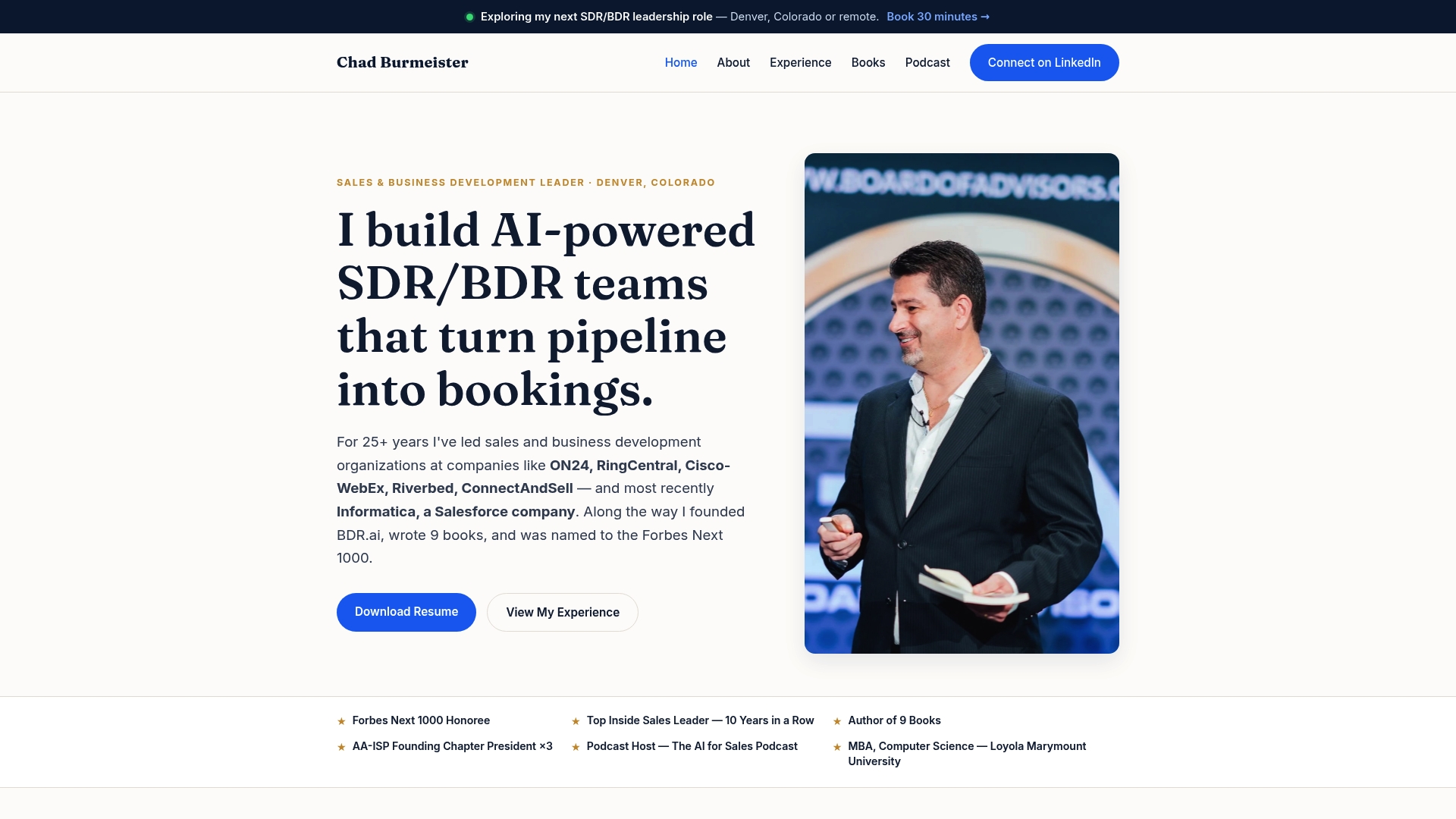
If you are building or fixing an SDR or BDR team, we can help. Chad Burmeister brings 25+ years of scaling sales and business development teams at companies such as Informatica, RingCentral and Cisco-WebEx, and he is the author of nine books and host of The AI for Sales Podcast.
For leadership teams, we offer speaking and workshop engagements built around the competencies in this guide. See the speaking and workshops page or start at chadburmeister.com to get in touch.
FAQ
What are the most important sales leadership competencies?
Coaching, strategic and tactical thinking, decisiveness, accountability, talent building and emotional intelligence cover most of what separates leaders from top sellers. If you can only build one first, build coaching. It reveals gaps in the others and compounds across the whole team.
How do I assess a sales leader's competencies?
Start with stage match, then use scored behavioral questions, a work sample and references from former direct reports. For leaders already on your team, add a 360 view against the same list. Score evidence against a written rubric before you compare people.
What is a sales leadership coaching model?
It is a repeatable system for developing reps: a set rhythm of one-on-ones, observation of real calls, one behavior focus at a time, practice and follow-through. Frameworks such as Keith Rosen's LEADS model emphasize asking more questions and giving less advice.
How do I know if sales coaching is improving performance?
Track coaching activity and observable behavior change first, then leading indicators such as stage conversion and ramp time, then outcomes such as win rate and the share of reps at quota. Allow at least one full sales cycle before judging results.
Do the same competencies apply to SDR and BDR managers?
Yes, with a faster cadence. SDR leaders coach closer to the call, review activity and conversion weekly, and hire heavily for coachability and resilience.
Sources
- What Top-Performing Sales Managers Do Differently (Harvard Business School)
- 6 Traits of Successful Sales Leadership (Salesforce)
- Sales Leadership by Keith Rosen (Wiley)
- Managerial coaching and sales performance (International Journal of Productivity and Performance Management)
- Community building examples that work