
This article gives you a categorized, scoreable question bank plus a staged interview framework for hiring VPs of Sales, sales managers, and SDR/BDR managers. The categories and stage-match logic draw on guidance from SaaStr, LLR Partners, and 25 years of sales leadership experience from Chad Burmeister. Run the screening shortlist first to filter fast, then save the deep-dive prompts and practical exercises for candidates who clear that bar.
TL;DR:
- Candidates with significantly different ARR, team size, or deal cycle from your company may struggle to adapt, but their willingness to adjust can be more important than their experience.
- Specificity in answers about past results, such as exact ARR or deal size, strongly predicts their ability to manage real revenue targets.
- For early-stage companies, prioritize execution and stage match in scoring, while later-stage firms should focus more on strategy and leadership capabilities.
- Standardizing questions, scoring rubrics, and reference checks ensures fair evaluation and reduces bias across all candidates.
- Asking for concrete examples of sales forecasts, hiring decisions, and coaching strategies reveals practical skills more reliably than charisma alone.
Table of Contents
- How to Use These Sales Leader Interview Questions
- 18 Screening Questions to Ask a Sales Leader Candidate
- Deep-Dive Questions and What Strong Answers Sound Like
- Matching Questions to the Role and the Stage
- Scoring Candidates Without Relying on Gut Feel
- Building an Interview Process That Actually Validates the Résumé
- Practitioner Tools From 25 Years of Sales Leadership Hiring
- Legal and Ethical Boundaries When Interviewing Sales Leaders
- Removing Bias From the Sales Leader Hiring Process
- The One Signal That Beats Everything Else
- How Chad Burmeister Can Help You Get This Hire Right
- Sources
- FAQ
How to Use These Sales Leader Interview Questions
Not every question belongs in every conversation. A 30-minute screening call needs different tools than a 90-minute operational deep dive, and mixing them up wastes everyone's time.
Screening questions should be fast to ask and fast to disqualify on: fit, motivation, and basic stage awareness. Deep-dive questions come later, once you know the candidate is worth two hours of your team's attention, and they demand specifics: names, numbers, dates, dollar figures.
Before that deep-dive conversation, hand senior candidates real context. SaaStr's guidance on VP of Sales interviews recommends sharing your ARR, growth rate, headcount, selling motion, and current AI stack ahead of time. A candidate who shows up without having studied that packet, or who can't connect their answers to it, is telling you something about how they'll operate on the job.
Stage match is the variable most hiring managers skip and regret skipping. A leader who scaled a team from 20 reps to 200 at a $50 million ARR company may struggle badly running a 6-person team at a $2 million startup, and vice versa. Verify it in minutes, not hours:
- Ask for their company's ARR and headcount at the start and end of their tenure.
- Ask what the average deal size and sales cycle looked like.
- Ask whether they inherited the team or built it from scratch.
- Compare those numbers directly against your own company's stage before you go further.
If the stage gap is wide, don't disqualify automatically. Ask them directly how they'd adapt. Their answer to that question often matters more than the résumé line itself.
18 Screening Questions to Ask a Sales Leader Candidate
These are built for a first call, roughly 30 minutes, aimed at filtering fast rather than exploring deeply. Listen for specific numbers, real company names, and named individuals. Vague answers here are a preview of vague answers later.
- "Why are you leaving your current role, and why this company?" Reveals motivation and whether they've actually researched your business.
- "Walk me through your last three roles and what changed at each company because you were there." Listen for measurable before/after change, not job descriptions.
- "What was your team's ARR and headcount when you joined, and when you left?" This is your fastest stage-match check.
- "How do you define your leadership style in one sentence?" Watch for a real answer versus a recycled buzzword.
- "Describe the last person you hired into a leadership role under you." Tests whether they've actually built a bench, not just managed one.
- "Describe the last person you fired, and why." A candidate who dodges this or blames the rep entirely is worth a hard look later.
- "How do you build and manage a sales forecast?" Listen for a named method or tool, not "I just check in with reps weekly."
- "What's your approach to territory and quota design?" Specifics on how they split accounts or set numbers signal real operational depth.
- "What sales methodology does your team run on, and why that one?" MEDDIC, Command of the Message, Sandler, whatever it is, they should name it and defend it.
- "How do you calculate quota attainment and what's an acceptable range?" A leader who can't state a target percentage hasn't managed a number-driven team.
- "How is your team compensated, and did you design that plan?" Comp design experience is a strong differentiator for VP-level candidates.
- "How do you use AI tools in your current sales motion?" SaaStr flags this as one of the highest-signal new questions for 2026 hiring.
- "What's changed about your ideal rep profile in the last three years?" Tests whether they're actually adapting to the market or running an old playbook.
- "Who's the best person in your network you'd hire first here?" A real name with context beats a vague "I know a lot of good people."
- "What's your coaching cadence with reps who are missing quota?" Listen for a specific rhythm, weekly one-on-ones, deal reviews, call shadowing.
- "What's the biggest mistake you made as a leader, and what did you change?" Self-awareness under pressure is hard to fake convincingly.
- "How do you handle a rep who's a top performer but toxic to the team?" Reveals whether results trump culture in their decision-making.
- "What tradeoff would you not be willing to make to hit a number?" Candidates who can't name one usually haven't been tested yet.
Deep-Dive Questions and What Strong Answers Sound Like
Once a candidate clears screening, the deep dive is where you separate people who talk well about sales leadership from people who've actually done it. Give each core category three to five follow-ups and push for specifics every time.
On operations and forecasting, ask them to walk through last quarter's forecast versus actual, deal by deal if needed. A strong answer includes real percentages, named CRM fields or tools, and an explanation of where the forecast broke down. A weak one stays at "we were generally close."
On leadership and coaching, ask them to describe how they turned around an underperforming rep, from diagnosis to result. Good answers include a timeline (60 days, 90 days), specific coaching actions, and a measurable outcome. Vague answers ("I just believed in them") are a red flag, especially paired with no mention of ever letting someone go.
On sales process and methodology, ask what they'd change about your current process in the first 30 days, based on what little they know. Strong candidates ask clarifying questions first, then commit to a specific hypothesis rather than hedging.
On metrics and compensation, ask them to defend a comp plan they built, including what tradeoffs it forced. Listen for numbers: quota-to-OTE ratios, accelerators, clawback terms.
Pro Tip: If a candidate can't name a single hiring mistake or a rep they should have let go sooner, that's not humility. It usually means they haven't managed long enough at scale to make one.

Matching Questions to the Role and the Stage
A VP of Sales interview and an SDR manager interview should not use the same script. Calibrate both the questions and your expectations to the level and the company stage before the conversation starts.
VP or Head of Sales: Push on strategy and network depth. Ask for a rough 90 to 120-day revenue plan based on what they know about your company so far, and ask who from their network they'd hire into the first open role. LLR Partners frames executive interviews around three buckets: can they lead, can they build winning teams, and can they build repeatable processes, which is a useful filter for deciding which deep-dive questions matter most at this level. VP candidates should also speak fluently to multithreading across enterprise stakeholders if your deals involve complex buying committees.
Sales manager: Focus on hiring, coaching, and territory design. Ask for a concrete example of developing a middle-of-the-pack rep into a top performer, including what changed and how long it took.
SDR or BDR manager: Center on pipeline generation metrics. Ask about outbound cadence design, ramp time for new hires, and coaching frequency. A strong SDR manager can state ramp time in weeks and quote a specific meetings-booked target per rep per month.
Before finalizing any offer, run a quick stage-match checklist:
- Your company's current ARR versus theirs at their last two stops.
- Typical team size they managed versus the team size they'll inherit.
- Average deal size and cycle length, then and now.
Scoring Candidates Without Relying on Gut Feel
Charisma is not a hiring qualification, and a structured scorecard is the fastest way to keep it from driving your decision anyway. Axe Recruiting's guidance on evaluating sales leaders points to weighting execution and stage match heavily over polish or presentation skill.
Score each candidate on a 1 to 5 scale across five axes:
- Strategy: Can they articulate a realistic plan for your next two quarters?
- Execution: Do their examples include real timelines and outcomes?
- People: Have they built, coached, and (when needed) exited talent with evidence?
- Metrics: Do they speak fluently in forecast accuracy, attainment, and comp structure?
- Stage match: How close is their background to your ARR, team size, and deal size?
Weight the axes differently depending on the hire. An early-stage company hiring its first sales leader should weight execution and stage match highest, since building from zero is a different skill than optimizing an existing machine. A later-stage company should weight strategy and people more heavily, since the job shifts toward scaling what already works.
That mini-profile would land as a maybe, not a yes: strong on people and strategy, but the stage gap is wide enough to warrant a direct conversation about how they'd adjust to a much smaller operation.
Building an Interview Process That Actually Validates the Résumé
A single interview, however sharp the questions, cannot validate everything a résumé claims. Axe Recruiting recommends a staged process built around screening, an operational deep dive, a strategic assignment, and extended reference checks.
- Screening call (30 minutes). Filter on motivation, basic fit, and rough stage match using the shortlist above.
- Operational deep dive (60 to 90 minutes). Push into forecasting, coaching, comp design, and process ownership with the follow-up questions above.
- Strategic assignment (take-home, one week). Give the candidate a standardized data packet, ARR by segment, pipeline coverage, last-quarter attainment, and comp plan, and ask for a written 90-day plan or a critique of your existing comp structure. Standardizing the packet across candidates makes the results genuinely comparable.
- Reference checks (6 to 10 calls). Call former peers, direct reports, and a boss, not just names the candidate hand-picked. Ask each one the same three questions: what did this person's team look like when they arrived and when they left, how did they handle a rep who wasn't working out, and would you hire them again. Patterns that repeat across independent references are far more reliable than any single glowing recommendation.
Practitioner Tools From 25 Years of Sales Leadership Hiring
The author has more than 25 years of sales and business development leadership experience and has conducted many sales leader interviews to identify effective hiring questions.
A few templates worth stealing directly:
- Reference call opener: "Tell me what this person's team looked like on day one and on their last day, in numbers if you can."
- The firing probe: "Walk me through the last person you had to let go, from the first sign of trouble to the final conversation."
- 0 to 90-day checklist for a new sales leader hire: clear ARR or pipeline target, one hiring or firing decision made, one process documented, and one forecast delivered on time.
Pro Tip: If you want a second opinion on a borderline candidate, run their answers past someone who has personally scaled a team through your exact stage. Stage-specific pattern recognition is hard to substitute with a generic HR rubric.
Legal and Ethical Boundaries When Interviewing Sales Leaders
Interview questions that reveal genuine operational judgment can still cross legal lines if you're not careful about how they're framed. In the United States, questions touching age, disability, family status, national origin, religion, or pregnancy are off limits regardless of how they're disguised, even when the intent is harmless curiosity rather than discrimination.
A common trap in sales leadership interviews is asking about "energy" or "stamina" as a proxy for age, or asking about "availability for travel" in a way that fishes for family obligations. Rephrase both around the actual job requirement: ask directly whether the candidate can travel 25% of the time next quarter, not whether they have kids at home.
The firing question above is legitimate and useful, but keep it focused on process and decision-making, not personal details about the terminated employee that have nothing to do with performance. Asking "what was the performance issue and how did you handle the conversation" is fair. Asking about that former employee's personal circumstances is not.
Document your scoring rubric before interviews start, and apply it consistently across every candidate for the same role. Inconsistent criteria applied after the fact are one of the most common ways a hiring process ends up exposed to a discrimination claim, even when no one involved intended any bias. When in doubt on a specific question, run it past your company's employment counsel rather than guessing.

Removing Bias From the Sales Leader Hiring Process
The strongest sales leader hiring processes use the exact same question set and scoring rubric for every candidate at a given level. Improvising new questions for candidates you personally like, while running a stricter script for candidates you're less sure about, introduces bias before you even realize it's happening.
A few practical habits reduce that risk:
- Have at least two interviewers score every candidate independently before comparing notes, so one person's first impression doesn't anchor the whole panel.
- Source candidates from more than one network. If every VP of Sales candidate comes from the same referral chain, you're likely seeing a narrow slice of the market.
- Normalize the weight given to nontraditional paths. A candidate who built a sales org inside a services or agency environment, where relationship-driven selling dominates, often brings coaching instincts that translate well even without a classic SaaS résumé.
- Avoid penalizing candidates for career gaps or lateral moves without asking about the context first.
- Standardize the take-home assignment's scope and grading criteria before candidates receive it, not after you've seen the results.
None of this means lowering the bar. It means making sure the bar is applied the same way to everyone who walks through the process, so the candidate who gets the offer is the one who actually performed best against a consistent standard, not the one who happened to interview on a good day with a favorably disposed panel.
The One Signal That Beats Everything Else
If you strip away every question in this bank, one signal predicts sales leadership performance better than the rest: specificity paired with stage match. A candidate who can name the exact ARR their team hit, the exact rep they fired and why, and the exact quarter their forecast broke down is telling you something a polished, general answer never will.
I've watched hiring managers get seduced by confidence and charisma more times than I can count, only to discover three months in that the new leader had never actually built a comp plan or managed a forecast at the scale the job demanded. The résumé said "VP of Sales." The specifics said otherwise.
Ask for the number. Then ask for the number behind that number. The candidates who can keep answering are the ones worth hiring.
— Chad
How Chad Burmeister Can Help You Get This Hire Right
Running this entire process solo, screening, deep dives, strategic assignments, and 6 to 10 reference calls, takes real time most hiring managers don't have. Consulting and workshop services are available to address common hiring challenges such as stage-match calibration, coaching cadence design, and AI-driven pipeline strategy, benefits explained in Lead nurturing explained: Boost conversions with effective strategies.
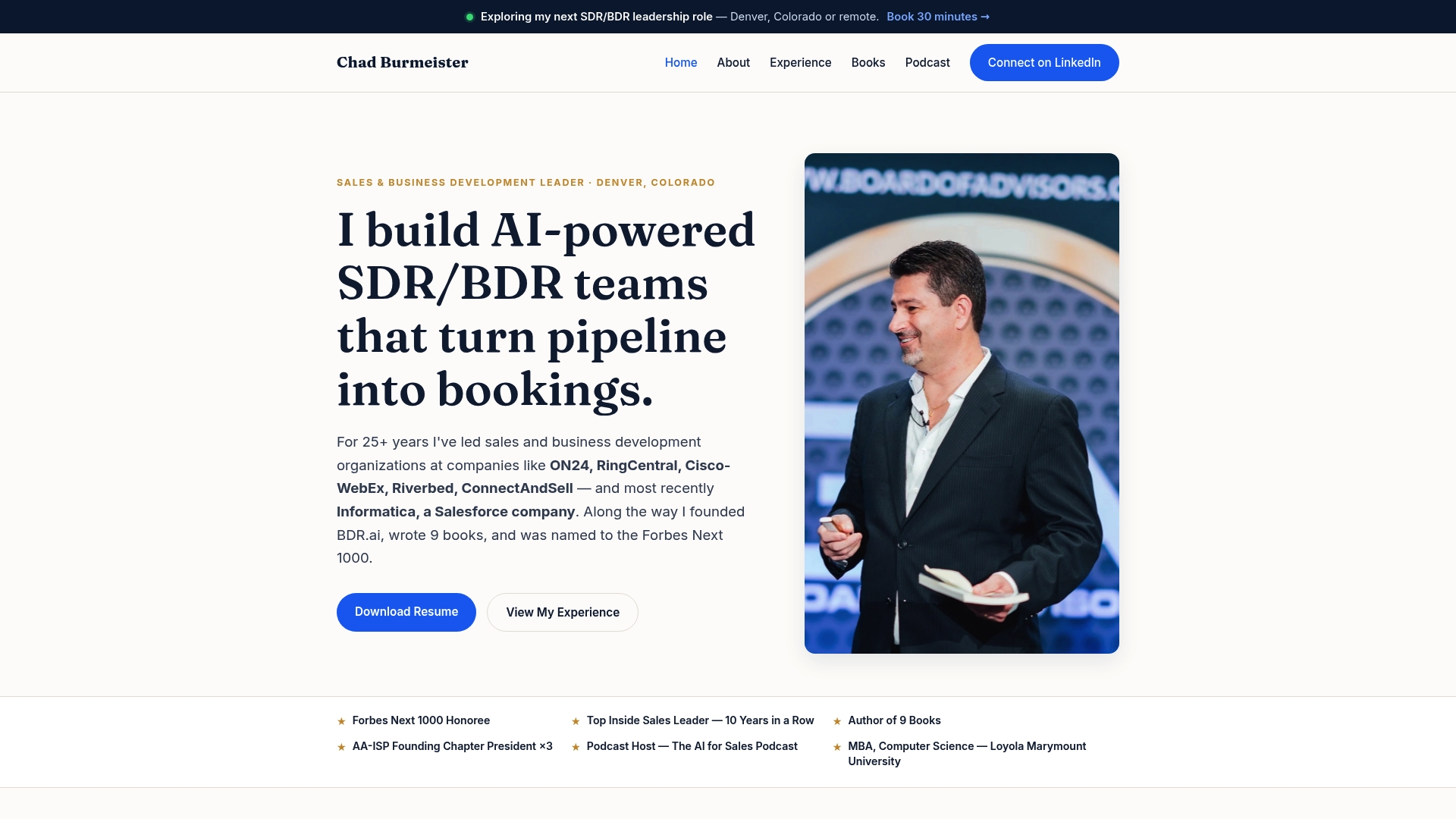
If you're weighing whether to bring in outside help on a search or want a second set of eyes on a final-round candidate, Chad Burmeister's site outlines the consulting and speaking engagements available. For hiring teams that want the deeper playbooks behind these questions, Chad's books on AI for Sales and B2B lead generation walk through the same frameworks in more depth. Reach out through the site to talk through your specific search before you make an offer.
Sources
- The Top 15 Questions to Ask a VP of Sales During an Interview (Updated for 2026) | SaaStr
- How You Should Really Interview a Head of Sales | LLR Partners
- How to Evaluate a Sales Leadership Candidate | Axe Recruiting
FAQ
What Are the 5 C's of Interviewing?
Definitions vary across sources, but a common version covers competence, character, communication, culture fit, and commitment. For sales leader interviews specifically, competence and character carry the most weight since they're the hardest to fake over a short conversation.
What Is the 30-60-90 Rule in an Interview?
It refers to asking candidates for a 30-60-90 day plan outlining what they'd tackle in their first month, quarter, and beyond. For sales leader interviews, this works better as a 90 to 120-day revenue plan tied to your actual ARR and pipeline data.
What Are the Top Leadership Interview Questions?
The highest-signal ones focus on hiring and firing decisions, coaching a struggling performer, forecast accuracy, comp plan design, and a concrete plan for the first 90 days, all covered in the screening and deep-dive sections above.
What Are the Hardest Sales Leadership Interview Questions?
The toughest ones force candidates to admit failure: describing the last person they fired, naming their biggest leadership mistake, or stating a tradeoff they refused to make to hit a number. Candidates without real leadership experience struggle most with these because there's no rehearsed answer that sounds convincing.
How Do I Know if a Candidate's Experience Matches Our Stage?
Compare their prior company's ARR, headcount, and average deal size directly against yours, then ask how they'd adapt if there's a meaningful gap. Stage match is one of the most reliable calibration checks in the entire interview process.