
That structure, documented across multiple industry guides, balances income stability with enough upside to keep reps dialing.
This week, do three things: set your OTE and write a crisp SQO definition, configure a monthly payout cadence, and add a 60–90 day non-recoverable ramp draw for any new hire. Those three moves eliminate the most common disputes before they start.
The core elements of a solid plan:
- OTE: a median around $85,000 for mid-market B2B in the U.S.
- Pay mix: 70% base / 30% variable as the default; adjust by role and motion
- Primary KPI: SQOs accepted by AE (not meetings booked)
- Secondary KPI: Closed-won revenue kicker with a modest percentage of ACV
- Quota rule: Annual SQO quota set at 5x–8x OTE
- Payout cadence: Monthly for SQO commission; quarterly for revenue kicker
Pro Tip: *Write your SQO definition in plain language, post it in your CRM as a required acceptance field, and require the AE to click "Accept" or "Reject" with a reason.
Key Takeaways
| Point | Details |
|---|---|
| Default pay mix | Use 70/30 base-to-variable; shift to 60/40 for high-velocity outbound or 80/20 for entry-level roles. |
| OTE and quota math | Set OTE using a 5:1–8:1 quota-to-OTE ratio; U.S. median OTE clusters near $85,000. |
| Primary KPI | Pay on AE-accepted SQOs, not meetings booked, to reduce gaming and improve pipeline quality. |
| Ramp and draw | Use a non-recoverable draw at 100/75/50% of variable target across months 1–3 of ramp. |
| Chadburmeister | Chad Burmeister offers comp design workshops, SDR playbook audits, and executive leadership engagements for teams building or rebuilding their SDR motion. |
Table of Contents
- How do you build an SDR compensation plan step by step?
- How do KPI choices and pay mix actually change rep behavior?
- What do inbound and outbound SDR commission templates look like?
- What operational rules do you need to run the plan cleanly?
- What mistakes do sales leaders make when designing SDR compensation?
- Chad Burmeister's checklist before you finalize your SDR comp plan
- How does company size and industry change the right SDR comp structure?
- What legal and compliance issues affect SDR compensation plans?
- How do you align the SDR compensation plan with broader sales team goals?
- When should you update your SDR compensation plan?
- The tradeoffs that actually matter when advising SDR teams
- What Chad Burmeister offers sales leaders building SDR compensation plans
- Sources
How do you build an SDR compensation plan step by step?
A comp plan built in the wrong order creates problems that are hard to unwind. Start with OTE, work backward to quota, then choose KPIs and operational rules. Here is the sequence.
Step 1: Choose OTE using quota-to-OTE ratios
The formula is straightforward: divide your expected annual SQO pipeline value by the quota-to-OTE ratio to land on a realistic OTE. Industry benchmarks put that ratio at 5:1–8:1, meaning an SDR with a $500,000 annual SQO quota should earn an OTE between $62,500 and $100,000.
Worked example:
- Annual SQO quota target: $600,000 in pipeline
- Quota-to-OTE ratio: 6:1
- OTE = $600,000 divided by 6 equals a reasonable OTE value.
- Base (70%): $70,000 | Variable (30%): $30,000
2026 benchmark data shows median U.S. SDR OTE near $85,000, with base salary typically landing between $55,000 and $65,000 on a standard 70/30 split. Use those numbers as a sanity check, not a ceiling.
Step 2: Set the base/variable split
The split you choose shapes who applies and how they behave once hired.
- 70/30 (default): Works for most mid-market B2B SDR roles. Attracts candidates who want stability with real upside.
- 60/40: Better for high-velocity outbound teams where reps control their own pipeline volume and tenure is longer.
- 80/20: Appropriate for entry-level roles or markets where SDR talent is scarce and you need to compete on base.
- 50/50: Rarely recommended for SDRs. Reserve it for senior BDR roles with strong deal influence. (See the BDR vs SDR breakdown for when that distinction matters.)
Sample math at 70/30 pay mix: At full quota attainment, commissions align proportionally to the variable amount.
Step 3: Choose KPIs and define SQO
Primary KPI should be SQOs accepted by an AE, per Salesforce's guidance on SDR commission plans. Secondary options include meetings progressed to next stage or a closed-won revenue kicker.
SQO definition checklist (write all five into your CRM):
- Decision-maker or economic buyer confirmed present
- Pain or business problem explicitly stated by the prospect
- Budget range confirmed or not disqualified
- Timeline to decision within 12 months
- AE has accepted the opportunity in CRM within 48 hours of handoff
Without a written definition, every disputed SQO becomes a manager judgment call. That gets expensive fast.
Step 4: Set quota rules and ramp percentages
Quota targets vary by deal size. Typical ranges exist by segment, with new hires generally given a ramp-up period starting at reduced quota and increasing over several months. Pair this with a non-recoverable draw to support onboarding.
How do KPI choices and pay mix actually change rep behavior?
The KPI you pay on determines what your SDR does at 9 AM every day. Pay for meetings booked and you get meetings. Pay for accepted SQOs and you get qualified pipeline. The difference compounds over a quarter.

Here is how the most common KPI choices stack up against revenue alignment and gaming risk:
| KPI | Revenue alignment | Gaming risk | Best use case |
|---|---|---|---|
| Meetings booked | Low | High (no-shows, unqualified) | Early-stage teams with no AE capacity to filter |
| SQOs accepted by AE | High | Low (AE acts as gate) | Default for most B2B SDR roles |
| Meetings progressed to next stage | Medium | Medium | Hybrid plans as a secondary metric |
| Activity metrics (calls, emails) | Very low | Very high | Training periods only, not comp |
| Closed-won revenue share | High | Low | Senior BDR or account-based roles |
The Salesforce SDR commission guide recommends exactly this structure, with the kicker set at 3–5% of ACV for sourced deals that close.
The behavioral math is simple: if you pay only for meetings, a rep who books 20 no-shows earns the same as one who books 10 solid conversations. Add the SQO gate and the incentive flips. Reps start pre-qualifying harder because their commission depends on AE acceptance, not just calendar entries.
Pro Tip: The SQO definition is only as good as its enforcement. Add a mandatory "AE Acceptance" field in your CRM with a dropdown (Accept / Reject / Needs More Info) and a required free-text reason for any rejection. Review rejection reasons weekly. Patterns in rejections tell you exactly where your SDR qualification is breaking down, and they give you coaching material that is far more specific than quota attainment alone.
For teams using sales engagement platforms to track activity, make sure those activity metrics feed a coaching dashboard, not a comp formula.
What do inbound and outbound SDR commission templates look like?
Two templates follow. Copy the structure, adjust the numbers to your ACV and stage, and hand to HR/finance for offer letter language.
Inbound SDR template
OTE: $80,000 | Base: $56,000 | Variable target: $24,000/year ($2,000/month)
Sample month calculation (rep hits 7 SQOs, response time at target):
- Response time bonus: $400
- SQO pay: 6 × $267 = $1,602 + 1 × $400 (accelerator) = $2,002
- Total variable: $2,402 (120% of monthly target)
Inbound SDRs work warmer leads, so response speed matters.
Outbound SDR template
OTE: $90,000 | Base: $63,000 | Variable target: $27,000/year ($2,250/month)
Sample month calculation (rep hits 5 meetings, 4 SQOs, touch quota met):
- Touch bonus: $225
- Meeting pay: 5 × $84 = $420
- SQO pay: 4 × $337 = $1,348
- Total variable: $1,993 (89% of monthly target — just under plan)
Outbound reps face longer cycles and colder prospects, so the higher OTE and heavier SQO weighting reflect that difficulty.
A few calibration notes:
- Raise per-SQO rates as ACV grows. At $100K+ ACV, $337/SQO is too low.
- Add a quarterly closed-won kicker at 3–5% of ACV for deals sourced by the SDR.
- For compensation software that automates these monthly calculations, look for tools that support tiered accelerators and AE-acceptance-triggered payouts.
What operational rules do you need to run the plan cleanly?
The plan design is only half the job. The other half is the operational infrastructure that prevents disputes, protects new hires, and keeps payouts accurate.
Quota by ACV band and ramp schedule
| Segment | ACV range | Monthly SQO quota | Ramp month 1 | Ramp month 2 | Full quota |
|---|---|---|---|---|---|
| SMB | Under $80,000 | 10 SQOs | 50% | 75% | Month 3 |
| Mid-market | $80,000–$600,000 | 5 SQOs | 50% | 75% | Month 3 |
| Enterprise | Over $75K | 3 SQOs | 60% | 80% | Month 4 |
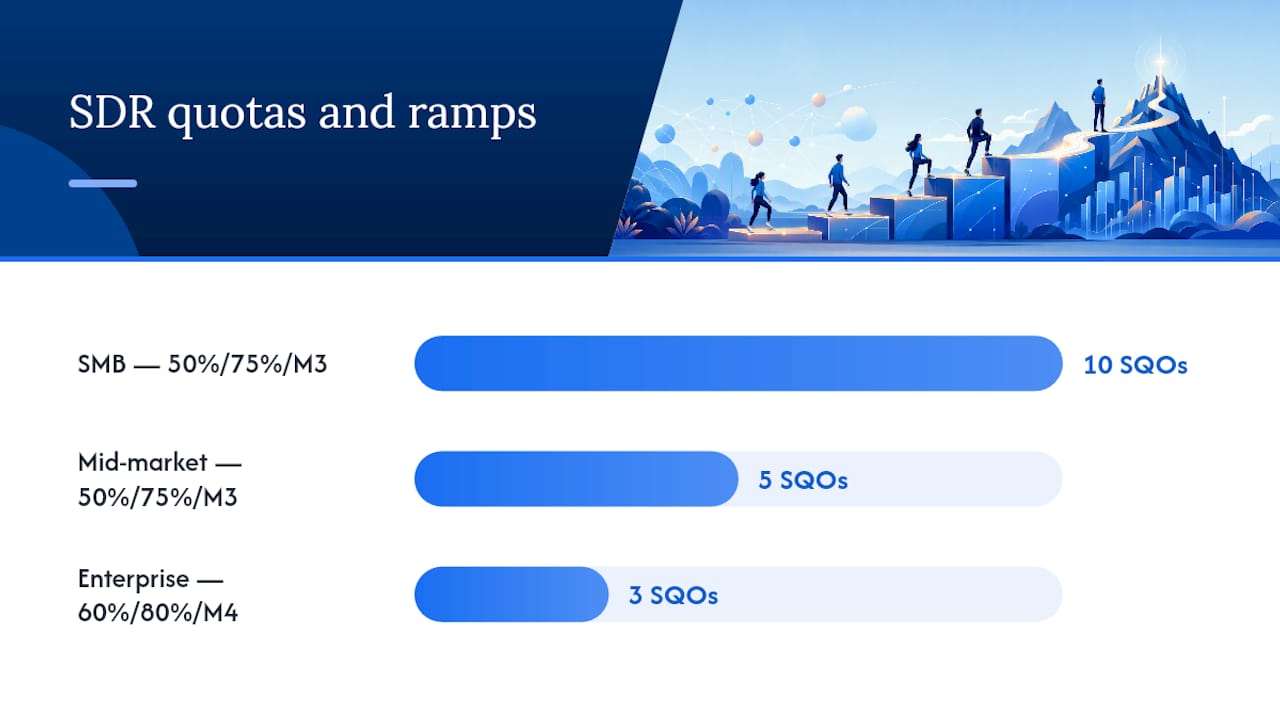
Enterprise ramps run longer because the sales cycle is longer and prospect lists are smaller. Holding a new enterprise SDR to full quota in month three is a fast way to lose them.
Non-recoverable draw for new hires
A non-recoverable draw means the company does not claw back draw payments if the rep leaves or underperforms during ramp. Industry practice favors this structure: 100% of variable target in month one, 75% in month two, 50% in month three, then live commission from month four.
Why non-recoverable beats recoverable for SDRs: recoverable draws create debt anxiety that kills learning velocity. A rep who owes the company money is not focused on pipeline. They are focused on their bank account.
Payout cadence
Pay SQO commission monthly. Automated BDR's 2026 compensation guide supports monthly cadence as the standard, noting that quarterly payouts are too slow for an activity-heavy role and weekly payouts add administrative overhead without meaningful motivation benefit. Run the closed-won revenue kicker quarterly, since deal close timing makes monthly kicker payouts impractical.
Clawbacks, credits, and credit windows
- No-shows: No payout until the meeting is rescheduled and held. Do not pay on a calendar entry.
- Reschedules: Hold the SQO credit in pending status for 30 days. If the meeting occurs and AE accepts, pay. If not, forfeit.
- Deal reversals: If a closed-won deal reverses within 90 days of close, claw back the revenue kicker. SQO pay is not clawed back since the SDR's work was complete.
- Credit window: SQO credit is awarded when the AE accepts in CRM, not when the meeting is booked. This is the single most important rule for reducing disputes.
SDR-to-AE handoff enforcement
A five-field handoff record completed before the AE meeting is the operational control that protects SDR qualification value. The five fields: company overview, pain points identified, objections handled, agreed next steps, and tech stack. Require all five to be populated in CRM before the SQO status can be set to "Accepted." AEs who skip the first-touch SLA (typically 24–48 hours) should have that tracked and reported to their manager weekly.
What mistakes do sales leaders make when designing SDR compensation?
Most SDR comp failures trace back to a small set of structural errors. Here are the ones that show up most often and what to do about each.
-
Paying only on meetings booked. This is the fastest path to a pipeline full of unqualified prospects. Fix: split pay between meetings accepted and SQOs, with SQOs carrying at least 60% of variable weight.
-
No written SQO definition. Without it, every disputed opportunity becomes a negotiation. Fix: write the definition, post it in CRM, require AE acceptance with a reason field.
-
No ramp draw for new hires. Reps who cannot cover rent in month one leave in month two. Fix: add a non-recoverable draw for 60–90 days.
-
Quota ramp that moves too fast. Jumping from 50% to 100% quota in 30 days is not a ramp, it is a cliff. Fix: use a three-step ramp (50/75/100) with an enterprise exception at four months.
-
Pay mix that creates churn. A 50/50 split for an entry-level SDR in a slow-cycle market means reps miss variable pay for months and leave. Fix: match the split to the role's revenue influence and cycle length.
-
Ignoring AE acceptance rates in performance data. If your AE acceptance rate drops below 70%, your SQO definition is broken or your AEs are cherry-picking. Watch this metric weekly.
-
No accelerator above quota. Reps who hit 100% and stop have no reason to keep going. Fix: add a 1.5x–2x accelerator on SQOs above quota.
Any one of those signals a structural problem, not a people problem.
Chad Burmeister's checklist before you finalize your SDR comp plan
Run through this before the plan goes into offer letters.
Structural checklist:
- Written SQO definition posted in CRM with required acceptance field
- AE acceptance SLA documented (24–48 hours) and tracked
- Five-field handoff record required before SQO status can be set
- Non-recoverable draw schedule documented and included in offer letter
- Payout cadence (monthly SQO, quarterly kicker) stated explicitly in comp agreement
- Legal and HR review of commission language completed before any offer goes out
Telemetry to run weekly:
- SQO dashboard: accepted vs. rejected, with rejection reasons
- AE acceptance rate (target: 70%+)
- Quota attainment median (target: 60%+ of reps at or above 100%)
- Handoff rework rate (AEs restarting discovery signals a definition problem)
Review cadence: Revisit the plan quarterly for the first year. Check whether quota targets still reflect market reality, whether accelerators are being hit, and whether the SQO definition needs tightening. Assign one owner for comp disputes, typically the VP of Sales or RevOps lead, and document the escalation path.
Pro Tip: Tie SDR promotion criteria explicitly to comp milestones. When reps can see the promotion criteria in the same document as their comp plan, retention improves and the career conversation becomes a coaching conversation instead of a retention panic.
How does company size and industry change the right SDR comp structure?
The 70/30 default works for most mid-market B2B companies, but it needs adjustment at the edges.
Seed and Series A: OTE is lower (often $65,000–$75,000), variable is harder to hit because the ICP is still being defined, and ramp draws are critical. Benchmark data confirms that seed-stage SDRs face higher OTE volatility and benefit from a more base-heavy split like 75/25.
Series B and C: The ICP is clearer, quota targets are more defensible, and the 70/30 default fits well. This is where SQO-primary plans with closed-won kickers work cleanly.
Series C+ and enterprise: Higher OTE, longer ramp, and account-based motions that may require different KPIs. Enterprise SDRs working named accounts benefit from a per-account-penetration metric alongside SQOs. Consider ABM-aligned comp structures where the KPI is multi-threaded engagement within a target account, not just a single meeting.
Industry adjustments:
- SaaS: Standard SQO model works well. Closed-won kicker is easy to track.
- Financial services and healthcare: Longer compliance cycles mean SQO-to-close timelines stretch. Reduce the closed-won kicker weight and increase the SQO rate to compensate.
- Manufacturing and industrial: Fewer total prospects, longer cycles. Lower monthly SQO quotas (2–3/month) with higher per-SQO rates.
What legal and compliance issues affect SDR compensation plans?
Commission plans are legal documents. Treating them as internal guidelines is a mistake that creates liability.
Written commission agreements are required in most U.S. states. California, Illinois, and New York have specific statutes governing commission pay, timing of payment, and what happens to earned commissions upon termination. In California, for example, commission agreements must be in writing and signed by the employee. Consult employment counsel before finalizing any plan in a state with active commission law.
Clawback language must be precise. A clawback clause that says "commission may be recovered if the deal reverses" is not enforceable in all jurisdictions. Specify the recovery window (e.g., 90 days from close), the triggering event (full deal reversal, not partial), and the recovery method (offset against future commission, not a direct debit from wages in states that prohibit wage deductions).
Draw agreements need to distinguish recoverable from non-recoverable. A recoverable draw creates a debt obligation. In some states, collecting that debt from wages is restricted. Non-recoverable draws avoid this entirely and are the cleaner legal structure for SDRs.
Pay timing laws vary by state. Most states require commission to be paid within a specific window after it is earned. Monthly payout cadence generally satisfies these requirements, but confirm with HR counsel for any state where you have SDRs.
Misclassification risk: SDRs classified as independent contractors rather than employees face different commission law protections. If your SDRs are employees (which they should be in most cases), their commission plan must comply with wage and hour law, including minimum wage floors that cannot be waived by a draw agreement.
This section is general information, not legal advice. Confirm your plan language with qualified employment counsel before issuing offer letters.
How do you align the SDR compensation plan with broader sales team goals?
An SDR comp plan that optimizes for SQO volume while the AE team is measured on deal size creates a structural conflict. Alignment starts with a shared definition of what a good opportunity looks like.
The most direct alignment lever is the closed-won kicker. When SDRs earn a percentage of ACV on deals they source that close, their financial interest matches the AE's. They start caring about deal quality, ICP fit, and whether the prospect has real budget, not just whether the meeting happened.
At the team level, connect SDR quota targets to the AE's pipeline coverage ratio. Work backward from that number to set the SDR quota, not forward from what seems achievable.
The SDR-to-AE handoff process is where alignment either holds or breaks. A clean handoff record with all five fields completed means the AE enters the first call informed, not restarting discovery. That saves AE time, improves show rates, and makes the SDR's work visible and valued.
At the company level, tie the SDR team's aggregate SQO target to the revenue plan. If the company needs $5M in new ARR and the average ACV is $50K, you need 100 closed deals. Divide by the number of SDRs to get individual quota. That math should live in a shared document that the SDR team, AE team, and finance all see.
When should you update your SDR compensation plan?
Most plans go stale within two quarters. The signals that a plan needs revision are usually visible in the data before anyone raises a complaint.
Review triggers:
- Median quota attainment drops below 60% for two consecutive months
- AE acceptance rate drops below 65%
- Voluntary SDR turnover exceeds 20% annualized
- A significant ICP shift or new product launch changes what a qualified opportunity looks like
- Competitive hiring pressure pushes market OTE above your current plan
Quarterly review process: Pull three metrics: median attainment, AE acceptance rate, and show rate. If all three are healthy, the plan is working. If one is off, diagnose before changing the comp structure. A low show rate is usually a qualification problem, not a comp problem. A low acceptance rate is usually a definition problem. Low attainment is usually a quota or ramp problem.
Annual reset: Rebuild quota targets from the revenue plan each year. If ACV has grown, if the ICP has narrowed, or if the SDR team has added headcount, the quota math changes.
When you do update the plan, give reps 30 days' notice before the new plan takes effect. Retroactive changes to commission structures are both legally risky and a fast way to destroy trust.
The tradeoffs that actually matter when advising SDR teams
The 70/30 default is right most of the time, but it is not always right. Here is how to think through the exceptions.
A base-heavy structure (80/20 or 75/25) makes sense when you are hiring in a tight labor market, when your ramp is longer than 90 days, or when your SQO definition is still being refined. Stabilize the definition first, then shift variable weight upward.
A variable-heavy structure (60/40) makes sense for experienced outbound SDRs in high-velocity motions where reps have real control over their pipeline volume and the SQO definition is airtight. The risk is that 60/40 filters out candidates who need income stability, which often means filtering out early-career talent. Know what profile you are hiring before you set the split.
The SDR-to-AE credit dispute is the most common cross-team friction point, and it is almost always a process failure, not a people failure. A CRM acceptance gate with a 48-hour SLA resolves most of it. The AE either accepts within 48 hours or the SDR escalates to the manager. No ambiguity, no negotiation. Simple rules protect both sides.
What Chad Burmeister offers sales leaders building SDR compensation plans
Building a comp plan that actually holds up takes more than a template. It takes someone who has run SDR teams at scale and knows where the structural failures hide.
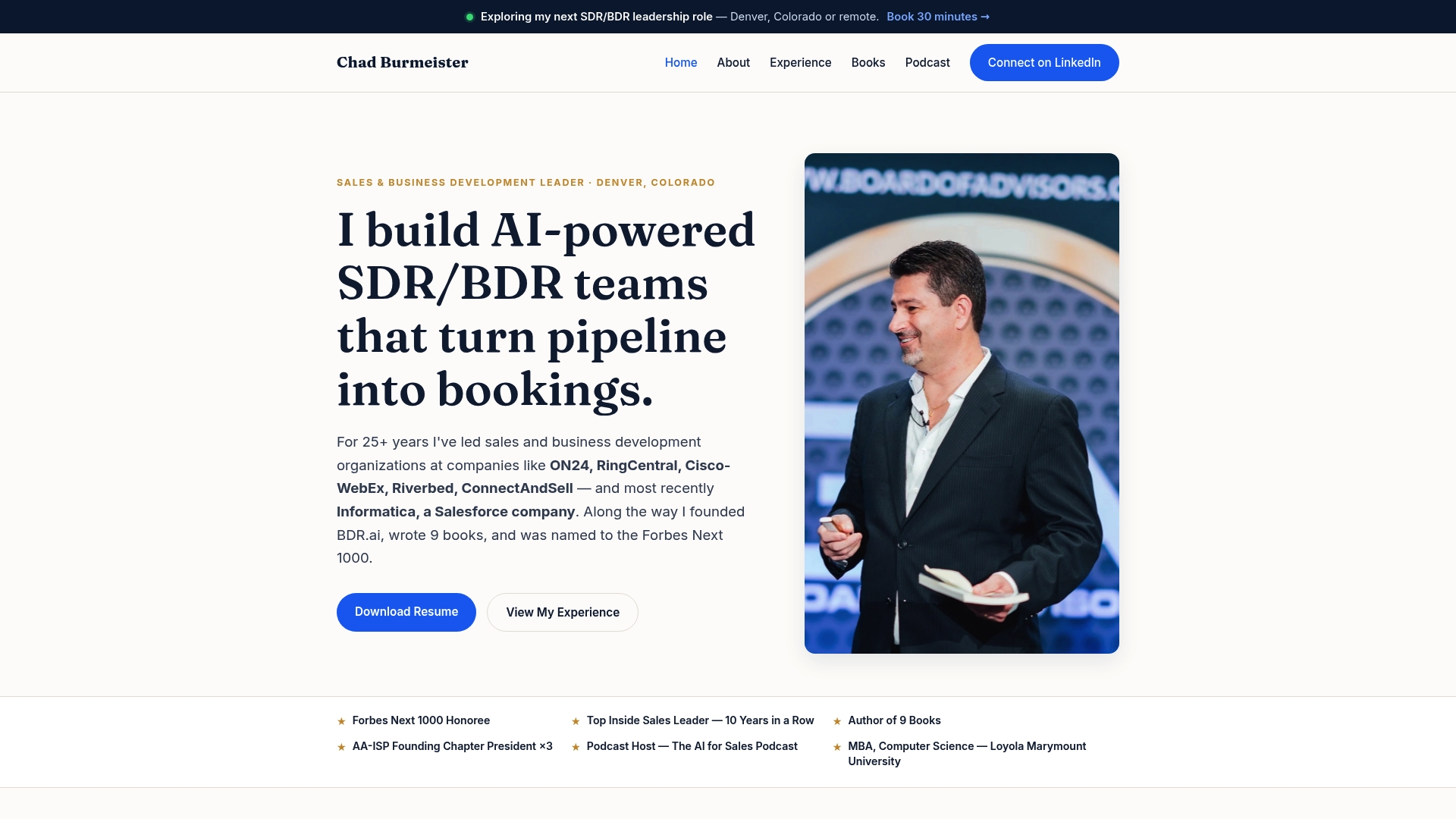
Chad Burmeister brings 25+ years of hands-on SDR and BDR leadership, with experience scaling pipeline teams at companies like RingCentral, Informatica, and Cisco-WebEx. For sales leaders and HR teams working through comp design, Chad offers executive SDR leadership engagements, compensation design workshops, SDR playbook audits, and speaking engagements tailored to your team's stage and motion.
If you want a second set of eyes on your plan before it goes into offer letters, or you need a workshop to align your SDR and AE teams on handoff and qualification standards, Chadburmeister to start the conversation. You can also pick up AI for Sales 2.0 and Mastering B2B Lead Generation with LinkedIn & AI at Chadburmeister for the frameworks Chad uses in every engagement.
Sources
- How to Pay Sales Development Rep: Full Guide | SyncGTM
- SDR Compensation: 2026 Benchmarks and Structures — Gangly Blog
- SDR Compensation Guide 2026: Salary, OTE, and Commission | Automated BDR
- SDR to AE Handoff Process: 6 Steps (with templates) | Rework Resources