A sales enablement audit is a structured review of everything that is supposed to help your reps sell: content, training, coaching, tools and the process that ties them together. You run it by mapping what exists to each deal stage, scoring how well it is used and where it is missing, ranking the fixes with your executive team, and writing the result into a charter that names owners and goals. This guide gives you that routine, the scorecard to run it with, and the way to carry the findings into a sales development charter.
TL;DR
- An audit answers four questions: what do we have, is it accurate, does it cover every buyer and stage, and do reps actually use it?
- Start from a baseline of win rate, ramp time and quota attainment so you can prove the fixes worked.
- Rank findings with leadership before you build anything. Fixing everything at once fixes nothing.
- Write the outcome into a charter: mission, scope, roles, owners and goals.
- For SDR and BDR teams, the charter should also set handoff rules and the first 90 days of ramp.
Table of Contents
- What a sales enablement audit covers
- Before you start: set the question and the baseline
- Step 1: Inventory and map your content
- Step 2: Check accuracy, coverage and usage
- Step 3: Review training, coaching and tools
- Step 4: Turn findings into ranked priorities
- Step 5: Measure whether it worked
- From audit to charter
- The sales development charter
- Common mistakes
- Bring the audit to your team
- FAQ
- Sources
What a sales enablement audit covers
Sales enablement, in the broad definition most practitioners use, is the ongoing work of giving sellers the information, training, content and tools they need to engage buyers. An audit asks whether that work is producing results or just producing material.
Five areas belong in scope:
- Content: pitch decks, one-pagers, case studies, battlecards, email templates, call scripts.
- Training and onboarding: new-hire ramp, product training, skills practice.
- Coaching: how managers inspect calls and give feedback, and how often.
- Tools and data: the CRM, sequencing and enrichment tools, and whether the data inside them can be trusted.
- Governance: who owns enablement, who approves messaging, and how priorities get set.
The terms "sales enablement assessment" and "sales content audit" show up in the same searches. In practice, an assessment is the whole review across all five areas, and a content audit is the first area done in depth. Most teams should start with content and the data on usage, because that is where the evidence is quickest to collect.
Before you start: set the question and the baseline
An audit without a question turns into a document inventory. Pick one business problem to anchor it. Typical ones: new SDRs take too long to book meetings, win rates fall at the proposal stage, forecasts keep slipping, or reps say they cannot find anything.
Then write down your baseline. Effectiveness is usually measured across three tiers: activity (training completion, content views), capability (skills gained, call quality) and business impact (win rate, ramp time, quota attainment). Capture today's numbers in each tier before you change anything. Without them you cannot say later whether the work paid off. If your pipeline data is messy, clean it first; our guide to pipeline cleanup for trusted forecasts shows how, and the sales team scorecard lists what to track.
Also decide who is in the room. Include a sales leader, a front-line manager, two or three reps (one top performer, one average, one new), marketing, and whoever owns the CRM. Rep interviews matter as much as dashboards, because they reveal why someone ignores a deck that usage reports show was shared 200 times.
Step 1: Inventory and map your content
List every asset reps might use: shared drives, the CRM, the enablement platform, Slack pins, and the private folders reps keep because they do not trust the official ones. Then build a content map by deal stage. Down the side, put your stages (prospecting, discovery, evaluation, proposal, negotiation, onboarding handoff). Across the top, put your buyer personas. Place each asset in the cell it serves.
The guidance on auditing a sales content library recommends scoring each asset against a goal-driven rubric. Attributes can include brand, format, stage, date, use case, persona and utilization. Patterns across those attributes point to your opportunities.
A workable rubric uses a 1 to 3 score on each of these:
| Criterion | What a 3 looks like | What a 1 looks like |
|---|---|---|
| Accuracy | Product, pricing and claims current within the last two quarters | Outdated names, retired features, wrong numbers |
| Stage fit | Clearly built for one stage and one problem | Generic, "use anywhere" material |
| Persona fit | Speaks to the economic buyer or user it targets | Written for no one in particular |
| Usage | Used in live deals and tied to progress | Never opened or shared |
| Findability | Reps locate it in under a minute | Buried, duplicated, or under three names |
If you want a second view of how well your written pages read to search and AI engines, an AI content optimization audit can flag structure and clarity issues on your public pages. It does not replace the stage-by-stage review of what reps use in live deals.
Step 2: Check accuracy, coverage and usage
Content reviews generally work through four layers: inventory, accuracy, coverage and usage. You have done inventory. Now do the other three.
Accuracy. Read every high-use asset against today's product, pricing and positioning. Flag anything that conflicts with what marketing and legal currently approve. Stale claims cost more than missing content, because a rep who sends a wrong number loses trust with the buyer.
Coverage. Look at the empty and crowded cells in your map. Empty cells at discovery and evaluation are common: teams over-invest in top-of-funnel decks and under-invest in material that helps a champion sell internally. Crowded cells signal redundancy, such as six near-identical case studies for one industry.
Usage. Pull view, share and download data, then compare it with deal outcomes. An asset with high usage in won deals and low usage in lost ones deserves promotion. An asset with high usage in lost deals deserves a rewrite. An asset nobody opens deserves retirement. We cover the human side, why reps ignore content that exists, in our piece on buyer mapping and AI to make reps use content.
Pair the numbers with loss data. Reviewing ten to twenty recent losses often shows which stage lacks support, and our walkthrough of loss reason analysis explains how to turn them into fixes.

Step 3: Review training, coaching and tools
Content is only one input. Next, test the rest of the system with a handful of direct questions.
Onboarding and ramp. How many days until a new rep or SDR books a first qualified meeting? Is there a written plan for the first 30, 60 and 90 days? Our SDR ramp playbook and scorecard gives a 0 to 90 day template you can compare yours against.
Skills. Do reps have a shared discovery method, or does each person improvise? A common framework shortens cycles because managers can coach to it. See six sales discovery frameworks for options.
Coaching. Count how many calls each manager reviews per rep per month and whether feedback is tied to a skill. Coaching that happens only when a quarter is at risk is not a program.
Tools and data. List every tool in the stack, who uses it, what it costs, and what decision it supports. Check contact and account data quality, because bad data undermines even excellent content. Our overview of data enrichment tools for B2B sales leaders is a starting point.
Technology adoption. Compare seats purchased with weekly active users. A tool with 20 percent adoption is a training or fit problem, not a tool problem, and the audit should say which.
Step 4: Turn findings into ranked priorities
The audit produces a long list. The value comes from ranking it. The Association for Talent Development recommends that you discuss assessment outcomes, needs and dependencies with leadership. Tie each initiative to an executive-level strategic objective, gain buy-in, and then set and rank priorities.
A simple scoring approach works:
| Initiative | Link to company goal | Impact on baseline metric | Effort | Dependency | Rank |
|---|---|---|---|---|---|
| Rewrite proposal-stage case studies | Raise win rate | High | Medium | Marketing capacity | 1 |
| Retire duplicate decks | Faster rep prep | Low | Low | None | 2 |
| Manager call-review cadence | Shorten ramp | High | Medium | Manager time | 3 |
The rows above are an illustration of format, not findings. Fill yours from your own data. Limit the first cycle to three initiatives. For each one, write the metric it should move, the owner, and the date you will check.
Some findings are not enablement problems at all. If forecasts are unreliable because deal stages are loosely defined, or if the team is hitting a wall that content cannot fix, the answer may be a deeper sales turnaround. Our guide on what a sales turnaround consultant does explains when that is the case.
Step 5: Measure whether it worked
Go back to the baseline you captured. After one or two sales cycles, compare activity, capability and business impact against it. Activity should move first (reps use the new material), capability second (call quality improves), and business impact last (win rate, ramp time, quota attainment). If activity moved and impact did not, the content or training is not addressing the real constraint, and the next audit cycle should look there.

Keep the review rhythm fixed: a light content check each quarter and a full audit once a year. Put both dates in the charter so they survive a change of leadership.
From audit to charter
An audit tells you what is wrong. A charter makes the fixes durable by saying who owns what. Forrester describes the revenue enablement charter as the document that identifies and communicates the function's mission, programs and performance goals, positioning enablement as the authorizing agency that pulls scattered efforts into one program.
There is evidence that this is worth the effort. CSO Insights' annual enablement research found that organizations with a formal charter outperformed those without, and that writing the charter and winning executive buy-in makes a formal approach easier to put in place. The Sales Enablement Collective frames its enablement charter playbook as giving direction and clarity on roles, responsibilities and plans for the enablement leader and key stakeholders, and it includes a template.
A one-to-two page charter should contain:
- Mission: one sentence on the business result enablement exists to move.
- Scope: which teams, products and stages are covered, and what is explicitly out.
- Goals: the three or four metrics from your baseline, with targets and dates.
- Roles and owners: who owns content, training, coaching standards, tools and data. Name people, not departments.
- Governance: how requests are submitted, who approves messaging, how conflicts are settled.
- Programs: the ranked initiatives from step 4.
- Review cadence: when you will re-audit and who sees the results.
The sales development charter
A sales development charter applies the same logic to your SDR or BDR team. It sets what the team is responsible for and what it hands off. Use your audit findings to fill it in:
- Responsibilities: which accounts and personas SDRs prospect, which channels they use, and how many qualified meetings they own.
- Qualification and handoff: the criteria for a meeting to count, what the account executive must receive, and how fast each side responds.
- Outcomes: meetings booked, qualified-opportunity rate, pipeline created, and conversion to closed-won, with a ramp target for new hires.
- Enablement commitments: which content, call frameworks and coaching cadence the team can expect.
- Data rules: required CRM fields and who fixes bad records.
If you are building or rebuilding an SDR team, the audit and the charter belong in the first month, before you add headcount. Hiring more reps into a system with stale content, no ramp plan and fuzzy handoffs multiplies the problem. For teams exploring added capacity, our 60-day nearshore SDR pilot covers hiring and compliance.
Common mistakes
- Auditing assets, not outcomes. A tidy library that does not move win rate is still a failed program.
- Skipping the rep interviews. Dashboards tell you what happened, and reps tell you why.
- Trying to fix everything. Three ranked initiatives beat fifteen unowned ones.
- No baseline. You will not be able to show results to the executives who funded the work.
- No owner. An audit with no named owner is a report, not a program.
Our perspective
After more than 25 years building sales and business development teams at companies including Informatica, RingCentral and Cisco-WebEx, we have learned that most enablement problems are diagnosis problems. Teams buy another tool or commission another deck before they know which stage of the pipeline is leaking. That is why we put the diagnosis first, in our workshop work and in our writing.
We also believe the audit has to end with a person's name next to each fix. A sales leader who owns the pipeline should be able to say what will change in 30 days, what will change in 90, and which number will show it. Enablement that lives in a slide deck rarely survives a reorg. Enablement tied to a charter, a scorecard and a coaching rhythm does.
For SDR and BDR teams the stakes are higher, because new reps have the least context and the least patience from buyers. Clear handoffs, one discovery method and a ramp plan do more for them than any library of content. Our approach to diagnosing the pipeline before the prompts applies the same thinking to AI: find the real constraint first, then decide what to automate.
Chad
Bring the audit to your team
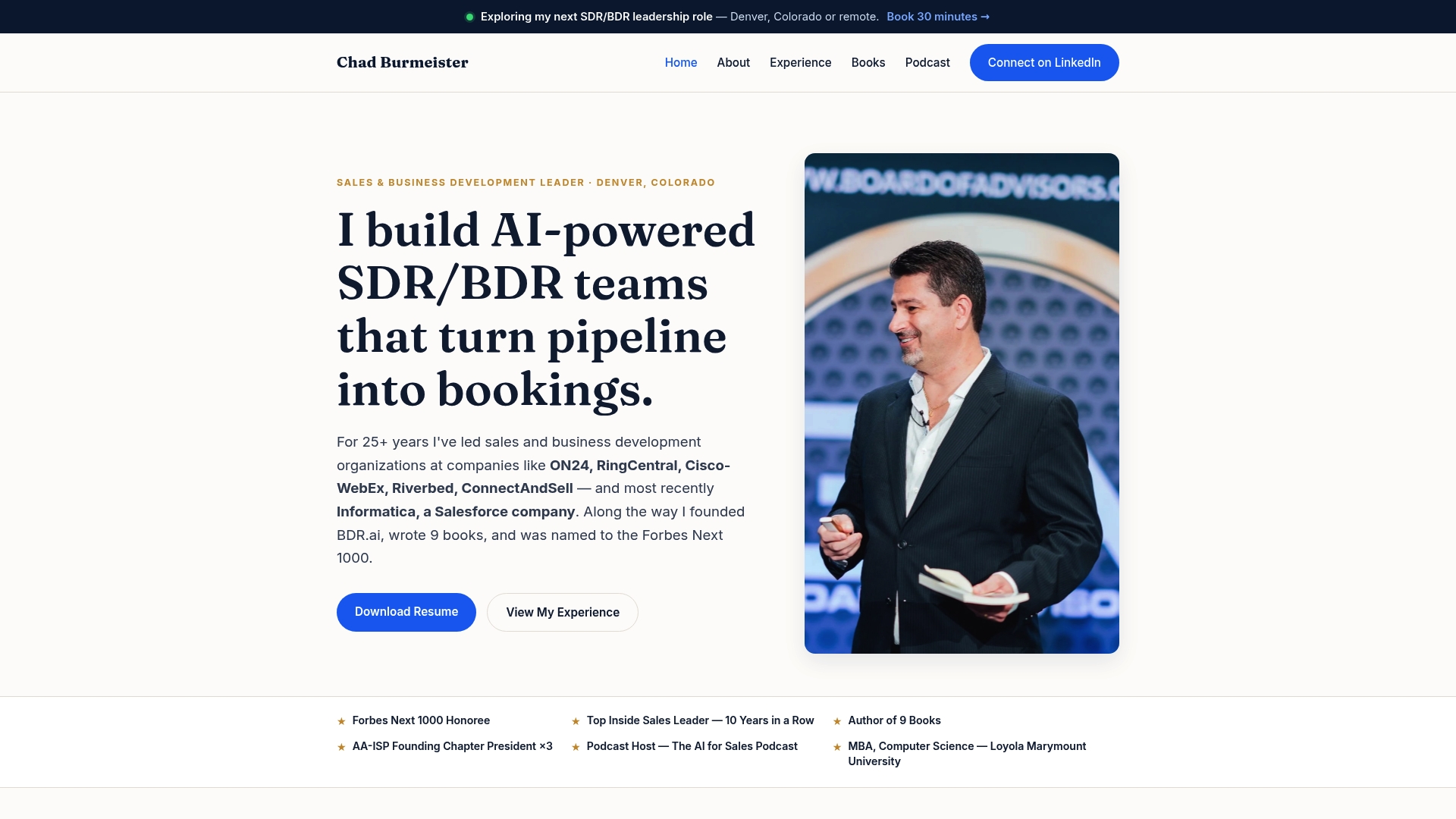
If you want a leader who has built high-performing SDR and BDR teams to run these sessions with your team, Chad Burmeister offers speaking and workshop engagements for sales organizations. Details are on the speaking and workshops page. Colorado-based, he is also the author of nine books on sales strategy and AI, including AI for Sales 2.0 and Mastering B2B Lead Generation with LinkedIn & AI.
Teams that prefer to learn on their own can also work through the Be Extraordinary curriculum.
FAQ
How long does a sales enablement audit take?
For a team of 10 to 30 sellers, plan on four to six weeks from kickoff to ranked recommendations. Most of the time goes to pulling usage data and scheduling rep and manager interviews. Narrow the first pass to one problem and one segment if you need results sooner.
What is the difference between a sales content audit and a sales enablement audit?
A content audit examines the assets reps use: accuracy, stage and persona coverage, and usage. An enablement audit covers content plus training, coaching, tools, data and governance. Start with the content audit when you need a fast win, then widen the scope.
What should a sales enablement charter include?
A charter should state the mission, scope, goals with metrics, named owners, governance rules, ranked programs and a review cadence. Forrester and the Sales Enablement Collective both describe it as the document that consolidates scattered efforts and clarifies who is responsible for what.
Who should own the audit?
A sales leader with authority over both the team and its priorities should sponsor it, with an enablement or sales operations lead running the work. Marketing, front-line managers and a few reps should take part. Executive sponsorship matters because the ranking step depends on leadership buy-in.
How often should we repeat it?
Run a full audit annually and a light content and usage check every quarter. Repeat sooner after a product launch, a major hiring wave or a change in target market, since each can make existing material outdated quickly.
Sources
- ATD: Selecting and Prioritizing Sales Enablement Initiatives for Impact, Part 2
- GTMnow: The Complete Guide to Auditing Your Sales Content Library
- Forrester: Establishing a Revenue Enablement Charter
- CSO Insights: 4th Annual Sales Enablement Report
- Sales Enablement Collective: Enablement Charter Playbook