Pick a framework that matches your deal, not the other way around. For consultative midsize deals, run a SPIN-style question sequence. For complex enterprise deals with multiple stakeholders, run MEDDIC or MEDDPICC. For fast-motion transactional sales, a tight BANT or minimum-viable checklist beats anything longer. Every one of the sales discovery frameworks below exists to do one thing: replace guesswork with a buyer's own words about pain, impact, and what happens if nothing changes.
TL;DR:
- Consultative deals benefit most from SPIN or Challenger frameworks, emphasizing buyer insights and understanding their own pain points.
- Complex enterprise sales require MEDDIC or MEDDPICC to identify stakeholders, decision criteria, and potential roadblocks through heavy pre-call research.
- Rapid, low-velocity deals are best qualified with BANT, focusing on quick qualification rather than deep understanding, with minimal prep time.
- Tailoring discovery questions to deal size and buyer stage improves effectiveness, with longer cycles involving multi-stakeholder mapping and specific role-based questions.
- Regular coaching, call recording, and scoring are essential to develop discovery skills, emphasizing the ability to articulate new buyer insights and next steps.
Table of Contents
- What Are the Main Sales Discovery Frameworks?
- How Do You Structure a 30-Minute Discovery Call?
- What Questions Should You Ask in a Discovery Call?
- How Do You Adapt a Framework to Deal Size and Buyer Stage?
- How Do You Train and Measure Discovery Skills?
- Why Buyer Clarity Beats Data Collection Every Time
- Scale These Frameworks Across Your Team
- Sources
- FAQ
What Are the Main Sales Discovery Frameworks?
Six approaches cover almost every situation a rep will face, and each one trades depth for speed differently.
SPIN (Situation, Problem, Implication, Need-payoff) came out of Neil Rackham's research at Huthwaite, built on analysis of thousands of recorded sales calls. It works because it sequences questions in an order that lets the buyer arrive at their own conclusion about urgency, rather than being told. It fits consultative, midsize deals where the buyer hasn't fully diagnosed their own problem yet.
MEDDIC and its extended cousin MEDDPICC (Metrics, Economic Buyer, Decision Criteria, Decision Process, Identify Pain, Champion, plus Competition and Paper Process) were built for complex enterprise sales with long cycles and multiple approvers. They demand heavy pre-call research and disciplined CRM hygiene, but they catch the deals that die quietly from a missing economic buyer or an undiscovered competitor.
BANT (Budget, Authority, Need, Timeline) is the oldest framework on this list and the fastest to run. It's built for qualification speed, not buyer insight, which is exactly why it gets criticized: it captures data for the seller more than it builds clarity for the buyer.
Challenger-style discovery flips the sequence. Instead of asking your way to the buyer's pain, you lead with a "commercial teaching" insight, something the buyer hadn't considered, and let their reaction reveal where the real problem sits.
Minimum-viable 3-step or 4-step frameworks strip discovery down to Gap, Impact, Change, or a similar short sequence: what's broken, what it's costing, what changes if it's fixed. These fit inbound leads, short sales cycles, or reps who need one solid question sequence to start with.
- SPIN: best for consultative deals; heavy coaching investment; question focus is buyer-centric.
- MEDDIC/MEDDPICC: best for enterprise, multi-stakeholder deals; heavy prep; mixed focus, buyer insight plus seller data capture.
- BANT: best for high-velocity, low-complexity deals; minimal prep; mostly seller-centric.
- Challenger-style: best for buyers who don't know they have a problem yet; moderate coaching complexity.
- Minimum-viable (3 to 4 step): best for early-stage reps or time-boxed calls; low prep, buyer-centric by design.
How Do You Structure a 30-Minute Discovery Call?
Every good discovery call has a repeatable shape, and most of the work happens before you dial.
Pre-call checklist (10 minutes of prep, minimum):
- Pull account triggers: funding news, leadership changes, job postings tied to your solution area.
- Map the stakeholders you know about and flag the ones you don't.
- Write down three specific insights or observations you want to test on the call, not generic questions.
The 30-minute call itself breaks into four blocks. Open with two minutes on rapport and a stated agenda: what you'll cover, how long it takes, and what happens after. This single move, sometimes called an AxNOT opener, increases buyer engagement because it removes the ambiguity of "so, tell me about your business." Spend the next 18 minutes in situation and problem questions, then implication questions that let the buyer size the cost of inaction. Reserve the final 8 minutes for need-payoff questions and a specific next step: a demo, a stakeholder introduction, or a proposal timeline.
Discovery has clear entry and exit criteria. You enter discovery with a qualified opportunity. You exit only when you can state the buyer's primary pain, its business impact, and the decision process without checking your notes. If you can't do that, you're not done, no matter how the call felt.

Pro Tip: Record every discovery call, even internally. The gap between how a call felt and what the transcript actually shows is where most reps lose deals without knowing why.
What Questions Should You Ask in a Discovery Call?
Discovery, done right, is distinct from qualification: qualification confirms fit, discovery builds understanding. Each question type does a specific job, and skipping one breaks the sequence.
Situation questions establish context without wasting time on things you could have found on LinkedIn.
- "Walk me through how your team handles this today."
- "How long has this process looked the way it does?"
- "Who else touches this workflow besides you?"
Problem questions surface friction the buyer may not have named out loud yet.
- "What's the most frustrating part of that process?"
- "Where does it break down most often?"
- "What have you already tried that didn't work?"
Implication questions are the ones most reps skip, and they're the ones that create urgency. SPIN's research found that top performers ask far more implication questions than average reps do, because these questions turn a minor annoyance into a quantified cost.
- "What does that delay cost you across a quarter?"
- "Who above you feels this problem when it happens?"
- "If this stays the same for another year, what breaks next?"
Need-payoff questions let the buyer articulate the value themselves, which sticks far better than you stating it.
- "If that were solved, what would change for your team?"
- "How would you measure whether this actually worked?"
Qualification and strategic questions round it out: "Who signs off on a change like this?" "What's driving the timeline, and is it firm?" "What does 'good' look like to your leadership six months from now?"
A short micro-script threading these together: "You mentioned onboarding takes three weeks. What's that costing you in lost deals during ramp?" (implication) → "If that dropped to one week, what would that free your managers to focus on instead?" (need-payoff) → "Who besides you would need to see that math to approve a change?" (qualification). One tight sample bank like this, borrowed and adapted from resources like Articulate's discovery question guide, outperforms a scattershot list of thirty generic questions nobody memorizes.
How Do You Adapt a Framework to Deal Size and Buyer Stage?
No framework survives contact with every deal unchanged. Use a quick decision guide instead of forcing every call through the same script.
- If the deal cycle is under 30 days and the buyer is a single decision-maker, compress to a 3-step Gap, Impact, Change sequence.
- If more than two stakeholders are involved, or the deal value crosses your team's enterprise threshold, run full MEDDPICC and budget extra prep time for stakeholder mapping.
- If the buyer hasn't identified a problem yet, open Challenger-style with an insight before asking any situation questions.
- If you're early in a long cycle with a warm inbound lead, SPIN's implication and need-payoff questions do more work than a qualification checklist.
Multi-threading changes the question set, not just the number of calls. A champion needs implication questions that help them build an internal business case. An economic buyer needs qualification questions about budget cycles and competing priorities. A technical evaluator needs situation questions about integration and security, not implication questions about business cost. Mapping questions to a multi-threading playbook before the call keeps you from asking a CFO the same question you'd ask an IT admin.
How Do You Train and Measure Discovery Skills?
Discovery skill decays fast without deliberate reinforcement, and most teams underinvest in the coaching half of any framework.
Recurring rituals that work:
- Shadow two live discovery calls per rep per month and score them against a fixed scorecard, not a gut feeling.
- Score four fields consistently: implication questions asked, exit criteria met, next step secured, and talk-to-listen ratio.
- Run 15-minute role-play drills weekly, rotating who plays the skeptical buyer.
Track three metrics over time: conversion rate from discovery to demo, average time spent in the discovery stage, and a qualitative scorecard trend across reps. Rackham's own research makes the point plainly: the coaching process around a framework, not the question list itself, is what produces measurable improvement.
Pro Tip: Run a two-week A/B test on one variable at a time, like a new opener line, and compare conversion-to-demo rates between the two groups before rolling it out team-wide. Tools that assess baseline sales competencies can help you see which reps need coaching on questioning versus listening before you build a training plan around the wrong problem.
Why Buyer Clarity Beats Data Collection Every Time
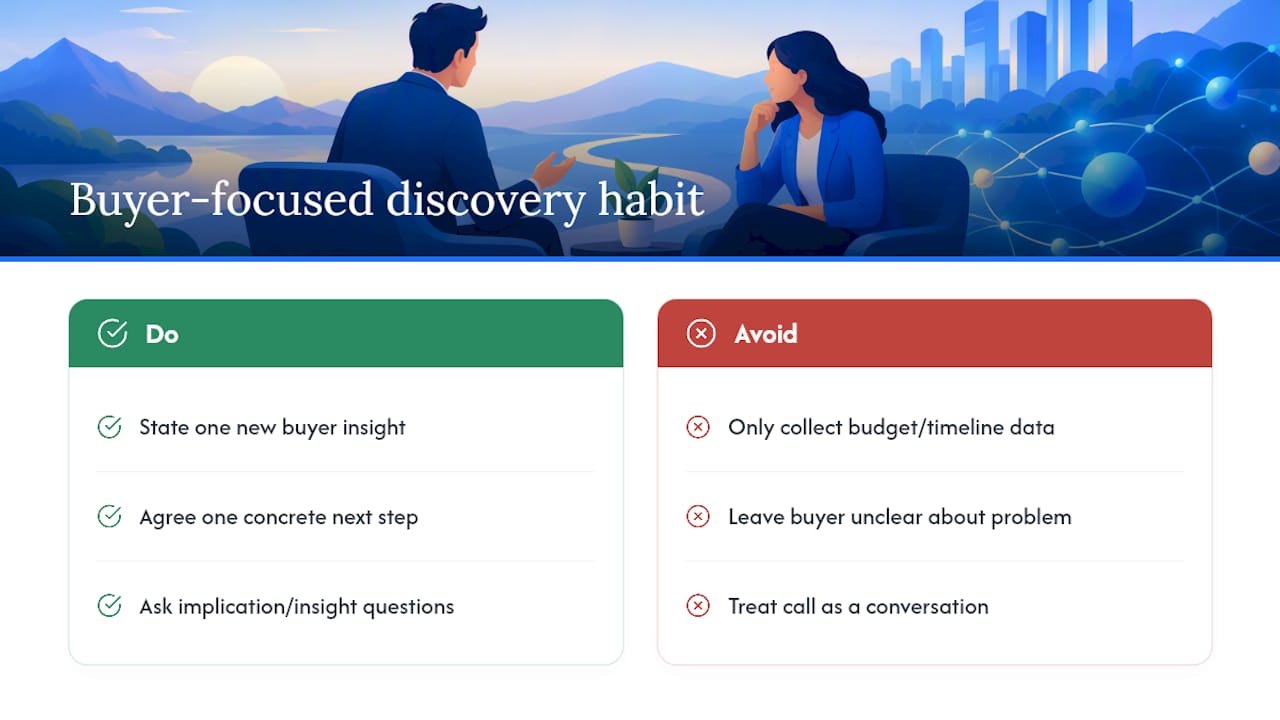
Most discovery frameworks quietly optimize for the wrong side of the table. They fill CRM fields with budget ranges and timelines while the buyer leaves the call no clearer on their own problem than when it started. That's backwards. The frameworks that actually move deals forward, whether it's SPIN's implication questions or a Challenger-style insight, work because they change what the buyer understands about their own situation, not just what the seller knows about the account.
The habit worth building into every team is simple: end every discovery call able to state one insight the buyer didn't have before, plus one concrete next step. If a rep can't do both, the call wasn't discovery. It was a conversation.
— Chad
Scale These Frameworks Across Your Team
Reading about SPIN or MEDDPICC is one thing. Getting a full team of reps to run them consistently, under pressure, on a Tuesday afternoon with a skeptical buyer, is another. That gap between knowing a framework and executing it under real conditions is exactly what live coaching closes and a blog post can't.
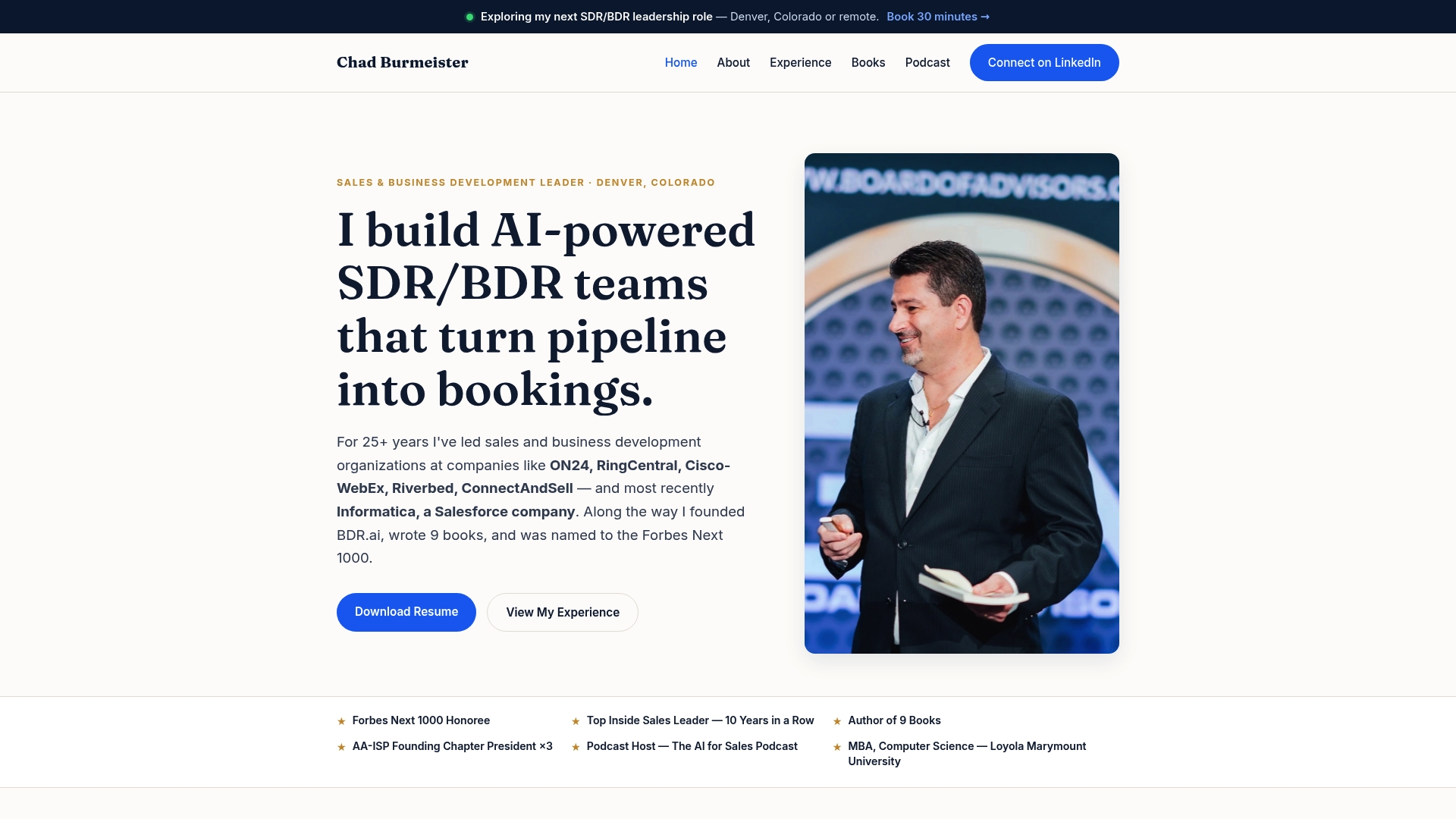
Chad Burmeister has spent more than 25 years building and coaching SDR and BDR teams inside companies like Informatica, RingCentral, and Cisco-WebEx, and that same coaching now shows up in speaking engagements and workshops built specifically to install discovery habits, not just explain them. For teams that want ongoing reinforcement rather than a one-time session, the Be Extraordinary Groups give sales leaders a structured way to practice these exact frameworks with peer accountability. If your team's discovery calls are producing notes instead of next steps, book a workshop or explore the curriculum built to fix that.
Sources
For deeper reading beyond this guide: Salesforce's breakdown of the seven-step sales process explains why discovery and qualification need separate treatment. Salesmotion's repeatable framework guide covers entry and exit criteria in more depth. Winning by Design's anatomy of a discovery call offers a tactical call template worth studying.
- 7 Steps to Building A Winning Sales Process | Salesforce
- Sales Process Steps: How to Build a Repeatable B2B Sales Framework | Salesmotion
- Sales Discovery Questions: Examples, Frameworks, and Training Tips
FAQ
What Is the 3-3-3 Rule in Sales?
The 3-3-3 rule generally refers to setting three goals across three time horizons, often 3 days, 3 weeks, and 3 months, to keep sales activity focused on both immediate and longer-term outcomes. It's less a discovery framework and more a goal-structuring habit some sales managers layer on top of frameworks like MEDDIC or SPIN.
What Are the Top Sales Methodologies?
The most widely used methodologies are SPIN Selling, MEDDIC/MEDDPICC, BANT, Challenger Sale, and Solution Selling, each suited to different deal sizes and buyer sophistication. SPIN and Challenger work best for consultative, insight-driven sales, while MEDDIC and MEDDPICC dominate complex enterprise deals with multiple approvers.
What Is the 30-60-90 Rule in Sales?
The 30-day ramp outlines a structured onboarding plan for new sales hires, covering initial learning and ramp-up. It's a ramp framework for new reps, distinct from the discovery call frameworks like SPIN or BANT covered in this guide.
Which Discovery Framework Should a New Rep Start With?
New reps generally get the fastest traction from a minimum-viable 3-step framework like Gap, Impact, Change, since it's easy to memorize and apply without heavy pre-call research. Once a rep is comfortable with basic question sequencing, layering in SPIN's implication questions adds depth without overwhelming them.
How Does Chad Burmeister Help Teams Adopt These Frameworks?
Chad Burmeister runs workshops and speaking engagements that install discovery habits through live coaching rather than static training materials, drawing on his 25-plus years leading sales and business development teams. Pricing for workshops and speaking is available directly through the Be Extraordinary site.