
The short answer: ZoomInfo leads for enterprise intent and org-chart depth, Apollo for all-in-one prospecting on a budget, Clearbit for real-time API enrichment in marketing workflows, Datanyze for technographic targeting, Crunchbase for startup and funding intelligence, Lusha for fast Chrome-based contact lookups, Cognism for EMEA phone coverage, Clay for waterfall orchestration across 70+ providers, Leadspace for enterprise account modeling, Snov.io for affordable small-team contact append, Zapier for no-code integration glue, and Pipl for social identity resolution. B2B contact data decays roughly 22.5% annually, which means a stale CRM is not a minor inconvenience—it is a pipeline tax you pay every quarter.
Quick-scan shortlist:
- ZoomInfo — Enterprise sales teams needing intent signals, org charts, and deep U.S. company coverage
- Apollo — Budget-conscious teams wanting enrichment, prospecting, and sequencing in one platform
- Clearbit — Marketing and RevOps teams that need real-time API enrichment and form-based lead append
- Datanyze — Teams targeting by technology stack and software-adoption signals
- Crunchbase — Teams prospecting into startups, investors, or funding-event triggers
- Lusha — Individual reps who need fast phone and email lookups during active outreach
- Cognism — Teams with strong EMEA pipeline goals and GDPR-conscious sourcing requirements
- Clay — RevOps teams building custom waterfall enrichment across multiple data sources
- Leadspace — Large enterprises that need account-level modeling and audience intelligence
- Snov.io — Small teams and startups looking for affordable credit-based contact enrichment
- Zapier — Teams that need to connect enrichment outputs to CRMs and apps without custom code
- Pipl — Teams that need social identity matching and individual-level alternative data signals
Key Takeaways
The most effective approach to selecting a B2B data enrichment tool is to match vendor architecture to your ICP, require a live pilot on your own records, and use waterfall orchestration when no single provider covers all your segments.
| Point | Details |
|---|---|
| Data decays fast | B2B contact data decays roughly 22.5% annually, making continuous enrichment a pipeline necessity, not a nice-to-have. |
| Pilot on your own data | Run a 200-record pilot on real CRM accounts and measure match rate, verified email rate, and reply-rate lift before signing any contract. |
| Waterfall beats single-source | No single provider wins on coverage across all ICP segments; waterfall orchestration via Clay or Apollo's built-in logic maximizes field-level accuracy. |
| Compliance requires vendor documentation | Confirm source transparency, opt-out handling, and a signed DPA before any PII flows into an enrichment workflow. |
| Chadburmeister's approach | Chad Burmeister's consulting and workshop services help sales and RevOps leaders design and execute enrichment pilots, govern data quality, and operationalize enrichment into CRM-driven workflows. |
Table of Contents
- How do the best data enrichment tools compare at a glance?
- Per-tool profiles: what each platform actually does
- How do you choose the right data enrichment tool for your team?
- What data types and features should you actually compare?
- How do integrations and implementation actually work in practice?
- What compliance and privacy considerations apply in the U.S.?
- What metrics should you track during a vendor pilot?
- The mistake most teams make when evaluating enrichment tools
- Expert help to operationalize enrichment for your sales team
- Sources
How do the best data enrichment tools compare at a glance?
Raw database size numbers — "300M contacts," "100M companies" — are marketing, not procurement criteria. What matters is effective coverage of your ICP and verified match rates on your records. Keep that in mind as you scan the table below.
One figure worth anchoring to: Apollo reports B2B contact data decays about 22.5% annually, which means roughly one in five contacts in an untouched CRM is wrong or gone within twelve months. Refresh cadence and waterfall architecture matter more than headline database counts.
| Tool | Best for | Pricing model | Data types | Enrichment modes | Key integrations | Compliance notes |
|---|---|---|---|---|---|---|
| ZoomInfo | Enterprise intent + org charts | Annual seat + module pricing | Contact, firmographic, intent, technographic | Real-time API, batch, native CRM | Salesforce, HubSpot, Marketo, Outreach | SOC 2; U.S.-focused database; opt-out registry |
| Apollo | All-in-one prospecting + enrichment | Freemium; credit-based paid tiers | Contact, firmographic, intent | Real-time API, batch, Chrome extension | Salesforce, HubSpot, Salesloft | GDPR/CCPA stated; waterfall enrichment built in |
| Clearbit | Real-time API + form enrichment | Usage-based / API calls | Contact, firmographic | Real-time API, batch, form enrichment | HubSpot (acquired), Salesforce, Marketo | CCPA/GDPR; business-contact sourcing |
| Datanyze | Technographic targeting | Credit-based; free tier available | Technographic, contact | Chrome extension, batch | Salesforce, HubSpot | CCPA-aligned; technology-signal sourcing |
| Crunchbase | Startup + funding intelligence | Freemium; Pro and Enterprise tiers | Firmographic, funding, hierarchy | Web app, API, batch export | Salesforce, HubSpot, CSV | Publicly sourced funding data; CCPA stated |
| Lusha | Fast contact + phone lookups | Freemium; credit-based per lookup | Contact, mobile phone | Chrome extension, API, batch | Salesforce, HubSpot, Pipedrive | CCPA/GDPR; community-verified data model |
| Cognism | EMEA phone coverage + GDPR sourcing | Annual seat pricing | Contact, mobile phone, firmographic | Real-time API, batch, Chrome extension | Salesforce, HubSpot, Outreach, SalesLoft | Diamond-verified phone data; GDPR-first sourcing |
| Clay | Waterfall orchestration (70+ sources) | Credit-based; tiered plans | Contact, firmographic, technographic, intent | API, batch, waterfall | Salesforce, HubSpot, Airtable, Zapier | Depends on underlying providers; configurable |
| Leadspace | Enterprise account modeling | Custom enterprise pricing | Contact, firmographic, intent, hierarchy | API, batch, native CRM | Salesforce, Marketo, Microsoft Dynamics | SOC 2; enterprise data governance |
| Snov.io | Affordable small-team enrichment | Freemium; credit-based tiers | Contact, email verification | Chrome extension, API, batch | HubSpot, Salesforce, Pipedrive, Zapier | GDPR stated; email verification built in |
| Zapier | No-code enrichment automation | Task-based; free tier + paid plans | Connector/automation layer | Workflow automation, no-code | 6,000+ apps including all major CRMs | Passes through underlying provider compliance |
| Pipl | Social identity + people matching | Custom / API pricing | Contact, social identity, alternative data | API, batch | Custom API integrations | Identity-resolution focused; CCPA-aware |
Per-tool profiles: what each platform actually does
ZoomInfo
ZoomInfo is the incumbent for enterprise B2B data enrichment in the U.S. Its database covers company hierarchies, org charts, and buying-committee contacts at a depth most competitors cannot match for mid-market and enterprise accounts. The intent signal layer — tracking content consumption and research behavior — lets SDR teams prioritize accounts showing active buying signals rather than spraying the full ICP. Pricing is annual and seat-plus-module, which means the total cost scales quickly once you add intent, technographics, or the Engage sequencing module. It is not the right fit for a 10-person startup, but for an enterprise team running account-based plays, the org-chart depth alone justifies the evaluation.
Pros: Deep U.S. company coverage; intent signals; org charts and buying-committee data; strong Salesforce and HubSpot native connectors. Cons: Annual contract with module add-ons makes total cost opaque; overkill for SMB ICPs; data freshness varies by segment.
Apollo
Apollo bundles enrichment, prospecting, and email sequencing into one platform at a price point that makes it the default starting point for budget-conscious teams. Its waterfall enrichment logic — pulling from multiple sources and selecting the best field-level result — is built in rather than requiring custom orchestration. The free tier is genuinely usable for small teams testing the workflow. Where Apollo trades off is data depth on enterprise accounts and phone verification quality compared to ZoomInfo or Cognism.
Pros: All-in-one (enrich + prospect + sequence); waterfall enrichment built in; freemium entry point; strong API. Cons: Phone data quality lags behind specialized providers; enterprise account depth thinner than ZoomInfo.
Clearbit
Clearbit, now part of HubSpot, is the go-to for marketing and RevOps teams that need real-time API enrichment at the point of lead capture. When a prospect fills out a form with just an email address, Clearbit appends company, title, industry, and firmographic attributes in milliseconds — before the lead even hits the CRM. That real-time enrichment pattern is what makes it valuable for lead scoring, routing, and personalization at scale. HubSpot's native enrichment capabilities now incorporate Clearbit's data layer, so HubSpot customers should evaluate what is already available before purchasing separately.
Pros: Real-time API enrichment; form-shortening use case; strong firmographic coverage; HubSpot-native for existing customers. Cons: Less strong on phone data; coverage gaps outside North America; pricing scales with API call volume.
Datanyze
Datanyze is the specialist for technographic data — identifying what software and technology a company runs. If your ICP is defined by the tools a prospect uses (say, Salesforce customers, or companies running a specific marketing automation platform), Datanyze surfaces those stack signals faster than generalist providers. The Chrome extension makes it practical for reps doing live research. Pricing is credit-based with a free tier, which keeps the entry cost low for small teams testing technographic targeting.
Pros: Technology-stack detection; Chrome extension for live research; affordable entry point; useful for competitive displacement plays. Cons: Narrower data coverage beyond technographics; not a full-stack enrichment solution on its own.
Crunchbase
Crunchbase is the right tool when your ICP includes startups, venture-backed companies, or organizations going through funding events. Its database of funding rounds, investor relationships, and company milestones is unmatched for that segment. Sales teams targeting Series A or B companies can set alerts on funding events and trigger outreach at exactly the right moment. Outside the startup and investor ecosystem, Crunchbase's contact-level data is thinner than dedicated enrichment providers.
Pros: Best-in-class funding and startup intelligence; funding-event triggers; investor relationship mapping; freemium access. Cons: Contact-level data is limited; not designed for broad B2B contact enrichment outside startup/VC segments.
Lusha
Lusha is built for speed. Individual reps who need a phone number or verified email while actively researching a prospect get it in seconds via the Chrome extension. The credit-based model means teams pay only for what they use, which suits smaller outbound teams or individual contributors who do not need a full enterprise platform. The community-verified data model — where users contribute and validate contact details — keeps freshness reasonable but introduces variability in accuracy compared to provider-verified sources.
Pros: Fast Chrome-based lookups; credit-based pricing; easy onboarding; Salesforce and HubSpot integrations. Cons: Community-verified model means accuracy varies; not designed for large-batch enrichment; limited firmographic depth.
Cognism
Cognism's differentiation is phone data quality in EMEA markets and a compliance-first sourcing approach. Its "Diamond Data" product verifies mobile numbers by calling them, which produces verified mobile coverage that outperforms most competitors for European outbound. For U.S.-focused teams, Cognism is less of a default choice, but for any team running EMEA pipeline, the phone verification and GDPR-conscious sourcing model reduce legal exposure meaningfully.
Pros: Verified mobile phone data; GDPR-first sourcing; strong EMEA coverage; Salesforce and Outreach integrations. Cons: U.S. coverage is less competitive than ZoomInfo or Apollo; annual seat pricing; primarily valuable for EMEA-heavy teams.
Pro Tip: If you are running outbound into both U.S. and EMEA segments, consider pairing ZoomInfo or Apollo for U.S. coverage with Cognism for EMEA — a two-provider waterfall that covers both markets without compromising on phone quality in either.
Clay
Clay is not a data provider but an orchestration layer that connects multiple enrichment providers into a single configurable workflow. A RevOps team can build a waterfall that tries Provider A for email, falls back to Provider B if no result, then enriches firmographics from Provider C, all in one automated sequence. That architecture is exactly what waterfall enrichment recommends as standard practice when no single provider wins on coverage across all segments. Clay's credit-based pricing means costs scale with usage, and the learning curve is real — it rewards teams with a dedicated RevOps operator.
Pros: 70+ provider integrations; custom waterfall logic; highly configurable; strong for complex ICP coverage needs. Cons: Requires RevOps expertise to configure; not a data source itself; credit costs add up at scale.
Leadspace
Leadspace targets large enterprises that need more than contact append — they need account-level modeling, audience segmentation, and predictive scoring built on enriched data. Its platform ingests first-party CRM data and layers third-party enrichment to produce scored, segmented audiences for ABM programs. The implementation timeline is longer than point solutions, and pricing is custom enterprise. For a 50-person sales team, it is likely overkill; for a 500-person revenue organization running multi-channel ABM, it fills a gap that simpler tools cannot.
Pros: Account-level modeling; predictive scoring; enterprise-grade data governance; Salesforce and Marketo integrations. Cons: Custom pricing; longer implementation; not suited for SMB or mid-market teams without dedicated data ops.
Snov.io
Snov.io is the practical choice for small teams and startups that need contact enrichment without an enterprise budget. Its credit-based model, email finder, and verification tools cover the core use case — finding and validating emails for outreach sequences — at a price point that scales with team size. The platform also includes basic drip sequencing, making it a lightweight Apollo alternative for teams that do not need the full feature set. Coverage depth on enterprise accounts is limited, but for SMB prospecting, it delivers solid value per credit.
Pros: Affordable credit-based pricing; email finder and verification; basic sequencing included; HubSpot and Salesforce integrations. Cons: Thinner coverage on enterprise accounts; less phone data than dedicated providers; limited firmographic depth.
Zapier
Zapier is not an enrichment provider — it is the integration glue that makes enrichment outputs operational across your stack. When a new lead enters HubSpot, a Zapier workflow can trigger enrichment via a connected provider, append the results, update the CRM record, and route the lead to the right sequence, all without a single line of custom code. For teams that lack engineering resources to build native API integrations, Zapier is the fastest path to operationalizing enrichment. The task-based pricing model means costs scale with workflow volume, so high-frequency enrichment at enterprise scale may warrant a native API integration instead.
Pros: No-code automation; 6,000+ app connectors; fast to deploy; free tier available. Cons: Not a data source; task costs scale at high volume; less suitable for real-time enrichment at enterprise API throughput.
Pipl
Pipl specializes in identity resolution using social and alternative data sources — the kind of signals that traditional B2B databases do not carry. For teams whose ICP requires matching individuals across social profiles, verifying identities, or enriching records with alternative-data signals, Pipl fills a gap that ZoomInfo and Apollo leave open. Pricing is custom and API-driven, which means it fits best as a specialized layer in a broader enrichment stack rather than a standalone solution.
Pros: Social identity resolution; alternative data signals; strong individual-level matching; API-first architecture. Cons: Custom pricing; niche use case; not a general-purpose B2B enrichment platform; requires API integration work.
How do you choose the right data enrichment tool for your team?
The biggest mistake teams make is choosing by database size. A vendor claiming 300 million contacts is meaningless if 40% of your ICP is in a vertical the vendor covers poorly. Start with your ICP, not the vendor's marketing deck.
Evaluation checklist
Work through these criteria before scheduling a single demo:
- ICP coverage fit: Does the vendor's database cover your target verticals, geographies, and company sizes at the depth you need?
- Data types required: Do you need contact-level email and phone, firmographic attributes, technographic signals, intent data, or all of the above?
- Enrichment mode: Do you need real-time API enrichment (form fill, CRM trigger), batch append (bulk CRM refresh), or Chrome extension lookups for individual reps?
- Refresh cadence: How often does the vendor update records? Monthly, weekly, or continuous? Ask for the specific SLA in writing.
- CRM integration: Does the vendor offer a native connector for your CRM, or will you need middleware like Zapier or Clay?
- Compliance posture: Can the vendor provide a data-processing addendum, source transparency documentation, and an opt-out process?
- Pricing model fit: Does the credit-based, seat-based, or usage-based model align with how your team actually consumes data?
Questions to ask vendors during demos
- "Can you run a sample match on 200 real accounts from our CRM before we sign?"
- "What is your verified email match rate and mobile phone match rate for our specific ICP?"
- "Where does your data come from, and how do you handle opt-outs?"
- "What is your SLA for data freshness, and how do you handle stale records?"
- "Do you provide an audit trail for enriched fields so we can track data lineage?"
HubSpot recommends starting with CRM-native enrichment when it meets your needs and layering external providers only for coverage gaps, technographics, intent, or specialized data like mobile phone verification. That sequencing saves budget and reduces integration complexity.
Pilot plan: a numbered checklist you can use verbatim
- Pull a sample of 200 real accounts from your CRM, including a mix of your best customers and active prospects.
- Define success metrics upfront: target match rate, verified email rate, mobile phone match rate, and duplicate rate.
- Submit the sample to two or three shortlisted vendors and run the enrichment in parallel.
- Manually verify a 20-record subset by calling or emailing to validate accuracy.
- Measure downstream impact over 30 days: open rates, reply rates, meetings booked, and SQLs generated from enriched records.
- Compare total cost per enriched record across vendors, including any middleware or integration costs.
- Assign a RevOps owner to document results and present a vendor recommendation with data.
Red flags to stop a vendor trial
- The vendor refuses to run a pilot on your actual records before contract signing.
- Source transparency documentation is vague or unavailable.
- API documentation is incomplete or requires a sales call to access.
- The vendor cannot provide a data-processing addendum for CCPA or GDPR compliance.
- Match rate claims in the demo use their own curated sample, not your ICP data.
What data types and features should you actually compare?
Data enrichment is a broad term covering several distinct attribute categories. Knowing which ones your use case requires prevents you from paying for data you will never use.
Data type to use case map
| Data type | What it includes | Primary use case |
|---|---|---|
| Contact-level | Email, phone, title, LinkedIn URL | SDR outbound, sequencing, rep research |
| Firmographic | Industry, revenue, headcount, HQ location | ICP scoring, routing, segmentation |
| Technographic | Tech stack, software vendors in use | Competitive displacement, ICP filtering |
| Intent | Content consumption, research behavior signals | Prioritizing in-market accounts |
| Hierarchy / franchise | Parent-child company relationships | Enterprise ABM, territory planning |
| Mobile / verified phone | Direct-dial and mobile numbers, call-verified | High-velocity outbound, phone-first SDR teams |
| Funding / events | Funding rounds, leadership changes, M&A | Trigger-based outreach, startup prospecting |
| Social identity | Social profiles, alternative identity signals | Identity resolution, people matching |
For SDR outbound, contact-level and firmographic data are the baseline. Technographic signals matter most for competitive displacement plays or technology-specific ICPs. Intent data is the multiplier — it tells you when to reach out, not just who to reach. For local-business ICPs, discovery-first providers that use public records and licensing data materially outperform LinkedIn-dependent databases on mobile phone coverage and decision-maker resolution.
Feature categories to compare
- Real-time API enrichment: Appends data at the moment of lead capture or CRM trigger. Required for form-shortening, lead scoring, and routing workflows.
- Batch enrichment: Bulk refresh of existing CRM records. Useful for quarterly data hygiene and historical record cleanup.
- Chrome extension lookups: Individual rep research during active prospecting. Lusha and Datanyze lead here.
- Native CRM enrichment: Direct connector to Salesforce, HubSpot, or Marketo without middleware. Reduces integration complexity.
- Waterfall orchestration: Chaining multiple providers and selecting the best field-level result. Clay is the specialist; Apollo has it built in. Waterfall enrichment is now standard practice for RevOps teams because no single provider wins on freshness and coverage across all segments.
For a deeper look at how intent data fits into this stack, the B2B intent data provider guide covers the leading providers and integration patterns in detail.
How do integrations and implementation actually work in practice?
The best enrichment data is worthless if it never reaches the rep or the workflow that needs it. Integration planning is where most pilots stall.
Common integration touchpoints
- Salesforce and HubSpot: The two most common CRM targets. Most major providers offer native connectors; verify field mapping and write permissions before the pilot.
- Marketo and Pardot: Marketing automation platforms that consume enriched lead records for scoring and nurturing. Real-time API enrichment at form fill is the highest-value pattern here.
- Outreach and Salesloft: Sales engagement platforms that need enriched contact data to populate sequences. ZoomInfo, Cognism, and Apollo all offer native connectors.
- Middleware (Zapier, Make, Clay): For teams without engineering resources, middleware is the fastest path to connecting enrichment outputs to CRMs and apps. Zapier's no-code automation handles the integration layer without custom code, though task costs scale at high volume.
- Custom API pipelines: For enterprise teams with engineering support, direct API integration offers the lowest latency and highest throughput for real-time enrichment.
Realistic implementation timeline
A well-run pilot takes four to six weeks from vendor selection to a go/no-go decision. A full rollout adds another four to eight weeks for governance, field mapping, and workflow configuration.
- Weeks 1–2: Sample selection, vendor pilot setup, field mapping review.
- Weeks 3–4: Enrichment run, accuracy sampling, downstream metric tracking begins.
- Week 5–6: Results analysis, cost-per-record comparison, vendor recommendation.
- Weeks 7–10: Contract, data-processing addendum, CRM field governance, workflow build.
- Weeks 11–14: Phased rollout to SDR team, monitoring, and SLA review.
Stakeholders to involve: RevOps owns the pilot and field governance. The SDR manager defines the ICP sample and validates accuracy. Marketing ops owns form-fill and lead-scoring integration. Legal reviews the data-processing addendum before any PII flows into enrichment.
For teams connecting enrichment to sales engagement platforms, the integration between enrichment outputs and sequencing tools is the highest-leverage workflow to configure first.
What compliance and privacy considerations apply in the U.S.?
U.S. privacy law for B2B contact data is less restrictive than GDPR, but it is not a free pass. The California Consumer Privacy Act (CCPA) applies to consumer data and, in some interpretations, to individual business contacts at California-based companies. The practical implication: your enrichment vendor's sourcing practices and opt-out handling matter for both legal exposure and deliverability.
Vendor compliance checklist
Before sending any PII into an enrichment flow, confirm the following with your vendor:
- Source transparency: Can the vendor document where contact data originates (public records, licensing, web crawl, user-contributed)?
- Opt-out handling: Does the vendor maintain a suppression list and honor opt-out requests within a defined SLA?
- CCPA scope: Does the vendor distinguish between consumer data and business-contact data, and can they confirm their sourcing falls within the business-contact exception?
- Data retention: How long does the vendor retain enriched records, and can you request deletion?
- Audit trail: Does the vendor provide field-level data lineage so you can trace where each enriched attribute came from?
- Data-processing addendum (DPA): Is a DPA available, and does it cover your use case and jurisdiction?
The distinction between business-to-business contact data and consumer data matters practically. Business email addresses and direct-dial numbers associated with a professional role generally fall outside CCPA's consumer-data scope, but home addresses, personal emails, and mobile numbers used outside a professional context may not. Source provenance — knowing whether a mobile number came from a professional directory or a consumer data broker — is the key question to ask vendors.
Pro Tip: Before any PII flows into an enrichment provider, request the vendor's DPA and review the data-sourcing section specifically. Look for language that distinguishes business-contact data from consumer data, confirms opt-out suppression, and specifies data retention limits. If the DPA is vague on sourcing or retention, treat that as a red flag equivalent to refusing a pilot.
What metrics should you track during a vendor pilot?
A pilot without defined metrics is just a demo with extra steps. The framework below gives RevOps a reproducible structure for any enrichment vendor evaluation.
Testing framework
Select 200 real accounts from your CRM — a mix of active prospects and existing customers across your primary ICP segments. Submit the same sample to each vendor you are evaluating. Run the enrichment in parallel, not sequentially, so results are comparable. After enrichment, manually verify a 20-record subset by attempting contact (email or phone) to validate accuracy.
Measure downstream impact over 30 days on the enriched records: email open rates, reply rates, meetings booked, and SQLs generated. Compare those figures against a control group of un-enriched records from the same ICP segment.
Sample pilot metrics table
Running a live pilot on your own records — not a vendor-curated demo set — is the single most important step in any enrichment evaluation. Vendors who refuse to run the test on your data before contract signing are telling you something important about confidence in their coverage for your ICP. Require it every time, without exception.
The AI sales forecasting playbook covers how enriched data feeds predictive pipeline models downstream — worth reading once your pilot produces clean, verified records.
The mistake most teams make when evaluating enrichment tools
The conventional wisdom in B2B data says: pick the vendor with the biggest database and the most integrations. That logic is how teams end up locked into six-figure annual contracts for data that covers 60% of their actual ICP.
The vendors with the loudest database-size claims are often the weakest on the segments that matter most to a specific team. An enterprise software company prospecting into mid-market manufacturing will find ZoomInfo's depth genuinely useful. A startup targeting Series A SaaS companies will get more value from Crunchbase's funding triggers than from ZoomInfo's org charts. A team running outbound into local service businesses may find that both of those providers underperform a discovery-first source that pulls from public records and licensing databases rather than LinkedIn profiles.
The pilot framework in this article is not a formality. It is the only honest way to know whether a vendor's coverage matches your ICP before you commit. Match rate on your records, verified email accuracy on your sample, and reply-rate lift on your sequences — those three numbers tell you more than any vendor demo ever will.
The other mistake: treating enrichment as a one-time project. Data decays continuously, which means enrichment governance — who owns the refresh cadence, how stale fields get flagged, what triggers a re-enrichment — needs to be built into your RevOps operating model from day one. Teams that bolt enrichment onto an existing CRM without a governance plan end up with a messier database six months later, not a cleaner one.
If you are evaluating whether to consolidate onto one platform or build a multi-provider waterfall, Reevo's comparative analysis of platform versus point-solution trade-offs is worth reading alongside the vendor demos. The answer depends on your team's RevOps maturity and whether you have the operator bandwidth to manage a multi-source stack.
For teams that want to go deeper on the best B2B contact databases before finalizing a vendor shortlist, that resource covers contact database selection and lead qualification criteria in detail.
Expert help to operationalize enrichment for your sales team
Most sales and RevOps teams know which tools they want to evaluate. The harder problem is designing the pilot, governing the data quality, and wiring enrichment outputs into the CRM workflows and sequences where they actually drive pipeline.
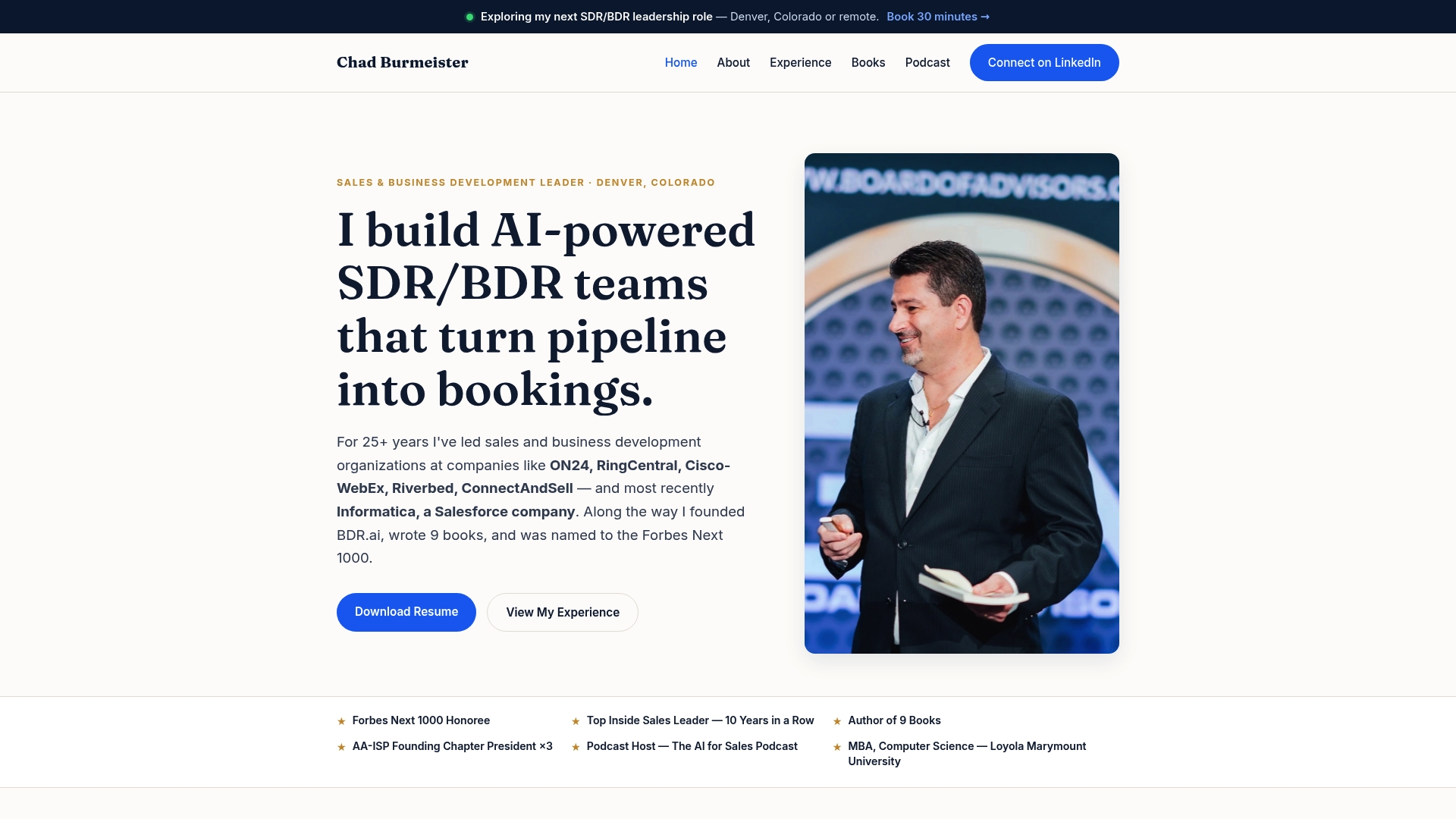
Chadburmeister offers executive sales leadership and RevOps consulting specifically for teams at this stage: pilot design, vendor evaluation frameworks, CRM field governance, and hands-on operationalization of enrichment into SDR and BDR workflows. With 25+ years scaling pipeline at companies like Informatica, RingCentral, and Cisco-WebEx, and practical frameworks published in AI for Sales 2.0 and Mastering B2B Lead Generation with LinkedIn & AI, Chad brings the kind of applied experience that turns a vendor shortlist into a running enrichment program.
If you are a CRO, VP of Sales, or RevOps leader who wants a structured pilot design or an interim engagement to get enrichment working in your stack, Chadburmeister. For teams that want to go deeper on AI-first sales strategy alongside enrichment, the AI for Sales Podcast covers data, pipeline, and RevOps topics in regular episodes with practitioners.
Sources
The links below are worth bookmarking for demos and pilot planning:
- The 11 best data enrichment tools in 2026
- What Is Data Enrichment in B2B Sales? | Apollo
- What is data enrichment? A practical guide for revenue and data teams | Datalane Blog
- CRM Data Enrichment: Best Practices to Improve Data Quality