
Which B2B intent data providers lead the market in 2026?
The five providers worth your attention in 2026 are Lead Forensics, Cognism, Demandbase Inc, 6sense, and Bombora. Each solves a different piece of the pipeline problem, and choosing the wrong one for your motion is an expensive mistake.
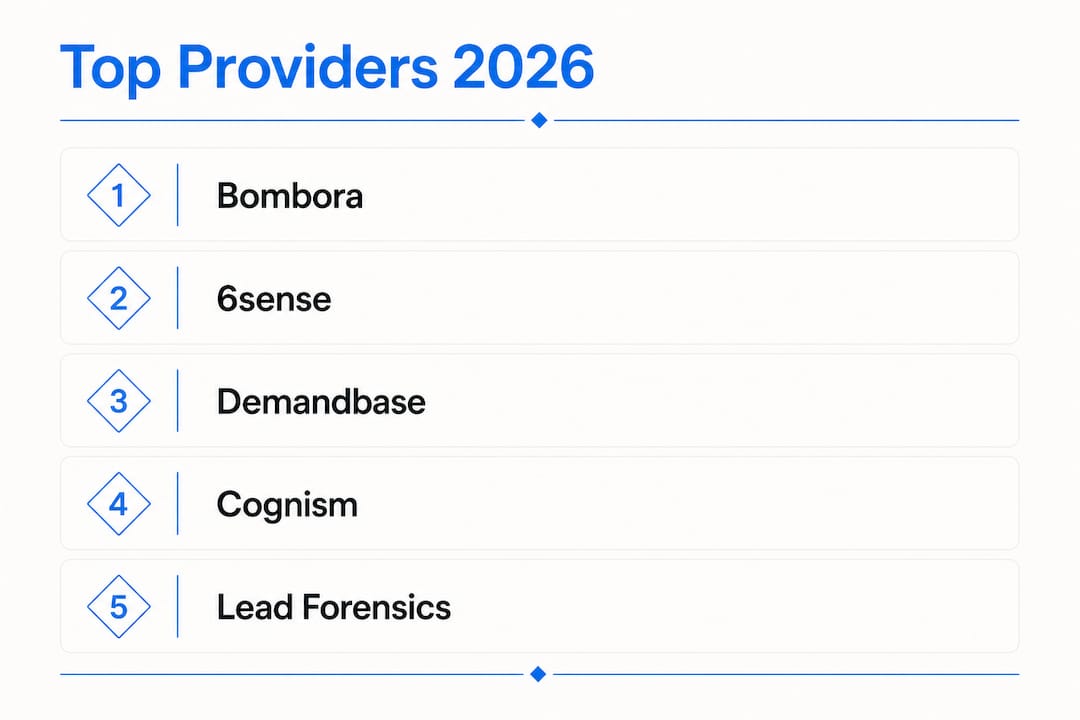
| Provider | Best For | Key Features | Positioning | US Availability |
|---|---|---|---|---|
| Lead Forensics | Converting anonymous web traffic into leads | Real-time visitor ID, sales routing, alerts | Leading B2B website visitor identification tool | Yes |
| Cognism | Compliant prospecting and CRM enrichment | ISO 27001, SOC 2 Type II, real-time API, verified contacts | Europe's most trusted B2B data provider | Yes |
| Demandbase Inc | Multi-channel GTM orchestration | ABM, sales intelligence, ad targeting, cross-functional coordination | Turns signals into coordinated GTM action | Yes |
| 6sense | ABM and outbound sales automation | Predictive modeling, AI workflows, audience builder, smart form fill | AI-powered revenue marketing platform | Yes |
| Bombora | Market intelligence and campaign personalization | Company Surge® data, Data Co-op, identity resolution, 100+ integrations | Pioneer in B2B intent data and identity solutions | Yes |
Lead Forensics focuses on one thing: identifying the companies visiting your website right now and routing those alerts to the right sales rep before the moment passes. If your pipeline problem is anonymous traffic you cannot act on, this is the most direct fix.

Cognism is the compliance-first choice. Its ISO 27001, ISO 27701, and SOC 2 Type II certifications matter to legal and procurement teams, and its Data-as-a-Service model delivers verified contact data via real-time API. Teams that have been burned by GDPR exposure tend to land here.
Demandbase Inc is built for revenue teams that need marketing, sales, and customer success working from the same account prioritization. Its advertising targeting layer sets it apart from pure data providers, making it a strong fit for enterprise GTM coordination.
6sense combines predictive modeling with AI-driven workflows to tell you not just who is in market, but where they are in the buying cycle. Its outbound automation capabilities make it a natural fit for teams running high-volume account-based outreach.

Bombora invented B2B intent data and still runs the largest third-party signal network, a Data Co-op drawing from thousands of B2B publishers. Its Company Surge® feed is the upstream signal source that many other platforms resell or blend into their own scoring. 86% of the data in Bombora's Co-op is shared exclusively with Bombora, meaning no competing provider accesses those signals.
Table of Contents
- How do you evaluate and select the right intent data provider?
- A closer look at each provider's capabilities and fit
- What is B2B intent data and why does it matter for 2026 pipeline growth?
- Expert advice on making intent data actually work
- Key Takeaways
- Chadburmeister brings practitioner-level intent data strategy to your team
How do you evaluate and select the right intent data provider?
The most common mistake teams make is conflating intent data providers with intent data platforms. These are two different categories: providers like Bombora generate or aggregate raw signals, while platforms like 6sense and Demandbase ingest those signals, score accounts, and trigger action. You need one from each column, not two providers doing the same job.
When evaluating any option, prioritize these criteria:
- Signal quality and freshness: Stale data kills pipeline efficiency. Ask vendors how frequently their signals refresh and what their methodology is for scoring surge versus baseline activity.
- Activation proximity: Raw signals sitting in a CSV nobody opens are worthless. Evaluating intent platforms should emphasize how close the signal is to a triggered action, whether that is a sales alert, an ad, or an automated sequence.
- Compliance posture: GDPR and CCPA exposure is real. Cognism's certifications and Bombora's consent-driven collection protocols are the standard to benchmark against.
- Integration depth: Your intent data needs to flow into Salesforce, HubSpot, or your marketing automation platform without manual intervention. Check native connectors, not just API availability.
- Total cost of ownership: Licensing is only part of the cost. Factor in the ops headcount required to manage the platform, the implementation timeline, and whether you need a separate activation layer on top of a raw data feed.
Pro Tip: Before signing any contract, run a lookback on your last 12 months of closed-won deals to identify which intent signal types actually preceded revenue. Generic intent feeds often miss the specific triggers that matter for your ICP.
A closer look at each provider's capabilities and fit
The distinction between providers and platforms shapes how each of these five fits into a real tech stack.
Bombora sits at the top of the signal chain. Its Company Surge® data tracks tens of thousands of topics across millions of B2B domains, and its patented identity resolution goes beyond standard IP-to-domain matching. With more than 100 integrations across ad tech, martech, and CRM platforms, it plugs into almost any existing stack. Teams that want the most trusted upstream signal, without paying for an activation layer they already have, start here.
6sense and Demandbase are the two enterprise-grade activation platforms most often evaluated head-to-head. Demandbase has historically been stronger on advertising activation; 6sense on predictive modeling depth. The gap between them has narrowed in 2026, and the right choice usually comes down to whether your primary motion is ad-driven ABM (Demandbase) or AI-scored outbound sequencing (6sense).
Lead Forensics occupies a narrower but genuinely useful niche: website visitor identification with real-time routing. It does not try to be a full ABM platform, and that focus is its strength. For teams whose biggest gap is converting inbound interest they cannot currently see, it delivers fast time-to-value.
Cognism's real-world use case is CRM enrichment and outbound prospecting with verified contact data. Its real-time API delivery means sales reps get fresh phone numbers and emails rather than stale records. Teams in regulated industries or with international reach tend to prioritize it for its compliance credentials.
Pro Tip: Siloed intent programs fail. Map your demand states before you activate any signal. A signal that fires without a corresponding content play or outreach sequence is just noise with a price tag.
What is B2B intent data and why does it matter for 2026 pipeline growth?
B2B intent data captures behavioral signals that indicate when a company is actively researching a solution like yours. Those signals come from content consumption, keyword searches, review site visits, and engagement patterns across the web. They tell you something a contact record alone never can: that a buying process is underway right now.
There are three types, and each has a different role:
- First-party intent data comes from your own website and product. It is the highest-quality signal because it is direct, but it only covers accounts already aware of you.
- Second-party intent data comes from a partner's first-party data shared directly, such as G2 buyer intent signals showing which accounts are comparing vendors in your category.
- Third-party intent data comes from aggregated signals across a publisher network, Bombora's Co-op being the most widely used example. It covers accounts researching your category before they ever visit your site.
The practical value is in combining all three. A prospect showing topic surge on Bombora, visiting your pricing page, and reading competitor reviews on G2 is a very different conversation than one who just filled out a contact form cold.
Privacy compliance shapes how you can use all three types. GDPR and CCPA require that data collection be consent-driven, which is why Bombora's tag-based, consent-first collection model and Cognism's certifications have become baseline expectations rather than differentiators for enterprise buyers.
Expert advice on making intent data actually work
Most intent data programs fail not because the data is bad, but because the activation is weak. Revenue leaders often treat raw signals as action items, skipping the context and pre-built outreach sequences that turn a signal into a conversation.
Chad Burmeister, who has spent 25+ years scaling sales teams at companies like RingCentral and Cisco-WebEx, points to three specific failure modes he sees repeatedly.
First, teams flood their AEs with every signal the platform surfaces. Volume without filtering creates burnout fast. The fix is tiered signal thresholds: route only the highest-confidence signals directly to account executives with a defined SLA, and let automation handle the lower tiers through nurture sequences.
Second, teams treat all intent signals equally. They are not. Frustration signals that name a specific competitor pain point, an integration gap, or a contract renewal window are far more valuable than generic topic surge. Those signals warrant hyper-personalized outreach, not a templated sequence.
Third, programs run in silos. Intent data that does not connect to your content strategy, your ad targeting, and your CRM scoring model will underperform. Integrated programs that run scoring, advertising, and outreach from a single platform preserve signal value and speed up sales response.
Pro Tip: Combine your highest-confidence intent signals with automated, context-rich sequences so your reps respond within hours, not days. Speed of response is often the only variable that separates a won deal from a lost one.
Key Takeaways
The strongest intent data programs in 2026 pair a trusted upstream signal source with an activation platform that scores, routes, and sequences without manual intervention.
| Point | Details |
|---|---|
| Provider vs. platform distinction | You need one signal provider and one activation platform; buying two providers leaves signals unacted on. |
| Signal quality over volume | Tiered thresholds and frustration signals outperform high-volume generic feeds for pipeline conversion. |
| Compliance is baseline | GDPR and CCPA compliance, as demonstrated by Cognism and Bombora, is a procurement requirement, not a differentiator. |
| Activation proximity wins | The closer a signal is to a triggered outreach action, the more pipeline value it generates. |
| Chadburmeister's role | For sales leaders who want to apply intent data strategy hands-on, Chadburmeister offers practitioner-level consulting and playbooks built from 25+ years of pipeline experience. |
Chadburmeister brings practitioner-level intent data strategy to your team
Every provider in this comparison sells you data or a platform. What they do not sell is the judgment to know which signals to act on, how to structure your team's response, and how to avoid the activation failures that waste most intent data budgets.
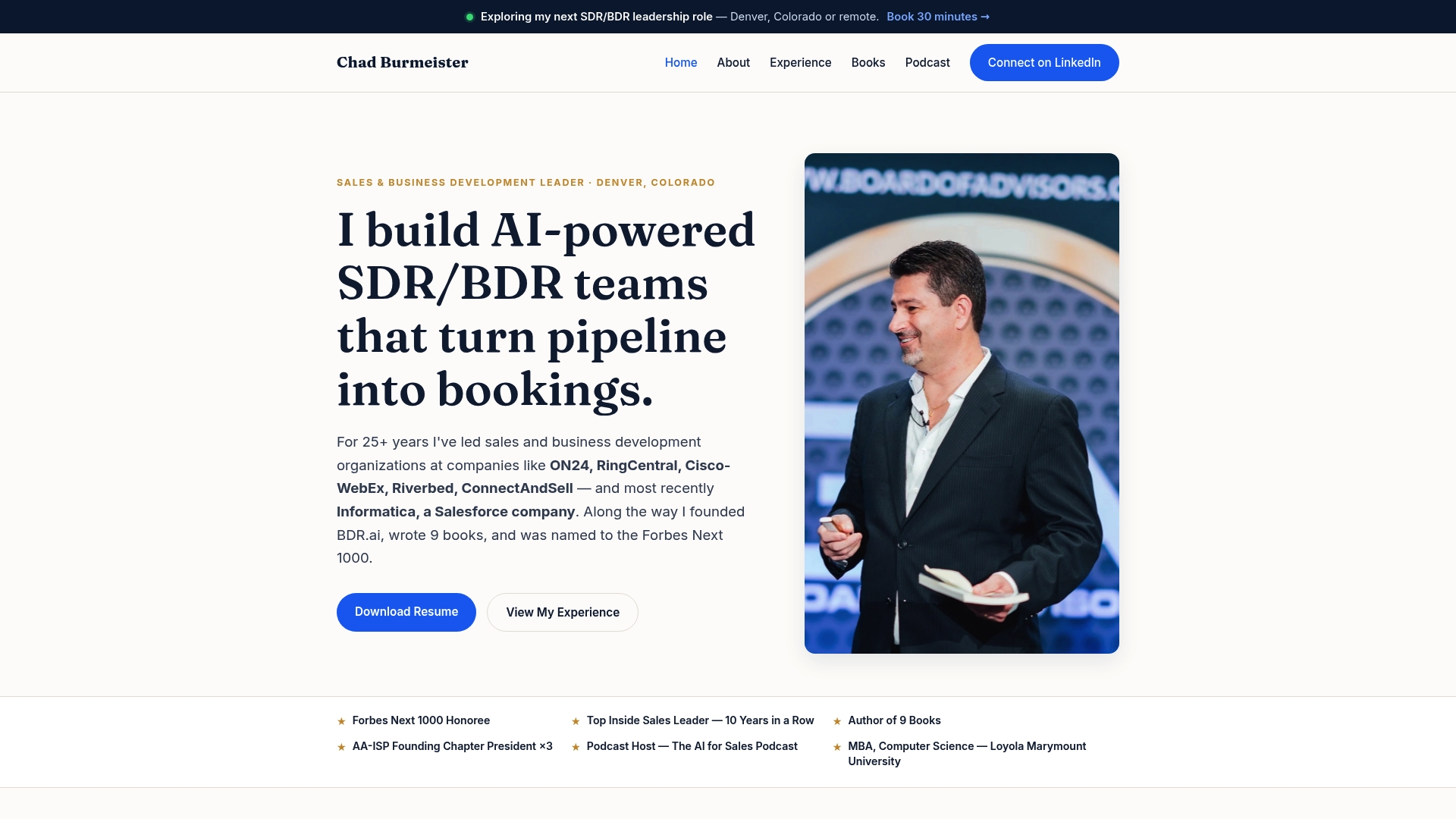
That is where Chadburmeister is a different kind of resource. Chad Burmeister has spent 25+ years building high-performance sales teams at companies like Informatica, RingCentral, and Cisco-WebEx, and has written nine books on AI-driven pipeline growth, including AI for Sales 2.0 and Mastering B2B Lead Generation with LinkedIn & AI. His AI for Sales Podcast features practitioners who have deployed the exact platforms covered here, with honest accounts of what worked and what did not.
If your team is evaluating intent data providers and wants a framework for turning signals into closed revenue, not just a vendor comparison, start with Chadburmeister's sales leadership resources to build the activation strategy before you sign the contract.