The fastest way to get consistent results from a sales team is a modular sales playbook template that combines ideal customer profiles, plays, scripts, process maps, and measurable KPIs into one working document. This article gives you the components checklist, a step-by-step build process, copy-ready templates, and adoption tactics that keep the playbook alive after launch.
TL;DR:
- A sales playbook should include concrete, measurable artifacts such as scored discovery calls and ICP assessments to validate rep skills during ramp-up.
- Embedding playbook guidance directly into CRM notes and conversation tools increases actual usage and reinforces consistent practices.
- Regular quarterly audits and version controls are essential to keep plays relevant, with clear rules to retire, rewrite, or scale based on win rates and feedback.
- Most playbooks fail because they are static documents; successful ones are living, data-driven resources integrated into daily workflows.
- Building a playbook with clear ownership, artifacts, and iterative testing accelerates adoption and improves sales results within the first 90 days.
Table of Contents
- What is a sales playbook and why does it matter
- Core components checklist to copy into your template
- A step-by-step process for building your playbook
- Templates and copy-ready examples you can paste into a playbook
- How to embed the playbook so reps actually use it
- Keeping the playbook alive: audits, governance, and versioning
- Common plays and the 30-60-90 artifact approach
- Metrics and KPIs that tell you the playbook is working
- Why most sales playbooks quietly fail
- Get hands-on help building and rolling out your playbook
- Where to go next for templates and deeper reading
- Sources
- FAQ
What is a sales playbook and why does it matter
A sales playbook is the master document that tells your team who to sell to, how to sell to them, and what "good" looks like at every stage. A sales play is one piece of that document: a specific, repeatable action for a specific situation, like reopening a stalled deal or handling a pricing objection. Salesforce's guide to sales playbooks describes it as a comprehensive resource covering customer personas, selling strategies, scripts, and best practices that help reps handle common scenarios the same way every time.
The benefits show up fastest in three places:
- Faster ramp: new hires learn the approved motion instead of reverse-engineering it from call recordings.
- Consistent messaging: every rep pitches the same value story, so marketing and sales stop contradicting each other.
- Repeatable plays: what works for your best rep becomes available to everyone else, not locked in one person's head.
- Easier onboarding and coaching: managers coach against a written standard instead of a gut feeling.
A rough rule of thumb: if you have more than three reps, or your ramp time is inconsistent across new hires, you need a playbook. Below that, a shared doc might hold you for a while, but the gap catches up with you the moment you hire your fourth rep.
Core components checklist to copy into your template
Most strong playbooks share a common skeleton. Salesforce and a widely used HubSpot playbook template.pdf) both point to the same core sections: company overview, ideal customer profile, a play library, scripts, process maps, and a KPI section. Copy this structure into a shared doc or wiki page and fill in the fields as you go.
Company overview and positioning
- Mission and vision in one sentence each, written for a new hire who has never heard your pitch.
- A one-paragraph positioning statement: what you sell, who it's for, and the single biggest reason buyers pick you over the alternative.
- A short competitive landscape section naming the categories of alternatives reps run into, not a marketing brochure.
ICP and use-case templates
- Firmographics: company size, industry, tech stack, and buying triggers that separate a good-fit account from a bad one.
- Persona snapshots: title, priorities, and the objection each persona raises most often.
- Two or three use-case templates showing how a real customer used the product, written as short before-and-after stories.
Play library structure
- Each play needs an objective (what outcome it drives), a trigger (when a rep should run it), the steps themselves, an owner, and a success metric.
- Keep each play to one page. A play nobody can read in ninety seconds won't get used in the field.
Scripts, process maps, and CRM fields
- Call and email scripts for discovery, demo, and objection handling, written as flexible frameworks rather than word-for-word lines.
- A one-page visual process map showing stage-by-stage exit criteria.
- A list of CRM fields tied to each stage, so the playbook and the pipeline speak the same language.
- Enablement resources: battle cards, case study links, and a KPI and reporting section that defines what "success" looks like for each play.
Pro Tip: Build the play library in the same tool your reps already live in, whether that's a CRM note field, a wiki, or a shared drive folder. A brilliant playbook nobody opens is worse than a mediocre one they check daily.
A step-by-step process for building your playbook
Building a playbook is a project with owners and deadlines, not a solo writing exercise. Here's a sequence that works for most teams:
- Plan and scope (week 1, sales leader). Define which motion you're documenting first: net new outbound, expansion, or renewal. Trying to cover everything at once is the most common reason playbook projects stall.
- Collect existing assets (week 1 to 2, sales leader and enablement). Pull call recordings, win/loss notes, top performers' email templates, and any existing decks. You are curating what already works, not inventing from scratch.
- Draft the core plays (week 2 to 3, enablement with input from top reps). Write the first version of three to five plays covering your highest-volume scenarios: prospecting, discovery, and the most common objection.
- Pilot with top reps (week 3 to 4, top rep plus sales leader). Have one or two strong performers run the drafted plays for two weeks and flag anything that reads well but doesn't survive a real call.
- Measure early signal (week 4 to 6, sales ops). Track whether pilot reps are closing discovery calls faster or hitting stage exit criteria more consistently than the control group.
- Roll out and iterate (week 6 onward, sales leader and enablement). Publish to the full team, then revisit the weakest play every two weeks based on manager feedback and CRM data.
This maps naturally onto a 30/60/90 rhythm. In the first 30 days, aim for a scoped draft with three core plays and a completed ICP section. By day 60, you should have a piloted, revised version with CRM fields mapped and at least one completed script for discovery and demo. By day 90, the full team should be using the playbook, and you should have your first round of KPI data showing which plays are earning their place.
Assign clear ownership so the project doesn't drift. The sales leader owns scope and final sign-off. Enablement, where you have a dedicated function, owns drafting and formatting. A top rep serves as the field-truth check, catching scripts that sound good in a doc but fall apart on a live call. Sales ops owns the data: pulling win/loss records, tagging CRM fields, and building the dashboard that will eventually tell you whether the playbook is working.
If you're building this without a dedicated enablement team, the sales leader absorbs both roles: drafting and validating. That's slower, but it still works, especially if you borrow structure from an existing framework rather than starting from a blank page. Chad Burmeister's published playbooks offer one such starting structure for teams that want an authored framework instead of building from zero.
Pro Tip: Don't wait for a perfect draft before piloting. A rough play tested on five real calls teaches you more than three weeks of internal debate about wording.

Templates and copy-ready examples you can paste into a playbook
Here's a reusable play template you can drop straight into your document. Fill in the brackets for your own use case:
- Play name: short, memorable label (example: "Stalled Deal Revival")
- Objective: what outcome this play drives
- Trigger: the specific signal that tells a rep to run this play
- Steps: three to five numbered actions
- Owner: who is accountable for running it
- Success metric: the number that tells you it worked
A completed example, using the stalled deal scenario: Objective is to reopen deals that have gone quiet for 14 days or more. Trigger is no activity logged in the CRM for two weeks on an open opportunity. Steps: send a pattern-interrupt email referencing a new trigger event, call within 24 hours if no reply, offer a scaled-down next step like a 15-minute check-in, and log the outcome regardless of result. Owner is the account executive. Success metric is reply rate within 48 hours.
Discovery script snippet: "Walk me through what's driving this project now, versus six months ago. What changed?" This kind of open, trigger-based question surfaces urgency faster than a scripted feature walkthrough.
Demo checklist:
- Confirm the buyer's specific use case before the call, not during it.
- Show the two features tied directly to their stated priority, not your full feature list.
- End with a specific next step and a date, not "let's follow up."
Objection script snippet (price): "Compared to what?" is a simple but effective reframe that gets the buyer to name their real alternative, whether that's a competitor, a manual process, or doing nothing.
For prospecting cadence templates with day-by-day structure, a practical sales cadence guide offers five ready examples worth adapting. When you borrow a template from any external source, note where it came from in a comments field and adjust the language to match your product and buyer, rather than copying it verbatim into buyer-facing materials.

How to embed the playbook so reps actually use it
A playbook that lives in a forgotten wiki tab dies quietly. SellingPower's reporting on sales playbooks makes the point directly: static playbooks fail, and the fix is embedding guidance into the workflow so it shows up at the moment a rep needs it, not as a separate document they have to remember to open.
Practical placement options:
- Add play summaries as CRM notes or guided fields directly on the opportunity record, tied to pipeline stage.
- Use call recording or conversation intelligence tools to surface the relevant script snippet mid-call.
- Pin the objection-handling one-pager inside the deal record rather than a shared drive folder three clicks away.
Reinforcement is where most managers underinvest. Ask playbook-specific questions in every pipeline review, especially in a new hire's first 90 days: "Which play did you run on this stalled deal?" or "What's the trigger you saw that made you send that email?" Reinforcement baked into every review during that window builds the habit before old habits fill the gap.
Behavioral design matters more than good intentions. Replace subjective goals like "understand our ICP" with checkable artifacts: a recorded discovery call scored against the script, a completed ICP fit assessment on a real account, a demo recording that hits every checklist item. Artifacts are gradable. Vague learning objectives are not, and they're the reason so many onboarding programs feel thorough on paper and thin in practice.
Pro Tip: Pick one CRM field and one recurring meeting to anchor the playbook in first. Trying to embed it everywhere at once usually means it sticks nowhere.
Keeping the playbook alive: audits, governance, and versioning
A playbook is a living product, not a one-time deliverable. Build a quarterly audit into your calendar where you pull win/loss data and conversion rates by play, and ask a simple question for each one: is this still working, or has the market moved past it?
Simple decision rules keep the audit fast:
- Retire a play if its win rate has dropped for two consecutive quarters with no clear external cause.
- Rewrite a play if reps report it doesn't match what buyers actually say anymore.
- Scale a play if one team's version is consistently outperforming the standard one, and roll it out company-wide.
Keep a simple change log: date, play name, what changed, and who approved it. One owner, usually the sales leader or head of enablement, signs off on every version so reps aren't working from three conflicting copies.
Playbooks work best as a living document. Teams that treat their playbook as a static, one-time deliverable tend to see relevance decay within a couple of quarters as buyer language and competitive positioning shift, which is why a recurring audit cadence tied to real win/loss data matters more than the initial draft.
Common plays and the 30-60-90 artifact approach
A handful of plays cover the majority of situations most B2B teams face:
- Prospecting cadence: a structured sequence of calls, emails, and social touches over 10 to 14 days targeting a defined trigger event.
- Discovery: an open-ended conversation focused on surfacing urgency and quantifying impact before any product talk.
- Demo: a tailored walkthrough built around the two or three features tied to the buyer's stated priority.
- Proof of concept: a scoped, time-boxed trial with clear success criteria agreed upfront.
- Close: a mutual action plan that lays out remaining steps, owners, and dates for both sides.
For 30/60/90 ramp validation, require artifacts instead of self-reported progress. At day 30, a new rep might submit a completed ICP scoring sheet on five real accounts. At day 60, a recorded discovery call scored against the script. At day 90, a full demo recording plus one active deal moved to a proof of concept stage. Grading concrete deliverables instead of asking "do you feel ready?" exposes skill gaps while there's still time to close them.
Objection lines worth scripting into the playbook include reframes for price ("compared to what?"), timing ("what happens if you wait another quarter?"), and incumbent loyalty ("what would need to be true for you to consider a change?"). Demo checklist bullets should always include confirming the use case beforehand, tailoring feature focus, and closing with a specific dated next step.
Metrics and KPIs that tell you the playbook is working
Track a small set of numbers rather than a sprawling dashboard nobody checks:
- Ramp time: days from hire to first closed deal or first quota-attainment quarter.
- Win rate by play: which plays correlate with closed-won versus closed-lost.
- Conversion rate by stage: where deals are stalling in the process map.
- Average deal size and cycle length: whether certain plays correlate with bigger or faster deals.
- Play adoption rate: what percentage of reps are actually logging the play in the CRM.
Set simple thresholds that trigger a review automatically: a play with a win rate that drops more than a defined amount for two straight quarters gets flagged for the next audit rather than waiting for someone to notice. A dashboard should show these five metrics by rep and by team, refreshed monthly, so managers spot drift early instead of discovering it at the end of a bad quarter.
Why most sales playbooks quietly fail
Most playbooks fail for a boring reason: they get written once, published with fanfare, and then never touched again while the market keeps moving. A static document can't compete with a live buyer conversation, and reps default back to whatever they were doing before the playbook existed within a matter of weeks.
The fix isn't more polish. It's embedding plays into the tools reps already use and replacing vague coaching goals with checkable artifacts, a recorded call, a completed ICP sheet, a real deal moved a stage forward. Artifacts don't lie the way self-assessments do, and they give managers something concrete to coach against instead of a gut feeling about whether someone "gets it" yet.
If your organization has a playbook success story worth sharing, a case study, a testimonial, a specific ramp time improvement, that kind of concrete evidence is exactly what turns a good playbook into a trusted one over time.
— Chad
Get hands-on help building and rolling out your playbook
Reading about a playbook and having one that reps actually run are different problems, and most teams get stuck between the two. Chad Burmeister's workshops and speaking engagements are built to close that gap, working directly with sales leaders to turn a draft playbook into plays reps use in real deals within the first quarter.
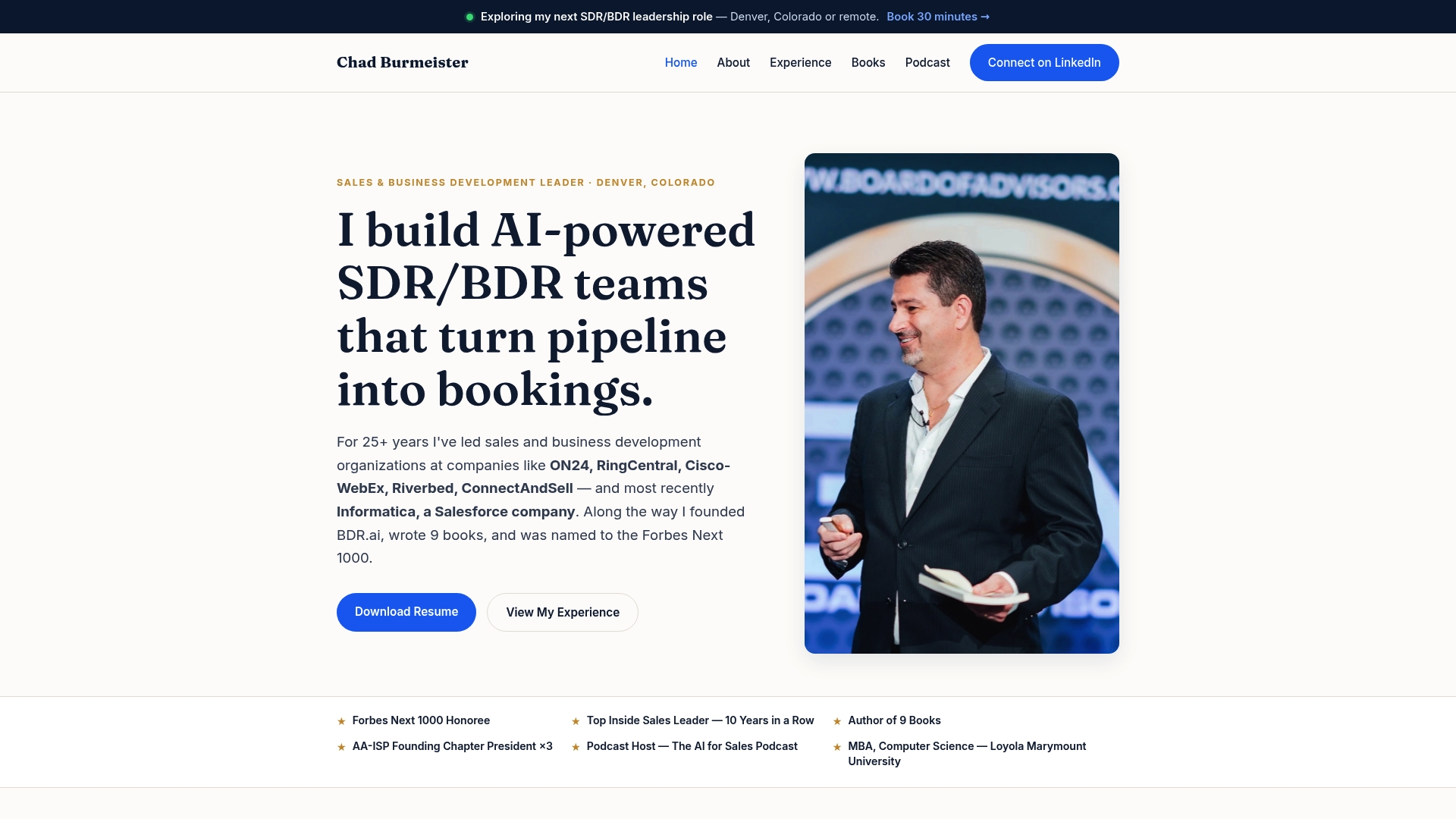
The Be Extraordinary curriculum gives teams a structured framework for building enablement content and reinforcement routines, drawing on lessons from scaling sales and business development teams at companies like Informatica, RingCentral, and Cisco-WebEx. Managers who work through a structured build process, rather than drafting alone, tend to see faster adoption and more consistent reinforcement in pipeline reviews, though results vary by team and starting point.
- Workshops focused on playbook structure, play design, and manager reinforcement habits.
- Curriculum built to operationalize onboarding artifacts and 30/60/90 ramp checks.
- Groups for leaders who want ongoing peer accountability while rolling out a new playbook.
Reach out through Be Extraordinary to talk through a workshop or engagement scoped to your team's current stage.
Where to go next for templates and deeper reading
For structural best practices, see Salesforce.org's enablement resources, the Salesforce sales playbook guide, and the downloadable HubSpot playbook template. For embedding guidance in workflow, read SellingPower's piece on AI and playbooks. For play examples, see multithreading tactics and mutual action plans. Professional services teams can also review Sales Phoenix's sales performance resources for a complementary perspective on tailoring plays to consulting-style sales cycles.
Sources
- Sales Playbook Guide: Examples & Templates for Success
- From static to smart: How AI is reinventing the sales playbook
- Salesforce
FAQ
What should be in a sales playbook?
A sales playbook should cover a company overview and positioning, an ideal customer profile, a library of plays with scripts, a process map, CRM field mapping, and a KPI section for measuring results. The Salesforce sales playbook guide frames this as a comprehensive resource covering personas, selling strategies, and best practices reps can apply consistently across common scenarios.
What are the 5 P's of sales?
Definitions vary across sources, but a common version covers product, price, promotion, place, and people, adapted from classic marketing frameworks into a sales context. There's no single authoritative sales-specific version, so treat it as a loose mental model rather than a fixed framework to build a playbook around.
What is the 30-60-90 rule in sales?
The 30-60-90 rule breaks a new hire's ramp into three phases, typically learning and shadowing in the first 30 days, applying skills on real deals by day 60, and hitting independent quota-relevant activity by day 90. The strongest version of this ramp plan ties each phase to a checkable artifact, like a scored discovery call or a completed ICP assessment, rather than a subjective learning goal.
What four elements should your sales playbook include?
At minimum, a sales playbook should include a defined ideal customer profile, a library of sales plays tied to specific triggers, scripts and process maps for each stage, and KPIs that measure whether each play is working. This structure matches the table of contents used in the HubSpot downloadable sales playbook, which covers vision, ICP, use cases, sales process, and competitive analysis as core sections.