
Multithreading in sales is the right move for any complex B2B deal, and you can start in the next 30 seconds. Map one stakeholder you haven't contacted yet, send them a message tailored to their specific role, and log both in your CRM. That's the starter plan. The rest of this playbook shows you how to scale it across your entire pipeline.
The core benefit is straightforward: multithreaded deals close at higher rates, stall less often, and survive personnel changes that would otherwise kill a single-threaded opportunity. Industry analyses recommend a floor of three active stakeholders for mid-market deals and five or more for enterprise.
When single-threading still makes sense:
- Transactional SMB deals with one clear decision-maker and a sub-30-day cycle
- Renewals where the relationship is strong and the contract is straightforward
- Early-stage prospecting before you've confirmed a real opportunity exists
- Deals under $10K where the buying committee is genuinely one person
For everything else — multi-stakeholder, multi-department, six-figure-plus — multithreading is the operating model.
Key Takeaways
Multithreaded deals close at higher rates and stall less often than single-threaded equivalents — the minimum floor is three active stakeholders for mid-market and five or more for enterprise.
| Point | Details |
|---|---|
| Start at discovery | Map the buying committee before your second call, not after the proposal is out. |
| Assign thread ownership | AE owns economic buyer; SDR opens tier-two threads; SE owns technical evaluator. |
| Use the 2-2-2 rule | Two channels, two touches per week, for the first two weeks of active engagement. |
| Track engagement breadth | Measure contacts with bi-directional activity in the last 14 days, not just contacts mapped. |
| Chadburmeister playbooks | Workshops and coaching engagements help teams operationalize multithreading with CRM config, pilot design, and a four-week coaching cadence. |
Table of Contents
- What is multi-threading in sales, and how does it differ from single-threading?
- Why does multithreading improve win rates, cycle times, and deal protection?
- How to execute a multithreading playbook at each deal stage
- What templates and cadence rules actually work for multithreaded deals?
- Which tools make sales multithreading scale across a full team?
- Operational checklist for rolling out multithreading across your team
- What mistakes kill multithreading efforts, and how do you fix them?
- What metrics prove that multithreading is working?
- Scaling multithreading across SDR/AE teams: a practitioner's view
- A note on the hardest part of adoption
- Multithreading workshops and coaching with Chadburmeister
- Sources
What is multi-threading in sales, and how does it differ from single-threading?
Multithreading in sales means deliberately building parallel relationships across every relevant member of a buying committee, not just the one contact who replied first. The goal is to have active, two-way conversations with multiple stakeholders simultaneously, each receiving messaging calibrated to their role and priorities.
Single-threading is the default failure mode: one rep, one contact, one thread. When that contact goes dark, changes jobs, or gets overruled, the deal dies. Gartner's analysis of B2B buying committees frames multithreaded engagement as a core revenue acceleration tactic precisely because modern buying groups are larger and more distributed than they were a decade ago.
The seven buying-role archetypes you need to map
Most enterprise deals involve some combination of these roles. Not every deal has all seven, but missing any one of them late in the cycle is expensive:
- Economic buyer: Controls the budget and signs the contract. Cares about ROI and risk.
- Champion: Your internal advocate. Sells on your behalf when you're not in the room.
- Technical evaluator: Validates fit, security, and integration. Can block a deal quietly.
- End user: Uses the product daily. Their adoption resistance can kill post-sale momentum.
- Executive sponsor: Provides air cover and strategic alignment at the C-suite level.
- Blocker: Has a competing agenda or a preferred vendor. Needs to be identified early.
- Procurement: Controls contract terms, timelines, and vendor compliance requirements.
Single-threading vs. multithreading at a glance
| Dimension | Single-threaded | Multithreaded |
|---|---|---|
| Stakeholder coverage | 1 contact | 3–7+ active contacts |
| Deal risk | High (champion dependency) | Distributed across roles |
| Cycle impact | Stalls when contact goes dark | Continues through personnel changes |
| Win rate trajectory | Flat or declining in complex deals | Materially higher with 3+ engaged |
Gartner's B2B buying-journey research documents how buying groups have grown in both size and internal complexity, which makes the single-threaded model structurally fragile in any deal above a certain threshold of organizational involvement.
Why does multithreading improve win rates, cycle times, and deal protection?
The business case isn't theoretical. Forrester's State of Business Buying research documents high rates of stalled purchases tied directly to complex buying groups where sellers failed to engage the full committee. Deals stall not because buyers lose interest but because internal consensus breaks down among stakeholders the seller never reached.
Deals with 3–5 engaged stakeholders close at materially higher rates than single-threaded equivalents, with enterprise deals requiring 5+ contacts to sustain momentum through procurement and legal review. Industry analyses summarized by AccountMap and Altify converge on this benchmark as a practical floor, not a ceiling.
The mechanism is consensus. B2B purchases above a certain dollar threshold require internal alignment that no single champion can manufacture alone. When you have active threads with the economic buyer, the technical evaluator, and the end-user lead simultaneously, you're building consensus from multiple directions at once rather than hoping your champion can carry the message upward and sideways without distortion.
Tangible outcomes leaders care about:
- Higher forecast reliability because deals have multiple confirmed contacts, not just one optimistic champion
- Shorter cycles when blockers are identified and addressed early rather than surfacing at contract review
- Deal protection when a champion leaves, gets promoted, or goes on leave mid-cycle
- Expansion potential because end users and department heads who were engaged during the sale become advocates for renewal and upsell
- Reduced churn from misaligned expectations, since technical evaluators and end users who participated in the buying process understand what they bought
ZoomInfo's pipeline research includes a Seismic case study showing a 54% productivity gain attributed to tool-assisted multithreaded engagement, which illustrates the scale of operational upside when the approach is systematized rather than left to individual rep initiative.
How to execute a multithreading playbook at each deal stage
The playbook below runs from first discovery through close. It assigns thread ownership and sequences outreach so multiple relationships grow in parallel without creating internal chaos at the account.
-
Discovery (Days 1–5): Map the committee before you pitch. Before your second call, use LinkedIn Sales Navigator, ZoomInfo, or your CRM's org-chart data to identify every plausible stakeholder. Tag each by role archetype. Your goal is a working hypothesis of the full buying committee, not a perfect org chart.
-
Prioritize threads by influence and access. Rank contacts by their likely influence on the final decision and your current access level. The economic buyer and champion are tier one. Technical evaluators and end users are tier two. Procurement and blockers are tier three — you need to know they exist even if you can't reach them directly yet.
-
Assign thread ownership. The AE owns the economic buyer and executive sponsor relationships. The SDR handles initial outreach to tier-two contacts. Solution engineers or technical pre-sales own the technical evaluator thread. Managers own any C-suite outreach that requires executive-to-executive credibility.
-
Tailor messaging by role, not by account. The CFO cares about payback period and risk. The IT lead cares about integration complexity and security. The end-user manager cares about adoption and training. Send each a message that speaks to their specific concern, not a generic pitch with the company name swapped in. Highspot's B2B selling framework emphasizes maintaining one shared narrative across all threads while varying the role-specific angle.
-
Sequence multi-channel touches so threads grow in parallel. Email first, then a LinkedIn connection request, then a call. Don't run all three channels on the same day. Space them across a 5–7 day window so outreach feels considered, not automated.
-
Brief absent stakeholders before key meetings. If the CFO can't attend a demo, send a one-page ROI brief the day before. If the IT lead missed the discovery call, send a technical summary with three specific questions answered. Never let a stakeholder walk into a meeting cold.
-
Run internal syncs weekly. The AE, SDR, and SE should spend 15 minutes weekly reviewing thread status: who's engaged, who's gone dark, what the next touch is for each contact, and whether any new stakeholders have surfaced.
-
Negotiation and close: confirm all threads are active. Before submitting a proposal, verify you have bi-directional activity (a reply, a meeting, a forwarded document) with at least three contacts. A proposal sent to a single champion who hasn't confirmed internal alignment is a coin flip.
Pro Tip: Before reaching out to any new stakeholder, ask your champion first. A simple script works: "I want to make sure [Name] has what they need to evaluate this on the technical side — would it be helpful if I sent them a brief directly, or would you prefer to loop them in?" This permission framing keeps your champion as an ally rather than making them feel bypassed.
Role-specific conversation goals to keep threads on track:
- Economic buyer thread: confirm budget authority, understand fiscal timing, align on business case
- Champion thread: co-create the internal narrative, prep them for objections, share competitive intel
- Technical evaluator thread: answer integration questions, offer a sandbox or POC, address security concerns
- End-user thread: understand workflow pain, show ease of adoption, offer reference calls with peer users
What templates and cadence rules actually work for multithreaded deals?
The 2-2-2 rule
Touch each stakeholder via two channels, twice per week, for the first two weeks of active engagement. For enterprise deals with five or more contacts, extend the window to three weeks and add a third channel (LinkedIn video message or a brief Loom). The rule isn't about volume — it's about establishing bi-directional activity before the deal advances to the next stage.

Three ready-to-use templates
Template 1: Forwardable intro for your champion
Subject: Quick note you can forward to [Name]
Hi [Champion], here's a short note you can forward to [Technical Evaluator] if helpful:
"[Name] — [Champion] suggested I reach out. We're working with [Company] on [use case]. I'd love to share how we handled [specific technical concern] for [similar company]. Would 20 minutes work this week?"
Happy to adjust the wording — just let me know.
Template 2: CFO ROI email
Subject: [Company] — the numbers behind the decision
Hi [CFO Name], [Champion] mentioned you're evaluating [solution area]. Based on what I've seen with similar companies at your revenue scale, the payback period typically runs [X months], driven by [specific efficiency or cost metric]. I can put together a one-page model specific to [Company] if that would be useful for your review. Worth 15 minutes?
Template 3: Executive outreach note
Subject: [Shared connection or trigger event] — quick note
Hi [Exec Name], [Champion] and I have been working through [initiative]. I wanted to connect directly to make sure the strategic framing aligns with your priorities for [year/quarter]. Would a brief call make sense, or would a written summary be more useful?
Sample 10-day cadence for two to five stakeholders
- Day 1: Personalized email to each stakeholder (role-tailored, not a blast)
- Day 3: LinkedIn connection request with a one-line note referencing the email
- Day 5: Follow-up email to anyone who opened but didn't reply; voicemail to tier-one contacts
- Day 7: Champion check-in: ask who else should be involved and whether any forwarded messages landed
- Day 10: Second email to tier-two contacts with a new angle (case study, ROI data, or a question specific to their role)
Keep each message single-threaded in purpose even when multithreading overall. Every message should have one clear ask and one clear reason why that specific person is receiving it.
Which tools make sales multithreading scale across a full team?
No single tool does everything. The stack that supports multithreaded selling at scale typically covers six functional categories, and each solves a distinct problem.
Contact and data platforms identify who's on the buying committee and provide verified contact information. ZoomInfo and similar B2B contact databases surface org-chart relationships, job changes, and intent signals that tell you which stakeholders are actively researching your category.
Intent and account signals tell you when to activate a thread. B2B intent data providers flag accounts showing research behavior so you can prioritize which threads to open first rather than spreading effort evenly across a cold list.
CRM (Salesforce and equivalents) is the system of record for thread ownership, role tags, last-contact dates, and engagement breadth. Without mandatory CRM fields for stakeholder role and last bi-directional activity, multithreading becomes invisible to managers and uncoachable.
Sales engagement platforms sequence and coordinate multi-channel outreach across threads. The best sales engagement platforms for multithreaded teams support contact-level sequencing (not just account-level), so each stakeholder receives a distinct cadence without manual coordination by the rep.
Conversation intelligence tools like Gong and Chorus analyze call and meeting recordings to flag when a deal is single-threaded, identify stakeholders mentioned but not yet contacted, and surface coaching moments where a rep missed a cue to expand the thread. Gong's deal intelligence dashboards, in particular, show stakeholder engagement breadth as a pipeline health metric.
Content and enablement platforms like Seismic ensure that when reps reach a new stakeholder, they have the right asset for that role — a CFO one-pager, a technical integration guide, an end-user case study — rather than sending the same deck to everyone.
LinkedIn Sales Navigator sits across all of these categories. It maps org charts, surfaces relationship paths, identifies job changes that signal a thread needs to be rebuilt, and provides InMail as a direct outreach channel for contacts who don't respond to email.
Minimum CRM fields to add before launching a multithreading pilot: stakeholder role tag, thread owner, last bi-directional contact date, channel used, and engagement breadth score (number of contacts with activity in the last 14 days).
Operational checklist for rolling out multithreading across your team
Phase 1: Pilot setup (Weeks 1–2)
- Select 10–15 active opportunities above your multithreading threshold (deal size, complexity, or stage).
- Assign thread ownership using a simple RACI: AE owns economic buyer and executive sponsor; SDR owns initial outreach to tier-two contacts; SE owns technical evaluator; manager owns any C-suite thread requiring executive credibility.
- Add the five mandatory CRM fields listed above to your opportunity record. Make role tag and thread owner required fields, not optional.
- Brief the pilot team on the 2-2-2 cadence rule and the three message templates.
- Schedule a weekly 15-minute thread review for the pilot cohort.
Phase 2: Governance and coaching (Weeks 3–6)
- Run a weekly pipeline review that includes stakeholder coverage as a deal health metric alongside stage and amount.
- Flag any opportunity in stage 3 or above with fewer than two active threads as a coaching priority.
- Review Gong or Chorus call recordings weekly for single-threading signals (rep mentions only one contact name throughout the call).
- Tie thread coverage to deal advancement criteria: no deal moves to "Proposal" without bi-directional activity from at least two stakeholders.
Phase 3: Scale (Weeks 7–12)
- Roll the playbook to the full team with a 60-minute training session and a written one-page reference guide.
- Add stakeholder coverage to your weekly forecast template.
- Assign a sales ops owner for CRM hygiene and weekly thread-gap reporting.
Resource estimate: Expect each rep to spend roughly two to three additional hours per week during the pilot phase on stakeholder mapping, message tailoring, and CRM logging. That drops to one to two hours per week once the habits are established and tooling is configured. Tooling lift depends on your existing stack — if you already have Salesforce, a sales engagement platform, and LinkedIn Sales Navigator, the incremental cost is primarily configuration and training, not new licenses.
SDR/AE pairing note: For SDR and BDR role clarity, the SDR's job in a multithreaded deal is to open tier-two threads and hand them to the AE once a conversation is established. The AE's job is to maintain and deepen those threads, not to restart them from scratch.

What mistakes kill multithreading efforts, and how do you fix them?
Carpet-bombing with the same message. Sending identical outreach to every stakeholder signals that you don't understand their role. Fix: write a distinct opening line for each contact that references their specific function or a concern relevant to their position. Even a single tailored sentence changes the response rate.
Going around the champion without permission. Reaching out to the CFO or CTO before your champion knows about it creates internal friction and can cost you the deal. Fix: use the permission-framing script from the playbook section. Ask first, always.
CRM discipline failures. If thread ownership and last-contact dates aren't logged, managers can't coach and reps can't coordinate. Fix: make role tag and last bi-directional contact date required fields. Run a weekly five-minute hygiene check where reps update any contact touched that week.
Starting too late. Multithreading a deal that's already in late-stage negotiation is harder and less effective than mapping the committee at discovery. Fix: add stakeholder mapping as a required step in your discovery call checklist, not an optional follow-up task.
Pro Tip: To re-thread a stalled single-threaded deal in 7–14 days, start with your champion. Ask directly: "Who else inside [Company] has a stake in this decision?" Then use the forwardable intro template to reach those contacts through your champion rather than cold. You'll recover more deals this way than by escalating to the executive level without an internal introduction.
Highspot's multithreading framework and Gangly's operational guide both emphasize that the political skill of permission framing is the most underrated element of multithreaded selling — technically correct outreach that bypasses the champion is still a mistake.
What metrics prove that multithreading is working?
Track these six metrics. Build them into your weekly pipeline review and your quarterly forecast model.
Core metrics and how to read them:
- Contacts per deal: Total stakeholders mapped per opportunity. A mid-market deal below three is a red flag; enterprise below five warrants a coaching conversation.
- Engagement breadth: Number of contacts with bi-directional activity (a reply, a meeting, a forwarded document) in the last 14 days. This is the most operationally useful metric because it distinguishes mapped contacts from active threads.
- Stakeholder coverage ratio: Mapped roles divided by engaged roles. A ratio below 50% means you know who's on the committee but aren't reaching them.
- Channel diversity: Number of distinct channels used per contact (email, phone, LinkedIn, in-person). Single-channel contacts are fragile.
- Win rate by thread count: Segment closed deals by number of active threads at proposal stage. The pattern almost always shows a step-change improvement at three or more threads.
- Cycle time by thread count: Same segmentation. Deals with broader stakeholder engagement tend to move faster through procurement because internal consensus is already built.
| Metric | How to calculate | Positive signal |
|---|---|---|
| Contacts per deal | Total mapped stakeholders / opportunity | 3+ mid-market, 5+ enterprise |
| Engagement breadth | Contacts with bi-directional activity (14 days) | Rising week over week |
| Stakeholder coverage ratio | Engaged contacts / mapped contacts | Above 60% |
| Channel diversity | Channels used per contact | 2+ channels per active thread |
| Win rate by thread count | Win rate segmented by threads at proposal | Step-change at 3+ threads |
| Cycle time by thread count | Average days to close by thread count | Shorter at higher thread counts |
Cognism's research on engagement signals recommends tracking email opens, replies, and meeting attendance as the primary engagement breadth inputs — these are the signals that distinguish a contact who received a message from one who is genuinely in the conversation.
Dashboard ownership: Sales ops builds and maintains the dashboard. Managers review it weekly. Reps see their own thread coverage in their CRM home view. Quarterly business reviews should include a cohort comparison showing win rate and cycle time before and after multithreading adoption.
Scaling multithreading across SDR/AE teams: a practitioner's view
The teams that make multithreading stick do one thing differently from the teams that don't: they make thread coverage a coaching metric, not just a pipeline metric. When a manager asks "How many active threads does this deal have?" in every pipeline review, reps start logging threads before the meeting rather than after.
The SDR/AE pairing structure that works best in practice assigns the SDR to open threads and the AE to deepen them. The SDR's job is to get a first reply from a tier-two or tier-three stakeholder. Once that reply arrives, the AE takes over the relationship. This division prevents the AE from spending time on cold outreach and prevents the SDR from holding relationships they're not equipped to advance.
Quota design matters here. If SDRs are measured only on meetings booked with a single contact, they have no incentive to map additional stakeholders. Adding a "stakeholder coverage" metric to SDR scorecards — even informally, as a coaching signal — shifts behavior within two to three weeks.
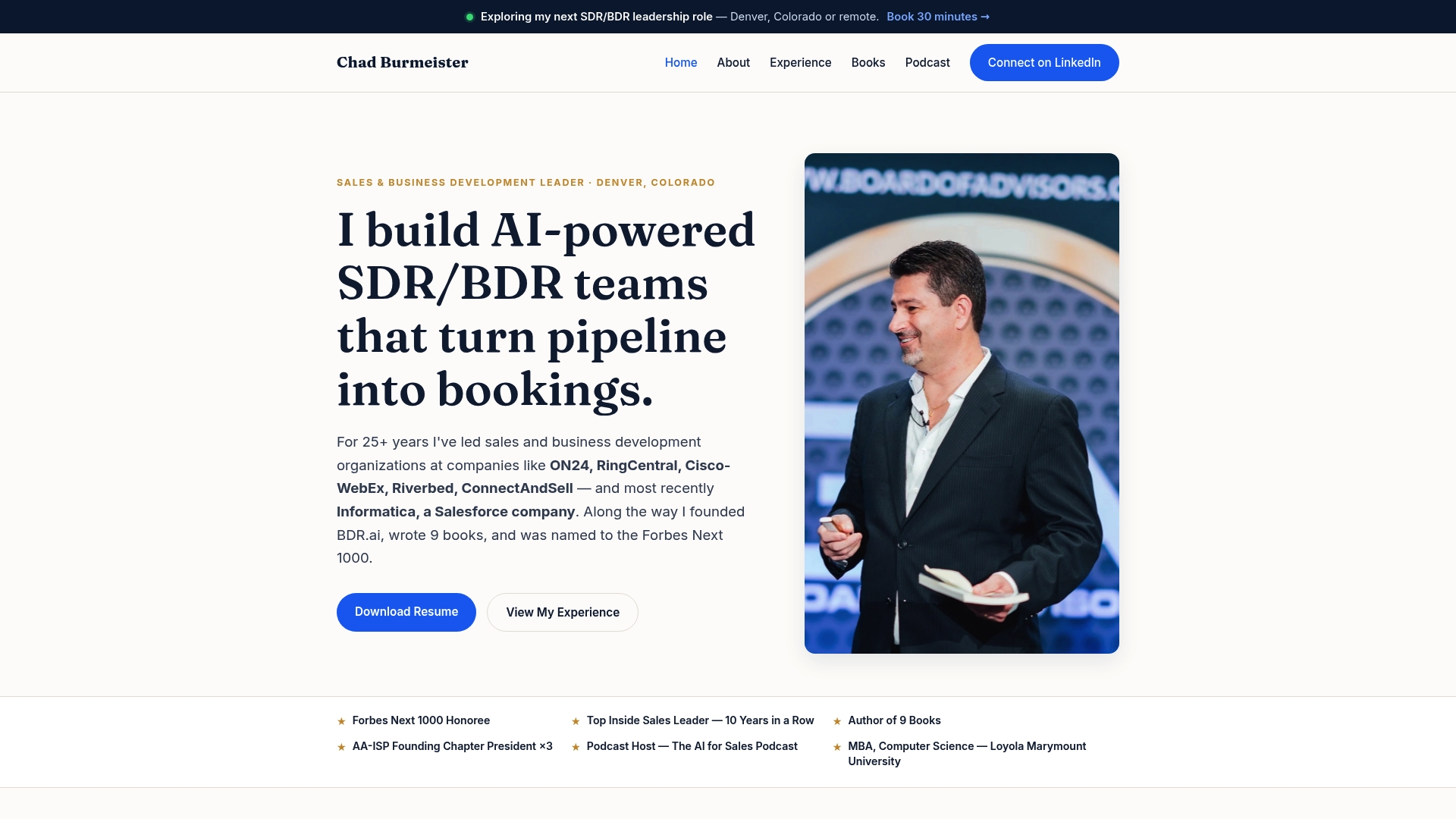
Chad Burmeister has spent 25+ years scaling high-performance sales and business development teams at companies including Informatica, RingCentral, and Cisco-WebEx. He is the author of nine books on sales strategy and AI, including AI for Sales 2.0, and hosts The AI for Sales Podcast. His books and playbooks are used by SDR and AE teams across the United States.
A note on the hardest part of adoption
The tactical playbook above is the easy part to write. The hard part is the first week of rollout, when reps who've been single-threading for years look at a stakeholder map with five names on it and feel like they've just been handed twice the work.
The fix isn't more training. It's a smaller pilot. Pick three deals, assign one extra thread per deal, and measure what happens over 30 days. When reps see a stalled deal start moving again because a new thread surfaced a blocker they didn't know existed, the behavior change follows naturally. Pilot first, measure the outcome, then scale what works.
Multithreading workshops and coaching with Chadburmeister
Most sales teams understand the concept of multithreading. The gap is execution: reps who default to single-threading under pressure, CRM fields that don't exist yet, and managers who don't have a coaching framework for thread coverage.
Chadburmeister offers hands-on workshops, SDR/AE pairing coaching, and pilot design engagements built specifically around the operational challenges above. A typical engagement delivers a customized multithreading playbook, a CRM configuration checklist with required fields and ownership assignments, a pilot metrics dashboard, and a four-week coaching cadence for managers. The goal is a team that multithreads by default, not by exception. If you're ready to run a pilot or want to discuss what a coaching engagement looks like for your team, reach out directly through Chadburmeister.
Sources
- Why multithreaded engagements are the secret to accelerating revenue growth
- Forrester: The state of business buying 2024
- Multi-Threaded sales approach (ZoomInfo pipeline)
- Multithreading in sales: The B2B selling framework
- Multi-Threaded Selling: The Complete Guide for 2026 | Account Map Blog
- Multi-Threaded Selling: Prevent Deal Loss | Altify