
Run a 30-60-90 SDR onboarding plan: month one builds product, ICP, and talk-track certification through role-play, month two moves reps into supervised live calling with pipeline targets, and month three hands them a calibrated quota with full accountability for forecast accuracy. Done well, this gets a rep to their first booked meeting inside two weeks and to steady quota contribution by day 90. Structured programs like this cut time-to-productivity by up to 34% compared to sink-or-swim onboarding.
Here's the month-by-month shape:
- Month 1: Certification over quota. Access, admin, product knowledge, ICP mastery, and 40 scored practice conversations before any live call.
- Month 2: Supervised live calling. Manager-observed calls, sequence discipline, and pipeline building against a partial quota.
- Month 3: Independent contribution. Full ramp quota, forecast ownership, and graduation from training wheels.
Two things to do in the next 48 hours: confirm system access, CRM logins, and dialer setup are ready before the rep's first day, and lock in comp plan clarity plus a scheduled first 1:1 so the new SDR isn't guessing about either their paycheck or their manager's expectations.
Key Takeaways
A structured 30-60-90 SDR onboarding plan with certification gates and phased quotas cuts ramp time and builds more consistent cohort performance than unstructured, sink-or-swim training.
| Point | Details |
|---|---|
| Certify before calling | Require 40 scored role-plays and passed certifications before any live prospect call. |
| Separate activity from output | Grade month 1 on practice volume and certifications, not pipeline created. |
| Use fixed checkpoints | Run manager reviews at days 3, 7, 14, and 30 to catch gaps before habits form. |
| Consider the 30-day accelerator | Reserve it for experienced hires with simple products and AI role-play tooling in place. |
| Get hands-on help | Chadburmeister builds custom 30-60-90 onboarding programs and delivers manager workshops for teams scaling SDR headcount. |
Table of Contents
- The Principles Behind an Effective SDR Onboarding Plan
- The 30-60-90 SDR Onboarding Playbook
- The 30-Day SDR Onboarding Accelerator
- Copy-Ready Checklists for Your Onboarding Docs
- Scaling Onboarding With AI Role-Play and Recorded Training
- What to Track: The SDR Onboarding KPI Dashboard
- Building the Mentor and Manager Coaching Cadence
- A Sample 90-Day Calendar You Can Import
- Why This Framework Holds Up Across Company Sizes
- Signs Your Ramp Is Actually Working
- How Chad Burmeister Can Help You Build This
- Where to Go Next
- Sources
The Principles Behind an Effective SDR Onboarding Plan
Most onboarding failures trace back to one mistake: managers let new reps make live calls before they've earned the right to. A rep who fumbles through their first 20 real conversations doesn't just miss quota. They burn prospects, damage confidence, and build bad habits that take months to unwind. The fix isn't more enthusiasm. It's sequencing.
Three principles separate SDR training programs that actually work from ones that just look organized on paper.
- Deliberate practice comes before live activity. Role-play isn't a formality before the real job starts. It is the real job's first phase. Programs that require 40 scored practice conversations before a rep's first unsupervised call see far more consistent outcomes than programs that let reps "learn on real prospects."
- Activity and output are different milestones, and conflating them wrecks your metrics. Month 1 should measure certification completions and practice volume, not pipeline. Month 3 should measure pipeline and forecast accuracy, not attendance at training. Fairview's onboarding research makes this distinction explicit: weight activity heavily early, then shift the weighting toward output as skills solidify.
- Feedback has to run on a fixed cadence, not an as-needed basis. Waiting until a rep is struggling to give them structured feedback means you've already lost weeks. Pass/fail checkpoints at set intervals, not vague "check-ins," catch problems while they're still cheap to fix.
That third point deserves emphasis because it's the one most managers skip. A pass/fail gate forces a real decision: does this rep move to the next phase, or do they repeat it? "Complete training" as a milestone is nearly meaningless. A certification with a scored rubric is not.
Pro Tip: Write your pass/fail criteria before the cohort starts, not while you're grading them. Grading on the fly almost always drifts toward leniency by the third or fourth rep.
The average sales rep now takes 5.7 months to reach full productivity, but the top onboarding programs compress SDR ramp to 6 to 8 weeks. The gap between those numbers is almost entirely structure: certification gates, checkpoint cadence, and a clear line between activity and output.
The 30-60-90 SDR Onboarding Playbook
This is the framework worth building your sales development onboarding checklist around: three 30-day phases, each with its own gate criteria, each unlocking the next.
Days 1 to 30: Foundation
The first month has one job: make sure the rep never has to think about basics once live calling starts. That means system access, product fluency, ICP recognition, and objection handling all become automatic before a single real prospect hears their voice.
Week 1 covers admin and orientation: CRM access, dialer setup, comp plan walkthrough, org chart, and shadowing calls with tenured reps. No outbound activity yet. The rep should end the week able to describe the product's core value proposition without notes.
Week 2 moves into ICP and messaging. Reps learn the ideal customer profile cold, study competitive positioning, and start building their first talk tracks. Role-play sessions begin here, scored against a rubric covering structure, value articulation, and objection handling.

Weeks 3 and 4 ramp up practice volume. This is where the 40 scored practice conversations benchmark matters most: conservative onboarding programs require this volume completed and passed before a rep gets access to live prospect lists. Certification exams on product, ICP, and talk tracks happen at the end of week 4.
Month 1 gate: Product certification passed, ICP certification passed, 40+ scored role-plays completed with an average passing score, and manager sign-off on readiness for live calls. No live-calling quota this month. Activity, not output, is what you're grading.
Days 31 to 60: Supervised live calling
Month two is where theory meets a real prospect's voicemail. Reps start dialing, but every early call gets reviewed. Managers should listen live or review recordings within 24 hours for at least the first two weeks of this phase.
Sequencing discipline matters here more than raw volume. A rep who sends 200 disorganized touches produces worse results than one who runs 80 touches through a structured, multi-channel sequence. Month 2 is also when pipeline-building tools and a solid contact database start paying off, since bad data wastes the calling reps just earned the right to do.
Conversion targets should be tracked weekly:
- Connect rate on dials (benchmark against your team's historical average, not an industry number)
- Meeting-set rate per 100 dials
- Sequence completion rate before manual intervention
- Manager-reviewed call quality score, trending upward week over week
Month 2 gate: Partial quota attainment, positive trend in call quality scores, and demonstrated ability to run a sequence without daily manager intervention. A rep who's still needing hand-holding on basic CRM logging at day 55 is not ready to graduate, regardless of how good their calls sound.
Days 61 to 90: Independent quota contribution
By month three, the rep should be operating like a full team member, just newer.
This is also when forecast accuracy becomes a graded metric. A rep who can hit quota but can't accurately predict their own pipeline for next week isn't fully ramped. Teach forecasting discipline here, not later, because bad forecasting habits calcify fast once a rep feels "done" with onboarding.
Month 3 gate (graduation criteria): Full quota attainment for at least two consecutive weeks, forecast accuracy within an agreed variance, and manager confirmation that the rep can operate without structured daily oversight. At this point, the rep moves to normal team cadence, not an onboarding track.
Teams that skip the middle step and jump straight from 0% to 100% see far higher early-tenure burnout and turnover.
The 30-Day SDR Onboarding Accelerator
Not every team should compress the timeline, but some can, and when it works, it works well. A tightly run 30-day sprint with AI role-play and strict pass/fail checkpoints has produced first meetings by day 10 and 50% quota attainment by day 30 in eligible programs.
Three prerequisites determine whether your team qualifies for this accelerated path:
- You're hiring experienced SDRs, not first-job graduates. A rep who's already run 40 discovery calls at another company doesn't need the same foundational reps that a true beginner does.
- Your product and ICP are simple enough to master fast. A single-product SaaS tool with one clear buyer persona compresses far better than a multi-product enterprise portfolio with five distinct ICPs.
- You have AI role-play tooling available. Manual role-play with a manager doesn't scale to the practice volume this timeline requires. AI-scored practice conversations do.
Here's a safe version of the 30-day sprint:
- Week 1: Compressed admin and product certification, completed in 3 days instead of 5. Daily AI role-play sessions start day 2, targeting 8 to 10 scored conversations per day.
- Week 2: Certification exam by day 8. First live calls, fully supervised, starting day 9 or 10. Target: first meeting booked by day 10.
- Week 3: Independent calling with daily manager call reviews (not live monitoring, recorded review). Partial quota introduced at roughly 30%.
- Week 4: Ramp to 50% quota target by day 30. Forecast discipline introduced. Graduation review at day 30, not automatic promotion.
The risk with a compressed timeline is obvious: reps hit live prospects faster, with less practice buffer. Two controls prevent this from becoming a liability. First, raise the role-play pass threshold rather than lowering it. Second, cap live call volume in week 2 (no more than 15 to 20 calls per day) so early mistakes stay contained to a small sample rather than burning through your best leads.
Pro Tip: If a rep fails the day 8 certification exam, don't push them into the accelerated track anyway "to keep pace with the cohort." Move them to the standard 90-day plan. A failed gate that gets waived defeats the entire purpose of having gates.
Copy-Ready Checklists for Your Onboarding Docs
You don't need to build this from scratch. Here's a sales development onboarding checklist structure you can adapt directly.
Day 1 checklist:
- IT access confirmed before the rep arrives (CRM, dialer, email, calendar)
- Comp plan walkthrough completed in writing, not just verbally
- Team introductions scheduled, including at least one session with a top-performing SDR
- First shadowing call scheduled for day 1 or day 2
Weekly checkpoint template (repeat for weeks 1 through 12, adjusting pass criteria by phase):
| Checkpoint element | Pass criteria |
|---|---|
| Manager 1:1 completed | Held on schedule, notes logged in shared doc |
| Skill milestone for the week | Rubric score meets or exceeds phase threshold |
| Activity volume | Meets weekly target for calls, role-plays, or sequences |
| Red flags identified | None unresolved from prior week's checkpoint |
Certification rubrics need explicit scoring criteria, not a simple pass or fail checkbox. A product certification rubric should score accuracy of feature explanation, ability to tie features to buyer pain points, and confidence under rapid-fire questioning. A call quality rubric should score talk-track structure, whether the rep articulated value in the first 30 seconds, how they handled the first objection raised, and whether they secured a clear next step before ending the call.
Managers who skip written rubrics and grade "by feel" tend to drift. Reps who talked to them early in the cohort get graded more leniently than reps evaluated after a long day. A written rubric fixes that.
Scaling Onboarding With AI Role-Play and Recorded Training
Manager bandwidth is the real constraint on any SDR onboarding program. One manager can't personally role-play 40 conversations with every new hire while also running the existing team. This is where AI role-play and short recorded walkthroughs earn their keep.
AI role-play operating model:
- Set a daily practice quota (8 to 10 conversations during month 1 foundation weeks)
- Score each session against the same rubric used for live call reviews: talk-track structure, value articulation, objection handling, and close
- Feed AI role-play scores directly into weekly checkpoint reviews so managers spend their time on coaching, not raw grading
- Require a minimum passing score before advancing to the next practice module, not just a completion checkbox
Record & Delegate for repetitive tasks: instead of walking every new hire through the same CRM update process live, record a five-minute screen capture once and reuse it across every cohort. This approach reduces manager interruptions and gives new hires something rewatchable when they inevitably forget a step during their second week. Good candidates for this format: CRM field updates, handoff note formatting, sequence enrollment steps, and calendar booking workflows.
Call library and tagging: build a shared library of anonymized recorded calls, tagged by scenario (cold open, gatekeeper navigation, pricing objection, competitor mention). New reps review tagged examples relevant to whatever skill they're currently building, and managers use the same library during call reviews to point at a concrete "here's what good looks like" example instead of describing it abstractly.
Pro Tip: Tag your call library by weakness, not just by topic. A rep struggling with objection handling should be able to pull ten tagged examples of strong objection responses in under a minute, not scroll through fifty unsorted recordings.
What to Track: The SDR Onboarding KPI Dashboard
Different checkpoints call for different metrics. Tracking pipeline in week 1 is meaningless. Tracking certification completion in week 10 is too late to matter.
Days 1 to 7: Time-to-first-call, time-to-first-role-play, and access setup completion are your only relevant signals. Nothing else matters yet.
Days 8 to 30: Certification completion rate, role-play pass rate, and time-to-first-meeting become the leading indicators worth watching. A rep who hasn't hit their first booked meeting by day 15 in a standard 90-day program, or day 10 in an accelerated one, needs a manager intervention conversation, not another week of hoping.

Days 31 to 60: Conversion ratios take over: connect rate, meeting-set rate per dial, and call quality score trend.
Days 61 to 90: Full quota attainment rate, forecast accuracy, and pipeline created become the graduation metrics.
Manager checkpoints at days 3, 7, 14, and 30 catch training gaps early enough to fix them before bad habits set in, according to practitioner playbooks across multiple training providers.
If you're running more than one cohort per year, compare them against each other. A cohort that consistently lags on time-to-first-meeting compared to prior groups is telling you something about that specific hiring batch, your product changes, or a gap in how you're running the program. Run small A/B tests: try adjusting role-play volume requirements or shifting the live-call start date by a week and measure which cohort ramps faster.
Building the Mentor and Manager Coaching Cadence
Pair every new SDR with a mentor, but choose that mentor deliberately. The best mentors aren't necessarily your top producer. They're reps who are strong performers and patient explainers, since those two traits rarely overlap as often as managers assume.
- Set expected shadowing hours explicitly. A new rep should shadow their mentor for at least 5 to 8 hours in week 1 alone, tapering to 2 to 3 hours weekly through month 2.
- Run a fixed manager cadence. Daily quick syncs (10 minutes, standing) through week 4, shifting to weekly call reviews by week 5, then bi-weekly pipeline deep dives from month 2 onward. A manager who moves from live monitoring to coached call reviews by week 4 frees up real time while keeping quality intact.
- Build a remediation plan template before you need one. Red flags worth triggering it: missed certification on the first attempt, call quality scores flat or declining for two consecutive weeks, or zero meetings booked by day 20 in a standard program. The template should specify a defined remediation window (typically two weeks), a named support person, and a clear go/no-go decision point at the end.
A Sample 90-Day Calendar You Can Import
Here's what week 1 looks like on a manager's calendar, and the recurring pattern that carries through months 1 to 3.
Day 1 sample agenda: 9:00 AM system access confirmation, 10:00 AM comp plan walkthrough, 11:00 AM team introductions, 1:00 PM shadow call with a senior rep, 3:00 PM first AI role-play orientation session.
Week 1 recurring blocks: 30 minutes daily for role-play practice (morning), 1 hour daily for product/ICP study (early afternoon), 30 minutes daily manager check-in (end of day).
| Phase | Weekly recurring pattern |
|---|---|
| Month 1 | Daily role-play block, daily manager sync, weekly certification review |
| Month 2 | Daily supervised calling block, weekly call review, bi-weekly pipeline check |
| Month 3 | Independent calling schedule, weekly 1:1, bi-weekly forecast review |
If you're onboarding multiple cohorts per year, stagger start dates by at least two weeks so mentors and managers aren't running two week-1 schedules simultaneously. Running cohorts back-to-back without staggering is one of the fastest ways to burn out your best mentors.
Why This Framework Holds Up Across Company Sizes
This playbook draws on more than 25 years of building and scaling sales development teams at companies including Informatica, RingCentral, and Cisco-WebEx, where the same core structure, certification before live activity, phased quota ramp, and fixed manager cadence, held regardless of company size or deal complexity.
Adapting it is mostly a matter of scale, not substance:
- Startups (under 10 reps): Compress mentor pools; the sales manager may need to serve as both mentor and gate-reviewer.
- Mid-market teams: Assign dedicated onboarding leads separate from quota-carrying managers so ramp doesn't compete with pipeline pressure.
- Enterprise teams: Build multiple ICP tracks into month 1 certification, since a single rep may need to master more than one buyer persona.
The mistake that costs the most isn't a slow ramp. It's a fast ramp built on skipped gates. A rep who "graduates" without earning it becomes a manager problem for the next six months instead of a training problem for the first ninety days.
Signs Your Ramp Is Actually Working
Three things tell you a cohort is on track before the KPI dashboard confirms it. First, new reps start asking sharper objection-handling questions in week 2 instead of just logistics questions. Second, mentors stop fielding the same repeated question more than twice, meaning the Record & Delegate videos are landing. Third, a rep's first live call doesn't sound like their first live call.
If none of these show up by week 3, don't wait for the day 30 numbers to confirm the problem. Pull the rep into an extra role-play block immediately. That single move, adding practice reps rather than adding pressure, fixes more stalled ramps than any dashboard review does.
— Chad
How Chad Burmeister Can Help You Build This
Reading a playbook is one thing. Running it across three cohorts a year while also carrying your own number is another. Chadburmeister works directly with sales leaders to design and implement onboarding programs like this one, not as a generic template, but built around your specific product, ICP, and team size.
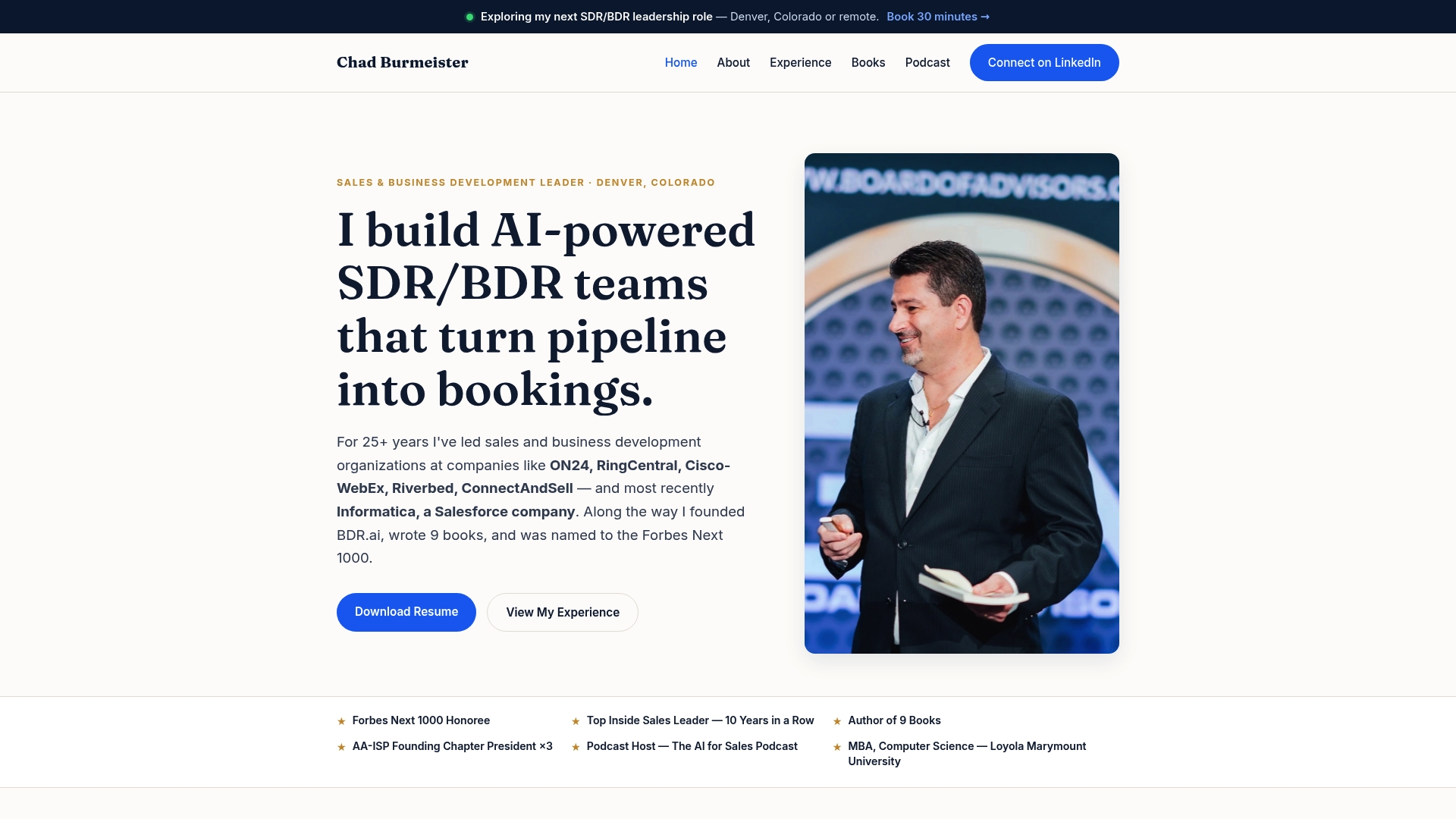
That includes hands-on workshop delivery for teams that want their managers trained on running certification gates and call reviews correctly the first time, and direct consulting engagements for CROs and founders who need someone to build the full 30-60-90 structure, from role-play rubrics to KPI dashboards, rather than adapting a generic checklist under deadline pressure. If your team is scaling SDR headcount and can't afford a slow, inconsistent ramp, Chadburmeister to talk through what a hands-on onboarding build or workshop would look like for your team.
Where to Go Next
For a broader process-design lens beyond SDR-specific training, review this onboarding process guide. To sort out comp structure before your next cohort starts, see how to build an SDR compensation plan. If you're still deciding role scope, BDR vs SDR differences clarifies which motions to teach during onboarding.
Sources
- Sales Onboarding Checklist Template: Free Download
- SDR Onboarding Checklist: 30-Day Plan That Cuts Ramp — QUOTA Training
- Sales Representative Onboarding Checklist