A sales transformation plan is a written, sequenced answer to one question: what has to change in how your company finds, qualifies and closes revenue, who owns each change, and how you will know it worked. The plan matters less than the leader running it. Gartner reports that only 11% of sales leaders maintain productivity through a transformation, so the person who owns the plan, usually a hands-on sales development or business development leader, decides whether it lands. This guide gives you the plan, step by step, and what to look for in that leader.
TL;DR
- Start with a diagnosis of the current sales organization, not with tools or a new org chart.
- Reduce the plan to one page of outcome goals tied to company objectives, with a few measures per goal.
- Cover four areas: strategy and targeting, process and metrics, people and enablement, data and technology.
- Sequence changes as pilots with monthly reviews, so the team is never asked to absorb everything at once.
- Culture is the part that sustains the change, and it is owned by a leader who stays close to the reps.
Table of Contents
- What a sales transformation plan actually is
- Why most transformation plans stall
- Step 1: Diagnose the sales organization
- Step 2: Set outcome goals on one page
- Step 3: Design the four working areas
- Step 4: Build the roadmap, with pilots and owners
- Step 5: Measure and review on a fixed rhythm
- Building a sales culture that keeps the change
- Who should lead the plan
- Work with Chad on your transformation
- FAQ
- Sources
What a sales transformation plan actually is
A sales transformation is a structural change to how a company generates pipeline, qualifies it and closes it. It is bigger than a new CRM, a new comp plan or a new playbook, though a transformation usually touches all three. Gartner describes it as a strategic process that lets an organization adapt and compete as the commercial landscape shifts.
The plan is the document and the operating rhythm that make that change manageable. A useful plan has five parts:
- A diagnosis of where the sales organization stands today.
- A short list of outcome goals linked to company goals.
- A design for the four working areas: strategy and targeting, process, people, and data and technology.
- A roadmap with stages, owners and pilots.
- A measurement routine, reviewed on a fixed schedule.
If you run a B2B company, the same parts apply whether you sell to mid-market firms in Denver and Boulder or to enterprise buyers nationally. What changes is the buying group you have to reach and the length of your cycle, which the diagnosis will show you.
Why most transformation plans stall
The failure pattern is consistent. Leaders announce a large program, add new tools and new reporting, and the sellers who were already stretched get more to do. Gartner warns that traditional efforts often overwhelm sales teams, cut productivity and produce repeated cycles of change without lasting results.
The gap between plan and daily work is wide in most companies. Gartner's sales strategy research finds that 61% of executives feel their organization struggles to bridge strategy formulation and day-to-day implementation, and that only 31% feel their sales strategies position them to hit long-term goals. It also finds that 56% see their current planning process as a waste of time.
Three design rules follow from that:
- Fewer changes, in order. Every initiative must displace something a rep does today, not add to it.
- Behaviors before technology. Gartner says the most effective transformations begin with a granular understanding of the actions and behaviors that drive commercial success, then simplify seller roles and remove unnecessary tasks.
- One accountable owner. A plan owned by a committee is owned by nobody.
Step 1: Diagnose the sales organization
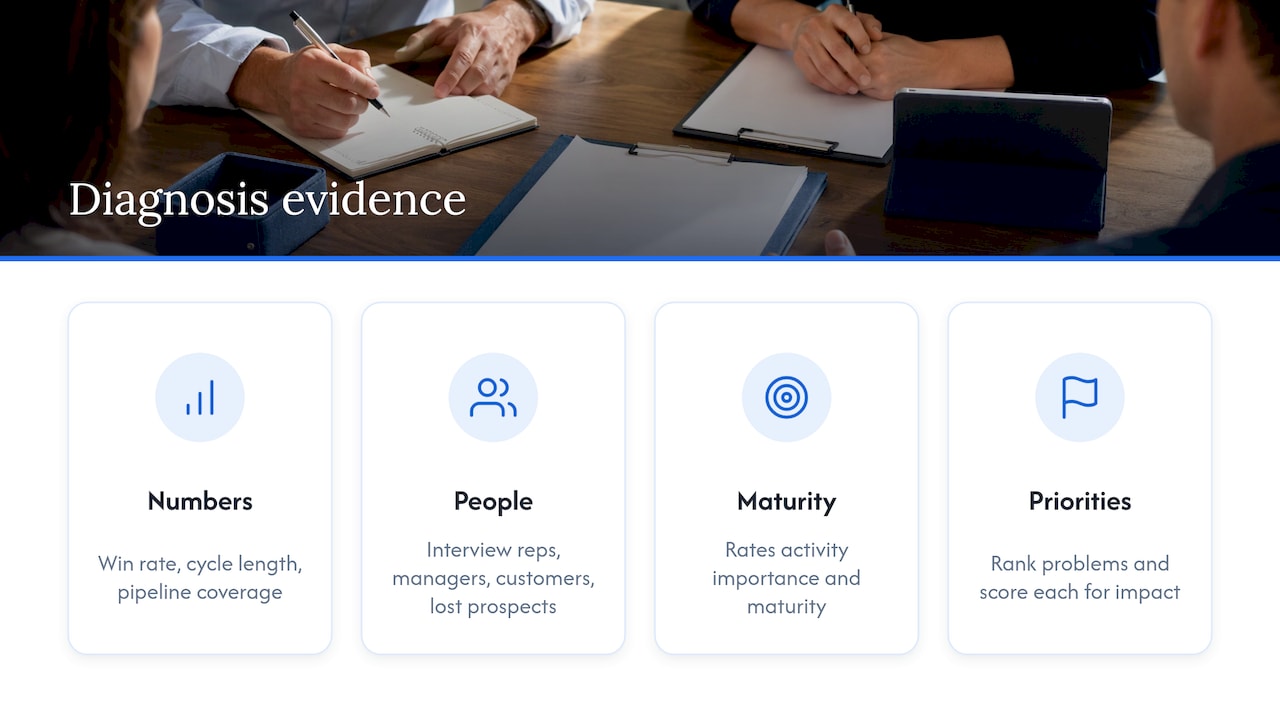
You cannot sequence a roadmap you have not diagnosed. Gather evidence from two places: the numbers and the people.
The numbers. Pull win rate by stage, average sales cycle length, pipeline coverage, conversion from first meeting to qualified opportunity, and rep ramp time. Look at the trend over four to six quarters, not a single quarter. A flat win rate with a lengthening cycle points to a different problem than a healthy win rate with thin top-of-funnel.
The people. Interview reps, SDRs or BDRs, front-line managers, and a few customers and lost prospects. Ask where time goes, which handoffs break, and which content or tools nobody uses.
For a structured view, Gartner's Sales Score is a maturity assessment that rates the importance and maturity of critical sales activities and can be repeated annually to track progress. Gartner's strategy guidance suggests assessing account management, customer acquisition and retention, sales technology, sales operations, enablement, strategy and design, and talent management. Whatever format you use, end the diagnosis with a ranked list of problems, each scored for impact, so you are choosing from evidence.
If enablement looks like the weak area, our sales enablement audit guide walks through that part of the diagnosis in detail.
Step 2: Set outcome goals on one page
The most common mistake in a plan is a goal list that reads like a task list: implement a platform, retrain the team, redesign territories. Those are activities. Goals are outcomes: shorten the cycle, raise qualified pipeline per SDR, improve win rate in a defined segment.
Gartner advises deriving outcome-oriented goals from external trends, your function assessment and company priorities, choosing strategic KPIs that give actionable intelligence, and communicating the plan in a succinct one-page document. It also reports that employees are 77% more likely to be high performers when they understand goals and how their work connects to them.
A workable one-page plan has:
- Three to five outcome goals, each with a baseline and a target date.
- For each goal, two or three measures. More than that and the team stops tracking any of them.
- A named owner per goal.
- The one or two things the team will stop doing.
That last line is the one most plans skip, and it is what protects selling time.
Step 3: Design the four working areas
A sales transformation framework is easiest to run when it is split into four areas. Each answers a different question.
Strategy and targeting
Who are you built to win? Redefine your ideal customer profile, your segments and your coverage model. Many companies discover they are spreading effort evenly across accounts that convert very differently. Strategic account planning is the practical tool here: it forces a choice about where the team's time goes.
Process and metrics
Define each pipeline stage, the entry and exit criteria for it, and the metrics that follow: stage conversion, win rate and cycle length. Ambiguous stages produce unreliable forecasts. Clear ones let you spot where deals stall. For a stage-by-stage view of pipeline setup, this breakdown of sales pipeline stages and metrics shows how stage definitions and tracking fit together.
People and enablement
Roles, compensation, hiring profiles, coaching and training. Keep compensation simple: our guide to designing comp with two or three measures explains why. Enablement fails when content is built for the seller's convenience instead of the buyer's journey, which is why we recommend buyer mapping so reps actually use content.
Data and technology
Clean the data first, then connect the tools, then add signals and automation. In that order. Teams that layer AI over a messy CRM get fast, confident wrong answers. Our CRM-first revenue roadmap for AI lays out the sequence, and if adoption is where you are stuck, see why sales AI adoption stalls. If you are choosing outreach tooling, the comparison of sales engagement platforms is written for CEOs and CROs.
Step 4: Build the roadmap, with pilots and owners
A sales transformation roadmap turns the four areas into a sequence. Use this structure:
| Stage | Typical window | What happens | Owner |
|---|---|---|---|
| Diagnose | Weeks 1 to 4 | Data pull, interviews, ranked problem list | CRO or sales development leader |
| Design | Weeks 4 to 8 | One-page plan, role and process changes drafted | CRO with front-line managers |
| Pilot | Months 3 to 5 | One team or segment tests the changes | Sales development or business development leader |
| Review and adjust | Monthly | KPI review, rep feedback, fixes | Same owner, with finance and marketing |
| Scale | Months 6 to 12 | Roll out what worked, drop what did not | CRO |
The windows are a planning pattern, not a promise. A smaller team may move faster, a company with several regions slower.
Two habits keep the roadmap honest. First, pilot before you scale: one SDR pod or one segment is enough to learn whether a new qualification rule or cadence works. Second, sell the need for change before you sell the solution. Reps accept a new process faster when they have seen the data on the problem it solves.
Be careful about the sequencing of ambitious changes. Changing territories, comp and CRM structure in the same quarter makes it impossible to tell what drove any result, and it is the fastest route to the overload Gartner warns about.
Step 5: Measure and review on a fixed rhythm
Pick a small set of measures that show whether the plan is working, and review them monthly:
- Win rate, overall and by segment.
- Sales cycle length.
- Qualified pipeline created per SDR or BDR.
- Stage-to-stage conversion.
- Tool adoption, meaning the share of reps using the new workflow weekly.
- Rep feedback, by short survey.
Published examples show what results can look like when a plan is concrete. In a Forrester case study, Office Depot combined a data clean-up, customer segmentation, a defined way of selling and rep-level KPIs, and reported a pipeline increase of more than $110 million, a close-rate increase of more than 400 basis points and more than three extra hours of selling time per month. In another Forrester client story, Palo Alto Networks moved from marketing-qualified leads to buying groups and found that opportunities with multiple people attached were eight times more likely to advance, with a 17% higher closed-won rate.
Notice what both share: a data foundation, a clear segment focus, and measures at the rep level. Those are results of one company each, so use them as models for the structure of a plan, not as targets for yours.
Building a sales culture that keeps the change
The questions about building a sales culture and sales culture transformation come down to the same point: a plan changes what people are asked to do, and culture decides whether they keep doing it. Gartner frames the aim as a culture and structure where sellers concentrate on high-value activities.
Practices that support adoption:
- Coach on the new behavior weekly. A change that is not coached in one-to-ones fades within a quarter.
- Make the metrics visible to the people who own them. Reps who see their own conversion numbers manage them.
- Recognize the behavior, not only the closed deal. Early on, the leading indicators are what you want to reinforce.
- Keep the leader in the work. A leader who joins calls, reviews cadences and runs the SDR standup earns the credibility that a slide deck cannot.
- Explain the why. Link each change to the buyer problem it solves.
This is also why the hiring decision matters so much. Culture is built by a person present with the team week after week.
Who should lead the plan
In most B2B companies, the day-to-day owner of a transformation in the top of the funnel is a sales development or business development leader who has built and scaled teams before. They need to do four things at once: read the data, redesign the process, coach the reps and report to the CEO or CRO in plain terms.
When you evaluate candidates or outside help for a Colorado-based team, look for:
- A record of scaling SDR and BDR teams at companies that sell into complex B2B markets.
- Comfort with the AI and CRM tooling the plan will rely on, and an ability to sequence it sensibly.
- Experience launching a new process in pilot form and measuring it.
- Willingness to coach, not only to advise.
If you are weighing options, our overview of sales development consulting in Colorado explains the categories, and if revenue is already slipping, the guide to hiring a sales turnaround consultant covers that situation.
Our view: transform the funnel from the front line
I have spent more than 25 years building sales and business development teams at companies such as Informatica, RingCentral and Cisco-WebEx, and the pattern I trust is simple: transformation is a leadership job before it is a technology job.
The plans that work start with the pipeline, not the platform. We diagnose the funnel, find the two or three behaviors that move conversion, and coach those behaviors until they are habit. Then AI earns its place, because it is sitting on clean data and a process people already follow. That is the thinking behind AI for Sales 2.0 and behind the conversations we have on The AI for Sales Podcast.
I also believe in keeping the plan short. A one-page plan the whole team can recite beats a forty-slide program nobody finishes. Pilot it, measure it monthly and let the reps see the results.
The most important variable is the leader who stays close to the SDRs and BDRs. Culture is built in the weekly coaching conversation, and that is where I like to work.
Chad
Work with Chad on your transformation
If you are a CEO, CRO or founder planning this change, Chad Burmeister brings a 25+ year career scaling sales and business development teams, nine published books on AI for sales and B2B lead generation, and the AI for Sales Podcast, along with recognition that includes the Forbes Next 1000. For your leadership team and sellers, Chad also offers speaking and workshop engagements. See the speaking and workshops page or start from the Chad Burmeister home page.
For a workshop built around diagnosing the pipeline before prompts, read about our AI sales workshops for leaders.
FAQ
How long does a sales transformation take?
Plan on a diagnosis and design phase of roughly two months, a pilot of a quarter or so, and a full year to scale and embed the changes. The pace depends on team size and how clean your data is. A monthly review keeps the schedule honest.
What is the difference between a sales transformation strategy and a roadmap?
The strategy is the one-page statement of goals and the choices behind them: which segments, which motion, which measures. The roadmap puts those choices in order, with stages, owners and pilot dates. You need both, and the strategy comes first.
Where should a B2B company start?
Start with the diagnosis: win rate, cycle length, stage conversion and rep interviews. The result is a ranked list of problems. Pick the top two or three and build the first pilot around them, rather than launching everything at once.
Do we need new technology to transform sales?
Not as the first move. Clarify the process and clean the data, then add or connect tools. Technology works best when it supports a process the team already follows, and it should be introduced after you know which activities you want to simplify.
Sources
- Gartner: Sales Transformation, Future-Fit Strategies for Chief Sales Officers
- Gartner: Sales Strategy
- Gartner: What Is Sales Score?
- Forrester: Office Depot data-driven execution strategy
- Forrester: Palo Alto Networks buying groups
- Sales pipeline stages and metrics