AI can cut the time it takes to produce a sales proposal and keep it consistent, but it only wins deals when your team controls what goes in and who signs off on what comes out. The teams that benefit treat AI as a drafting engine fed by discovery notes and approved pricing, with a person owning the argument. That is how I would set it up for any SDR, BDR or sales team, and it is the CRM-first, pilot-first approach we use when we lead AI-enabled pipeline work.
TL;DR
- AI is strongest at assembling context, drafting sections, and checking claims. Humans should own pricing, commitments, and the "why us" argument.
- Give the model an approved packet: discovery notes, scope, current pricing, and cleared proof. Better inputs beat a cleverer prompt.
- Run a governed workflow: context, draft, pricing controls, human review, send, then feed results back.
- Before sending, verify every name, date, number, and commitment against your records. Have the AI flag gaps instead of filling them.
- Start with one pilot and a handful of metrics, because small proposal counts produce noisy win-rate signals.
Table of Contents
- What AI actually does well in a proposal
- What to feed the AI before it writes a word
- A step-by-step workflow for AI-drafted proposals
- The pre-send checklist
- Keep the human voice where buyers read hardest
- Measure it like a pilot, not a rollout
- Handling objections inside the proposal
- Perspective
- Bring this to your team
- FAQ
- Sources
What AI actually does well in a proposal
A proposal is not one task. It is a chain of small ones: pulling the right account facts, remembering what the buyer said on the discovery call, finding approved language, drafting, getting reviews, and learning what worked. According to one 2026 guide on proposal automation, AI can pull CRM opportunity data, summarize discovery calls and objections, match buyer problems to approved content, draft sections in the buyer's own terminology, flag missing context, route sections for review, and capture engagement signals.
That list matters because it shows where the time goes. Most reps do not lose hours to typing. They lose them to hunting for the last call's notes, the right case study, and the current terms. AI removes that hunt.
The measured gains are real but modest, which is the honest way to plan around them. A consulting-sector case study reported that an AI system cut proposal development time by 20% and raised win rates by 10%. A separate 2026 guide describes a manufacturing distributor that cut quote generation from three days to two hours, with quote accuracy up 89%. Those are case studies, not promises. Use them to set a target for your own pilot, not to forecast your results.
The design principle: fixed numbers, flexible narrative
The cleanest rule in this area is to split the proposal into two parts. Prices, terms, and scope come from a controlled source and are never invented by the model. The narrative, meaning how the buyer's problem connects to your solution, is where the AI drafts freely. The same Rework guide calls this the deterministic price and generative narrative split, and argues that a workflow without it will eventually produce either a pricing error or a generic narrative.
If your team adopts only one habit from this article, make it this one.
What to feed the AI before it writes a word
The most common reason an AI proposal reads like every other proposal is thin input. A generic prompt produces generic prose. A 2026 guide on writing proposals with AI makes the point directly: better inputs do more for quality than a clever prompt.
Think of it as an approved proposal packet. Build one for each deal, containing:
- Seller context: the approved product description, who it fits, differentiators, limits, and your voice.
- Discovery notes: the buyer's own quotes, their current process, friction, desired outcome, timing, and open questions.
- Account and stakeholder brief: roles, priorities, likely objections, and the approval path.
- Proposed scope: deliverables, users, integrations, and who is responsible for what.
- Current approved pricing and terms.
- Success measures: baseline, target, owner, and how it will be measured.
- Approved proof: case studies and references you are cleared to share.
The same guide suggests an evidence ledger: a simple record of each important statement, its source, its owner, and how it is treated. A buyer's goal is not a promised result, and the AI can calculate with approved numbers but should not create financial inputs.
The buyer's words are the most valuable input
If you only have time to improve one input, improve the discovery notes. Research on AI-generated pitches found that the bottleneck is retrieval rather than reasoning: models improve a lot when handed the facts a human researcher would gather, and rarely find those facts on their own through web search. The same study grounds its view in how enterprise buyers behave: they scrutinize the argument over long cycles, so effective personalization is about the reasons connecting your solution to their situation, not the styling of the message.
In practice, that means a proposal that quotes the buyer's stated problem, in their vocabulary, beats a polished one that does not. If you want a deeper look at turning call preparation into usable notes, our AI meeting prep playbook walks through it.
Keep the packet clean and authorized
Only give the model what is appropriate for the task. Confidential CRM data, personal contact details, and account records must be handled according to your organization's authorization and privacy rules, as one 2026 prompt guide stresses. Decide up front which fields the AI may see, and leave the rest out.
A step-by-step workflow for AI-drafted proposals
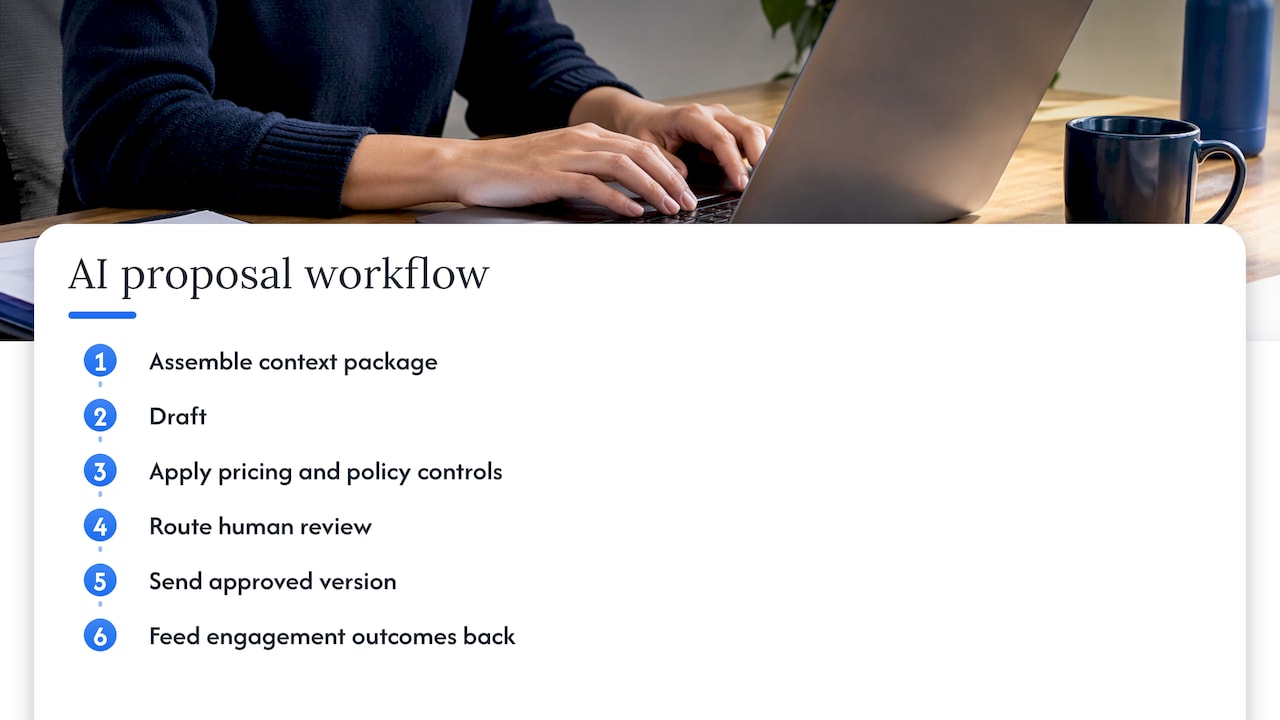
A governed workflow has six stages, which the metacto guide describes as: assemble a context package, draft, apply pricing and policy controls, route human review, send the approved version, and feed engagement outcomes back. Here is how I would run each one.
1. Assemble the packet
Pull the discovery notes, CRM fields, and approved content into one place. Mark gaps explicitly. A good habit is to tell the model what to do when information is missing: ask a question or mark the gap, never guess.
Where it goes wrong: reps paste in a call transcript and nothing else, and the model fills scope and timing from habit.
2. Draft the narrative sections
Ask for the problem statement, proposed approach, and outcomes the buyer named. Use the buyer's phrasing. One useful test comes from a 2026 prompt guide: buyers forward parts of a proposal internally, so ask whether your champion could paste your value line into a message to a colleague without editing it. If not, it is still written in vendor vocabulary.
Where it goes wrong: the draft describes your product's features rather than the buyer's situation.
3. Apply pricing and policy controls
Pricing comes from your approved source, not from the model. On presentation, the same guide recommends anchoring price to real costs the buyer mentioned, offering three tiers with an explicit recommendation, and stating the price plainly instead of softening it with euphemisms.
Where it goes wrong: a discount or term appears in the narrative that finance never approved.
4. Route human review
Not every section needs the same scrutiny. Product overviews and catalog pricing can move quickly. Sections containing live commitments, such as service levels, implementation timelines, security certifications, or custom contract terms, should be explicitly approved by a reviewer, as Rework's guidance puts it. Define who reviews what: rep, manager, finance, legal or security, and delivery.
5. Send the approved version
Send only a version labeled as approved, to the right recipient, with the right attachment and a clear expiration date.
6. Feed results back
Record what happened. Did the buyer open it, forward it, ask for changes? Which sections drew questions? Use that to improve your approved content library.
The pre-send checklist
This is the part that protects your credibility. A scorecard for B2B consultants suggests the following, which I have adapted for a sales team:
- Facts: confirm client names, dates, and figures against your records.
- Scope: check requirements, deliverables, acceptance criteria, milestones, exclusions, dependencies, and assumptions.
- Responsibilities: make sure the buyer's duties are spelled out next to yours.
- Commitments: a person personally approves pricing, payment terms, legal language, security claims, delivery dates, staffing, and service levels.
- Housekeeping: check recipient, attachment, version, and expiration date, then record the approval and any unresolved risk.
Two practices make this faster. First, instruct the AI to mark missing inputs with a tag such as [NEEDS CONFIRMATION] instead of filling the gap. Second, label each component as AI draft, human edited, or human approved, so reviewers know where to look.
Keep the human voice where buyers read hardest
As AI use spreads, fluency stops being a differentiator. Loopio data cited in one 2026 report shows nearly 80% of RFP teams used generative AI in 2025, up 10 points year over year. When every response in the pile is well formatted, evaluators look for signs of real effort.
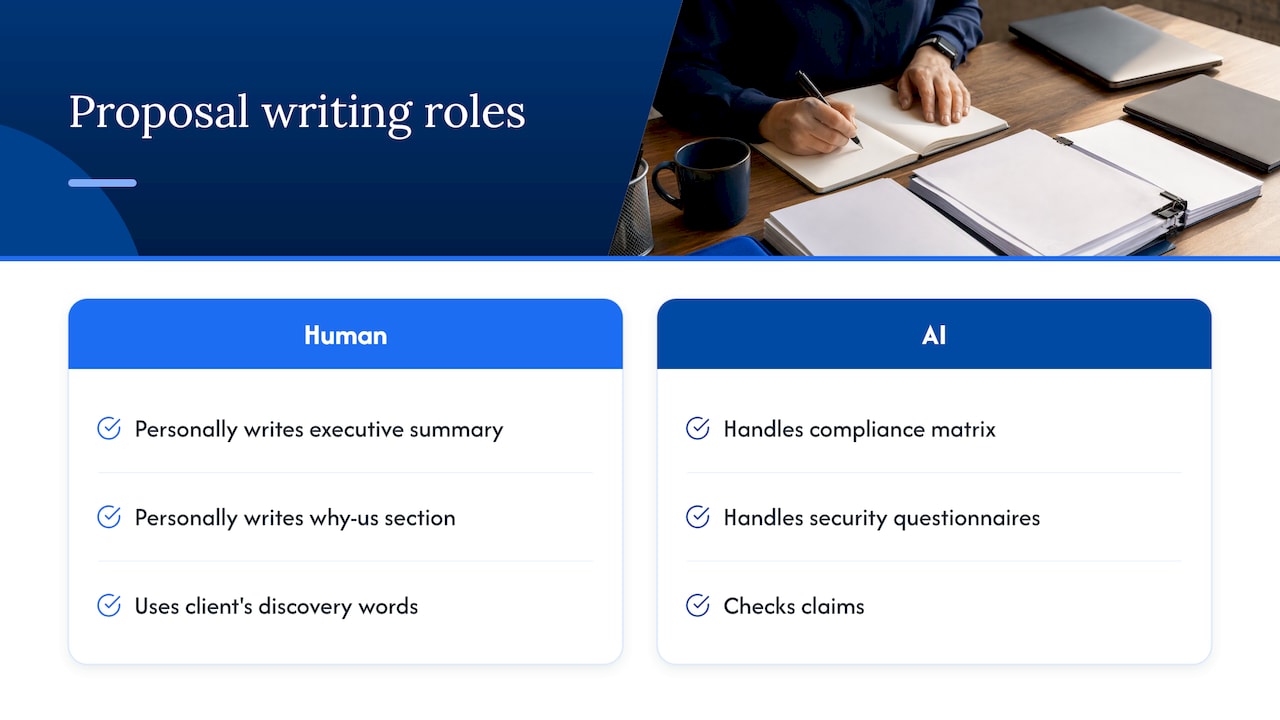
The practical answer in that report is a division of labor: the account lead personally writes the executive summary and the "why us" section using the client's own words from discovery, while AI handles the compliance matrix, security questionnaires, and claim checking. I agree with that split. It puts the AI where it saves the most time and the human where the buyer pays the most attention.
It also fits what the SDR-Arena benchmark found. Across 50,000 customer success stories in 22 industries, professional SDRs rated 48% of generated pitches usable without editing. Roughly half of AI drafts need a human, so plan for that edit as part of the process rather than a failure of it.
Measure it like a pilot, not a rollout
Before you change how the whole team writes proposals, run a short pilot on one segment. The metacto guide recommends tracking eight things: time to a reviewed draft, proposal cycle time, reviewer correction rate, pricing and legal correction rate, proposal engagement, win rate by proposal type, rep adoption, and content freshness. It also notes that small proposal counts produce noisy conversion signals, so lean on the first four early and judge win rate only after enough volume.
This mirrors how we recommend leaders approach AI generally: one scoped pilot with clear measures. See our 90 day pilot approach for sales leaders and the CRM-first roadmap for sales teams for how to structure it. Teams that stall after a promising start will find the causes in our piece on why sales AI adoption stalls.
Proposal quality also depends on what happens upstream. If prospects reach the proposal stage unqualified, no draft will rescue them. That is why early-funnel work matters, a point explored in B2B AI demand generation and the buyer shortlist, and why pipeline discipline, as in our guide to AI for pipeline reviews, pays off at proposal time.
Handling objections inside the proposal
A strong proposal answers the objection the buyer will raise privately, the one they will not say on the call. Feed the AI your discovery notes on concerns and ask it to surface likely objections for each stakeholder, then address them in the scope, timeline, or proof sections. Our guide to AI objection handling explains why asking before answering produces better responses, and the same logic applies on the page.
Perspective
After more than 25 years building SDR, BDR and sales teams, I have watched every new tool promise to fix the proposal. What actually changes results is the discipline around the tool.
Our view is simple. The AI should do the assembly work: gather the notes, draft the sections, check the claims. The leader should own the argument and the commitments. That is why the AI work I teach in AI for Sales 2.0 starts with the CRM and the data feeding the model, not with the prompt.
If your proposals are slow, start with the packet. If they are generic, start with the discovery notes. If they are risky, start with the review gate. Fix those three and the drafting almost takes care of itself.
Chad
Bring this to your team
If you are a CEO, CRO, or founder building or rebuilding a sales development function, the workflow above is something I run with teams hands-on. I am a Colorado-based sales executive with a 25+ year career scaling sales and business development teams at companies including Informatica, RingCentral, and Cisco-WebEx, and the author of nine books including AI for Sales 2.0 and Mastering B2B Lead Generation with LinkedIn & AI. For team workshops and speaking engagements on AI in sales, see the speaking and workshops page, or start from my main site.
FAQ
Can AI write a complete sales proposal on its own?
It can draft most of it, but it should not finish it alone. Let it assemble context and write narrative sections from approved inputs, and have a person approve pricing, legal language, delivery dates, and any commitment. Mark gaps for review rather than letting the model fill them.
What should I give an AI tool to draft a proposal?
Give it structured discovery notes, a proposal template that matches your business, current approved pricing and scope, and cleared proof such as case studies. Two or three past winning proposals can serve as voice examples. Pricing and scope should come from you, not from the model.
What should I check before sending an AI-written proposal?
Verify names, dates, figures, scope, deliverables, and exclusions against your records, then personally approve pricing and commitments. Check the recipient, attachment, version, and expiration date. Record who approved it and any open risks.
How do I know whether AI is improving my proposals?
Track time to a reviewed draft, cycle time, and how many corrections reviewers make, then add engagement and win rate by proposal type. Because proposal volumes are usually small, judge win rate over a longer window rather than a few deals.
Sources
- AI Proposal Automation: Personalize Sales Proposals at Scale (metacto)
- Generative AI For B2B Proposal Creation (IJCRT)
- AI-Generated Quotes and Proposals (Rework)
- Benchmarking the Personalization Capabilities of Large Language Models (arXiv)
- How to Write a Sales Proposal with AI Without Inventing ROI
- 15 AI Sales Prompts for Outreach and Follow-Ups (Promptessor)
- AI Proposal Writing Prompts (SurePrompts)
- AI Workflow Scorecard for B2B Consultants (Barron Tech)
- Your AI-written proposals are telling buyers you didn't try (Fentner)
- B2B AI Demand Generation: Win the Buyer Shortlist Early