AI's highest-value job in sales leadership isn't chatbots or flashy dashboards. It's turning messy pipeline data into reliable coaching, forecasting, and rep capacity gains, but only when a leader pairs the tool with clean data and keeps a human checking its work. Start now: pick one measurable pilot tied to a revenue number, set 90-day success criteria, and don't add a second tool until that one proves out.
TL;DR:
- Starting with a single measurable pilot tied to a revenue goal and setting clear success criteria within 90 days is crucial for AI adoption.
- Manual data validation and cleaning should precede automation, with low-risk tasks like transcription and logging targeted first to stabilize data quality.
- AI coaching and conversation intelligence provide the strongest returns when paired with active human oversight, rather than operating fully autonomously.
- Forecast accuracy typically stabilizes after six to twelve months of clean data, with revenue improvements appearing within 90 to 180 days.
- Building governance policies around AI recommendations, overrides, and customer data privacy before scaling minimizes compliance risks.
Table of Contents
- Priority AI Use Cases for Sales Leadership
- How Should You Sequence AI Adoption Across Your Team?
- What Should You Look for in an AI Sales Tool?
- How Long Does It Take to See ROI from AI in Sales?
- What Are the Governance Risks of AI in Sales?
- A Practitioner's Playbook for Rolling This Out
- The Leader's Role in the AI Era
- Get Hands-On Help Implementing AI in Your Sales Organization
- Sources
- FAQ
Priority AI Use Cases for Sales Leadership
Most sales leaders try to adopt everything at once. That's backward. The teams seeing real returns pick two or three use cases and go deep, according to Pipeliner's 2026 research, which found 46% of organizations have already moved past pilot mode into committed deployment.
Here's where the return on effort is strongest:
- AI coaching: Scales what your top performer does instinctively into a repeatable script for everyone else, through call roleplays, real-time feedback, and nudges during live calls.
- Conversation intelligence: Flags skill gaps and deal risk signals as they happen, not three weeks later in a pipeline review.
- CRM automation and data capture: The unglamorous work that makes every other AI use case possible. Bad data in, bad forecasts out.
- Forecast intelligence: Produces confidence ranges instead of a single number a rep pulled from gut feel, cutting the guesswork baked into rep-assigned probabilities.
- Prospecting and outreach automation: Frees SDR hours for actual selling conversations instead of manual list building and sequencing.
An analysis of 938 B2B companies found reps using hybrid AI coaching, meaning AI recommendations paired with active manager involvement, closed at roughly 19.7% higher conversion rates and moved through cycles about 32.6% faster than reps without that combination. The AI didn't replace the manager. It gave the manager better material to coach with. That distinction shapes everything else in this article: coaching, forecasting, and CRM data capture only pay off when a human stays in the loop, not when the tool runs on autopilot.
How Should You Sequence AI Adoption Across Your Team?
Sequencing beats speed. Leaders who roll out five tools simultaneously usually end up with five half-adopted tools and a team more confused than before. Run it in phases instead.
- Audit before you automate. Spend 30 to 60 days validating your process and data manually. Where do deals actually stall? Which fields does your CRM never get filled in correctly? Set clear success criteria before you touch a vendor demo.
- Automate the low-risk, high-frequency layer first. Call transcription and CRM logging are the safest starting points because they don't require your models to make judgment calls. Challenger's guidance on AI for sales leaders backs this up, noting that logging and transcription typically deliver the fastest measurable wins and stabilize the data your later intelligence layers will need.
- Layer in scoring and forecast intelligence once your data is stable. Most models need six to twelve months of clean historical data before their predictions are worth trusting. Rushing this step is the single most common reason AI forecasting tools get abandoned within a year.
Gartner calls the failure mode here the "productivity paradox": organizations invest in AI tools without the organizational readiness to use them well, and the tools end up bolted onto broken workflows instead of fixing them. Gartner's fix is a centralized context layer, one place where deal data, activity data, and AI outputs live together, rather than five disconnected point solutions each guessing at half the picture.
Pro Tip: Write your governance policy before your first pilot, not after. Define who can override an AI recommendation, who reviews those overrides, and how often. Retrofitting governance onto a live tool is far harder than building it in from day one.
What Should You Look for in an AI Sales Tool?
Vendor demos are optimized to impress, not to reveal what breaks in month three. Evaluate on these criteria instead of the feature list:
- Integration depth: Does it connect natively to your CRM, your meeting platform, and your enrichment sources, or does it require manual exports that quietly die within a quarter?
- Data requirements: Ask exactly how much historical data the model needs before its recommendations are reliable, and get that answer in writing.
- Security and auditability: Can you see why the AI made a specific recommendation, and is there a log of every override a rep or manager made?
- Workflow fit: Does it sit inside the tools your reps already use, or does it demand a new tab they'll forget to open by week two?
- Vendor pilot terms: Ask what sample size they recommend for a valid pilot, what the expected warm-up timeline looks like, and whether their claimed metrics come from your industry or a generic benchmark.
If a vendor can't answer the data-requirements and warm-up-timeline questions specifically, that's a signal their tool wasn't built with sales leadership's realities in mind. A CRM-first approach to evaluating AI tools tends to surface these gaps faster than a feature-by-feature comparison ever will.
How Long Does It Take to See ROI from AI in Sales?

Forget "hours saved." That's the metric vendors love and the one Gartner explicitly warns against relying on. Gartner's research found that even when AI saves sellers real time, most organizations fail to reinvest those hours into anything that moves revenue. Time saved that doesn't get redirected into selling activity is a vanity number.
Track these instead: expanded seller capacity (how many more qualified conversations per rep, per week), forecast accuracy expressed as a confidence range rather than a single guess, win rate lift, and cycle-time compression.
Most forecasting and scoring models start stabilizing after about two quarters of clean data, and measurable revenue lift tends to show up somewhere in the 90 to 180 day window once training data quality catches up, based on implementation patterns documented across Pipeliner's 2026 adoption research.
Structure your pilot as a cohort comparison or A/B test where possible, and track override frequency and override accuracy as an early signal. If reps override the AI constantly and turn out to be right most of the time, your model isn't ready for prime time yet.
What Are the Governance Risks of AI in Sales?
Three risks show up in almost every rollout: hallucinated recommendations presented with false confidence, sensitive customer data flowing into a model without clear boundaries, and buyers noticing (and disliking) when a conversation feels AI-scripted.
Build these guardrails before scale, not after a customer complains:
- Define exactly which actions an AI agent can take autonomously and which require human sign-off, especially for pricing, contract terms, and anything customer-facing.
- Log every override and review the pattern monthly, not just the individual incident.
- Track customer sentiment toward AI-assisted interactions directly. Pipeliner's research points to a governance blind spot here: most organizations that have deployed AI tools have never actually measured how customers feel about them.
- Consolidate tools where you can. Every extra platform is another data silo and another place governance can quietly fail.
Pro Tip: Treat data minimization as a design constraint, not an afterthought. Before you feed a transcript or contract into any model, ask whether it needs to be there at all, especially for anything covered by an NDA or containing personal customer information.
A Practitioner's Playbook for Rolling This Out
Most of the transformation work isn't glamorous. It's data hygiene, measurement design, and feedback loops, the unsexy majority of the effort that determines whether the flashy layer on top ever works.
As a leader, split your time deliberately: heavy early investment in systems and data quality, then a steady cadence of deal inspection once the foundation holds. A workable manager rhythm looks like this: daily, a five-minute scan of AI-flagged deals at risk; weekly, a review of override patterns with the team to catch where the model and the reps disagree and why.
Keep your pilot charter simple: one use case, one owner, one success metric, a 90-day timeline. For deeper sequencing detail, the AI Sales Strategy playbook and AI Sales Forecasting playbook walk through pilot design and forecast warm-up timelines in more depth, and The AI for Sales Podcast covers implementation stories from leaders further along the curve.

The Leader's Role in the AI Era
AI is a co-pilot, not a replacement for judgment. The moment a rep or a manager stops explaining why they made a call and just points to what the model said, you've lost something that mattered. Korn Ferry's research on AI-ready sales leadership makes the point plainly: AI accelerates answers, but it can't earn customer trust or replace leadership judgment. That's still your job.
Protect your people while you automate. Reps need to see a path forward, not a slow replacement schedule. Automate the busywork. Keep the human-led parts of the job, the ones that build careers and close six-figure deals, visibly human.
Run one measurable pilot. Protect one human-led process. Do both on purpose.
— Chad
Get Hands-On Help Implementing AI in Your Sales Organization
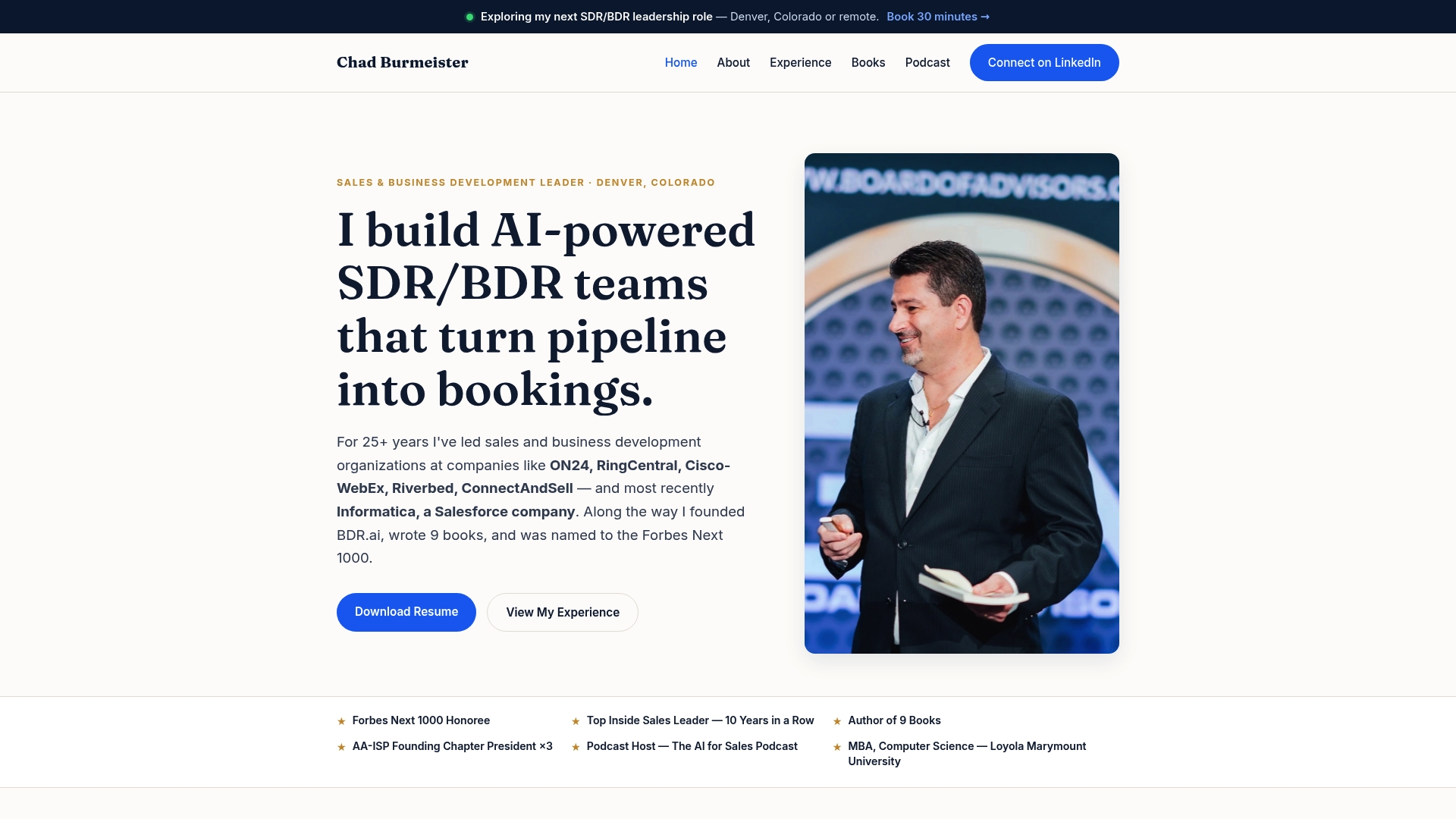
Reading a playbook and running one are two different things. If you're a CRO, founder, or sales leader trying to scale an SDR or BDR team with AI in the mix, An experienced sales leader brings 25-plus years of hands-on leadership at companies like Informatica, RingCentral, and Cisco-WebEx directly into your organization, not just a framework on a slide.
Three ways in are offered depending on where your team stands. Speaking engagements bring the AI-for-sales playbook to your sales kickoff or leadership offsite. Workshops go deeper, working through pilot design, tool selection, and governance policy with your actual team in the room. Peer leadership groups offer ongoing leadership development for sales leaders who want a peer cohort and structured accountability while they scale. Pricing for speaking and workshop engagements is available on request. Check available speaking and workshop dates or explore Be Extraordinary Groups to find the format that fits where your team is right now.
Sources
The Gartner sales AI hub covers the productivity paradox and context-layer guidance referenced throughout this piece. Pipeliner's 2026 research tracks real adoption rates and early wins. The Salesforce State of Sales Report and ZDNet's coverage detail agent adoption trends, while the Optif.ai coaching study and Korn Ferry's leadership analysis ground the coaching and leadership claims.
- The Role of Artificial Intelligence (AI) in Sales (Gartner)
- Pipeliner Research: 46% of sales organizations move beyond experimentation as measurable performance gains emerge (PR Newswire)
FAQ
How Can AI Be Used in Sales Management?
AI supports sales management most effectively through coaching (flagging skill gaps and suggesting talk tracks), conversation intelligence (surfacing deal risk in real time), CRM data capture, and forecast intelligence that produces confidence ranges instead of gut-feel numbers. The strongest results come from hybrid setups where AI recommendations pair with active manager oversight, not from letting the model run unsupervised.
What Is the 30% Rule in AI?
If you've encountered it referencing time savings or adoption thresholds, treat it as informal shorthand rather than an established industry standard, and focus instead on tracked metrics like seller capacity and forecast accuracy.
Which Jobs Are Most Resistant to AI Replacement?
Roles built on judgment, trust building, and complex negotiation, like senior sales leadership, enterprise account management, and consultative selling, tend to be the most resistant, since AI can accelerate answers but can't replace leadership judgment or earn customer trust. Roles centered on repetitive data entry or basic outreach automation face the most disruption first.
What Are the 5 C's of Sales?
Definitions of the "C's of sales" vary across sales training programs, and there's no single standardized version tied specifically to AI-driven sales leadership. Rather than force a definition that doesn't hold up, focus on the metrics this article covers directly: seller capacity, forecast accuracy, win rate, and cycle time.
How Long Before AI Improves Sales Team Performance?
Most teams see forecasting and scoring models stabilize after roughly two quarters of clean training data, with measurable revenue lift often appearing in the 90 to 180 day range once the data foundation is solid. Skipping the data hygiene phase is the most common reason that timeline stretches out much longer than leaders expect.