AI meeting prep means using AI to gather account context, profile the people on the call, and turn both into a short brief before every sales meeting. Done well, it takes a rep from scattered tabs to a one-page plan in minutes. Done badly, it hands reps confident-sounding guesses. The difference is the process around the tool: what you feed it, what you ask for, and how you check what comes back.
This guide covers that process for sales teams, SDRs and sales leaders: the inputs, a brief template, a prompt structure, a verification step, and a way to measure whether it works.
TL;DR
- AI meeting prep pulls CRM history, recent emails, call notes and public research into one brief before a call.
- A good brief is one page: purpose, people, verified facts, unknowns, discovery questions, proof and a proposed next step.
- Keep AI output in three buckets: facts you supplied, inferences to test, and unknowns that become questions.
- Protect customer data with clear rules about what may be pasted into which tool.
- Measure it: compare prep time, next-step rates and stage progression for prepped and unprepped meetings.
Table of Contents
- What AI meeting prep actually does
- Step 1: Research the account and the people
- Step 2: Build a one-page brief
- Step 3: Prompt for goals, talking points and practice
- Step 4: Choose the proof and spot the risks
- What data and integrations the workflow needs
- Check the output and protect customer data
- How to measure whether it works
- Common mistakes
- Our perspective
- Work with Chad
- FAQ
- Sources
What AI meeting prep actually does
A rep's prep used to mean opening the CRM, skimming the last email thread, checking LinkedIn and scribbling a few questions. AI compresses that into one step. You give it the material (the calendar invite, the account record, earlier notes, public information about the company), and it returns a structured summary.
There are really four jobs:
- Gathering. Collecting the invite, attendees, account record, recent emails and notes from earlier calls.
- Summarizing. Turning that pile into what changed since the last conversation and what is still open.
- Planning. Proposing a meeting goal, talking points and questions.
- Rehearsing. Playing the buyer so the rep can practice an opening or an objection.
Some products bundle all four inside a CRM or a conversation platform. Others are just a general AI assistant plus a good template. Either route works if the rep still owns the judgment. The tool drafts. The rep decides what matters.
Step 1: Research the account and the people
Start with what you already own, because it is the most reliable input. Your CRM holds the deal history, the stakeholders you have met, what was promised and what was objected to. Add:
- Prior touchpoints: emails, call notes, transcripts, proposals sent.
- Company context: what the company does, its size and segment, recent announcements, hiring patterns that hint at priorities.
- Participant context: each attendee's role, tenure, likely stake in the decision, and how they relate to each other.
- Trigger events: a funding round, a leadership change, a new product, a reorganization.
Then ask the AI to do something specific with it. "Research this company" returns generic copy. A better request is: "Using only the material below, list what this company has said publicly about its priorities this year, name the source and date for each, and flag anything you cannot support."
For participants, ask for role-based reasoning, not personal trivia. What does a VP of Operations typically care about in a purchase like ours? What would a finance approver need to see? Use that to shape questions, not to flatter someone with scraped personal details. Our guide on AI sales ethics covers where the line sits on using personal information in outreach and prep.
Step 2: Build a one-page brief
Long briefs do not get read. One page does. A useful structure, based on the one-page brief recommended by WinningWithAI, looks like this:
| Brief section | What goes in it |
|---|---|
| Purpose and next step | Why this meeting exists and the specific next step you want |
| Participants | Names, roles, what each likely cares about |
| Account facts | Five verified facts, each with a source name and date |
| Stated priorities | What the prospect has told you, in their words where possible |
| Unknowns | Three things you do not know and need to learn |
| Discovery questions | Five to seven, tied to the unknowns |
| Proof | The customer story, metric or reference most relevant to this buyer |
| Risks | Objections you expect and promises you must not make |
| Opening | A sixty-second opening, a plan to listen, and a proposed close |
The source and date on each fact is the habit that matters most. It forces the AI, and the rep, to separate what is known from what is assumed.
A worked example
Say a rep at a B2B software company has a second call with a director of customer support at a mid-sized logistics firm. The brief might read:
- Purpose: confirm the ticket-volume problem and agree on a pilot scoping call.
- Participants: the director (owner of the problem), a support operations manager (will use the tool daily), and an IT contact joining for the first time (likely security questions).
- Facts: the company's headcount range from the CRM, the date and topic of the last call, a hiring post for support agents found on their careers page, and the pricing tier they asked about in an email.
- Unknowns: who signs off on spend, how tickets are tracked today, and what happened with the last vendor they tried.
- Questions: "What does a bad Monday look like for your team?" and "What would have to be true for a pilot to be a yes?"
- Risks: do not promise an integration date; do not quote a discount that has not been approved.
That page takes a rep five minutes to read. It also gives a manager something concrete to coach against afterward.
Step 3: Prompt for goals, talking points and practice
The best prompts give the AI a role, the material, the constraints and the output format. A structure that works:
- Role: "Act as a sales preparation assistant for a B2B team."
- Material: paste or attach the approved inputs only.
- Constraints: "Use only the supplied material. Label anything you infer as a possibility. List unknowns separately."
- Output: the brief template above, one page.
Once the brief is built, use the same conversation to get ready:
- Set the goal. Ask for three possible meeting outcomes ranked from minimum to ideal, so the rep knows what a good call looks like even if the buyer pushes back.
- Draft talking points. Ask for them tied to the buyer's stated priorities, not to your feature list.
- Rehearse. Ask the AI to play the buyer in role, with the objections from your risk list, and have the rep answer out loud. Our piece on handling objections with AI explains why asking a clarifying question before answering usually beats a rehearsed rebuttal.
- Stress-test the opening. Ask for the likely reactions to your sixty-second opening and where a buyer might interrupt.
For new reps, this practice loop is often the most valuable part. It is a safe place to be wrong. We cover the training side in AI for sales training.
Step 4: Choose the proof and spot the risks
A brief that lists features but no evidence leaves the rep improvising. Before a meeting, pick the one or two pieces of proof that match this buyer's situation: a customer in a similar segment, a before-and-after metric you can stand behind, a reference who will take a call.
The same discipline applies to trust signals. Reviews, testimonials and case examples work when they are specific and relevant to the person reading them. If you want to see how that thinking applies to choosing credible evidence, this breakdown of social proof examples shows how different formats land with an audience.
Then name the risks. What is the buyer likely to push on? What can the rep not promise, whether for legal, pricing or product-roadmap reasons? Having these written down before the call prevents the improvised commitment that sales and customer success spend weeks unwinding.

What data and integrations the workflow needs
AI prep is only as good as its inputs. A practical minimum:
| Input | Why it matters |
|---|---|
| Calendar | Attendees, time, meeting type |
| CRM | Account, opportunity stage, contacts, history |
| Recent threads, commitments, tone | |
| Call notes or transcripts | What was actually said last time |
| Enrichment or public research | Company facts, trigger events |
| Your own playbook | Qualification criteria, proof points, approved claims |
The unglamorous truth is that CRM hygiene decides the quality of the brief. If stages are stale and notes are empty, the AI will summarize the mess. That is why we recommend a CRM-first approach, covered in AI for sales teams. Fix the data fields reps actually use, then connect the AI.
If your team records calls, the notes feed the next brief. We show how to turn those notes into coaching in turning AI meeting notes into manager coaching.
Check the output and protect customer data
AI will occasionally state something wrong with total confidence. Build a quick review into the workflow.
Sort every output into three buckets, as WinningWithAI advises:
- Facts supported by material you supplied.
- Inferences labeled as possibilities to test.
- Unknowns that turn into questions for the meeting.
A rep should be able to point at the source for any fact in the first bucket. If they cannot, it moves to the second.
Set data rules before rollout. Decide, in writing, which tools are approved, which fields may be shared with them, and what must never be pasted (for example, confidential contract terms or personal data a customer has not agreed to share). Check your company's security and privacy policies and ask your legal or security team to review the tool's data handling before connecting the CRM. Keep a human as the final reviewer for anything that will be said to a customer.
A two-minute checklist for reps:
- Are the five key facts sourced and dated?
- Did I remove anything I cannot back up?
- Does the brief contain any data I should not have shared with this tool?
- Do I know the one next step I am asking for?
How to measure whether it works
Do not roll this out and hope. Run a short pilot, the same way you would for any AI program. Our pilot-first approach to AI cold calling applies equally here.
Pick a small group, set a baseline for a few weeks, then compare. Useful measures:
| Measure | What it tells you |
|---|---|
| Prep time per meeting | Whether the workflow saves rep hours |
| Rep confidence (short survey) | Whether reps feel more ready |
| Next step agreed on the call | Whether meetings end with momentum |
| Stage progression after meeting | Whether prepped meetings move deals |
| Brief accuracy errors found | Whether the review step is catching problems |
| Manager coaching notes | Whether managers see better discovery |
Compare prepped and unprepped meetings of the same type, such as first discovery calls, so you are not comparing a demo with a renewal. Keep the pilot long enough to cover several sales cycles' early stages, and be honest that small samples are noisy. Track the results alongside your pipeline reviews; AI for pipeline reviews shows how to fold this into the weekly rhythm.
Common mistakes
- Treating the brief as a script. It is a plan. The buyer's actual words change it.
- Feeding the AI everything. Too much material buries the signal. Curate inputs.
- Skipping the unknowns. The three things you do not know are where the best discovery questions come from.
- No owner. Someone, usually the sales leader, must own the template, the data rules and the review habit.
- Automating before standardizing. If every rep preps differently, automation scales the inconsistency.
Our perspective
After more than 25 years of building SDR and business development teams, I have watched the same pattern repeat: the reps who win are rarely the ones with the best pitch. They are the ones who walked in knowing who they were talking to and what they wanted from the call.
AI makes that level of preparation cheap enough for every rep on every call. But we hold a firm view: AI should raise the floor on preparation, not replace the rep's thinking. A brief is only as good as the questions it helps a rep ask.
That is why the playbooks in our work start with process, data quality and a leader who coaches to the brief. Tools change every quarter. A team that knows how to prepare, verify and learn from each meeting adapts to all of them.
If you lead a sales team, start small: one meeting type, one template, one review habit. Prove it, then scale it.
Chad
Work with Chad
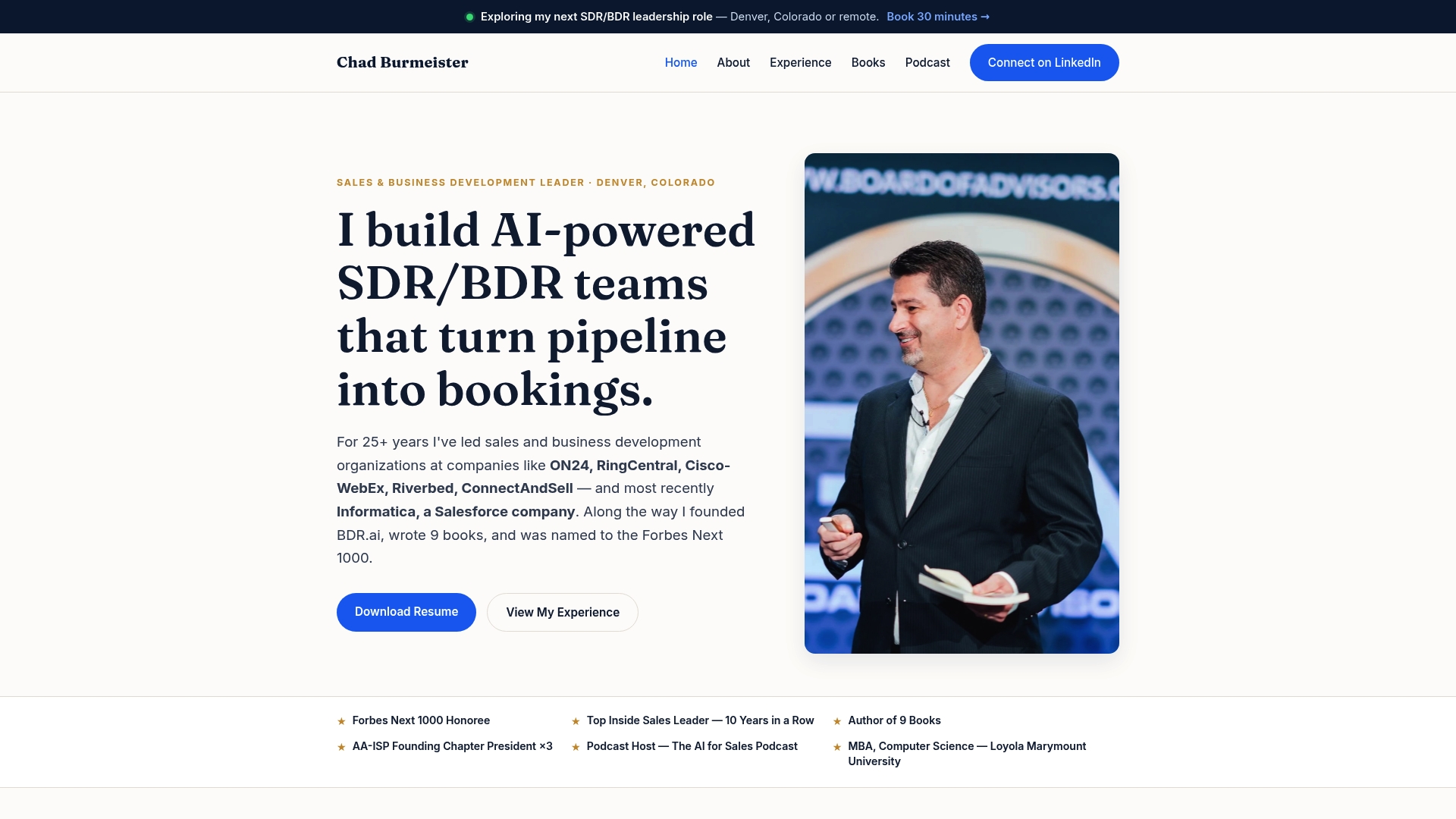
If you want your team preparing like this on every call, Chad Burmeister leads workshops and speaking engagements on AI for sales, drawing on a 25+ year career scaling SDR and business development teams. Bring a practical session on AI meeting prep, pilots and coaching to your team.
See the speaking and workshop options or explore the Be Extraordinary curriculum.
FAQ
Can ChatGPT do meeting prep for sales?
A general AI assistant can draft a solid brief if you give it the right material and clear constraints. Tell it to use only what you supplied, to label inferences, and to list unknowns. Review the result before you rely on it, and follow your company's data rules on what can be pasted.
What should I include in an AI meeting prep prompt?
Include the role, the approved material, the output format and the rules. Ask for the meeting purpose, participants, sourced facts, unknowns, discovery questions, proof and risks. Finish with a request for a short opening and a proposed next step.
How long should meeting prep take with AI?
For most calls, reviewing and correcting a generated brief should take a few minutes, not an hour. High-stakes meetings, such as an executive presentation, deserve more human time. Use the AI to cover the routine research so that time goes to thinking.
Does AI meeting prep work for SDRs?
Yes. SDRs run many short calls, so a lightweight brief covering the contact's role, a trigger event and two or three questions is enough. Rehearsing openings with AI is especially useful for new reps. Pair it with call review and coaching so improvements stick.
Sources
- AI Sales Meeting Prep for B2B Teams, WinningWithAI
- Social Proof Examples That Win Local Customers, The Savage Influence