
The transition from founder-led sales is the work of moving each step of selling, from first conversation to signed contract, out of your head and calendar and into a process other people can run. It works when you finish closing deals yourself, write down what you learned, hire in the right order, and give the first sales leader a defined job. It fails when you hire a person to replace you before there is anything to hand over. Below is the sequence, with the checks that tell you when to move to the next stage.
This guide is written for CEOs, CROs and founders weighing whether to bring in a sales development or business development leader. Our view comes from more than 25 years of building and leading sales and business development teams at companies such as Informatica, RingCentral and Cisco-WebEx.
TL;DR
- Founder-led sales is the right start. The job is to turn what you learn from your first customers into a documented process, not to escape selling.
- Watch for the bottleneck: deals waiting on your calendar, follow-up living in your inbox, and pipeline that rises and falls with your travel.
- Document qualification, objection handling and pricing limits before you post a job.
- Hire sellers or a hands-on leader only once the process has been proven by real closed deals, and stay on key calls afterward.
- Give any new sales leader a 90-day plan with clear ownership, so you can judge the result fairly.
Table of Contents
- What founder-led sales is and why it works early
- Signs you have become the bottleneck
- What to write down before you hand off a single deal
- Test whether your process is repeatable
- Who to hire first: sellers, a leader, or something in between
- What the first sales leader should own
- Stay close to customers while you step back
- Mistakes that derail the handoff
- A 90-day path from founder-led to team-led
- Our perspective
- Work with Chad on the handoff
- FAQ
- Sources
What founder-led sales is and why it works early
In founder-led sales, you personally run the conversations that matter: finding prospects, qualifying them, demoing, negotiating and closing. At the start, that is a strength. Nobody explains the product, the pain it solves and the objections better than the person who built the company, and every call teaches you something about who buys and why.
SaaStr's Jason Lemkin advises founders to close their first 10 to 20 customers themselves so they learn the sales process firsthand, then hire the first two sales executives. He places the handoff at roughly $1M in annual recurring revenue, or the point where you can no longer handle the lead volume. He also warns that hiring too early risks reps who flounder because the process is not yet defined.
That last point is the heart of the matter. A new hire can execute a process. A new hire cannot invent one while also hitting quota.
Signs you have become the bottleneck
Staying founder-led is not a mistake in itself. The problem starts when sales depends on a person instead of a process. SimplicityCMO describes the patterns: new opportunities wait until the founder has time, follow-up lives in email and memory, the team cannot say which prospects are qualified or what happens next, the CRM holds contacts but not reliable stages, owners or next actions, and activity swings with the founder's travel. One or two of these early on is normal. Several at once mean the process lives in one head.
Launch Marketing adds three red flags: a pipeline that slows or leaks through missed follow-ups, revenue that plateaus despite strong market interest, and team members who keep waiting on the founder to move deals forward. It also notes that CEOs running lead generation and sales often spend 20 to 30 hours or more each week on it.
A simple self-check:
- Take a week off from sales conversations. Does pipeline movement stop?
- Open your CRM and pick five deals. Can someone other than you say what the next step is and who owns it?
- Look at your calendar for the last two weeks. How much of it went to selling instead of product, hiring and customers you already have?
The hardest part of this check is usually emotional. Founders often read a full calendar as proof of commitment. If you recognize yourself in the warning signs of self-sabotage, such as holding on to work because letting go feels risky, name it early. It is far cheaper to face before a bad hire than after.
What to write down before you hand off a single deal
The handoff fails most often because the founder tries to hand over relationships rather than a method. Before you post a job, put these on paper:
- A qualification checklist. Who is a real buyer? What size, what trigger, what budget, who signs? Write it so two people scoring the same prospect reach the same answer.
- Your top objections, with the language that works. Not "handle pricing concerns," but the actual sentences you use and the proof you point to.
- Pricing and packaging limits. How much discount can a seller give without asking you? What can never be bundled? Without limits, every negotiation lands back on your desk.
- The path from first call to signature. Average deal size, typical sales cycle and the decision-makers involved. Wing VC's founder guide says these should be known before you consider a sales leader, after at least the first 10 deals have closed, preferably by the founder.
- Your ideal customer list. If you plan to start outbound prospecting, a short list of target accounts and the message that has worked is the raw material. A structured approach such as account-based outbound to 50 to 75 accounts turns that list into pipeline.
Writing this is not busywork. It is the product the new hire will use every day, and the first time you will see where your own process is thin.
Test whether your process is repeatable
Before you scale, find out whether prospects are buying your product or buying you. Three practical tests:
- Deal velocity. Pull your last 20 closed-won deals and look at the days from first call to signature. A tight range suggests a process. Wild swings suggest instinct without a system.
- A solo-close trial. Have a cofounder, an advisor or a contract seller run the next handful of qualified demos without you on the call. If the win rate drops sharply, the buyers were responding to your credibility. That tells you what to document and which calls you need to stay on.
- Calendar tracking. Log your time for two weeks. If selling consumes the largest share of your week, the company is paying for it in lost product and hiring time.
Sierra Ventures' Brett Orlanski lists readiness indicators for building a sales framework: product-market fit, sales being a soft spot for the founding team, and growing revenue demands. He also notes that the urge to hire a head of sales right away is itself a sign you need a framework first.
Pipeline has to come from somewhere, too. If your demand is mostly your own network and referrals, plan how marketing and outbound will fill the pipeline. A 90-day content velocity strategy is one way to think about steady content-driven demand while the sales team is being built.
Who to hire first: sellers, a leader, or something in between
There are three common routes, and the right one depends on what you have already proven.
Two sellers first. Wing VC advises hiring two reps before a sales leader. It typically takes three to six months for a new rep to fully ramp, and two reps let you compare approaches informally and avoid blaming a method for one rep's poor fit. This suits you if you have the time to coach them.
A hands-on leader. If you do not have the hours to coach, or you want outbound built from scratch, a player-coach leader who builds the playbook and the team together is often the faster path. The risk Wing VC points to is hiring that leader before a repeatable process exists, which it says can set the business back a year or more. That is why the documentation step comes first.
Fractional or interim leadership. If you have a process but not yet the budget or certainty for a full-time executive, a part-time or temporary leader can bridge the gap. We cover this in our founder's guide to fractional sales leadership and in what an interim VP of Sales is, costs and when to hire one.
| Situation | Best first move |
|---|---|
| 10+ deals closed, process written, founder can coach | Two sellers, founder stays on key calls |
| Process written, no time to coach, outbound needed | Hands-on SDR/BDR leader who builds the team |
| Process proven, budget or timing uncertain | Fractional or interim sales leader |
| Fewer than 10 closed deals, process unclear | Keep selling, document, test |
What the first sales leader should own
A vague title produces vague results. Define the job in terms the board and the founder can inspect:
- Pipeline creation. Who builds the target list, runs outbound and books meetings? For SDR and BDR teams, this means defined activity, qualification standards and handoff rules to closers. Our 0 to 90 day playbook for building an SDR team and BDR outbound strategy playbook lay out one version.
- Coaching and reporting. Weekly pipeline reviews, clear stage definitions and a CRM where every deal has an owner and a next action.
- Hiring and ramp. Who recruits the next sellers, and what do they need in their first 90 days?
- Forecasting. A number you can plan around, built from stages rather than hope.
Hire with a scorecard, not a feeling. A set of 18 scoreable sales leader interview questions helps you compare candidates on the same terms. Then plan the start: a 90-day sales leader onboarding plan keeps the first quarter focused on learning, ramping and early wins instead of improvisation. Give the new hire a fair runway before you compare their numbers with your own closing record, because your results came with a founder's trust and a product only you fully understand.
Stay close to customers while you step back
The best transitions do not remove the founder from selling. They change the founder's role. Lemkin argues that founders never really get out of sales: even after hiring, they join key calls, review pipeline and keep talking to customers. He advises giving the sales leader a call quota on your time, at least four customer calls a week the leader can pull you into.
This protects two things. Your customer insight stays fresh, so product and messaging do not drift. And large or strategic deals still get the credibility only a founder carries. A good arrangement is explicit: you join named account tiers, executive-level conversations and renewals of strategic customers, and the team owns everything else. Our 0 to 90 day C-suite selling playbook describes how reps and managers prepare for the calls where a founder or executive sponsor is most useful.
Mistakes that derail the handoff
Patterns show up repeatedly in founder transitions, and most are preventable:
- Hiring a VP of Sales before the playbook exists. The new executive spends the first year discovering what you could have written down in a month.
- Exiting completely, all at once. Gradual handoff, one stage at a time, keeps pipeline and learning intact.
- Comparing the new hire to you on day 30. You closed with the founder's story and full context. They need a ramp, which Wing VC puts at three to six months for a rep.
- No shared definition of a qualified lead. Sellers chase volume, closers receive junk, and each side blames the other.
- No owner for pipeline creation. If nobody is accountable for outbound, the pipeline reverts to your network and referrals.
- Skipping the coaching cadence. A weekly rhythm of call reviews and pipeline inspection is what turns documents into behavior. Reviewing recorded calls is one way to do it, as in our guide on turning AI meeting notes into manager coaching.
A 90-day path from founder-led to team-led
Here is a realistic sequence for a company that has closed its first deals and wants to move forward.
Days 1 to 30: capture. Write the qualification checklist, objection responses and pricing limits. Pull your last 20 closed deals and note velocity. Define who owns which stages.
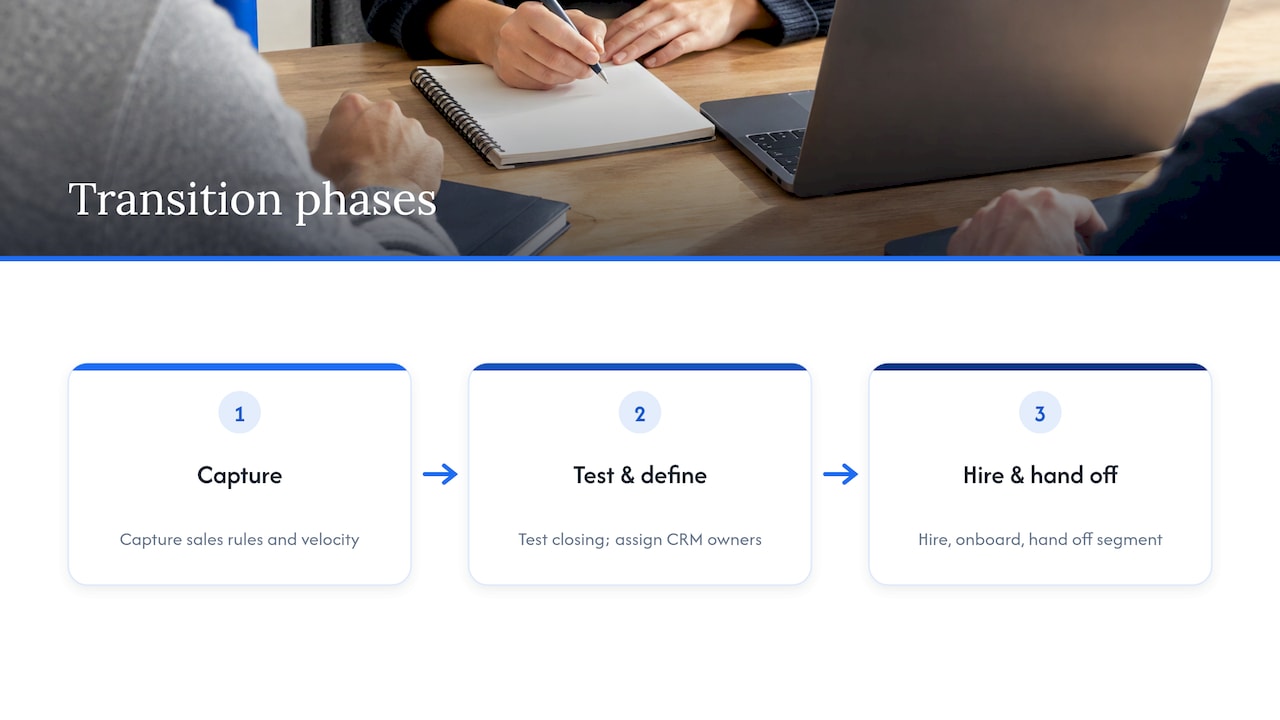
Days 31 to 60: test and define. Run the solo-close trial. Clean up CRM stages so every opportunity has an owner and next step. Decide your first hire type using the table above and write the scorecard.
Days 61 to 90: hire and hand off. Start the search, or onboard a fractional leader. Hand over one segment first, usually the smaller deals or inbound leads, while you keep strategic accounts. Set your weekly call quota with the new leader.
Each stage ends with a test: do the documents produce the same decision from two different people, does the solo-close result hold up, and does pipeline keep moving during a week you are not involved? If not, stay in that stage.
Our perspective
Most founders ask whether to hire a salesperson. The better question is what you can hand over today and what still needs you.
In more than 25 years leading sales and business development teams, we have found the handoffs that hold up share one trait: the founder's knowledge was captured before the new leader arrived. Qualification, objections, pricing limits and a clear definition of who owns pipeline creation make a new leader productive in weeks rather than quarters.
For many Colorado companies and others, the missing piece is not a closer. It is someone who builds the front of the funnel: the SDR and BDR motion that creates qualified meetings so the founder is not the only source of pipeline. That is the work we do as a hands-on sales leader, and it is why our playbooks focus on the first 90 days.
Founders also need to be honest about their own role. You do not stop selling. You move from doing every call to designing the system and joining the calls that matter. That shift is where growth resumes.
Chad
Work with Chad on the handoff
If you are a CEO, CRO or founder looking for a sales development or business development leader, Chad Burmeister is based in Colorado and brings a 25-plus-year career building high-performance sales teams, nine published books and The AI for Sales Podcast. His recognition includes Forbes Next 1000 and top inside sales leader awards.
For teams that want to work through this transition together, speaking and workshop engagements are available on the speaking and workshops page, and you can start from chadburmeister.com to see the books and podcast behind the playbooks.
FAQ
When should a founder stop doing sales?
Not completely, and not before the process is proven. A common marker is the first 10 to 20 customers closed by the founder, with the sales cycle, deal size and decision-makers understood. After that, the founder moves to key calls and customer conversations while a team runs the routine work.
Should the first hire be a sales leader or a salesperson?
It depends on your time and your proof. If you can coach and have a written process, start with two sellers. If you need outbound built and cannot coach, a hands-on leader who builds the team makes sense, provided the playbook exists first. A fractional leader suits companies that need structure before a full-time commitment.
How long before a new sales hire produces results?
Wing VC says it typically takes three to six months for a new rep to ramp fully. Plan your expectations, quotas and coaching around that window instead of the founder's own track record.
How do I keep customer insight after stepping back?
Build it into the arrangement. Set a standing number of customer calls the sales leader can bring you into each week, review pipeline together and keep ownership of strategic accounts. That keeps messaging and product direction tied to what buyers actually say.
Sources
- SaaStr: How to transition from founder-led sales to your first sales hires
- SimplicityCMO: When founder-led sales becomes a bottleneck
- Launch Marketing: Founder led sales
- Sierra Ventures: Transitioning from founder-led sales
- Wing VC Founder Docs: Making the transition from founder-selling to having a sales team