A good pipeline review agenda is short, repeatable and built around decisions. Open with a few minutes on what changed, spend most of the time on three to five deals that can swing the quarter, and close by writing down who does what by when. Everything else stays in the CRM. Sales leaders at Colorado startups and growth-stage companies tend to get this wrong in the same way: the meeting becomes a status recital, and nothing leaves the room. After 25+ years building and leading SDR and BDR teams at companies like Informatica, RingCentral and Cisco-WebEx, I run reviews the way this page lays out.
TL;DR
- Time-box the meeting: 30 minutes for a weekly 1:1, 45 to 60 minutes for a team review. Spend the bulk on 3 to 5 deals, not the whole pipeline.
- Send a pre-read the day before so the meeting is for decisions, not data entry.
- End every deal discussion with a next step, an owner and a date. A status is not an action.
- Keep the pipeline review separate from the forecast call. One coaches deals, the other predicts the number.
- Set the cadence by sales cycle length: weekly for deal movement, monthly for trends, quarterly for a full audit.
Table of Contents
- What a pipeline review is for
- Before the meeting: the 24-hour pre-read
- Which deals belong in the room
- The 30-minute pipeline review agenda
- Questions that make the deep dive work
- Reading the numbers without being fooled
- Pipeline review cadence: how often to meet
- Closing the loop
- Mistakes that sink pipeline reviews
- Bring this to your team
- FAQ
- Sources
What a pipeline review is for
A pipeline review is a recurring, structured meeting, usually between a manager and a rep, about the status and next steps of open deals. One widely used definition puts the focus on obstacles to closing and the steps that remove them, held weekly or twice a month. The point is not to admire the pipeline. It is to find risk early and find the deals that can be accelerated.
That purpose gets lost when the review is also the forecast call. The forecast answers a leadership question: what will we close this quarter? The pipeline review answers a frontline question: what do we need to do this week to move deals forward? When teams blend them, the meeting becomes mostly forecast talk with a rushed few minutes of deal coaching at the end. Run them as two meetings with two audiences.
Before the meeting: the 24-hour pre-read
The agenda only works if the data is already clean when everyone sits down. Two habits make that happen.
Reps update every deal in the CRM beforehand. Prep guidance for 1:1 reviews suggests about 15 minutes each from the rep and the manager. The rep updates stage, amount, close date and next step. The manager pulls deals stuck in the same stage for 14 or more days, scans activity logs, notes deals with no next step and checks the rep's pace against quota.
The manager sends a pre-read. A practical template lists every open deal above a materiality threshold with amount, stage, days in stage, last activity and last logged next step, sent 24 hours ahead. Another approach flags deals older than 1.5 times the median sales cycle when refreshing the data. Pick one rule and use it every week so reps know what will be inspected.
Routine prep, like pulling stale-deal lists and reminding reps to update records, is the kind of task teams often automate. A step-by-step automation checklist is a useful way to think through which repetitive steps to hand to software so the manager's prep time goes to judgment.
Which deals belong in the room
You cannot review everything, and trying to guarantees shallow conversations. Select by rule, not by who is loudest. One template chooses 3 to 6 deals by four triggers:
- The close date moved.
- No meaningful change in three weeks.
- The deal has aged past the group's normal close point.
- It is among the top five by value.
A rule-based list removes the politics. Reps stop wondering why a deal was picked, and managers stop missing the quiet deal that has been sitting untouched. Everything not on the list stays in the CRM. If you want a faster way to find where a stuck deal is actually stuck, our guide to sales pipeline diagnostics walks through a 15-minute approach.
The 30-minute pipeline review agenda
This is the agenda I recommend for a weekly manager and rep 1:1. It blends the structures that most published templates share: a short look at movement, a long block on priority deals, one coaching moment and written commitments.
| Block | Time | What happens |
|---|---|---|
| Recap and quick wins | 3 min | Check last week's actions first. Name what closed or advanced. |
| Pipeline snapshot | 5 min | Coverage against quota, stage distribution, movement since last review, deals past close date. |
| Deal deep dives | 15 min | Three to five priority deals, selected by rule, with the same questions each time. |
| One coaching theme | 5 min | A single skill or habit to work on, taken from the deals just discussed. |
| Actions | 2 min | Written next steps with owner and deadline, read back. |
A 30-minute structure from Salesforce is similar in spirit: 4 minutes of overview, 7 minutes on each of the three biggest problem leads and 5 minutes of wrap-up. Another published agenda gives 17 minutes to 3 to 5 deals and 3 minutes to written commitments. Notice the pattern: more than half the clock goes to deal inspection, and the last minutes are reserved for commitments, never cut for time.
The 45 to 60 minute team version
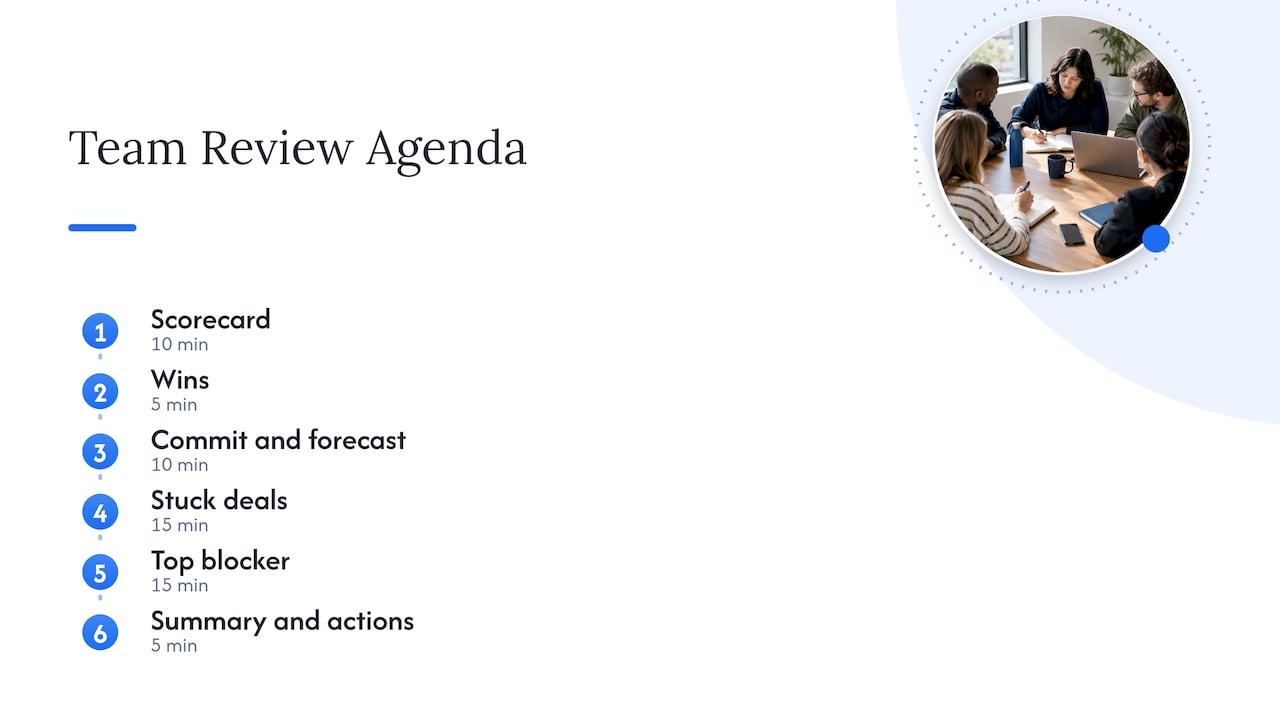
For a team review, add a scorecard and a forecast sanity check, but keep the inspection block. One 60-minute weekly agenda runs 10 minutes of scorecard (activity, pipeline, bookings against target), 5 minutes of wins, 10 minutes on commit and forecast, 15 minutes on stuck deals, 15 minutes on the top blocker and 5 minutes of summary with actions read back. A 45-minute data-driven version starts with a 5-minute health check on three data points: coverage ratio, coaching score versus last week and stale-deal count.
Questions that make the deep dive work
The deep dive is where most reviews fail, because it drifts into storytelling. Use the same short list for every deal so the conversation is about evidence.
- What has the buyer done since the last review? Buyer action is the best indicator of momentum, more than anything the rep did.
- Who is actively championing the deal inside the account?
- What could kill it?
- What specific evidence supports the close date? A close date should tie to a customer event, such as a board meeting or contract expiry, not a hope.
- What does the rep need from the manager?
One question matters most: what is the next concrete step, and when does it happen? For deals that have sat for weeks, add: should we disqualify this, or is there a real reason it is still here? A healthy pipeline of 20 real opportunities beats a bloated one with 50 half-qualified leads.
For late-stage deals, also check the economic buyer, the documented pain, the decision process and whether a joint close plan exists. If it does not, a mutual action plan is the fix to assign.
Status versus action
The single habit that changes meetings fastest is separating a status from an action. A status is "Procurement is working on it." An action is "The AE will ask the procurement owner to confirm the review sequence by Thursday." Only the second one can be checked next week. If a deal discussion ends with a status, the discussion is not finished.
Reading the numbers without being fooled
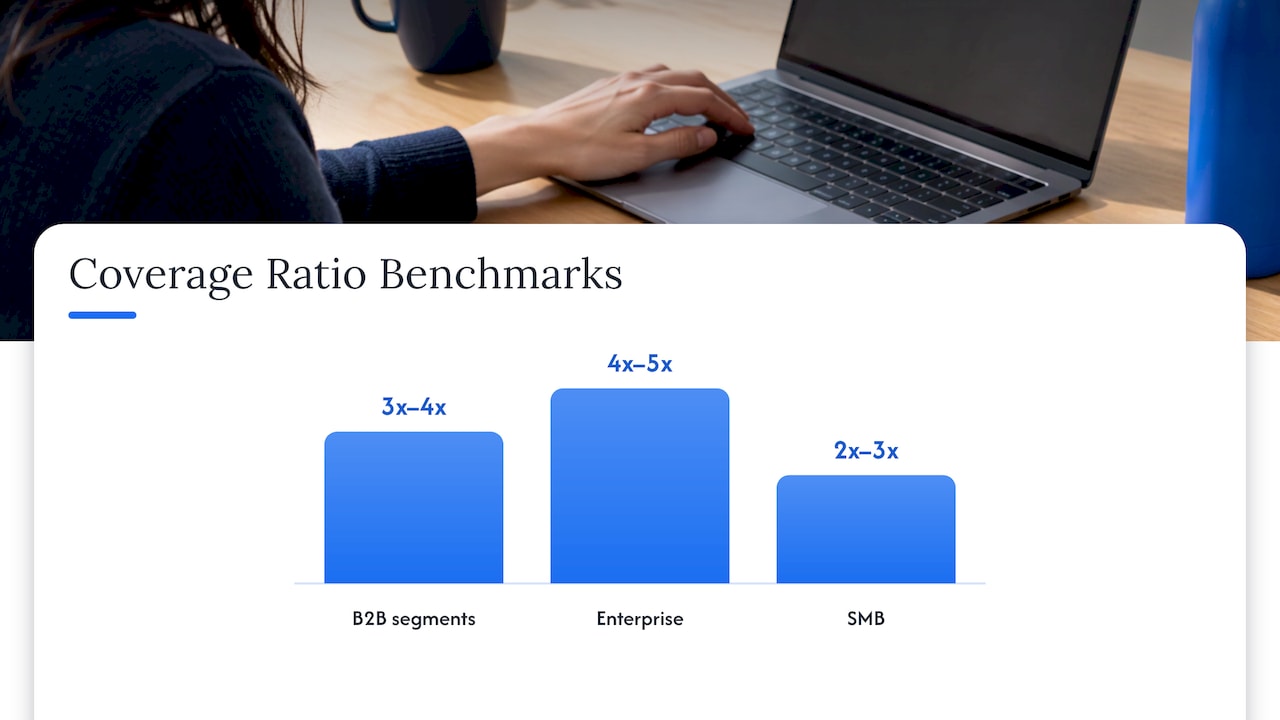
Coverage ratio, the value of open pipeline divided by the quota still to hit, is the headline metric. A common benchmark is 3x to 4x for most B2B segments, 4x to 5x for enterprise and 2x to 3x for SMB. Below 2x for an upcoming period is acute risk, and above 5x often signals bloat.
Treat the ratio as a starting point. The same source recommends calculating "real coverage" by excluding deals with no activity in 45 or more days, missing qualification fields or passed close dates. One vendor analysis found that more than 10% of pipeline had gone untouched for twelve months, with coverage ranging from about 1.4x to 5x across customers. A 3x rule alone says little about whether one specific quarter is safe. For the math, see our walkthrough on the pipeline coverage ratio, and for cleaning up the inputs, pipeline cleanup.
Pipeline review cadence: how often to meet
Cadence should follow sales cycle length, deal count and deal size. One framework recommends:
| Layer | Frequency | Length |
|---|---|---|
| Manager and rep 1:1 | Weekly | 30 to 45 min |
| Team review | Biweekly | 60 to 90 min |
| Forecast review | Monthly | 90 to 120 min |
| Planning | Quarterly | Half day |
Short sales cycles, under 30 days, can shrink this to 15 to 20 minute weekly 1:1s, monthly forecasts and no quarterly planning. Cycles of six months or more need all four layers. Larger-ACV enterprise deals earn more frequent senior attention.
Another four-level model adds daily rep logging of activity and next steps, a weekly exception-based review with a hard 30-minute limit, a monthly look at conversion trends and a quarterly audit covering field completeness, a dead-deal purge and ICP validation. Its author compares a steady cadence to a smartwatch baseline: one review is an inspection, but the same review every week makes deviations visible, so coverage gaps show up in month one rather than week twelve. The monthly and quarterly layers should include the CRO, finance and marketing and revisit whether stage definitions and forecasting methods still fit the business.
Closing the loop
A review is only as good as the follow-through. Three rules:
- Log every action before the meeting ends. One approach is to record each action in the CRM and check completion at the start of the next review.
- Send a written recap quickly. One guide suggests within two hours, with dated next steps, owners and updated forecast numbers.
- Open the next meeting with last week's actions. Skipping this teaches the team that commitments are optional.
If you record reviews, AI notes can help turn them into coaching material, which we cover in turning AI meeting notes into manager coaching and in AI for pipeline reviews.
Mistakes that sink pipeline reviews
- Reviewing every deal. Depth beats breadth. Use the selection rules above.
- Mixing in the forecast call. Keep deal coaching and the number separate.
- Accepting stories. Ask for buyer evidence and dated next steps.
- Skipping the pre-read. If the meeting is spent fixing CRM fields, there is no time left to coach.
- Inconsistent timing. A fixed day and length is what lets the baseline mean something.
Perspective
In my career scaling SDR and BDR teams, the pattern I trust is simple: the review is the manager's most important coaching moment of the week, and it deserves a structure. Pipeline reviews fail when they turn into interrogations about activity or storytelling about hope. They work when everyone knows the questions in advance, the deals are chosen by rule and every conversation ends with a dated action.
We built our playbooks, books and podcast conversations around that idea. Whether you use AI to prepare the data or just a clean CRM view, diagnose the pipeline first and the tools second. That is the thread through our work on AI for sales and B2B lead generation, and it is what we bring into leadership roles and workshops with sales teams.
Chad
Bring this to your team
If you are a CEO or CRO in Colorado weighing how to build or lead an SDR or BDR function, the review routine above is one piece of a larger operating system for pipeline growth. Chad Burmeister offers speaking and workshop engagements for sales organizations, drawing on 25+ years scaling sales and business development teams and on nine published books, including AI for Sales 2.0. You can see the options on the speaking and workshops page.
For a leadership team, a workshop can turn the agenda above into your own agenda, with your stage definitions and your close-date rules. Our write-up on AI sales workshops for leaders explains how we approach diagnosing the pipeline before introducing prompts.
FAQ
How long should a pipeline review meeting be?
A weekly manager and rep 1:1 works well at 30 to 45 minutes focused on 3 to 5 deals. Team reviews usually run 45 to 90 minutes depending on team size. If a review regularly runs over, you are probably discussing too many deals.
Who should attend a pipeline review?
For a deal-level review, the rep and their direct manager. Team reviews add the rest of the sales team, and monthly or quarterly reviews often add the CRO, finance and marketing so they can weigh in on conversion trends and pipeline structure.
How is a pipeline review different from a forecast call?
The pipeline review is for deal movement and coaching: what do we do this week to advance these opportunities? The forecast call is for leadership and answers what will close this quarter. Keeping them apart protects the coaching time.
What should I do if a deal has been stuck for weeks?
Ask what the buyer has done recently, who the champion is and what evidence supports the close date. Then decide on one of three paths: keep it with a dated next step, re-qualify it or close it out. Removing dead deals makes your coverage ratio honest.
Sources
- Sales pipeline review meeting structure and 30-minute agenda
- Weekly pipeline meeting agenda
- Pipeline review glossary: status versus action
- Pipeline review meeting guide with 30-minute agenda
- Data-driven pipeline review and forecast separation
- Weekly pipeline review agenda and template
- Pipeline review guide and pre-read template
- Pipeline review template with deal selection rules
- Sales pipeline health and coverage benchmarks
- Four-level pipeline review cadence
- Sales pipeline review prep and key questions
- Pipeline review deal deep-dive questions
- Pipeline review cadence framework
- Pipeline analysis weekly, monthly and quarterly rhythm
- Marketing automation checklist