
The single most effective approach to gaining executive access is matching your message to the executive's immediate decision need, then delivering it through the warmest path available. If they need proof, lead with a marquee customer name. If they need math, lead with a specific ROI figure. Either way, ask for a 15-minute briefing, not a demo. This week, run three moves: identify whether your target is a "proof" or "math" buyer, map one warm introduction path through LinkedIn or your CRM, and send a single, role-specific message under 100 words with a clear, low-friction ask.
Quick signals to guide your choice:
- "Proof" signals: recent executive hire, new board pressure, regulatory scrutiny, or a competitor just deployed your category
- "Math" signals: quarter-end pressure, cost-reduction mandate, CFO-led evaluation, or a stated ROI target in their earnings call
- Warm path available: always prioritize it over cold outreach, regardless of message type
Key Takeaways
The most effective executive access strategy combines a matched message (proof or math), a warm introduction path, and a concise, role-specific ask for a 15-minute briefing.
| Point | Details |
|---|---|
| Diagnose proof vs. math first | Match your message to the executive's buying mode before choosing a template or channel. |
| Warm paths convert 10–15x better | Map referral paths through your CRM, board, and customers before sending cold outreach. |
| Multi-channel doubles response rates | Reaching an executive across three or more channels can double response rates versus single-channel. |
| Prep the meeting before you win it | Have a one-page business case, a 30-minute agenda, and a stakeholder map ready before the call. |
| Treat executives as peers | Respect their time, follow through on commitments, and give value before asking for anything. |
Table of Contents
- What the research actually shows about executive access strategies
- How to pick the right message: the proof vs. math framework
- Your outreach playbook: templates, cadence, and personalization
- Alternative routes to executive access worth investing in
- How to measure what works and iterate fast
- What to prepare once you win the meeting
- Advanced tactics from Chad Burmeister's executive playbook
- What experience teaches you about timing and executive etiquette
- Sources
What the research actually shows about executive access strategies
Most sellers treat executive outreach as a messaging problem. The research suggests it is a targeting and channel problem first, and a messaging problem second.
Studies and practitioner frameworks consistently test four messaging conditions: unique product value (feature-led), known initiative plus ROI (math), provocative industry insight (insight-led), and competitive benchmark offers (social proof). Across these conditions, insight-led and ROI-driven messages consistently outperform feature-led pitches when reaching senior leaders, because executives buy outcomes tied to pressures they already feel, not capabilities they have not yet imagined.
"Access" in these studies is measured across four metrics: response rate (did they reply?), meeting rate (did they agree to a call?), warm-introduction conversion (did a referral produce a booked meeting?), and time-to-meeting (how many days from first touch to calendar invite?). The table below shows how each messaging condition typically performs across these metrics and channels.
The warm referral row is the one that should stop you cold. Warm referrals convert at 10–15x the rate of cold outreach, which means a single mapped introduction is worth more than 50 cold emails. Multi-channel outreach reaching an executive through three or more channels can double response rates compared to single-channel approaches, per the same practitioner data.
Statistic to set A/B test expectations: If your cold email baseline is 3% response rate, a well-crafted insight-led message to a warm-ish contact should target 10–12%. A true warm referral should target 40%+. Use these as your control benchmarks before declaring a test inconclusive.
How to pick the right message: the proof vs. math framework
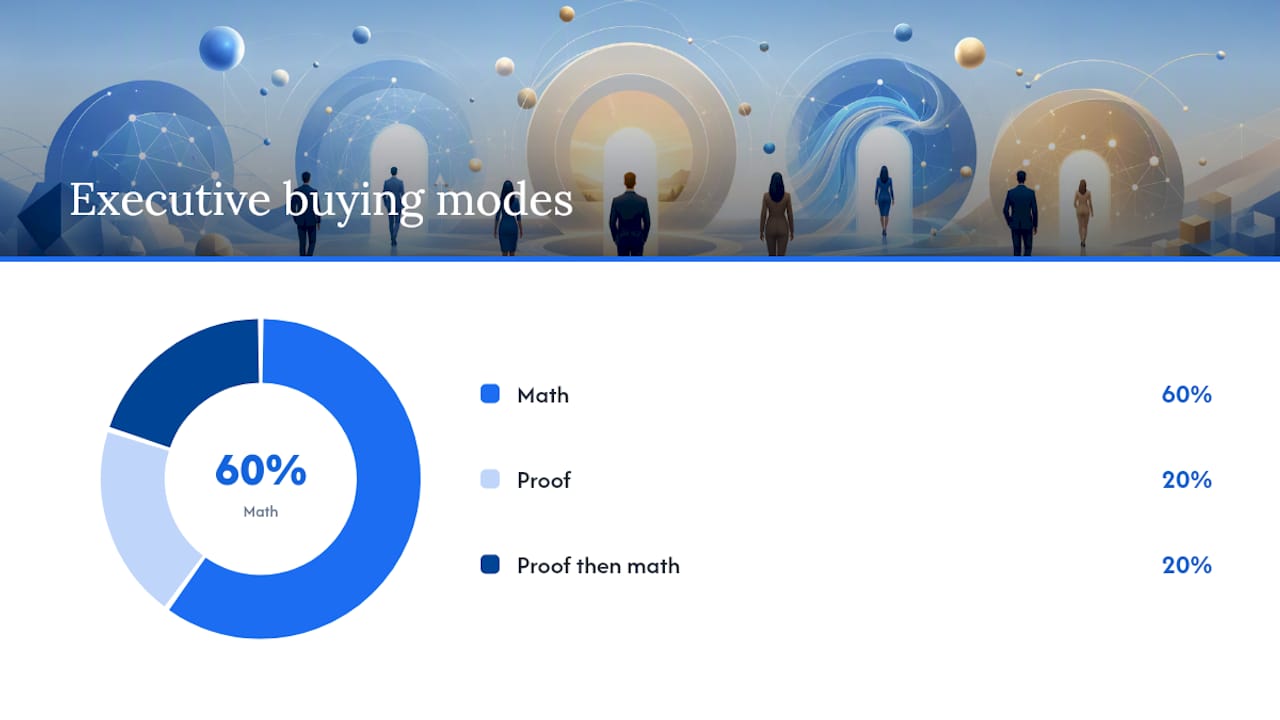
The lighthouse vs. landgrab framework from Andreessen Horowitz draws a clean line: some buyers need proof that your solution works at all (they want a marquee logo, a lighthouse customer, a name they recognize), while others need math (they want a cost-per-unit reduction, a payback period, a headcount offset). Sending math to a proof buyer makes you sound like a vendor. Sending proof to a math buyer makes you sound like a name-dropper.
Here is how to diagnose quickly by role and trigger:
| Executive role | Default buying mode | Triggering event | Messaging priority |
|---|---|---|---|
| CFO | Math | Quarter-end, cost mandate, audit | ROI, payback period, headcount offset |
| CTO | Proof then math | New hire, architecture review, security incident | Lighthouse customer in same stack |
| CRO/VP Sales | Math | Pipeline miss, new quota, comp change | Revenue impact, ramp time, win-rate lift |
| COO | Math | Process failure, scale pressure, M&A | Efficiency gain, error reduction, SLA improvement |
| CEO | Proof | Board pressure, competitive threat, new market | Strategic peer reference, category leadership |
Two quick examples. A CFO at a mid-market SaaS company facing a Q3 cost review wants a one-page ROI model, not a case study. A newly hired CTO at an enterprise manufacturer wants to know which companies in their peer group already trust your platform before they will take a meeting. Same product, completely different door.
Pro Tip: When a deal stalls at the VP level and you cannot get executive access, check whether the blocker is a proof gap or a math gap. If the VP keeps asking for "more references," the executive above them is a proof buyer. If they keep asking for "a better business case," the executive is a math buyer. Solve the gap at the VP level first, then ask for the executive introduction.
The lighthouse approach also applies to ecosystem plays. When a company like SK Telecom builds a validated commercial ecosystem around a solution, it reduces the executive's perceived deployment risk, which is a form of proof that accelerates access without requiring a direct reference call.
Your outreach playbook: templates, cadence, and personalization
Executives scan, they do not read. HBR's guidance on connecting with senior leaders is direct: keep outreach concise, lead with credibility, and make the ask specific and low-effort. Six sentences maximum. One idea per message. One ask per touch.
Email templates by role and trigger
CFO / Math buyer (cost mandate trigger)
Subject: [Company] cut SaaS spend 22% in 90 days — 15 minutes?
Hi [Name], [Peer company] reduced their SaaS operations cost by 22% using [your category]. Given [Company]'s Q3 cost review, I thought the model might be worth a quick look. I can share the one-pager in a 15-minute call this week. Would Thursday at 10 AM work?
CTO / Proof buyer (new hire trigger)
Subject: How [Peer company in same stack] solved [specific problem]
Hi [Name], Congratulations on joining [Company]. [Peer company] faced the same [architecture/security/scale] challenge in their first 90 days and resolved it with [your category]. Happy to share what they did in a 15-minute briefing. Any time Thursday or Friday work?
LinkedIn message (universal, under 50 words)
Hi [Name], [Peer company] used [your category] to [specific outcome] in [timeframe]. Given [Company]'s focus on [initiative from their LinkedIn or earnings], I thought it might be worth 15 minutes. Would you be open to a brief call this week?
Recommended multi-channel cadence
| Day | Channel | Action |
|---|---|---|
| Day 1 | Send insight-led or ROI message (template above) | |
| Day 3 | Send connection request with a one-line context note | |
| Day 5 | Follow up with the peer reference or insight | |
| Day 7 | Brief follow-up referencing the LinkedIn message | |
| Day 10 | Assistant touch | Call or email the executive assistant, ask for 15 minutes |
| — | Warm intro | Activate mapped referral if available |
Mid-week mornings, specifically Tuesday through Thursday between 7:30 AM and 9:00 AM in the executive's time zone, tend to produce higher response rates than Friday afternoons or Monday mornings.
Personalization checklist (5-minute research sprint):
- Recent earnings call or press release: what initiative did the CEO or CFO name?
- LinkedIn activity: what has the executive liked or shared in the last 30 days?
- Job postings: what roles is the company hiring? That signals where the pain is.
- Peer reference: which customer in their industry or peer group can you name?
- Trigger event: new hire, funding round, acquisition, or regulatory filing?
For assistant engagement, be direct and respectful. State your name, your company, the executive's name, and a one-sentence reason for the meeting. Ask for 15 minutes. Never pitch the assistant. They are a gatekeeper and a connector; treat them as a professional and they will often route you correctly.
Pro Tip: Use B2B intent data to time your outreach. When a company is actively researching your category, your cold message lands as timely rather than random. That shift alone can double your response rate.
Alternative routes to executive access worth investing in
Cold outreach is the slowest path. The routes below often produce faster, higher-quality access, especially for large accounts where a single meeting is worth six figures in pipeline.
Warm referrals are the highest-leverage option. Systematic mapping of warm introduction paths shows that top-to-top introductions, CEO-to-CEO or CFO-to-CFO, significantly increase executive engagement rates compared to rep-level introductions. Map your CRM, your board, your investors, and your existing customers before sending a single cold email.

Executive events and roundtables give you access in a non-selling context. The executive is there to learn and network, which lowers their guard. The downside is lead time: quality events require 60–90 days of planning, and attendance is not guaranteed. Best for accounts where you have a 6–12 month horizon.
Advisory boards are a longer play but produce durable access. Inviting a target executive to advise on your product roadmap or market strategy creates a relationship before a sales conversation. Lead time is 3–6 months to formalize, but the quality of access is unmatched.
Paid sponsorships and sponsored briefings work when the account value justifies the investment. Curated, intelligence-led approaches to pre-deal management access use sector mapping and strategic fit analysis to create high-touch introductions that a cold email cannot replicate. Precision-led market access models treat access as a disciplined system combining intelligence, timing, and human oversight rather than volume. For enterprise accounts with seven-figure potential, that investment calculus often makes sense.
When to choose a sponsored path over direct outreach:
- Account value exceeds $500K in potential annual contract value
- Direct outreach has failed twice or more at the executive level
- The executive is actively avoiding vendor conversations (common in regulated industries)
- You need access within 30 days and have no warm path available
- The relationship requires a peer-level introduction that only a third party can broker
For account-based approaches targeting a small number of high-value accounts, combining a sponsored briefing with a mapped warm introduction is often the fastest path to a first executive meeting.
How to measure what works and iterate fast
Measuring executive access is not complicated, but most teams track the wrong things. Pipeline created is a lagging indicator. The leading indicators are response rate, meeting rate, time-to-meeting, and quality score (defined as: did an executive with decision authority attend, and did they influence the next step?).
Simple A/B test design:
- Test one variable at a time: subject line, opening sentence, or call to action
- Minimum sample: 50 sends per variant before drawing conclusions
- Run duration: 2–3 weeks to account for response lag
- Control: your current best-performing message
- Success threshold: 20% lift in response rate or meeting rate
Test-plan checklist:
- Who owns the test: one person, not a committee
- Where metrics live: CRM field or sequencing platform dashboard
- Review cadence: weekly check-in, final read at week 3
- Decision rule: if variant beats control by 20%+, it becomes the new control
Use sales engagement platforms that support A/B testing at the sequence level. Manual tracking in a spreadsheet works for small teams but breaks down above 200 outreach attempts per month.
What to prepare once you win the meeting
Getting the meeting is half the work. Executives cancel or disengage when the first meeting feels like a discovery call in disguise. Executive briefing frameworks recommend engaging C-suite stakeholders at mid-to-late deal stages with a clear strategic frame and a defined business outcome, not a product walkthrough.
Minimum prep deliverables:
- One-page business case (problem, solution, financial impact, risk, next step)
- 30-minute agenda sent 48 hours in advance
- Stakeholder map (who is in the room, their role in the decision, their likely objection)
- Success metrics (what does a good outcome from this meeting look like?)
One-pager template outline
- Problem: One sentence naming the specific business pressure (not the product category)
- Solution: One sentence on what you do, tied to that pressure
- Evidence: One named customer, one metric, one timeframe
- Financial impact: ROI range or payback period (for math buyers) or peer reference (for proof buyers)
- Next step: One specific action with a date
30-minute agenda template
- Minutes 0–5: Context alignment (why this meeting, what success looks like)
- Minutes 5–15: Business case presentation (one-pager walk-through)
- Minutes 15–25: Executive questions and objections
- Minutes 25–30: Next step agreement and owner
Briefing your executive sponsor: Tell them the account name, the executive's role, the business pressure you are addressing, and the one thing you need from them in the room (a peer reference, a strategic endorsement, or a question that opens the door to the next step). Do not give them a product brief. Give them a conversation guide.
Advanced tactics from Chad Burmeister's executive playbook
After 25+ years scaling sales and business development teams at companies like Informatica, RingCentral, and Cisco-WebEx, the situations that break standard playbooks are the ones worth preparing for. Here are the moves that work when the basics stall.
Peer-to-peer executive asks. When your VP of Sales calls their VP of Sales, or your CEO calls their CEO, the conversation shifts from vendor to peer. The ask is simple: "We think there is a fit here. Would you be open to a 20-minute call so our teams can explore it?" That framing removes the sales dynamic entirely.
CEO-to-CEO intro script. Keep it to three sentences: name the shared context (mutual investor, industry event, peer company), name the specific opportunity, and ask for a 20-minute call. No pitch deck. No product mention.
Executive briefing swaps. Offer to share proprietary research, a benchmark study, or an industry insight in exchange for 30 minutes with the executive team. You give value first; the meeting is the return. This works especially well with CTOs and Chief Strategy Officers who are actively benchmarking.
Time-boxed pilots. When an executive is interested but not ready to commit, propose a 30-day pilot with a defined success metric and a clear exit clause. It removes the risk of a long commitment and gives you a proof point for the next executive conversation.
Red flags to watch:
- Pilot purgatory: the pilot extends indefinitely with no decision criteria. Fix it by agreeing on success metrics before the pilot starts.
- Over-customization requests: the executive asks for features that only apply to their account. This signals a champion without authority. Escalate to find the real decision-maker.
- Meeting without a next step: if the executive ends the meeting without agreeing to a specific action, the deal is stalling. Always close on a named next step with a date.
Pro Tip: When a deal is stalled mid-stage and you need executive intervention, do not ask your champion to "get their boss involved." Instead, ask: "Who else in your organization would want to know about this outcome?" That question surfaces the executive sponsor without putting your champion in an awkward position.
What experience teaches you about timing and executive etiquette
The sellers who consistently win executive access share one trait: they treat executives as peers, not targets. That shift in posture changes everything, from how you write the subject line to how you handle a "not now."
Patience is a competitive advantage in executive selling. A "no" from an executive in January often becomes a "yes" in April when a board meeting surfaces the exact problem you solve. The sellers who stay in light, respectful contact during that gap, sharing a relevant article, congratulating on a company milestone, forwarding a peer reference, are the ones who get the call when the window opens.
One gesture that consistently earns access: sending a one-page competitive benchmark or industry insight with no ask attached. Just "Thought this might be useful given what you are working on." No reply needed. No follow-up scheduled. Executives remember the people who gave them something useful without asking for anything in return. That memory is worth more than a perfectly crafted cold email.
The one rule of executive etiquette worth following without exception: never waste their time. If you get 15 minutes, use 12. If you promised a one-pager, send one page. If you said you would follow up by Thursday, follow up by Thursday. Executives have a long memory for people who respect their time and an equally long memory for those who do not.
Sources
The research and practitioner frameworks behind this playbook, with brief context on each:
- Lighthouse or Landgrab? How to Pick Your AI Sales Strategy | Andreessen Horowitz
- New to sales? Here’s how to connect with senior leaders — Harvard Business Review
- How to Get Meetings with Executives: 7 Strategies That Work
- Executive Engagement: How to Reach C-Suite Decision-Makers Through Warm Introductions
- Executive Engagement: Getting C-Suite Involvement to Close Deals - 2026 Guide
- Deal Origination, Identification and Management Access — Drax Executive
- Elite Market Access — The Grey Cardinal Group®