CEO social selling is a CEO using a personal social profile, mostly LinkedIn, to build trust with buyers, partners and talent, then handing that attention to a sales team that is ready to act on it. A profile alone does not produce pipeline. A profile that is wired to your SDR and BDR motion, with a clear point of view, a steady routine and metrics tied to your CRM, does. That connection between the executive and the outbound team is where most companies lose the value, and it is the part a sales development leader is hired to build.
This guide is written for CEOs, CROs and founders, including those hiring a sales development or business development leader in Colorado. It covers what the research says, how to pick your role, a weekly routine, how to get the team aligned, and how to measure the result.
TL;DR
- Social media use helps the early stages of selling, such as creating opportunities and managing relationships. It does not by itself move revenue, so it has to be paired with a team that follows up.
- The CEO role that pays is the selective one: relationship building aimed at strategic accounts, with a revenue goal attached.
- Audience quality beats audience size. A few thousand buyers, partners and candidates in your market are worth more than a large, unrelated following.
- Social strategies that are formally aligned between sales and marketing outperform the average win rate. Informal effort does not.
- Measure activity, meetings, opportunities and influenced pipeline in your CRM, and compare to your own history.
Table of Contents
- What CEO social selling actually means
- What the evidence says, and what it does not
- Pick your role: not every CEO should sell the same way
- Build an audience that can buy, partner or hire
- A realistic weekly routine for a CEO
- Get the sales team aligned before you post
- Manage the backlash risk
- Measure what the CEO's activity produces
- Where a sales development leader fits
- Work with Chad
- Our perspective
- FAQ
- Sources
What CEO social selling actually means
Social selling is the practice of using social media to find, connect with and build relationships with potential buyers, as HubSpot's social selling playbook defines it. The CEO version has a different job from the rep version. A rep uses LinkedIn to research accounts, start conversations and prepare calls. A CEO uses it to give the company a face, a stance and credibility that a rep cannot borrow on a cold message.
That difference matters in practice. When an SDR messages a VP at a target account, the VP checks who the SDR works for and who leads that company. If the CEO has a profile that shows real knowledge of the buyer's problems, the message lands warmer. If the CEO's profile is empty, or filled with reposted press releases, the rep starts from zero.
What the evidence says, and what it does not
Be precise about what social activity can deliver. A peer-reviewed study of 1,699 B2B salespeople across more than 25 industries found that social media use is positively related to sales processes, meaning creating opportunities and managing relationships, and to relationship sales performance. It did not directly raise outcome measures such as revenue or quota attainment. In plain terms: social selling fills and warms the front of the funnel. Closing still depends on the team behind it.
That is the right frame for a CEO. Posting is not the product. Posting is the thing that makes your outbound, your referrals and your enterprise conversations easier to start.
Pick your role: not every CEO should sell the same way
Harvard Business Review's 2021 research podcast with Christoph Senn looked at how CEOs get involved with customers. In that conversation, only 14% of the CEOs in the sample acted as "growth champions", combining relationship building with a revenue focus. The CEOs who were social visitors or deal makers each produced about twice the growth and three times the profitability of the "loose cannon" type, and the hands-off CEOs, 28% of the sample, showed no impact or slightly negative profitability.

Senn's point is that CEOs who build relationships with no revenue focus frustrate customers and sales teams, while pure deal making is hard to sustain. The role that works is the growth champion, applied selectively to strategic customers.
Translate that to social:
- Choose a short list of accounts. Twenty to fifty strategic accounts, partners and a handful of future hires is plenty.
- Engage with those people specifically. Comment on their posts, congratulate them on announcements, share something relevant to their business.
- Hand warm signals to the team. When a target VP likes your post or accepts your connection, your SDR or BDR lead should know the same day.
- Step in at the right moment. A CEO note to a prospect who is already in a sales cycle can unstick a deal. A CEO note with no context can derail one. Agree with your sales lead on when you join.
Our guide to executive access strategies goes deeper on how to get in front of senior buyers, and the 0 to 90 day C-suite selling playbook covers how reps and managers prepare for those conversations.
Build an audience that can buy, partner or hire
Most CEOs are not yet doing this. Research from Temple University's Fox School of Business found that fewer than half of 50 sampled B2B CEOs across ten sectors had any significant social presence. Their stated reasons were lack of time, unclear return and fear of risk. The same research reported that 73% of millennials are involved in B2B end-purchase decisions and tend to see CEOs with an established social presence as stronger, more personable and more trustworthy.
That gap is an opening. If your competitors' CEOs are silent, a consistent presence is a visible difference.
Who should follow you
A useful test: could the person who just followed you buy from you, refer you, partner with you or join your team? A CEO with 5,000 followers who fit that description will usually do more for pipeline than one with 50,000 who never will. Build for relevance. Connect with the buyers your reps are already targeting, your customers, your channel partners and the people your best hires would come from.
What to post
Broadcasting promotions does little. Alexander Low of DCM Insights, quoted in HubSpot's playbook, describes showing up daily with intention and engaging through likes and comments as creating "micro-moments of influence" that build familiarity and trust. You do not need long essays. You need to be consistently useful to a specific audience.
Good CEO content tends to fall into four buckets:
- Buyer problems. What you hear in the market that your buyers struggle with, described without naming anyone.
- Decisions and lessons. A choice you made, why, and what you would do differently.
- Customer and team wins, told from the customer's point of view.
- Opinions on your category. A real position, stated clearly.
Inc. reported in January 2026 that a sales lead at Workshop went from three to five demos a month to 18 to 20 by posting about buyer pain points on LinkedIn, creating opportunities worth over $500,000. That example involved a salesperson rather than a CEO, but the mechanism is the same: name the problem your buyer has, and the right people raise their hands.
For a fuller view on this, see our LinkedIn thought leadership guide for sales leaders.
A realistic weekly routine for a CEO
Time is the objection CEOs raise most. A routine that fits a full calendar looks like this:
| Task | Time | Purpose |
|---|---|---|
| Two original posts | 30 minutes total | Share a buyer problem, a lesson or an opinion |
| Comments on target-account posts | 10 minutes a day | Stay visible to the people your team is pursuing |
| Reply to every comment and message | 10 minutes a day | Turn attention into conversation |
| Weekly review with your sales lead | 15 minutes | Pass along who engaged, and decide who to approach |
That is roughly two hours a week. The review is the step most CEOs skip, and it is the one that turns social activity into selling.
Get the sales team aligned before you post
A CEO who posts while the sales team runs its own separate outreach creates noise. The 2016 CSO Insights Sales Enablement Optimization Study found that when sales and marketing social strategies were formally aligned, win rates climbed 16% to 53.6%, against a study average of 46.2%. Social selling training rated as exceeding expectations improved win rates by 38% and quota attainment by 51%. The study also found that only formal alignment let sales forces outperform the average. It is an older study, but the lesson holds: structure beats enthusiasm.
Formal alignment, in practice, means:
- One target account list shared by the CEO, SDRs, BDRs and marketing.
- A shared message. The problems you post about are the problems your reps open with.
- A signal protocol. Who gets told when a target engages, and how fast the follow-up goes out.
- Training. Reps know how to use LinkedIn for research, lead development and call preparation. The same study found LinkedIn was the most-used social selling tool, used by 84% of salespeople.
Our LinkedIn outreach strategy for B2B sales leaders and LinkedIn B2B lead generation playbook lay out the team side. If you want to add automation, the safer 60 to 90 day AI outreach pilot shows how to test it without putting your brand at risk.
Manage the backlash risk
The main risk of a social CEO is not wasted time. It is reputation. Dori Shae Taylor of Temple University notes that the biggest risk is backlash, because a CEO is seen as the leader and what they say is expected to reflect the views of the firm. She also observes that when a communications team writes everything, the presence can come across as stale, since people want to relate to a CEO's personality and opinions.
Both problems have the same fix: a short set of ground rules, agreed in advance.
- Decide which topics are yours (your market, your customers, leadership) and which are off limits.
- Write your own first drafts. A communications team can polish and schedule, not replace your voice.
- Agree who monitors comments and how fast sensitive ones are escalated.
- Keep an eye on how the company shows up online overall. This walkthrough on how to manage online reputation step by step covers the basics for smaller businesses.
Measure what the CEO's activity produces
A CEO who cannot see results stops posting. Measure in layers, using the CRM you already have.
HubSpot's playbook recommends tracking activity, engagement, meetings, opportunities, influenced pipeline and revenue, then comparing against your historical numbers. A practical version:
- Activity: posts, comments and messages from the CEO and the team.
- Engagement: profile views, replies and connection acceptances from target accounts.
- Meetings booked where the first touch was a social interaction.
- Opportunities created and pipeline influenced by those accounts.
- Revenue from deals where social was part of the path.
Log the source on the contact record so the attribution survives. HubSpot has described a case in which a sales training firm found that 73% of its business over 18 months was influenced by social media, tracked through its CRM attribution. Treat that as an illustration of what tracking can reveal, not a benchmark for your company. Your benchmark is your own pipeline before you started.
Give it a full quarter before judging. Relationship-driven channels build slowly, and the early gains show up in meetings and opportunities before they show up in closed revenue.
Where a sales development leader fits
A CEO's profile creates attention. Someone has to turn that attention into booked meetings, which is the work of an SDR or BDR team and the leader who runs it. If you are hiring for that role in Colorado, look for a leader who has built outbound teams and understands social selling as part of the motion, not a side project.
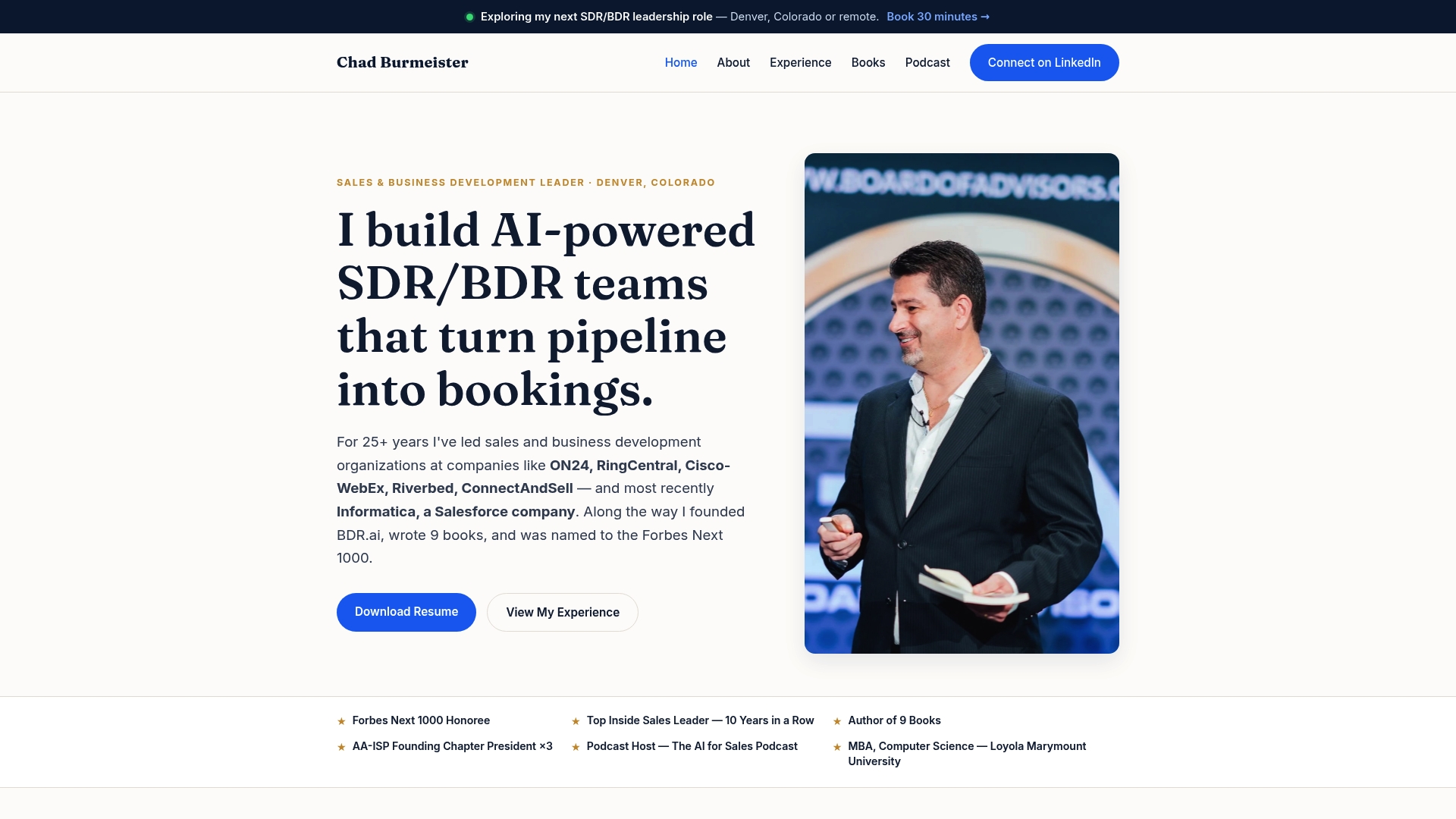
Chad Burmeister is a Colorado-based sales executive with more than 25 years of experience scaling sales and business development teams at companies including Informatica, RingCentral and Cisco-WebEx. He is the author of nine books, including AI for Sales 2.0 and Mastering B2B Lead Generation with LinkedIn & AI, and hosts The AI for Sales Podcast. His recognition includes the Forbes Next 1000 and top inside sales leader awards.
Work with Chad
If you want your leadership team or sales organization to build a CEO-led social selling motion, Chad offers speaking and workshop engagements. You can see the options on the speaking and workshops page, or start from the Chad Burmeister homepage to see his books, podcast and background.
Our perspective
Over 25 years of building SDR and BDR teams, the pattern we keep coming back to is simple: attention is cheap, follow-up is what is valuable. A CEO who posts well and a sales team that never sees the signals is a missed opportunity.
The companies that get this right treat the CEO as the most credible voice in the outbound system. The CEO shapes the message, names the buyer problems and opens doors at a short list of strategic accounts. The SDR and BDR team does the daily work of turning those doors into meetings.
That is why we teach social selling together with prospecting, AI-assisted outreach and executive access, in our books, on The AI for Sales Podcast and in workshops. The pieces only pay off when they run as one motion. If you are a CEO or CRO who wants that built, or who wants your team trained on it, we would like to talk.
Chad
FAQ
Does CEO social selling really generate revenue?
It generates the conditions for revenue. Peer-reviewed research shows social media use is linked to creating opportunities and managing relationships, but not directly to revenue or quota. The revenue comes when a sales team follows up on the attention the CEO creates.
How much time should a CEO spend on LinkedIn?
About two hours a week is enough for most: two original posts, short daily comments on target-account posts, replies to messages and a brief weekly review with your sales lead. Consistency matters more than volume.
Should the CEO's team write the posts?
A team can edit, schedule and monitor, but the ideas and first drafts should come from you. Temple University's research notes that people want to relate to a CEO's own personality and opinions, and communications-written content can feel stale.
How do I know if it is working?
Track meetings, opportunities and influenced pipeline in your CRM, with the social source logged on each contact. Compare against your own results from before you started, and give it at least a quarter.
Sources
- Social Media's Influence on Business-to-Business Sales Performance
- How CEOs Can Drive Sales, or Kill Deals (HBR)
- The social selling sales playbook (HubSpot)
- Fox School of Business: the case for the social CEO
- Gen-Z Salespeople Are Closing Deals on Social Media (Inc.)
- CSO Insights 2016 Sales Enablement Optimization Study
- How a Multi-Channel Approach to Prospecting Influenced 73% of Business (HubSpot)