LinkedIn thought leadership means publishing useful, specific expertise on the platform until buyers, peers and recruiters think of you first when your topic comes up. It is not a posting schedule or a personal-brand costume. It is a repeatable habit of teaching what you know, backed by real results, aimed at the people who can hire you, buy from you or refer you. This guide covers what it is, how to find your point of view, which formats earn attention, how paid amplification fits, and how to tell whether it is working.
TL;DR
- Thought leadership is free, expert content about a topic you know well. It is not a product pitch in disguise.
- Start with one audience and one point of view. Posts built on personal stories and measurable results tend to beat generic advice.
- Consistency beats polish. Two or three solid posts a week, plus real comments on other people's work, will do more than one perfect essay a quarter.
- Measure inbound conversations, target-account engagement and pipeline influence, not just impressions.
- Sponsoring a person's post can extend reach, but it only works if the organic post was already worth reading.
Table of Contents
- What thought leadership on LinkedIn actually is
- Why LinkedIn is the place to do it
- Find your point of view before you post
- Formats and post types that earn attention
- A weekly rhythm you can keep
- Perspective: what we have seen work
- Thought Leader Ads: when paying to promote a person's post makes sense
- Measure what leads to revenue
- Common mistakes that stall thought leadership
- Work with us
- FAQ
- Sources
What thought leadership on LinkedIn actually is
The most useful definition comes from research that LinkedIn itself ran with a communications firm. The Edelman–LinkedIn US 2020 Thought Leadership Study defines it as free material produced by an organization or individual about a topic they know well and believe others can benefit from. The same study excludes content that mainly describes products or services.
That exclusion matters. A post that says "our platform now does X" is marketing. A post that says "here is what we learned after 400 cold calls to CFOs, and what we changed" is thought leadership. Both have a place, but only the second builds the kind of trust that makes a buyer answer your message.
The 2022 Edelman–LinkedIn Thought Leadership Impact Report widens the lens: expertise, guidance or a distinctive point of view, delivered as essays, videos, webinars, presentations or research reports, offered free or in exchange for registration. In practice, on LinkedIn that means posts, carousels, short video, newsletters, live events and long comments that teach something.
Forbes contributor Kathy Caprino adds the ethical test. Credible thought leadership rests on deep expertise, authenticity, transparency and a genuine intention to help others, not on opinions posted for visibility. If you cannot name the experience behind a take, hold it back.

Why LinkedIn is the place to do it
LinkedIn is where your buyers already keep their professional identity. Executive search firm Korn Ferry notes that the platform lets professionals share a point of view and get noticed by potential employers, clients, colleagues and bosses, and that relevant topics plus an authentic perspective build a personal brand and credibility.
For a sales or revenue leader, three things follow:
- Buyers check you before they reply. When your cold message lands, the first thing a prospect does is open your profile. A feed of useful posts answers the question "who is this?" before you do.
- Candidates check you too. A sales leader who teaches publicly attracts better SDRs and BDRs than one with an empty profile.
- Your network does the distribution. A comment from a respected peer on your post puts your name in front of people you have never met.
There is a trade-off worth respecting. The American Statistical Association points out that LinkedIn is a polite platform, but that politeness often means less community-led fact-checking. Accuracy is therefore a differentiator. If you quote a number, know where it came from. If you describe a result, make sure you can defend it in a comment thread.
One more point from Korn Ferry: if you write content as part of your job, make clear it was written for your employer, and tag the company so you do not pass off the work as yours alone. That small habit protects you and the team that helped.
Find your point of view before you post
Most stalled LinkedIn efforts do not fail on formatting. They fail because the author has no angle, so every post sounds like every other post about "leadership" or "AI".
PR Daily's guidance on crafting thought leadership on LinkedIn starts in the right place: define the audience, learn its questions, needs and content interests, then align your expertise with your organization's value proposition and clear business goals.
Step 1: Pick one reader
Not "sales professionals." Pick something like "CEOs of Series A software companies deciding whether to hire their first head of sales development." Narrow is good. A narrow reader lets you be specific, and specificity is what makes people stop scrolling.
Step 2: List the questions they ask you
Open your sent mail, call notes and DMs. The questions people actually ask you are the best content calendar you will ever have. Examples for a revenue leader:
- How many SDRs does a team need before it needs a manager?
- What should we measure in the first 90 days of outbound?
- Which parts of prospecting can AI do safely, and which should stay human?
- Why did our reply rates drop after we automated?
Step 3: State your position in one sentence
A point of view is something a smart person could disagree with. "Outbound is important" is not one. "Most teams automate before they have a message worth automating, and that is why reply rates fall" is one. Write three of these. They become the spine of your next two months of posts.
Step 4: Attach proof
For every position, find the experience behind it: a team you built, a test you ran, a mistake you made. Proof is what separates a thought leader from a commentator.
Formats and post types that earn attention
Forbes reporting on positioning yourself as the expert in your niche says posts with personal stories or case studies generally get two to three times more engagement than generic advice, and that adding measurable outcomes, such as timeframes and specific percentage improvements, strengthens credibility. Treat that as a directional guide rather than a guarantee, since results vary by audience and account size.
Here is how that plays out in a working mix:
| Format | Best for | What makes it work |
|---|---|---|
| Short story post | Lessons from a deal, hire or mistake | One scene, one lesson, one number |
| Case-study post | Showing method and results | Before, what changed, after, timeframe |
| Contrarian take | Staking out a position | A clear claim plus the experience behind it |
| Carousel or checklist | Frameworks people save | One idea per slide, usable without you |
| Poll | Learning what your audience thinks | A substantive question, not a vanity one |
| Short video or voice | Showing personality | Under a minute, one point |
| Newsletter or article | Deeper arguments | Reserved for ideas that need room |
| Comments on others' posts | Building relationships | Add data, a counterexample or a question |
Caprino's advice lines up with the last rows: thoughtfully repost other people's work, ask substantive poll questions, and publish a specific personal perspective on issues within your expertise. Reposting with a real comment is generous and positions you as someone who reads the field, not just broadcasts into it.
A simple structure for a post that teaches
- Hook: a specific situation or result in the first line. "We cut our no-show rate on first calls by a third in six weeks."
- Context: two or three short lines on what was going wrong.
- The move: what you changed, in steps someone could copy.
- The number: the outcome, with the timeframe.
- The question: one sentence inviting a real answer.
Keep paragraphs to a line or two. Cut anything that sounds like a press release.
A weekly rhythm you can keep
A cadence you can sustain for a year beats a sprint you abandon in a month. A workable week for a busy executive:
- Monday: one story or lesson post, written from a call or meeting the week before.
- Wednesday: one framework, checklist or case study.
- Friday: one question, poll or reaction to something in your industry.
- Daily, 10 minutes: leave three comments that add something. Reply to everyone who comments on your own posts within the first hours.
Batch the writing. Block 45 minutes once a week, draft three posts, and schedule them. Keep a running note on your phone for ideas, since the best ones show up in the middle of real work.
The profile behind the posts matters as well. Make the headline say who you help and how, not just a title. Put proof in the About section, feature your best post, and make sure the first two lines of your summary would make sense to a stranger. If thought leadership is the front door, the profile is the lobby.
Perspective: what we have seen work
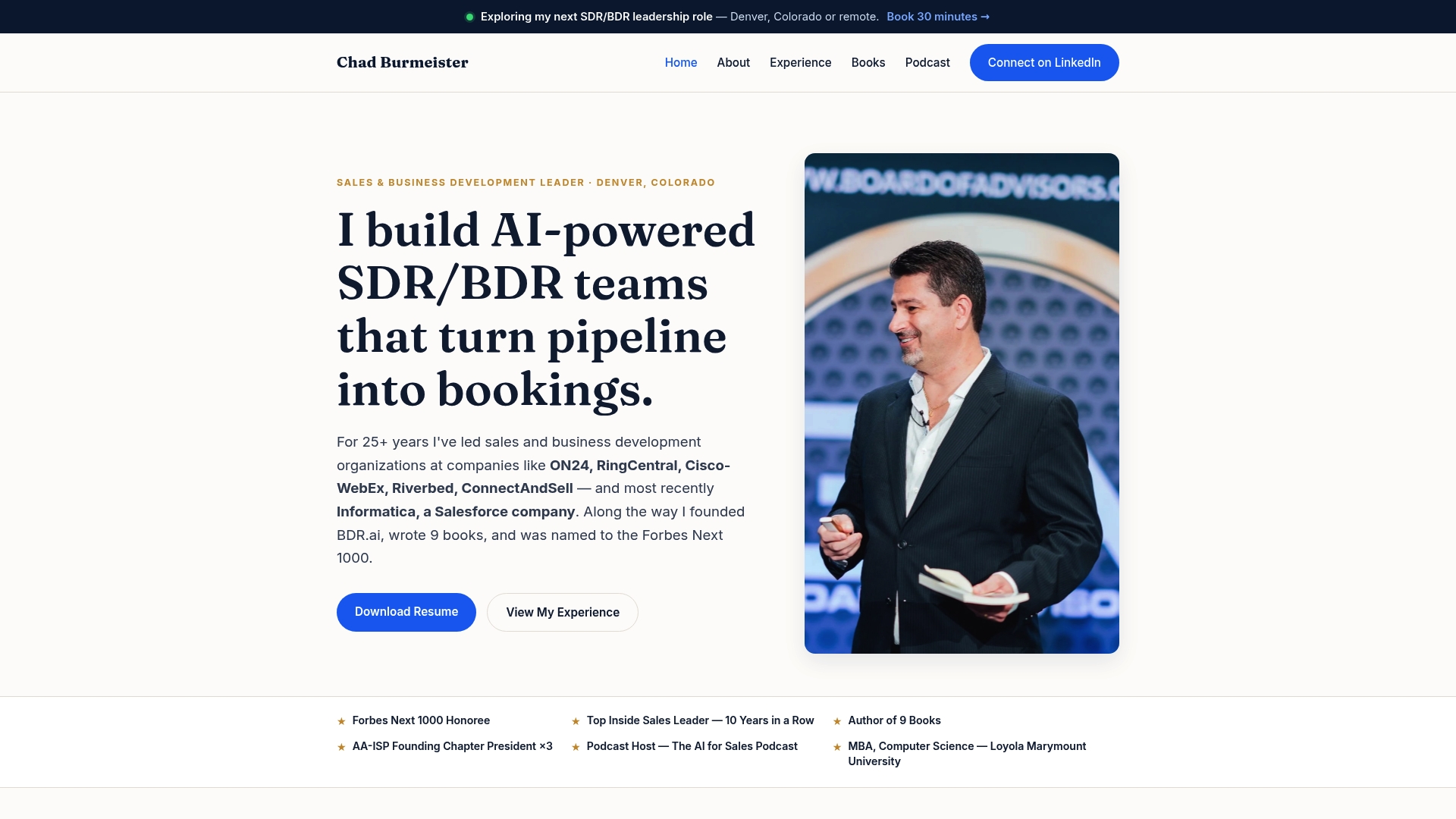
We have spent more than 25 years building and scaling sales development and business development teams, and we have written and hosted our way through AI for Sales 2.0, Mastering B2B Lead Generation with LinkedIn & AI and The AI for Sales Podcast. Here is where we land on LinkedIn thought leadership for revenue leaders.
Teach what you do on Tuesday. The best posts come from live work: a script we tested, a team meeting that went sideways, a metric that surprised us. Readers can tell the difference between lived experience and recycled advice.
Thought leadership and outreach are one system. Your posts warm the audience, and your outreach gives people a reason to look at the posts. When a prospect sees a message from you and then recognizes your name from the feed, the conversation starts a step ahead. That is why we write about LinkedIn outreach strategy for B2B sales leaders and LinkedIn B2B lead generation alongside the content side.

Use AI as an editor, not a ghost. AI can tighten a draft, suggest hooks and help you repurpose a podcast episode into five posts. It cannot supply your experience. Teams that let it write the whole post end up sounding like everyone else. If you do use automation around LinkedIn, pilot it carefully; we lay out a safer 60 to 90 day approach that protects accounts.
Be generous, then be clear. Give away the how. Be plain about what you do for a living, so the right CEO or CRO knows when to call.
— Chad
Thought Leader Ads: when paying to promote a person's post makes sense
LinkedIn offers a sponsored format, Thought Leader Ads, that lets a brand promote posts published by its own people. The pitch is that readers see a trusted individual voice rather than a logo. The people-first look is the draw, and it also creates the main condition for success: the post has to be good before you spend anything on it.
Before sponsoring a post, think through:
- Is the organic post already working? Promote what has proven itself with your network. Money does not rescue a weak idea.
- Does the author agree? The post lives on a person's profile, so the person must consent, and you need a plan for what happens if they leave the company.
- Who is the audience? Define the job titles, industries and target accounts first. Broad targeting wastes budget on people who will never buy.
- What is the next step? A post that teaches and then points to one specific resource performs better than one that asks for a demo cold.
- How will you judge it? Decide before launch whether success means target-account engagement, qualified conversations or pipeline, and check the current setup steps and specs on LinkedIn's own ads help pages, because formats and requirements change.
For most individual executives and small teams, the order is simple: earn attention organically for a few months, learn which posts resonate, then consider sponsoring the best one.
Measure what leads to revenue
Impressions feel good and prove little. A more honest scorecard for a sales leader looks at:
- Reach and follower growth among the right roles, not just total numbers.
- Engagement from ideal-customer decision-makers. Ten comments from VPs at target accounts beat a hundred from unrelated profiles.
- Shares and saves by people at accounts you are pursuing.
- Inbound connection requests and messages that mention a specific post.
- Pipeline influence. Ask every new prospect and candidate how they heard of you, and log the answer in your CRM.
- Hiring impact. Track how many strong candidates arrive referencing your content.
Review this monthly. If posts about a topic keep producing relevant conversations, write more about it. If a format gets likes but no conversations, drop it.
Common mistakes that stall thought leadership
- Posting only when you have news. Announcements are not teaching.
- Chasing virality. Broad applause from the wrong audience does not pay for a single SDR.
- Vague claims. "We grew pipeline massively" persuades no one. "Pipeline from outbound rose 40% in two quarters after we rewrote the first line of every email" invites questions, provided it is true and you can explain it.
- Never replying. The comment section is where relationships form.
- Ignoring the link between content and outreach. Posts with no follow-up conversations are wasted. Consider layering in personal touches such as LinkedIn voice messages when someone engages with your content.
- Letting accuracy slip. One wrong statistic in public costs more credibility than ten good posts earn.
Work with us
If you are a CEO, CRO or founder who wants a sales development leader who has built teams and teaches openly, or an organization that wants your reps to learn LinkedIn and AI-assisted prospecting from someone who does it, we run speaking engagements and workshops. You can see the details and get in touch on our speaking and workshops page.
If you would rather start with the written playbooks, the full list of titles, including AI for Sales 2.0, is on our books page.
FAQ
What is thought leadership on LinkedIn?
It is free, expert content you publish about a topic you know well, meant to help others rather than sell a product. On LinkedIn it shows up as posts, comments, newsletters, video and live events. Its purpose is to make you the person people think of first for that topic.
How do I post thought leadership on LinkedIn?
Pick one audience and one point of view, then share short posts built on real experience: a story, a case study or a framework with a measurable result. Post a few times a week, comment on other people's work, and answer every reply. Revisit what gets real conversations and do more of it.
Are LinkedIn Thought Leader Ads worth it?
They can be when the organic post is already strong, the author has agreed, and the audience is tightly defined. They are a poor fix for weak content. Set a clear goal first, such as engagement from target accounts or qualified conversations, and check LinkedIn's current ad documentation for requirements.
Who are the best thought leaders on LinkedIn?
There is no official ranking, and the best ones for you are people in your own field who teach with specifics and show their work. Follow a handful of practitioners in your niche, study how they structure posts and respond to comments, and borrow the habits rather than the voice.
How long does it take to see results?
Expect a few months of steady posting before patterns show. Early signs are better conversations, not bigger numbers: more relevant connection requests, replies that mention your posts, and prospects who already know your name.
Sources
- Edelman–LinkedIn US 2020 Thought Leadership Study
- Edelman–LinkedIn 2022 Thought Leadership Impact Report
- Forbes: 5 Ways To Share Thought Leadership On LinkedIn
- Forbes: How To Use LinkedIn To Position Yourself As The Expert In Your Niche
- Korn Ferry: 4 Ways to Raise Your Professional Profile Online
- American Statistical Association: Why and How You Should Share Knowledge on LinkedIn
- PR Daily: How to craft impactful thought leadership on LinkedIn