The best LinkedIn B2B lead generation approach combines intent-first prospecting, a conversion-focused profile and content engine, and narrow paid campaigns built around Lead Gen Forms. Run those three together and you get a repeatable pipeline machine instead of a string of random tactics. Skip any one leg and the whole thing wobbles: content without outbound goes nowhere, outbound without a credible profile gets ignored, and paid spend without a qualification layer just buys you unqualified form fills.
Here's what to do in the next 24 to 72 hours if you want proof this works before committing real budget:
- Rewrite your headline and About section around the outcomes you deliver, not your job title.
- Pull a list of 50 to 100 prospects who match your ICP and have engaged with relevant content in the last two weeks.
- Send 10 to 15 personalized connection requests referencing that specific engagement.
- Publish one carousel or short-form post that states a clear, specific opinion on a problem your buyers have.
- Set up a Lead Gen Form campaign at minimal spend just to test message-to-audience fit.
Priority split: do the profile rewrite and outreach messaging yourself, since they need your judgment. Delegate list-building and enrichment to an SDR or a tool. Automate CRM syncing and reporting from day one so you're not rebuilding dashboards in month three.
Pro Tip: Don't launch paid campaigns before your profile and Company Page are fixed. A cold click that lands on a thin profile wastes the ad spend you just paid for.
Key Takeaways
LinkedIn B2B lead generation succeeds when intent-first prospecting, a conversion-focused profile and content system, and narrow paid campaigns with Lead Gen Forms work together rather than in isolation.
| Point | Details |
|---|---|
| Lead with intent signals | Reach out within 24 hours of engagement, job changes, or relevant posts for higher acceptance and reply rates. |
| Fix the profile before scaling outreach | An outcome-focused headline and About section convert cold clicks far better than a resume-style profile. |
| Use Lead Gen Forms for volume offers | Pre-filled forms can lift submit rates to 30 to 40% versus standard landing pages. |
| Score before you route | Weight firmographic fit and intent signals above raw engagement when qualifying leads. |
| Get expert help scaling the pilot | Chadburmeister's consulting engagements and published playbooks help teams move from a 90-day test to a repeatable program. |
Table of Contents
- Why LinkedIn Works for B2B Lead Generation
- How Do You Build an ICP That Actually Works on LinkedIn?
- What Makes a LinkedIn Profile Convert Visitors into Leads?
- What Content and Posting Cadence Actually Drive Leads?
- How Do You Run Outbound Sequences That Still Feel Personal?
- When Should You Use LinkedIn Ads Instead of Organic Outreach?
- Which Tools and Integrations Keep LinkedIn Outreach Scalable and Safe?
- How Do You Qualify and Route LinkedIn Leads into Meetings?
- What KPIs Actually Prove LinkedIn Is Driving Pipeline?
- How Do You Structure a 90-Day LinkedIn Lead Gen Pilot?
- Ready-to-Use Playbooks and Templates
- Get Hands-On Help Scaling Your LinkedIn Pipeline
- Sources
Why LinkedIn Works for B2B Lead Generation
Roughly A large majority of B2B marketers already use LinkedIn for lead generation, and many report that it produces genuinely qualified leads. That's not a niche channel anymore. It's closer to table stakes for anyone selling into companies rather than consumers.
The bigger number is where LinkedIn sits relative to other social platforms: it accounts for a significant majority of all B2B leads sourced from social media according to this resource. No other network comes close for reaching decision-makers by title, seniority, and company attributes at the same time.
LinkedIn earns its budget when you need precision: account-based campaigns, executive outreach, high-consideration offers like a demo or a strategy call. It's the wrong tool when you're chasing volume on a low-ticket, low-consideration product. Good use cases include:
- Webinar and event registration for a defined buying committee
- Demo requests tied to a specific ICP segment
- ABM nurture sequences aimed at named target accounts
- Executive-level outreach where credibility matters more than reach
Pro Tip: If your average deal size is under a few thousand dollars, LinkedIn's targeting precision may not justify its cost per click. Save it for offers where a qualified meeting is worth real money.
How Do You Build an ICP That Actually Works on LinkedIn?
Start with the business problem you solve, not a demographic checklist. A vague ICP ("VP-level, 500+ employees, tech industry") produces a bloated audience and mediocre results. A sharp one starts with the trigger event that makes your product urgent, then works backward into the roles who feel that pain.
- Identify the problem your product solves and who experiences it directly.
- List the buying committee: the champion, the economic buyer, and any technical or legal evaluator.
- Translate each role into LinkedIn filters: job title, seniority, function, and company headcount.
- Layer in firmographic filters (industry, revenue band, geography) to narrow further, such as targeting the real estate industry where such precision can significantly improve campaign impact.
- Save the combination as a Saved Search inside Sales Navigator so new matches surface automatically.
Audience sizing matters more than most marketers assume. Go too narrow (under a few hundred people) and you'll exhaust the list in weeks. Go too broad (tens of thousands) and your messaging gets generic fast. A workable range for most outbound campaigns is somewhere between 500 and 5,000 contacts per active segment, tight enough for relevance, wide enough to sustain a quarter of outreach.
Sales Navigator's advanced filters and lead alerts make this workflow far faster than manual searching, and consistent use correlates with higher connection rates for teams running structured outbound.
- Champion: the person who will feel the pain daily and advocate internally.
- Economic buyer: whoever signs off on budget, often two levels up from the champion.
- Technical evaluator: security, IT, or procurement, depending on your category.
Pro Tip: Sequence your outreach to hit the champion first, then loop in the economic buyer once you have a champion's endorsement. Cold-calling the CFO before anyone downstream knows you exist rarely works.
What Makes a LinkedIn Profile Convert Visitors into Leads?
Most profiles read like resumes. A resume tells people what you've done. A conversion-focused profile tells them what you can do for them right now, which is the only thing a prospect actually cares about when they click through from a connection request.
Your headline should state the outcome you deliver, not your title. "VP of Sales" tells a visitor nothing. "I help RevOps teams cut CPL by tightening lead routing" tells them exactly why to keep reading. Your About section should follow the same logic: open with the problem you solve, back it with a specific result, and close with a low-friction next step.
Buyers scan a LinkedIn profile the same way they scan a landing page: they're asking "does this person understand my problem?" within the first three seconds. If the headline answers that question, they read on. If it doesn't, they scroll past.
Your Company Page needs the same discipline. Fill out Specialties completely, since it feeds search and filtering. Use Showcase Pages to spotlight a specific product line or use case rather than cramming everything into one feed. Place a clear call-to-action in your page's custom button, pointed at a demo request or content offer.
| Profile element | Resume-style approach | Conversion-focused approach |
|---|---|---|
| Headline | Job title only | Outcome-based statement |
| About section | Career history | Problem, proof, next step |
| Featured section | Empty or generic | Case study PDF, one-pager |
| Company Page CTA | None or generic "Visit website" | Direct link to demo or offer |
Publish a short library of assets in your Featured section: a one-page case study, a two-minute recorded demo, a client result summary. Keep every asset scannable on a phone screen, since a large share of LinkedIn browsing happens on mobile.

Pro Tip: Rewrite your headline every quarter to reflect your current priority offer. A stale headline signals a stale profile, even if your content is fresh.
What Content and Posting Cadence Actually Drive Leads?
LinkedIn's feed algorithm rewards conversation over passive approval. Comments and meaningful replies push a post further than likes do, which changes what "good content" means. A post engineered to spark disagreement or a specific question in the comments will outperform a polished announcement almost every time.
Format choice matters too. Carousels and short video consistently show stronger engagement than plain text posts, largely because they hold attention longer inside the feed. Long-form text posts still work when they open with a specific, opinionated claim rather than a broad industry observation.
A realistic cadence for a B2B team:
- Three to five posts per week from the founder or a senior seller.
- One or two posts per week from each SDR, focused on prospecting insights rather than product pitches.
- One long-form or carousel piece per month that can be repurposed into ad creative later.
- Draft and schedule posts a week ahead so timing isn't rushed.
- Alert your team the moment a post goes live so they can comment within the first 60 minutes.
- Reply to every comment within a few hours to keep the thread active in the algorithm.
- Track which post types generate DMs or connection requests, not just likes.
| Format | Best use | Typical engagement pattern |
|---|---|---|
| Carousel | Frameworks, step-by-step breakdowns | High saves and shares |
| Short video | Personal takes, quick tips | Strong watch time, moderate comments |
| Text-only | Opinions, contrarian takes | High comment volume when opinionated |
| Long-form | Case studies, playbooks | Slower burn, longer shelf life |
Pro Tip: The first hour after publishing is critical in determining the post's reach, with early engagement playing a key role. Get three or four teammates to comment early rather than just liking it. That, more than the post itself, decides distribution.
How Do You Run Outbound Sequences That Still Feel Personal?
Static list-building is losing ground to what practitioners now call intent-first prospecting: watching for real-time signals, like someone engaging with a competitor's post, changing jobs, or commenting on an industry pain point, then reaching out while that signal is still fresh instead of relying on a stale, purchased list.
Reaching out within 24 hours of a prospect's public engagement measurably increases both acceptance and reply rates compared with cold outreach that ignores timing entirely. The mechanism is simple: a person who just posted about a hiring freeze or a new initiative is primed to talk about that exact topic, and a message that references it reads as relevant rather than intrusive.
- Build a signal source: monitor comments on industry influencer posts, job-change notifications, and company page follows.
- Filter signals against your ICP so you're not chasing every reaction.
- Send a connection request within 24 hours referencing the specific signal, not a generic opener.
- Follow up two to three days after acceptance with a value-first message, not an immediate pitch.
- Escalate unresponsive but engaged prospects to email or phone after the third touch.
A connection request that says "Saw your post on scaling ops without adding headcount. I work with a few teams solving that exact problem" gets replies. A connection request that says "I'd like to add you to my network" gets ignored.
Keep daily volume conservative: 15 to 20 connection requests and 20 to 30 messages per account per day is a safer range than pushing toward LinkedIn's outer limits. Warm up any new account slowly over two to three weeks before running full sequences, and never run identical scripts across multiple accounts pointed at the same targets.
Pro Tip: If you're using multiple seats or virtual assistants for outreach, stagger their activity and vary message wording. Identical scripts firing from several accounts at once is one of the fastest ways to trigger a platform restriction.
When Should You Use LinkedIn Ads Instead of Organic Outreach?
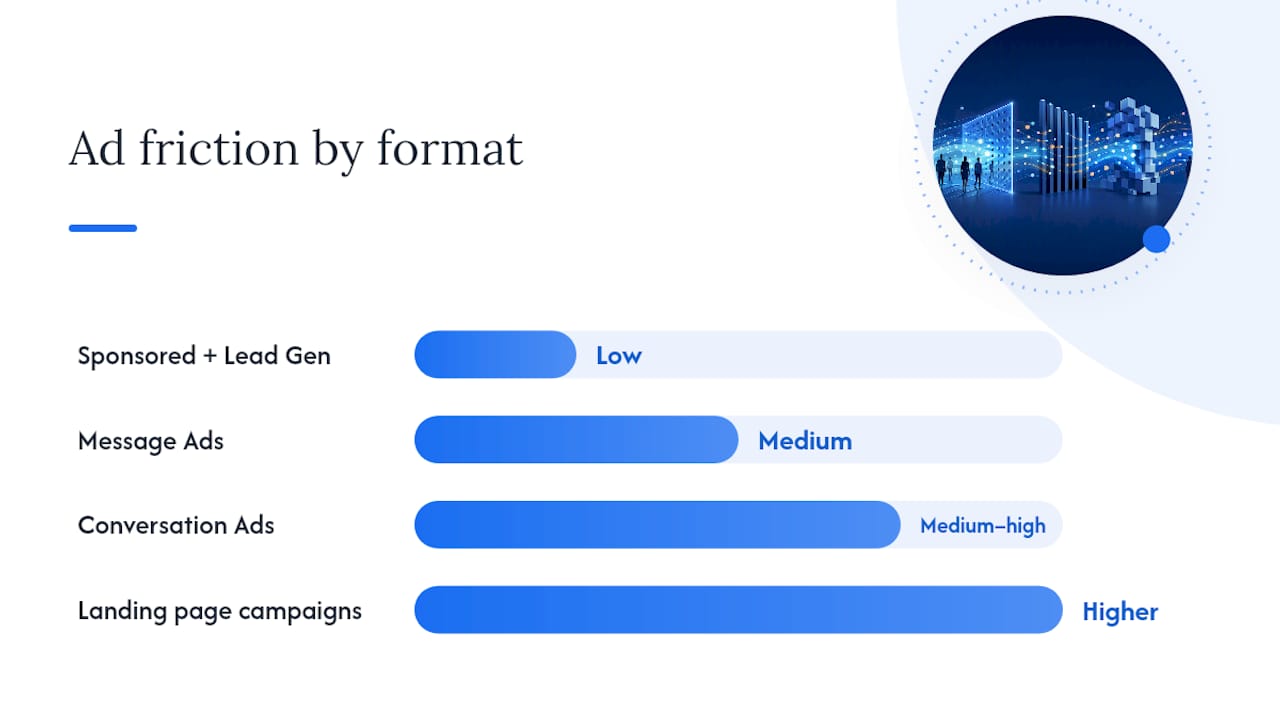
Paid and organic solve different problems, and the format you pick should match the commitment you're asking for. Sponsored Content paired with Lead Gen Forms works best for mid-funnel offers like a guide, webinar, or assessment, where the ask is low and volume matters. Message Ads and Conversation Ads work better for higher-touch offers like a demo request, since they land directly in an inbox and can carry a more personal tone.
| Ad format | Best for | Typical friction level |
|---|---|---|
| Sponsored Content + Lead Gen Forms | Content offers, webinar signups | Low |
| Message Ads | Direct demo asks, event invites | Medium |
| Conversation Ads | Multi-step qualification, interactive offers | Medium to high |
| Standard landing page campaigns | High-intent, branded searches | Higher |
Lead Gen Forms change the math because they pre-fill with a visitor's existing profile data, removing the friction of manual form entry. That pre-fill is why well-targeted campaigns can hit 30 to 40% submit rates, well above what a standard landing page typically achieves. Keep the form itself short: name, email, and one qualifying question is usually enough. Every additional field trades submission volume for a marginal gain in lead quality.
Budget expectations vary widely by industry and targeting precision, but a reasonable starting point for testing is $3,000 to $5,000 a month, enough to gather statistically useful data on which audience segments and creatives convert before scaling spend. Cost per lead can range from tens of dollars to several hundred depending on how narrow the targeting is and how competitive the offer's industry happens to be.
Pro Tip: Route every Lead Gen Form submission into your CRM within minutes, not hours. A form fill that sits unrouted overnight loses most of its urgency by morning.
Which Tools and Integrations Keep LinkedIn Outreach Scalable and Safe?
Five tool categories cover most of what a B2B team needs: prospecting, automation, enrichment, intent monitoring, and CRM sync. Each solves a distinct bottleneck, and trying to force one tool to cover all five is where most stacks break down.
- Prospecting and targeting: LinkedIn Sales Navigator for filtered search, Saved Searches, and lead alerts.
- Automation: Expandi for cloud-based connection and messaging sequences that mimic human timing patterns.
- Enrichment: dedicated contact databases that fill in verified emails and phone numbers once a LinkedIn connection converts to a lead, worth reviewing against options in this breakdown of B2B contact databases.
- Intent monitoring: platforms tracking buyer intent signals like content engagement and account-level research activity.
- CRM sync: HubSpot for native LinkedIn ad integrations, or Zapier and PhantomBuster for teams stitching together custom workflows across tools that don't talk to each other natively.
Automation tools accelerate volume, but they carry real platform risk without safe limits and human review built in. Stay under LinkedIn's informal daily thresholds, rotate message variations, and have a person spot-check automated sequences weekly rather than letting them run unsupervised for months.
- Capture the lead or connection inside LinkedIn or Sales Navigator.
- Enrich contact details through your chosen database or enrichment tool.
- Sync verified records into your CRM via a native integration or Zapier.
- Trigger a routing rule that assigns the lead to the right rep within minutes.
Pro Tip: Audit your automation tool's activity logs monthly. A sudden spike in connection requests, even one you didn't intend, is often the first sign an account is approaching a restriction.
How Do You Qualify and Route LinkedIn Leads into Meetings?
A LinkedIn lead is not automatically a qualified lead. Score every submission or reply against three factors: engagement signal strength (did they comment, download, or just accept a connection?), firmographic fit (does the company match your ICP?), and intent indicators (recent job change, hiring surge, competitor research activity).
- Score incoming leads on a simple scale, weighting firmographic fit above raw engagement.
- Route high-fit, high-intent leads directly to an AE for same-day outreach.
- Route mid-fit leads to an SDR for a nurture call within 48 hours.
- Route low-fit leads into a marketing nurture track rather than discarding them outright.
- Set a speed-to-lead SLA of under one hour for anything scored as high intent.
Ownership needs to be explicit before volume scales. Marketing typically owns Lead Gen Form submissions until they're scored; SDRs own outbound-sourced conversations from first reply through a booked meeting; AEs take over once a meeting is confirmed. Blurred ownership is the most common reason leads stall.
A workable nurture sequence looks like this: LinkedIn DM reply on day one, a follow-up email with a relevant case study on day three, a content touch (a relevant post or article) on day seven, and a call attempt on day ten if there's been no response. Space touches enough that they read as helpful persistence rather than pressure.

Pro Tip: Track time-to-first-response separately from time-to-meeting-booked. A slow first response kills more deals than a mediocre pitch ever will.
What KPIs Actually Prove LinkedIn Is Driving Pipeline?
Cost per lead tells you almost nothing on its own. Track it alongside conversion to meeting, meeting to opportunity, and total pipeline influenced, since a cheap lead that never books a meeting is more expensive than an costly one that closes.
| Metric | What it tells you | Reporting cadence |
|---|---|---|
| Cost per lead (CPL) | Efficiency of paid spend | Weekly |
| Lead to meeting rate | Quality of lead scoring and outreach | Biweekly |
| Meeting to opportunity rate | Sales team's qualification accuracy | Monthly |
| Pipeline influenced | Revenue impact of the channel | Monthly |
| Connection acceptance rate | Outreach relevance and targeting fit | Weekly |
Work backward from your numbers to set a realistic CPL ceiling. If your average deal size is $20,000, your win rate from meeting to close is 20%, and you need five meetings to produce one closed deal, then each meeting is worth roughly $800 in expected value. That tells you how much you can afford to pay per lead and still hit profitable pipeline math.
With Lead Gen Forms often convert at significantly higher rates than standard landing pages, a lower CPL there can still produce a strong meeting rate, which is why raw CPL comparisons across channels without conversion context are misleading. Build a shared dashboard that marketing and sales both check weekly, covering CPL, connection acceptance, meetings booked, and pipeline influenced side by side.
How Do You Structure a 90-Day LinkedIn Lead Gen Pilot?
Treat the first 90 days as a controlled test, not a full rollout. Each phase has its own deliverables and its own bar for whether to keep scaling.
- Days 0 to 30: Fix profiles and Company Page, build ICP segments and Saved Searches, launch signal-based outbound at low volume, and publish two to three posts a week.
- Days 31 to 60: Layer in a small paid test with Lead Gen Forms, refine messaging based on reply data, and begin tracking meeting-to-opportunity conversion.
- Days 61 to 90: Scale the outbound cadence that's working, increase paid budget on the best-performing audience segment, and formalize the nurture sequence with SLAs.
| Milestone | Target by day 30 | Target by day 90 |
|---|---|---|
| Connection acceptance rate | 30%+ on signal-based outreach | Sustained above 30% |
| Reply rate | 10%+ on first follow-up | 15%+ with refined messaging |
| Demo bookings | 2 to 3 from outbound | 8 to 10 combined outbound and paid |
| CPL (if running paid) | Establish baseline | Within budget model target |
A team running this kind of structured pilot benefits from the same operating discipline that goes into scaling an SDR function, which is where sales development consulting support tends to pay for itself fastest.
Pro Tip: Set your day-30 checkpoint as a go or no-go decision, not just a status update. If connection acceptance and reply rates aren't moving, fix messaging before adding budget.
Ready-to-Use Playbooks and Templates
Adapt these directly rather than building from scratch:
- Connection request: "Saw your post on [specific topic]. I work with teams facing that same challenge. Would love to connect."
- First follow-up: "Thanks for connecting. Quick question: how is your team currently handling [specific problem]?"
- Demo ask: "Based on what you shared, it sounds like [specific offer] could help. Worth a 15-minute call to see if it fits?"
- Confirm ad creative includes a specific outcome claim, not a vague benefit statement.
- Check that the audience size falls in a workable testing range before launch.
- Limit the Lead Gen Form to three fields maximum.
- Confirm a routing rule fires the moment a form submits.
A simple four-week content calendar: week one, an opinionated take on an industry pain point; week two, a carousel breaking down a framework; week three, a short video answering a common objection; week four, a case study or client result. Repeat with fresh specifics each month, and always alert your team to comment within the first hour of publishing.
Pro Tip: *Keep a shared document of every message template's reply rate.
Author Perspective: What Scaling Real SDR Teams Taught Me About LinkedIn
Most teams overinvest in volume and underinvest in sequencing. I've watched SDR programs pile on more connection requests instead of asking whether the timing and message quality were the actual problem. Signal-based outreach outperforms cold lists precisely because it fixes timing, not volume.
The trade-off nobody warns you about: intent-first prospecting takes more setup than list-buying, and it's slower to reach scale. It's worth the wait. If you want help resourcing this properly instead of guessing, that's exactly the kind of engagement I take on.
Get Hands-On Help Scaling Your LinkedIn Pipeline
Building this playbook is one thing. Resourcing it with the right people, sequencing, and measurement discipline is another, and that's the gap most in-house teams hit around month two. Chadburmeister brings 25 years of experience scaling SDR and BDR functions at companies like Informatica, RingCentral, and Cisco-WebEx directly into your pilot, so you're not rebuilding the wheel from a blog post.
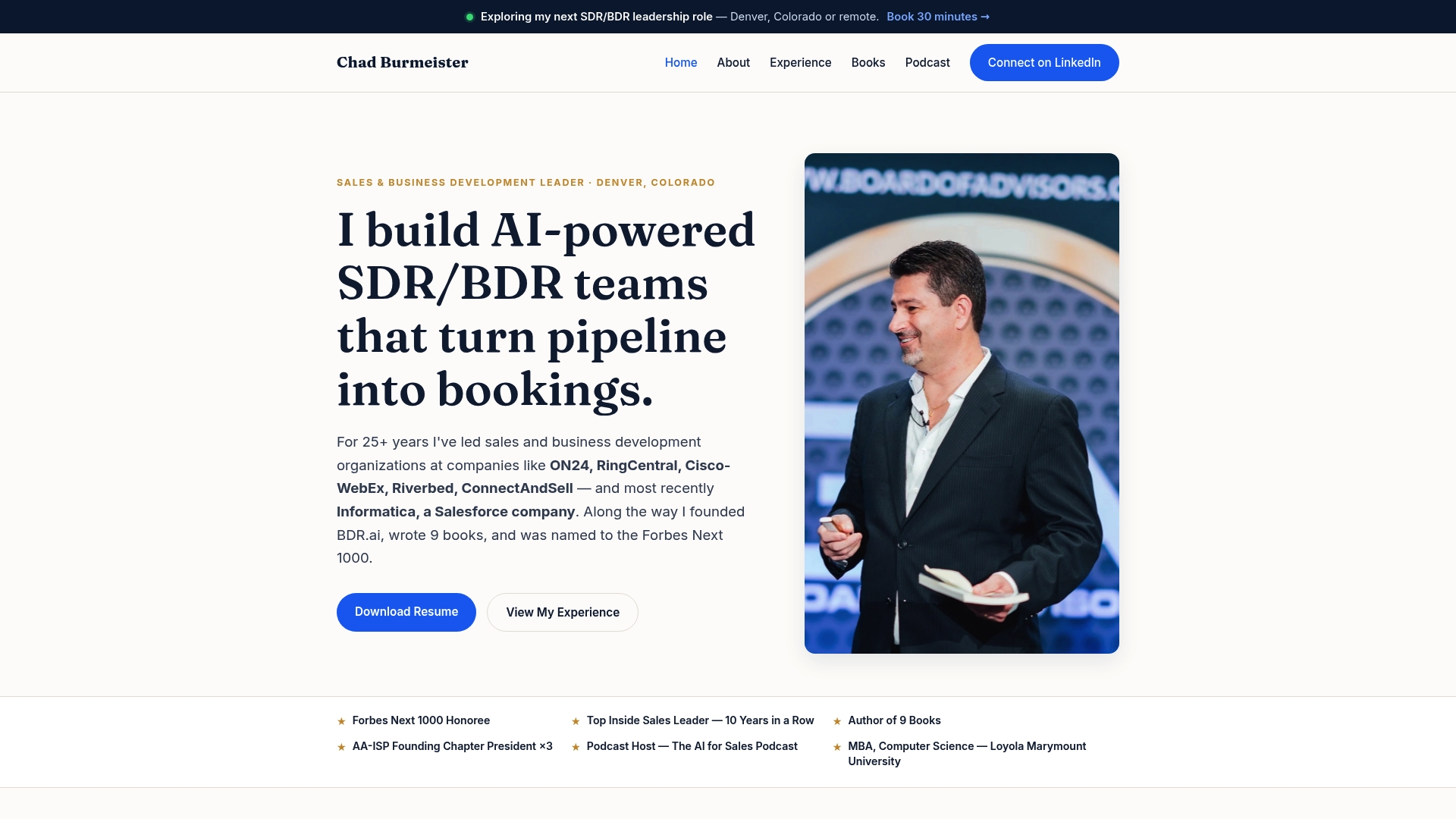
If your team needs a leader who's actually run this playbook at scale, not just read about it, book a consultation with Chad Burmeister to talk through your specific pipeline goals. For teams that want the tactical detail first, the book Mastering B2B Lead Generation with LinkedIn & AI walks through the same framework in far more depth, and The AI for Sales Podcast covers how AI tools are reshaping outbound sequencing in real time. Start with whichever format fits how you like to learn, then reach out when you're ready to put it into action.
Sources
- Lead Generation - Marketing Solutions - LinkedIn Business
- LinkedIn Lead Generation: The Complete B2B Playbook for 2026
- LinkedIn Lead Generation: The Complete Guide for B2B Companies in 2026 - Speedwork
- How to Generate B2B Leads on LinkedIn in 2026 | LinkedNav