
What are LinkedIn voice messages, and why do they matter?
LinkedIn voice messages are short audio clips up to 60 seconds sent directly through the LinkedIn mobile app to first-degree connections. That single constraint, first-degree only, is worth sitting with. You cannot cold-voice-message a stranger. The feature is designed for people who already share a connection, which actually makes it more powerful, not less.
Here is what makes them worth your attention:
- Personal connection at scale. Voice carries tone, warmth, and personality that text simply cannot fake. A well-delivered 45-second message communicates more humanity than three paragraphs of carefully edited prose.
- They stand out. Most LinkedIn inboxes are packed with copy-paste InMails. A voice note is still rare enough to stop someone mid-scroll.
- Low pressure for the recipient. Recipients can listen when convenient and respond on their own terms, which makes the channel feel less intrusive than a cold call.
- Strong engagement benchmarks. Warm outreach via voice messages tends to produce a significant listen rate and a notable reply rate, with a good portion of those replies converting to calls within two weeks.
Technical requirements to know upfront:
- Recording is mobile-only (iOS or Android). Desktop users can listen but cannot record natively.
- Maximum duration is 60 seconds per message.
- Only available to first-degree connections or inside group chats.
- Desktop workarounds exist for professionals who prefer not to switch devices: record externally and attach, or use a third-party tool integrated with LinkedIn.
Table of Contents
- When should you actually send a LinkedIn voice message?
- Common mistakes to avoid with LinkedIn voice messages
- Voice message templates for real networking scenarios
- The case for voice messaging, from someone who has built pipelines with it
- Key Takeaways
- Why voice messaging rewards the professionals who commit to it
When should you actually send a LinkedIn voice message?
The single biggest mistake professionals make is treating voice messages like a cold outreach channel. They are not. Sending voice notes to cold contacts feels presumptuous and often triggers defensive reactions. Voice demands active listening, and strangers did not sign up for that.
Use voice messaging strategically:
- After a connection accepts your request. Wait 24–48 hours before sending a voice note. Let the connection breathe before you ask for attention.
- Following prior engagement. If someone liked your post, commented on your content, or replied to a text message, a voice note is a natural next step.
- As a follow-up to a missed call or meeting. Voice bridges the gap between "we talked" and "let's talk again" better than a text ever will.
- To congratulate or acknowledge a milestone. A promotion, a company announcement, a published article. These moments are made for voice.
Privacy note: LinkedIn voice messages are stored within the conversation thread. Treat them like any professional communication. Avoid sharing sensitive information, pricing details, or anything you would not want screenshotted and shared.
Pro Tip: Send a brief text message within five minutes of your voice note. Something like "Just sent you a quick voice message — curious to hear your thoughts." Dual-format outreach accommodates different listening habits and meaningfully increases the chance your audio actually gets played.
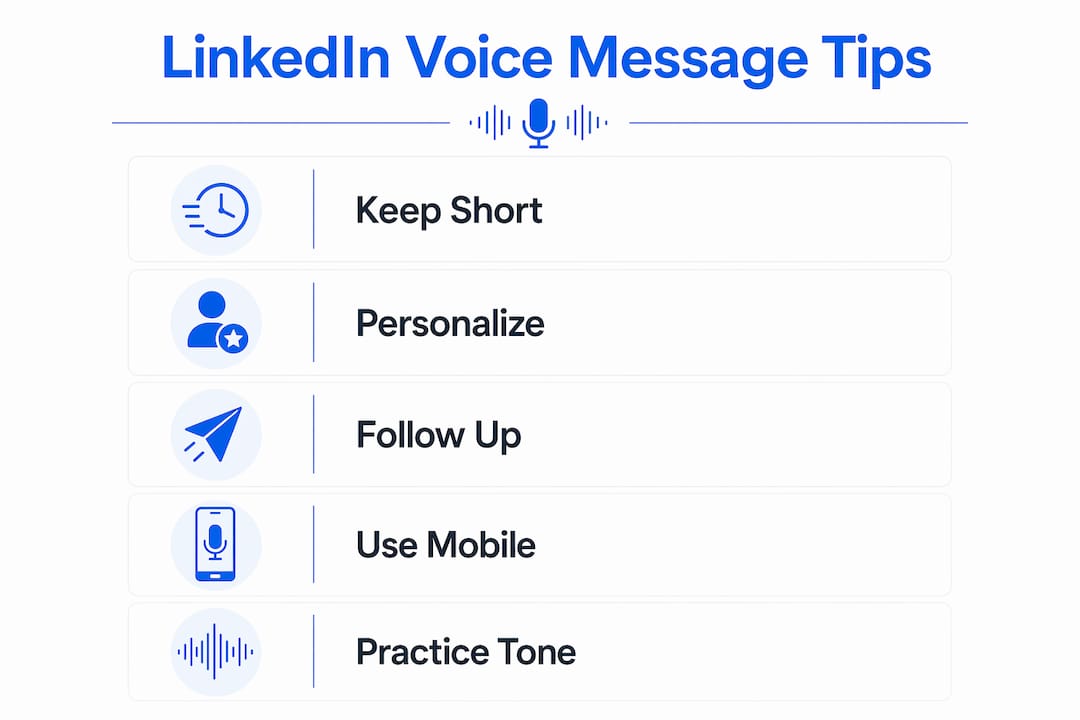
Keep your LinkedIn voice messages between 30–45 seconds for optimal engagement. This length delivers enough substance while holding attention, in line with recent best-practices benchmarks.
Common mistakes to avoid with LinkedIn voice messages
Even professionals who understand the format fall into predictable traps. Here is a checklist worth reviewing before you build voice messaging into your outreach:
- Cold outreach via voice. If they do not know you, do not do it. Use voice for warm leads only.
- Rambling past 45 seconds. Messages longer than 45 seconds tend to lose attention quickly. Edit before you record, not after.
- Sounding scripted. Over-rehearsed messages feel like a robocall with better audio quality. Aim for conversational, not polished.
- Generic openers. "Hey, I came across your profile and thought I'd reach out" is the text equivalent of a mass email. Reference something specific or do not send it.
- No clear call to action. Every message needs one ask, and it should be easy to say yes to.
- Sending to non-connections. LinkedIn will not allow it, but attempting workarounds damages your account reputation.
- Ignoring follow-up. A voice note with no follow-up strategy is a missed opportunity. Track who listened, who replied, and who went quiet.
- Ignoring channel preference. Some people simply do not like audio messages. If a contact consistently responds to text and ignores voice, respect that signal.
Best practices checklist:
- ✅ Warm contact only
- ✅ Personalized opener with a specific reference
- ✅ 30–45 seconds, no longer
- ✅ Conversational tone, smile during recording
- ✅ One soft-close call to action
- ✅ Text follow-up within five minutes
- ✅ Track listen and reply rates over time
Voice message templates for real networking scenarios
These are starting points. Adapt the specifics every time.
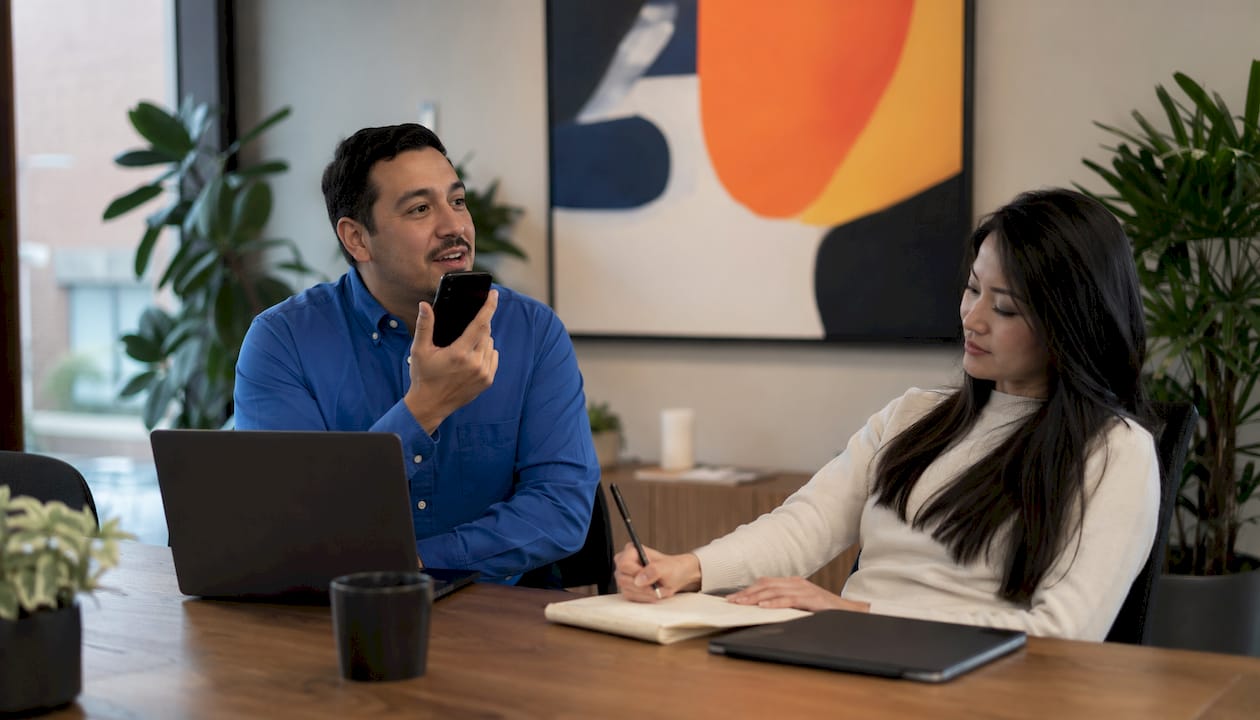
After a new connection accepts: "Hey [Name], thanks for connecting. I noticed you're leading sales ops at [Company] and saw your recent post on pipeline forecasting. I had a thought on that I think you'd find useful. Mind if I share it? Happy to keep it brief."
Following a missed call or meeting: "Hey [Name], sorry we missed each other earlier. I wanted to follow up with a quick thought on [topic we discussed]. No rush on your end, but I'd love to pick up where we left off when you have a few minutes."
Congratulating a milestone: "Hey [Name], just saw the announcement about your promotion to VP. That is a big deal, and clearly well-earned. I'd love to hear how the new role is shaping up when you come up for air."
Re-engaging a quiet connection: "Hey [Name], it's been a while. I came across [specific article or post] and immediately thought of a conversation we had a few months back. Wanted to share it and see how things are going on your end."
Each template follows the same logic: name the person, reference something real, make a low-friction ask. The words change; the structure holds.
The case for voice messaging, from someone who has built pipelines with it
Voice messaging is not a novelty tactic. It is a signal about how you communicate.
Most sales professionals, including SDRs in Colorado and across the country, are sending the same InMails, the same follow-up sequences, the same templated connection requests. Voice breaks that pattern not because it is flashy but because it is human. You cannot fake warmth in 40 seconds. Either you did your homework and you care about the person you are reaching out to, or it is obvious you did not.
Chad Burmeister, author of Mastering B2B Lead Generation with LinkedIn & AI and host of The AI for Sales Podcast, has spent over 25 years building high-performance sales teams at companies like RingCentral and Cisco-WebEx. The consistent thread across that career: relationships close deals, not tools. Voice messaging is valuable precisely because it forces brevity and personalization simultaneously. You have 60 seconds. You cannot ramble. You cannot be generic. That constraint is a feature.
The professionals who get the most out of LinkedIn audio messages are the ones who treat it as one layer of a broader outreach strategy, not a silver bullet. Pair it with a strong LinkedIn profile, a clear value proposition, and consistent follow-up. Track your listen rates and reply rates the same way you track email open rates. Iterate.
If you want to go deeper on modern prospecting and AI-enhanced sales strategy, Chad's published playbooks cover exactly this territory, with frameworks built for SDR teams and founders who need pipeline growth, not theory.
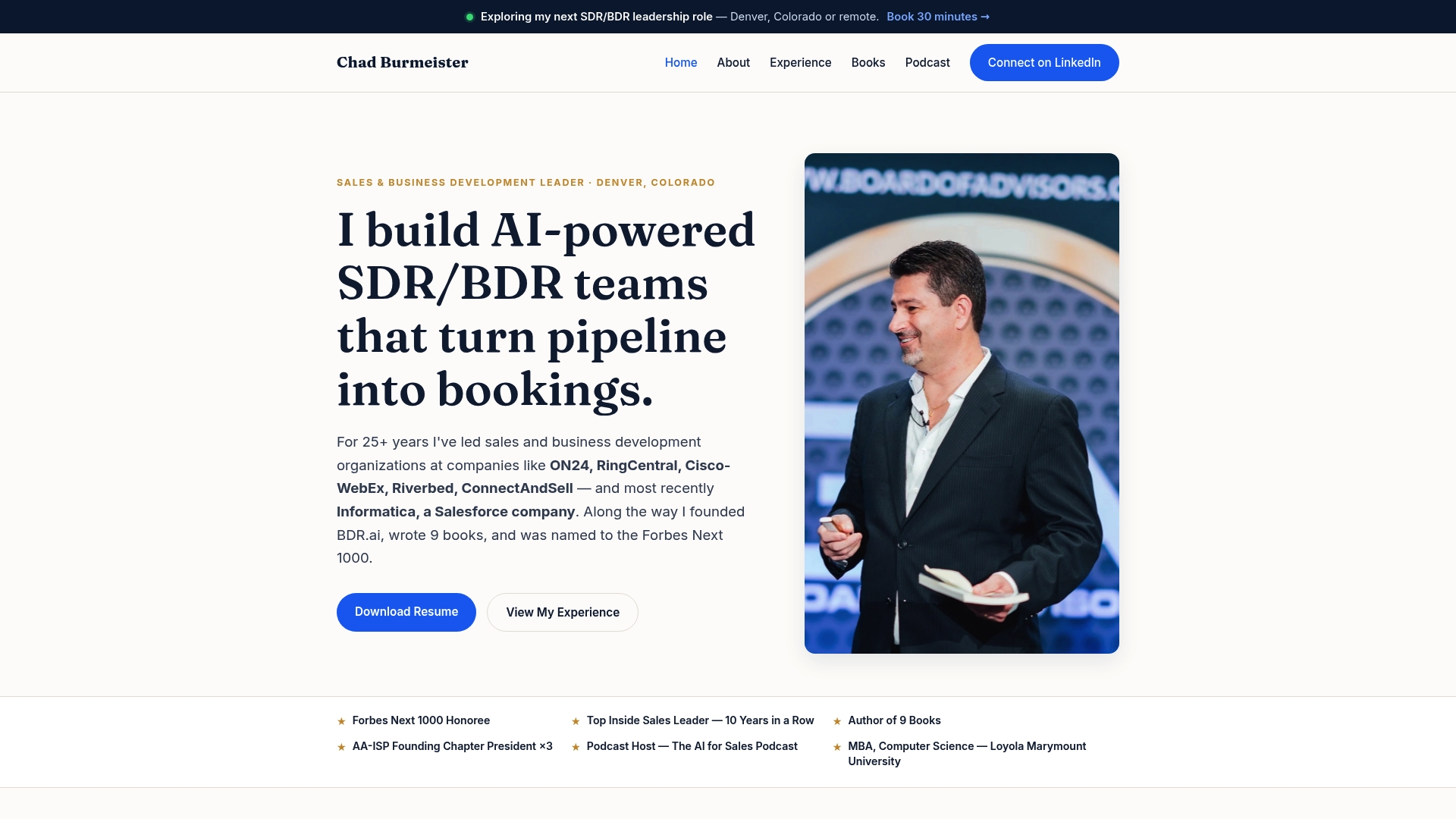
Explore Chad's sales leadership work and see how these strategies translate into real pipeline results for B2B teams.
Key Takeaways
LinkedIn voice messages work best as a warm-contact tool within a multi-step sequence, combining personalization, brevity, and a text follow-up to drive a 40–55% listen rate and 18–28% reply rate.
| Point | Details |
|---|---|
| Mobile-only recording | Voice messages require the LinkedIn mobile app; desktop users must use workarounds or third-party tools. |
| Warm contacts only | Sending voice notes to cold contacts feels invasive and drops response rates significantly. |
| Optimal message length | Keep messages between 30–45 seconds for best results; longer messages lose attention quickly. |
| Follow up within five minutes | A brief text sent right after the voice note doubles the chance the audio gets played. |
| Personalization is non-negotiable | Openers lacking a specific reference drop reply rates below 12%; personalized hooks drive the 18–28% benchmark. |
Why voice messaging rewards the professionals who commit to it
The professionals who dismiss LinkedIn voice messages usually do so after one or two awkward attempts that felt unnatural. That reaction is understandable and also exactly wrong. The first few recordings are supposed to feel uncomfortable. You are learning to communicate in a format that strips away the safety net of editing and revision.
What the data actually shows is that tone and enthusiasm are the primary drivers of whether a voice message earns a reply. Not the script. Not the offer. The energy you bring to a 40-second recording is the thing that makes someone stop, listen again, and write back. That is a skill, and like every skill in sales, it compounds with practice.
The professionals building the strongest pipelines right now are not the ones with the best templates. They are the ones willing to pick up the phone, or in this case, the microphone, and sound like a real person.