Value-based selling means anchoring every sales conversation to a buyer's measurable outcomes, cost savings, time savings, risk reduction, or revenue gains, rather than product features or a generic solution pitch. Do it well and price stops being a sticking point because you've already proven the return. This guide gives you the framework, the discovery questions, the objection handling, and the metrics to run it deal by deal.
TL;DR:
- Requiring a quantified business case before moving past the discovery stage increases deal quality and improves the likelihood of closing at higher prices.
- Building the ROI model collaboratively with the buyer enhances trust, adoption, and future renewal rates, especially in enterprise deals.
- Validating actual post-sale outcomes within 90 days creates credible proof points that strengthen future value-based pitches.
- Focused discovery questions that uncover hidden costs, risks, and delays in the buyer’s processes produce more trustworthy, defendable numbers.
- Tracking metrics such as win rate, deal size, sales cycle length, and post-sale ROI proves whether value-based selling initiatives are effectively shifting focus from features to outcomes.
Table of Contents
- What Is Value-Based Selling, Really?
- The Core Principles Behind Selling with Integrity
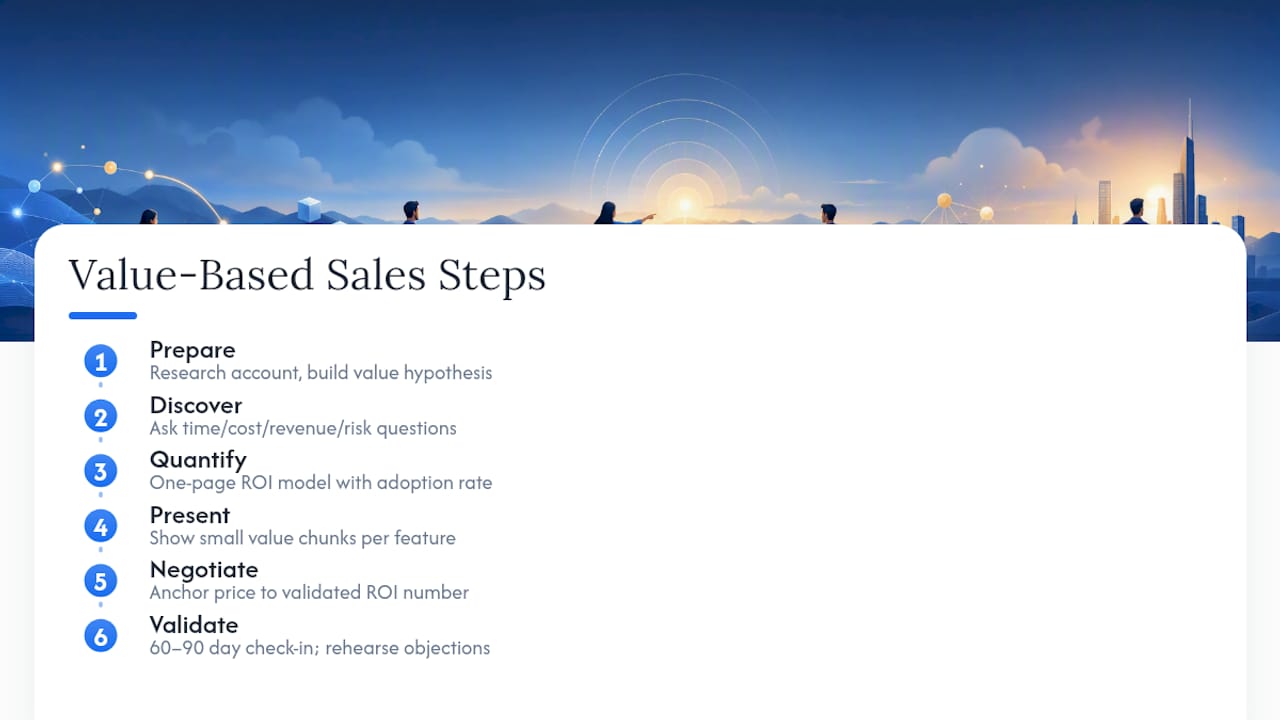
- How Do You Run a Value-Based Sales Process Step by Step?
- What Discovery Questions Produce Numbers Buyers Actually Trust?
- Handling Objections Without Abandoning the Value Conversation
- Which Metrics Prove Your Value-Based Sales Motion Is Working?
- How Chad Burmeister Applies Value Selling in Real Sales Teams
- Why Selling on Value Is the More Honest Way to Sell
- Sources
- FAQ
What Is Value-Based Selling, Really?
Value-based selling is a conversation built around what the buyer actually gets: lower costs, faster cycle times, reduced risk, or a real edge over competitors. It's not about listing what your product does. It's about proving what happens to the buyer's numbers once they own it. Salesforce's research on value selling frames this as centering deals on measurable outcomes and treating price as an investment against those outcomes, not a cost to be minimized.
That distinction separates it from two approaches most reps default to:
- Feature-based selling leads with specs and capabilities. It works when buyers already know exactly what they want and are comparing checklists.
- Solution-based selling packages features into a bundle that solves a stated problem. It works when the buyer has identified the problem but hasn't quantified its cost.
- Value-based selling goes a step further. It quantifies the cost of the problem, ties your offering to closing that gap, and lets the buyer’s own numbers make the case.
MIT Sloan's research on value-based sales adds a layer most sales training skips: selling value works best when the seller and buyer co-create the business case together instead of the seller simply calculating benefits and presenting them. That collaboration, not just the math, is what makes buying committees trust the number enough to act on it.
The Core Principles Behind Selling with Integrity
Principle-based selling isn't a soft skill add-on. It's a set of disciplined behaviors that change what happens in the room, and each one has a concrete tell you can spot in a real call.
- Buyer outcomes come before your pitch. Before you talk about your product, you should be able to state the buyer's target metric in their own language. A rep who opens a demo with "let me show you what we built" instead of "let's confirm the $400,000 in freight costs we're targeting" has skipped this step.
- Discovery goes deeper than surface pain. Surface pain is "our onboarding takes too long." Deep discovery gets to "onboarding delays cost us three enterprise renewals last year." One question, asked with patience, usually separates the two.
- Quantify in the buyer's units, not yours. Salesforce's guidance on value selling stresses converting benefits into the buyer's specific currency, hours regained, dollars saved, revenue uplift, never a vendor-centric metric like "40% faster processing."
- Co-create the business case. MIT Sloan's research found that sellers who build the ROI model alongside the buyer, rather than handing over a finished spreadsheet, see better adoption and stronger renewal numbers later.
- Frame price as investment, not cost. Once the ROI is buyer-validated, the price conversation becomes a return conversation: "This costs $80,000 and returns $310,000 in year one," not "here's our list price."
- Validate after the sale. Go back 90 days post-close and measure the actual result against the promised one. That data becomes your next deal's proof point.
Pro Tip: In manager role-plays, ban the phrase "our platform." Force reps to open every practice pitch with a number tied to the buyer's business. If they can't produce one, discovery wasn't deep enough yet, and that's the real lesson of the drill.
How Do You Run a Value-Based Sales Process Step by Step?
Selling on value follows a repeatable sequence, and skipping a stage is usually why deals stall in "still evaluating" purgatory.
Prepare. Research the account's public financials, recent earnings calls, job postings, and industry benchmarks before the first call. Build a hypothesis: "We think this account loses roughly 15 hours per week to manual reconciliation." Tools like the engagement platforms CROs rely on can surface signal data that sharpens this hypothesis before you ever pick up the phone.
Discover. Ask structured, open-ended questions mapped to time, cost, revenue, and risk. Don't just ask "what's your budget." Ask "what does a one-week delay in this process cost your team." HubSpot's framework on value-based selling recommends building a repeatable discovery template so every rep asks the same core questions in the same order, which makes the resulting data comparable across deals.
Quantify. Build a simple model, current cost or lost revenue, minus projected cost or revenue after your solution, times a realistic adoption rate. Keep it in one page. Complexity kills credibility.
Present. Break the ROI story into small "value chunks," each feature tied to a specific dollar or hour outcome, so the buyer can follow and challenge each assumption individually rather than accepting or rejecting one giant number.
Deals where price is presented as return on investment see fewer discount requests and faster committee alignment, according to Outsales' analysis of value-based selling outcomes. That's the practical payoff of doing the math before you get to the negotiating table.
Negotiate. Anchor every price conversation back to the validated ROI number. If procurement pushes on price, ask what specifically changed about the value calculation, not the number.
Validate. Schedule a 60 to 90 day check-in to measure actual results. This is also where you rehearse: managers should run mock objections ("we can build this ourselves," "we don't have budget until Q3") in weekly call reviews, not just at kickoff.
For enterprise deals with multiple stakeholders, the 90-day C-suite selling playbook is worth reviewing before you present the ROI story to an executive sponsor who wasn't in the discovery calls.
What Discovery Questions Produce Numbers Buyers Actually Trust?
The gap between a number that gets accepted and one that gets argued down usually comes from how it was sourced, not how it was calculated.
- Time bucket: "Walk me through how this task gets done today, step by step, and how many people touch it." This surfaces hidden hours a generic "how long does this take" question misses.
- Cost bucket: "What's the fully loaded cost of the team running this process, including overhead?" Get finance on the call if the rep can't answer with confidence.
- Revenue bucket: "Where have delays or errors in this process cost you a deal, renewal, or upsell?" Real anecdotes here beat estimated percentages.
- Risk bucket: "What's happened the last time this process failed, and what did it cost to fix?" Compliance and security stakeholders usually have a specific incident in mind.
Validation matters as much as collection. Cross-check buyer estimates against public benchmarks for their industry, and where possible, get a short confirmation call with someone in finance or operations, not just the champion who's excited about your product. Present your assumptions openly, including a low, mid, and high case, so the buyer sees you're not hiding behind a single optimistic number.
Pro Tip: Ask the champion directly, "If your CFO challenged this number, what would they push back on?" It surfaces the weak point in your model before procurement finds it for you.
Handling Objections Without Abandoning the Value Conversation
Objections on value deals tend to cluster into a handful of predictable shapes.
- "It's too expensive." Re-anchor to the ROI number already validated in discovery: "Compared to the $310,000 impact we calculated together, this is a 3.9x return in year one."
- "We can build this ourselves." Ask what the fully loaded cost of that build is, including opportunity cost of the engineering time diverted from other priorities. Most buyers haven't run that math.
- "We don't have budget until next quarter." Use cost-of-delay math: "Every month this waits costs roughly $26,000 based on the numbers we built together. That's the real price of waiting."
- "Procurement wants a lower price." Ask what specifically changed in the value calculation. If nothing did, the conversation isn't really about price.
Not every buyer will engage with a value conversation. If a prospect refuses to share numbers, won't involve finance or ops in validation, or treats every question as a stalling tactic, that's a signal to qualify them out rather than keep discounting to close.
Which Metrics Prove Your Value-Based Sales Motion Is Working?
Track these across a quarter, not a single deal, to see whether the motion is actually changing outcomes:
| Metric | What it tells you |
|---|---|
| Win rate | Whether quantified ROI stories close more often than feature pitches |
| Average deal size | Whether value framing supports higher pricing without pushback |
| Sales cycle length | Whether a validated business case speeds up committee approval |
| Discount rate | Whether reps are still negotiating on price instead of value |
| Realized ROI (post-sale) | Whether promised outcomes actually materialized |
| Retention/expansion rate | Whether the value delivered supports renewal and upsell |
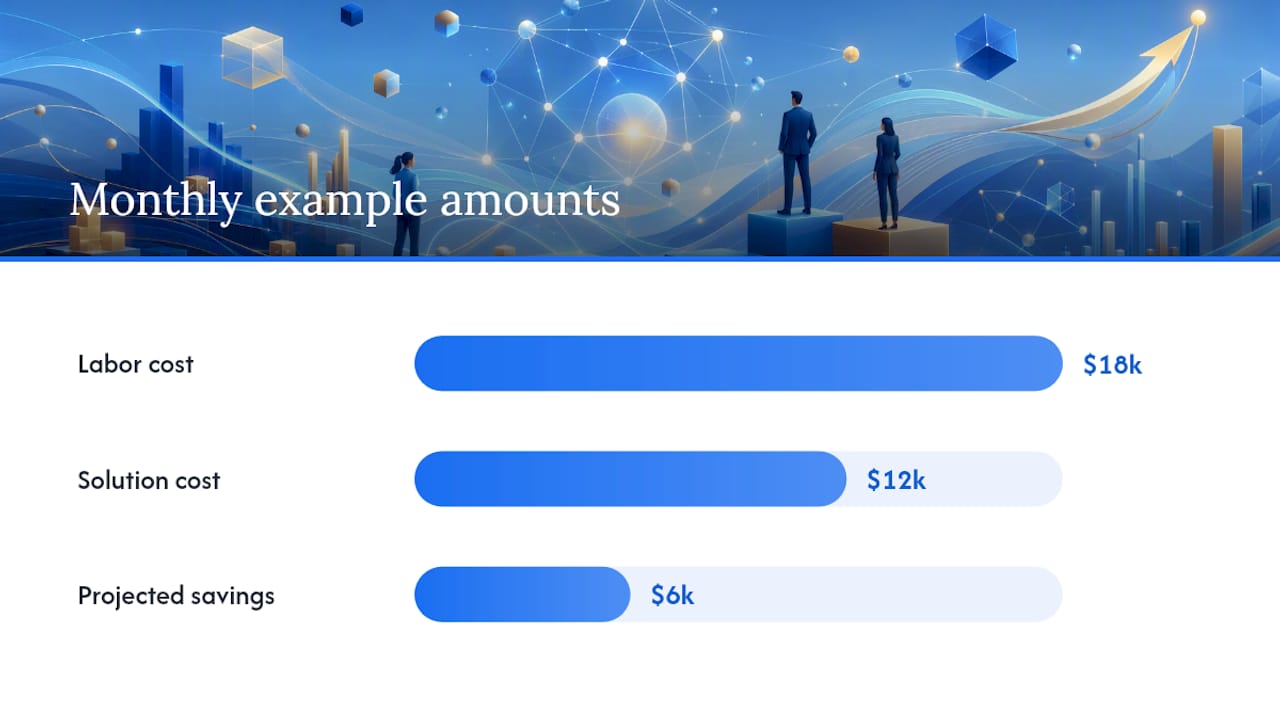
A simple worked example: a rep quantifies $18,000 per month in labor cost tied to a manual process. The proposed solution costs $12,000 per month. Projected monthly savings land at $6,000, or $72,000 annually, a straightforward return once adoption is factored in. Run a sensitivity check by cutting the projected savings by 30% to account for slower-than-expected adoption. If the deal still returns positive ROI at that reduced number, it's a defensible pitch. If it doesn't, the model was too optimistic before it ever reached the buyer.
Build a proof-point library from every validated post-sale outcome. Six months of real, measured results beats any hypothetical ROI slide you could build from scratch.
How Chad Burmeister Applies Value Selling in Real Sales Teams
Running SDR and BDR teams for companies like Informatica, RingCentral, and Cisco WebEx over a 25-plus year career taught one lesson repeatedly: reps who ask better discovery questions close more, and reps who skip discovery lean on discounts to compensate. That pattern shows up in call reviews long before it shows up in the pipeline report.
In practice, that means requiring a quantified business case, however rough, before a deal moves past the second call. Managers reviewing recorded calls should listen for one specific thing: did the rep get a number in the buyer's own words, or did the rep supply the number for them? The first builds a business case the buyer will defend internally. The second builds a business case the rep has to defend alone.
For the full frameworks behind this approach, including AI-driven pipeline tactics, see the published playbooks on value-based and AI-enabled selling.
Why Selling on Value Is the More Honest Way to Sell
Value-based selling works because it forces alignment between what the customer needs and what the rep gets paid to close. When the business case is real, the customer's success and the seller's revenue move in the same direction instead of fighting each other at the negotiating table.
The one change worth making this week: require a quantified business case, even a rough one, for every opportunity above your average deal size before it advances past discovery. Then measure realized outcomes at 90 days, not just activity metrics like calls made or demos booked. Activity tells you effort. Realized ROI tells you whether the deal was ever real.
— Chad
Sources
For deeper frameworks, MIT Sloan's research on value-based sales covers buyer co-creation and adoption. Salesforce's value selling guide breaks down outcome-based quantification. HubSpot's principles of value-based selling offers enablement templates. Outsales' knowledge hub covers discounting and credibility. For ethical framing, Sharon Morgen's book Selling with Integrity remains a foundational text on principle-based sales.
- Acing Value-Based Sales - MIT Sloan Management Review
- What is value selling? Techniques & Examples | Salesforce
- 7 Key Principles of Value-Based Selling — HubSpot
- Value-Based Selling: Selling Outcomes, Not Features | Outsales
FAQ
What is an example of a value-based approach?
A vendor quantifies that a buyer loses $18,000 monthly to a manual process, proposes a $12,000 solution, and builds the ROI case together with the buyer's finance team rather than presenting a finished pitch deck.
What's the difference between value-based and solution-based selling?
Solution-based selling packages features around a stated problem; value-based selling goes further by quantifying that problem's cost in dollars, hours, or risk and tying the price directly to a measurable return.
What is an example of value-added selling?
Value-added selling includes an extra benefit alongside the core product, like free onboarding support, whereas value-based selling quantifies and sells the outcome itself, such as the labor hours or revenue that outcome protects or creates.
What is Miller Heiman value-based selling?
Miller Heiman's sales methodologies emphasize understanding buyer roles and decision criteria within complex committees; when applied to value selling, that means mapping quantified outcomes to each stakeholder's specific priorities rather than pitching one generic ROI story to the whole group.