You can run high-performing outbound cold-call programs that stay TCPA-aware by combining tight ICPs, verified direct-dial data, a compliance-first dialer, and a focused multichannel cadence. It takes a defined targeting model, real number hygiene, and a dialer configured for timezone-aware windows and opt-out logging. Chad Burmeister's approach treats this as an operational build, not a legal debate.
TL;DR:
- Verify and scrub direct-dial numbers against Do Not Call lists and manually sample-check a subset before launching campaigns to prevent performance drops.
- Configure the dialer for compliance features like timezone-aware calling, automatic DNC scrubbing, and opt-out logging before making any calls.
- Focus on building effective openers tied to specific triggers and follow a strict call and qualification rhythm to maximize engagement.
- Track key metrics such as dial-to-connect rate and connect-to-meeting rate weekly to identify and fix data quality, timing, or coaching issues.
- Prioritize fixing data and dialer compliance first; script optimization alone cannot recover poor connection and engagement rates.
Table of Contents
- What Does a TCPA-Compliant Cold-Calling Playbook Look Like?
- What Should a Cold-Call Opener Actually Sound Like?
- Operations and Compliance Checklist Before You Launch a Campaign
- How Do You Know If Your Cold-Calling Program Is Actually Working?
- What Chad Burmeister's Field Experience Says About Fixing Outbound Programs
- Why Most Cold-Calling Advice Gets the Order Backwards
- How Chad Burmeister Helps Sales Leaders Implement This Playbook
- Sources
What Does a TCPA-Compliant Cold-Calling Playbook Look Like?
Most sales leaders treat compliance as a legal afterthought bolted onto a script. That's backwards. The teams that scale outbound calling without burning their number reputation or their reps' time build compliance into the platform first, then layer targeting and messaging on top. Here's the seven-step sequence that works.
1. Define the ICP with trigger events and disqualifiers. Score accounts on firmographic fit plus timing signals like recent funding, a new VP hire, or a tech stack change. Disqualify accounts on a suppression list or in the wrong vertical before a single dial happens.
2. Source and verify direct-dial numbers. Cheap, unverified data is the single biggest reason connect rates collapse. Verified direct-dial numbers paired with tight account selection consistently outperform larger, dirtier lists. Scrub every list against the national and state Do Not Call registries before load, and manually spot-check a sample of records to catch stale or mis-enriched numbers.
3. Configure a compliance-first dialer. This is the platform decision that determines your risk exposure. Require timezone-aware calling windows, automatic DNC scrubbing, STIR/SHAKEN attestation, opt-out logging, and recording disclosure where applicable. These four features are treated as baseline requirements for any large-scale outbound program, not optional add-ons.
4. Build a short opener, a permission question, and a discovery question bank. Reps should never improvise the first fifteen seconds of a call.
5. Design the cadence. Front-load 3 to 5 call attempts inside an 8 to 12 touch multichannel sequence that blends calls, email, and LinkedIn. Set explicit rules for when voicemail gets left.
6. Log every call in the CRM and follow up fast. Send a personalized email referencing the call notes within 24 hours. Speed here correlates directly with reply rates.
7. Run a coaching loop and refresh the list continuously. Weekly call reviews and a recurring data-refresh cadence keep both the script and the list from decaying.
Steps 2 and 3 do the heaviest lifting. A rep with a great script working a dirty list or a non-compliant dialer will still underperform a mediocre script running on clean data and a properly configured platform.
- Score and disqualify accounts before list-building
- Verify and scrub numbers, then sample-check manually
- Configure the dialer for compliance before launch
- Build opener, discovery bank, and cadence rules
- Log calls and follow up inside 24 hours
- Coach weekly and refresh lists on a fixed schedule
Pro Tip: Sample-verify a small slice of any new list manually before you dial the full batch. Enrichment tools make mistakes quietly, and a five-minute manual check catches problems a full campaign launch would expose the hard way.
What Should a Cold-Call Opener Actually Sound Like?
The best openers do two things in the first ten seconds: they give the prospect a specific, account-relevant reason for the call, and they ask permission to keep talking. That combination is what earns a pause instead of a hang-up, because it signals the rep did homework instead of dialing a random list.
Three examples tied to common triggers:
- Funding trigger: "Hi [Name], this is [Rep] with [Company]. I saw you closed your Series B last month. Companies at that stage usually hit a specific bottleneck in [process] within about 90 days. Got 60 seconds for me to explain why I'm calling?"
- New hire trigger: "Hi [Name], [Rep] here from [Company]. Congrats on the new VP of Sales role. I work with a lot of new sales leaders in their first quarter, and I have a quick question about how you're approaching [specific area]. Is now an okay time?"
- Tech change trigger: "Hi [Name], this is [Rep] with [Company]. I noticed [Prospect Company] recently adopted [tool/platform]. That usually creates a gap around [related process]. Mind if I ask you one question about that?"
Once permission is granted, keep the call to 90 to 120 seconds and move through a tight rhythm: one broad diagnostic question, one qualifying question, then a soft close. A few reliable diagnostic questions:
- "What's driving the timing on [initiative] right now?"
- "Who else is involved in evaluating this internally?"
- "What's working fine, and what's actually broken?"
- "If nothing changes in the next two quarters, what happens?"
Close soft, not hard: "Based on what you just told me, it sounds worth a 20-minute call with specialist/AM]. I've got Tuesday at 10 or Thursday at 2. Which works better?" That structure alone reflects the opener design behind most modern cold-call frameworks built for B2B motions. Reps who [rehearse specific lines tied to real triggers consistently book more time than reps working from a generic template.
Operations and Compliance Checklist Before You Launch a Campaign
Sales ops owns this list, and it should run before every new campaign, not just once at platform setup.
Dialer requirements to verify:
- DNC scrubbing runs automatically against the current suppression list
- Calling windows are timezone-aware and blocked outside allowed hours
- STIR/SHAKEN attestation is active on outbound numbers
- Number rotation is configured to protect caller ID reputation
- Opt-out requests are logged and enforced platform-wide, not tracked manually by reps
- Recording disclosure triggers automatically where call recording is enabled
Data hygiene steps:
- Verify phone numbers at the source, not after a campaign stalls
- Set a fixed list-refresh cadence, not an ad hoc one
- Manually sample-check a slice of any new list before full deployment
- Map state-specific consent and calling-hour rules into the dialer configuration rather than relying on reps to remember them
Campaign controls: disable automated voicemail "drop" features and avoid synthetic outbound voice. Both practices reduce callback rates and can introduce legal exposure depending on the state. Document express consent wherever it exists in your data, since that changes what's permissible for a given contact.
STIR/SHAKEN attestation along with number rotation and local-presence dialing helps improve carrier trust and connect rates over a matter of weeks. as carriers relearn that your numbers are legitimate. That rehab period matters most right after a number gets flagged, and most teams underestimate how long it takes to recover.
Pro Tip: Treat compliance as a platform configuration project owned by ops, not a policy every rep has to remember and apply consistently on their own.
How Do You Know If Your Cold-Calling Program Is Actually Working?
Five numbers tell you almost everything: dials per day, dial-to-connect rate, connect-to-meeting rate, meeting show rate, and dials-per-meeting. Dial-to-connect rate exposes data or timing problems, connect-to-meeting rate exposes conversation quality, and dials-per-meeting is the bottom-line efficiency number worth optimizing above the rest.
A quick troubleshooting flow:
- Low dial-to-connect rate → check list quality and calling-window timing first
- Decent connects but weak conversion → the opener or qualifying questions need coaching
- Meetings booked but low show rate → fix calendar confirmation and reminder process, not the script
Review these weekly at the rep level and monthly at the program level, with sales ops owning data integrity and the sales manager owning coaching against the numbers.
What Chad Burmeister's Field Experience Says About Fixing Outbound Programs
The three highest-ROI interventions, in order: fix the list, coach the opener, then validate dialer compliance. Most teams do it backwards, spending weeks rewriting scripts when the real problem sits in the data feeding the dialer.
In coaching sessions, listen for tone and pace in the first ten seconds, a clear one-line reason for the call, and whether the rep actually follows the diagnostic-then-qualifying-then-close question sequence instead of freelancing.
A team stuck at a 4% connect rate usually isn't failing because of the script. It's failing because nobody verified the list in 90 days and the dialer's calling window was still set to the wrong timezone. Fix those two things before touching a single word of the opener.
Why Most Cold-Calling Advice Gets the Order Backwards
Most outbound advice starts with the script. That's the wrong entry point. The data comes first, the dialer configuration comes second, and the script is genuinely the third lever, not the first.
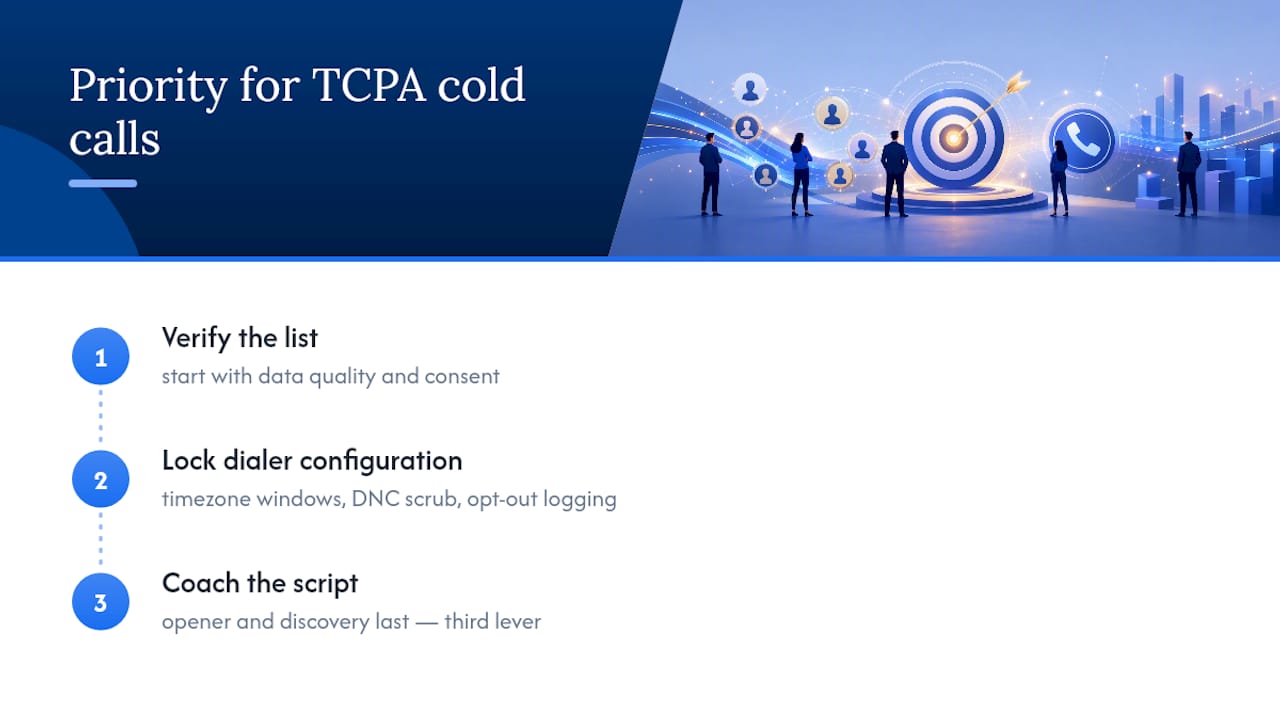
The conventional wisdom also treats TCPA awareness as a legal review exercise—something the compliance team signs off on once a quarter. That framing misses how this actually works in practice. Timezone windows, DNC scrubbing, and opt-out logging are dialer settings, not policies. Configure them once at the platform level and every rep inherits the protection automatically, instead of hoping fifty individual reps remember fifty individual rules.
If you're building or auditing a program right now, prioritize in this order: verify the list, lock down the dialer configuration, then coach the opener and discovery questions. Skip straight to script coaching and you'll spend a quarter optimizing the wrong variable.
— Chad
How Chad Burmeister Helps Sales Leaders Implement This Playbook
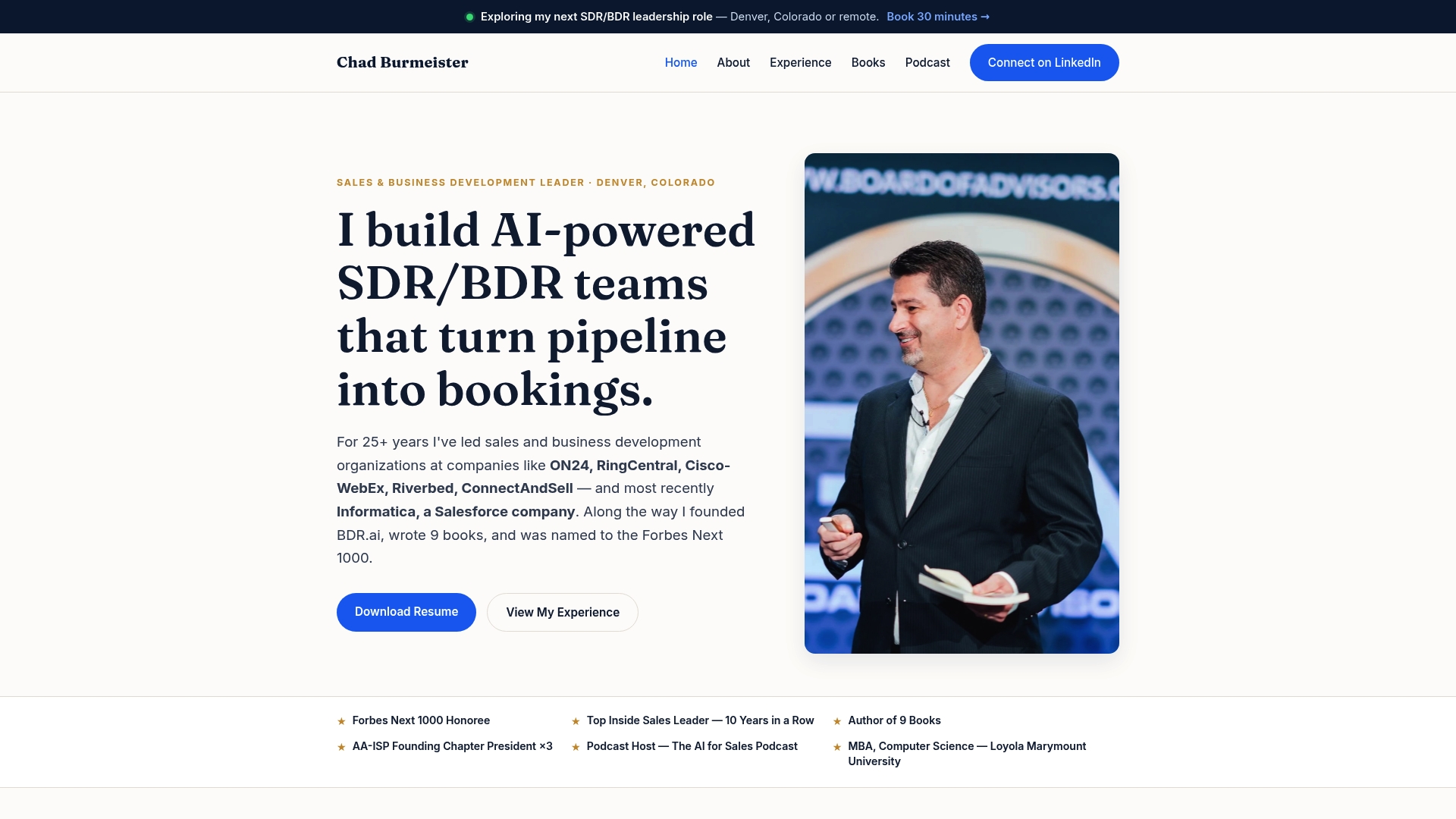
Building this program internally takes months of trial and error most sales leaders don't have time for. Chad Burmeister brings 25-plus years scaling outbound teams at companies like Informatica, RingCentral, and Cisco-WebEx directly into your organization, whether that's an executive sales leadership hire, a hands-on consulting engagement, or a workshop that gets your SDR/BDR team running this playbook in weeks instead of quarters.
An experienced leader closes the gap between knowing the playbook and running it correctly. That includes auditing your dialer configuration for compliance risk, rebuilding your ICP scoring, and coaching reps on the exact opener and discovery structure covered above. If your team is stuck rewriting scripts instead of fixing the data feeding them, that's a sign the fix needs to start at the top.
Visit Chad Burmeister's site to discuss a leadership engagement or workshop, or check out his published books for a deeper walkthrough of the AI-driven playbooks referenced throughout this piece.
Sources
- Cold calling best practices and openers
- B2B cold calling best practices and targeting
- The Complete B2B Cold Calling Guide for 2026
- B2B Cold Calling Strategy: The Complete 2026 Playbook