
Use a capacity-first, pipeline-backwards six-step model: convert your revenue target into pipeline, pipeline into opportunities, opportunities into meetings, and meetings into productive SDR capacity. Then apply explicit discounts for ramp, attrition, and performance band, run the math in base, optimistic, and conservative scenarios, and always round the final hire number up, never down.
TL;DR:
- Models must incorporate ramp, attrition, and performance assumptions, typically applying a 20% to 35% capacity discount before determining hires.
- Accurate pipeline and opportunity calculations rely on correct inputs like ACV, conversion rates, and benchmark productivity, but benchmarks depend heavily on sales motion and deal size.
- Outbound enterprise teams usually operate at roughly two SDRs per AE, mid-market teams around one to 1.5, and managers should oversee no more than six to eight SDRs for effective coaching.
- Scattering hires across multiple cohorts, rather than all at once, improves ramp success and allows managers to provide proper onboarding and ongoing coaching.
- Relying solely on idealized models without validation against actual activities and outcomes leads to inaccuracies; continuous review and adjustment are critical.
Table of Contents
- What Is the Difference Between an SDR Headcount Model and Capacity Planning?
- The Six-Step Pipeline-Backwards Model, With a Worked Example
- How Do You Choose Ramp, Attrition, and Performance Inputs?
- Where Do the Benchmark Numbers Actually Come From?
- What SDR-to-AE Ratio and Manager Span Should You Plan Around?
- How Do You Turn Productive SDR Capacity Into an Actual Hiring Plan?
- Where Do Headcount Models Break Down in Practice?
- How Should AI Change the Way You Plan SDR Capacity?
- Get Expert Help Turning Your Model Into a Working SDR Team
- Sources
- FAQ
What Is the Difference Between an SDR Headcount Model and Capacity Planning?
A headcount model answers "how many SDRs do we need to hire?" Capacity planning answers "how much output can our current and future reps actually produce?" You need both, but they're not interchangeable, and conflating them is where most sales operations teams get into trouble.
Headcount models tend to work backward from a hiring budget or an org chart target. Capacity plans work forward from what a rep, once fully ramped, can realistically deliver in booked meetings or sourced pipeline. The two approaches meet in the middle: your capacity plan tells you how many productive SDR-equivalents you need, and your headcount model tells you how many bodies you have to hire, train, and retain to hit that number, accounting for the fact that a new hire in month one is nowhere close to a rep in month five.
Two structural approaches dominate how teams build this out.
Bottom-up models start with your current team's actual productivity, whatever an average rep is booking per month, and multiply that forward. They're accurate for teams with at least six months of clean CRM history, but they inherit every bad habit already baked into your current process. If your reps are underperforming because of a broken lead-routing rule, a bottom-up model just projects that dysfunction into next year's budget.
Top-down models start with the revenue number Finance handed you and work backward through pipeline coverage, opportunity volume, and meeting conversion to land on required capacity. This is the model banks and boards actually trust, because it ties headcount directly to the number the company is accountable for. It's also less forgiving of soft assumptions, since a single bad input (say, an inflated meeting-to-opportunity conversion rate) cascades through every downstream number.
Most experienced operators run a hybrid: top-down for the target, bottom-up for the sanity check.
Scenario planning is what keeps either model from becoming a liability the moment reality diverges from the plan. Build three versions:
- Base case: your most likely ramp, attrition, and conversion assumptions
- Optimistic case: faster ramp, lower attrition, higher AI-assisted output.
- Conservative case: slower ramp, higher attrition, a rough quarter for lead quality
Presenting all three to Finance, rather than a single confident number, is usually what gets a headcount request approved on the first pass instead of getting sent back for "more detail."
The Six-Step Pipeline-Backwards Model, With a Worked Example
This is the defensible approach most SDR leaders use when Finance wants the math shown, not just the conclusion. It runs revenue through five conversions before it ever touches a headcount number.
- Revenue to pipeline. Take your new ARR target and multiply by your pipeline coverage ratio (commonly 3x to 4x) to get required pipeline.
- SDR share of pipeline. Decide what percentage of that pipeline SDRs are responsible for sourcing versus AEs, marketing, or partners.
- Pipeline to opportunities. Divide the SDR-sourced pipeline dollar figure by your average contract value (ACV) to get the number of opportunities needed.
- Opportunities to meetings. Divide opportunities needed by your meeting-to-opportunity conversion rate to get required meetings booked.
- Meetings to productive SDRs. Divide total meetings needed by meetings-per-ramped-SDR-per-year to get your required productive SDR headcount.
- Apply ramp, attrition, and performance band to convert that productive-SDR number into an actual hiring number, then round up.
Pro Tip: Never round down at any step in this chain. A model that says you need 4.6 productive SDRs needs 5 human beings, not 4 with a note to "monitor closely."
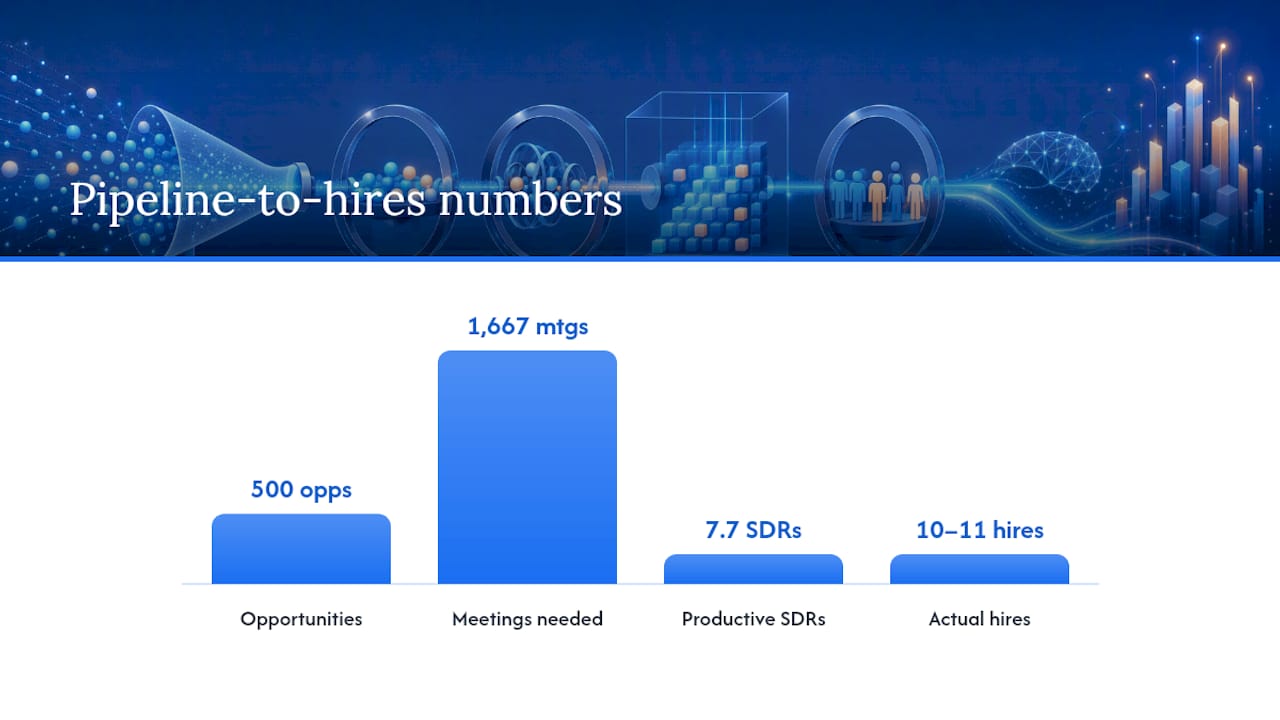
Here's the math with real inputs. Average contract value is $40,000, so that's 500 opportunities needed.
Using a Bridge Group-referenced benchmark, a strong SDR books around 18 qualified meetings a month once fully ramped, or roughly 216 a year. Divide 1,667 meetings by 216, and you land at 7.7 productive SDR-equivalents.
That's before ramp and attrition. Apply a combined discount, more on that in the next section, and 7.7 productive equivalents typically becomes 10 to 11 actual hires once you account for the fact that new reps spend their first quarter producing at a fraction of full capacity, and a percentage of the team will churn before the year is out.
How Do You Choose Ramp, Attrition, and Performance Inputs?
The inputs are where most models quietly fall apart, because leaders either guess or borrow numbers from a blog post that has nothing to do with their motion.
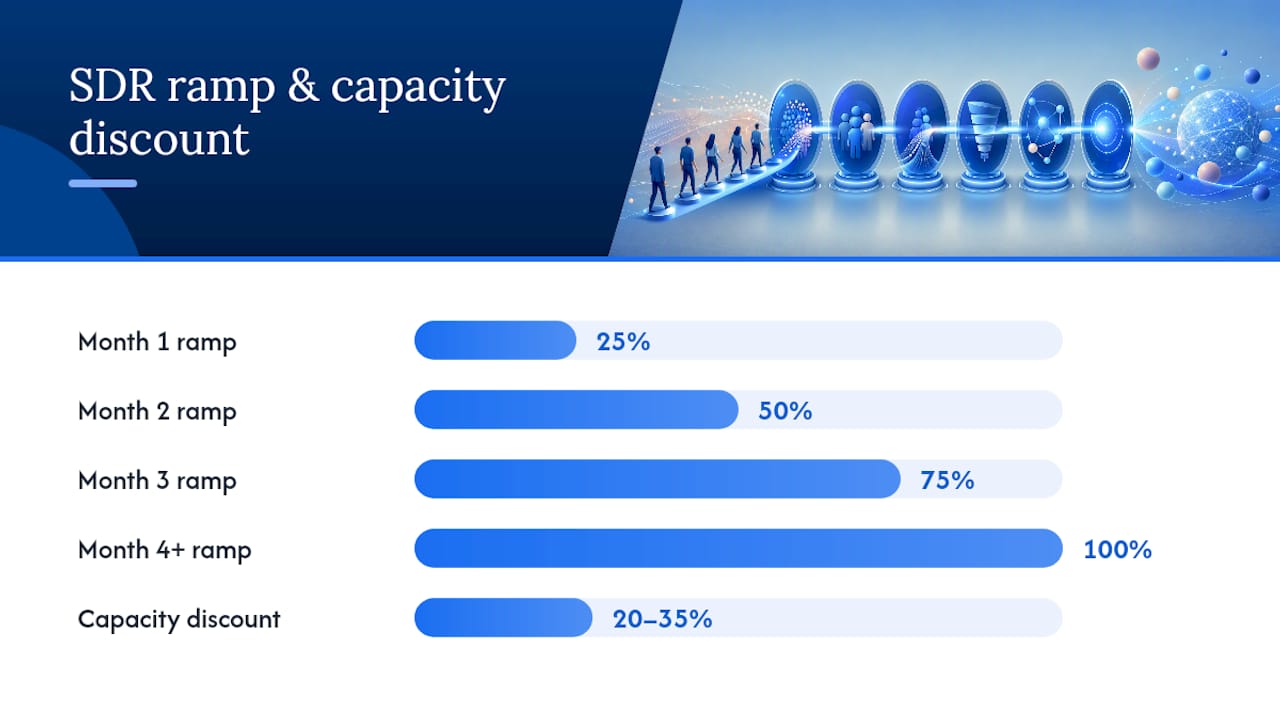
Start with ramp. A common default has SDRs hitting full productivity around month four, with output climbing roughly like this:
- Month 1: 25% of full quota, mostly training and tooling setup
- Month 2: 50%, first live calls and outreach sequences
- Month 3: 75%, pipeline starting to show up in the CRM
- Month 4 onward: 100%, fully productive
That ramp curve matters more than most planners assume, because a rep hired in October produces almost nothing against this year's number and everything against next year's. If your hiring cadence doesn't account for that lag, your Q4 pipeline will fall short no matter how many offer letters went out.
Attrition needs a real number, not a guess. Pull your trailing 12-month voluntary and involuntary turnover rate for the SDR function specifically, not the sales org as a whole, since SDR churn typically runs higher than AE churn. Blend that into your capacity discount rather than treating it as a separate line item.
Combined, ramp drag, attrition, and performance banding typically justify a 20% to 35% capacity discount applied to your productive-SDR number before you convert it to hires.
No-shows deserve their own line.
AI-assisted prospecting is the newest input, and the one people either ignore or wildly overstate. Tools that automate sequencing, research, and follow-up can lift SDR-generated qualified pipeline by roughly 30% to 40%, but that's a ceiling, not a guarantee, and it depends heavily on how well the team actually adopts the tooling. Model an AI uplift on the conservative end of that range, and treat anything above it as upside you'll capture in the optimistic scenario, not a number you bake into the base case.
Where Do the Benchmark Numbers Actually Come From?
Two sources carry most of the weight in this space: the Bridge Group's long-running SDR metrics research and the calculator tools built on top of it. Bridge Group data puts median pipeline sourced per SDR at roughly $2.7 million a year, which is the number most capacity calculators use as a default when a company doesn't yet have enough internal history to trust its own average.
A working capacity calculator needs a handful of inputs to spit out a usable number:
- Target new ARR or pipeline dollar amount for the period
- Average contract value (ACV)
- Pipeline coverage ratio (commonly 3x to 4x)
- Meeting-to-opportunity conversion rate
- Meetings booked per fully ramped SDR per month (18 is a common benchmark)
- Ramp timeline and attrition rate
Once you have an output number, run it through a sanity check using SDR-to-AE ratio and manager span, covered in the next section. If your model says you need 14 SDRs but your ratio check and your manager's actual coaching bandwidth both say 9 is the ceiling for this org right now, that gap is worth investigating before you submit the number, not after.
The biggest risk with generic benchmarks is treating them as your number instead of your starting point. A $2.7 million pipeline-per-SDR median assumes a specific sales motion, deal size, and market. If your ACV is a tenth of the benchmark company's, or your sales cycle runs twice as long, borrowing their productivity number wholesale will make your model wrong in a way that looks precise.
What SDR-to-AE Ratio and Manager Span Should You Plan Around?
Ratio guidance varies by motion, and using the wrong benchmark for your sales model is a common way plans go sideways. Outbound-heavy enterprise motions often run close to 2 SDRs per AE, since enterprise cycles need more top-of-funnel volume to fill a smaller number of large deals. Mid-market hybrid motions tend to land closer to 1:1, and inbound-strong or product-led growth teams often need fewer dedicated SDRs per AE because marketing and product usage are doing part of the sourcing work.
Manager span matters just as much as the ratio. One manager per 6 to 8 SDRs is the widely used guideline, and pushing past that ceiling usually shows up first in coaching quality, not in the org chart. A manager stretched across 12 reps simply cannot run the call reviews and pipeline coaching that keep a ramp curve on schedule.
- Outbound enterprise: roughly 2 SDRs per AE
- Mid-market hybrid: roughly 1 to 1.5 SDRs per AE
- SMB or inbound-led: often under 1 SDR per AE
- Manager span: 6 to 8 SDRs per frontline manager
Specialization, splitting inbound and outbound into separate roles, is usually worth the overhead once a team crosses roughly six SDRs. Below that size, a hybrid rep handling both motions is typically more efficient than building two half-staffed specialist pods.
Treat the ratio as your final sanity check, not your starting input. If your pipeline-backwards model and your ratio benchmark land within a rep or two of each other, you're in good shape. If they're wildly apart, something upstream, usually your ACV or conversion rate assumption, needs a second look.
How Do You Turn Productive SDR Capacity Into an Actual Hiring Plan?
The productive-SDR number from your model isn't your hiring number. To account for ramp and attrition, most teams add a 25% to 40% multiplier on top of productive capacity, meaning 8 productive SDR-equivalents can require 10 to 11 actual hires across the year.
Spread those hires in cohorts rather than one big class. Hiring in waves of two to three every quarter, instead of ten at once in January, smooths the ramp risk and gives your managers room to actually coach new reps instead of drowning in onboarding.
- Stagger start dates to avoid one manager onboarding an entire cohort simultaneously
- Build a 30/60/90-day performance checkpoint into every new hire's plan
- Track fully loaded cost per hire and cost per sourced opportunity as your two budget levers
- Pair aggressive hiring plans with retention investment, since a high-attrition cohort defeats the purpose of the extra headcount
Present hires needed alongside a phased timeline showing when each cohort actually becomes productive. Finance cares about timing as much as the headcount number itself.
Where Do Headcount Models Break Down in Practice?
The failure pattern that shows up most often: a rep's actual output is lower than the model predicted, and the team's first instinct is to blame the rep instead of the assumptions. Pull the CRM data before you do anything else. Check activity volume against outcome volume, and check stage velocity to see where deals are actually stalling.
A few assumption errors show up constantly across teams that get this wrong:
- Bad ACV assumptions borrowed from a blended company average instead of the specific segment the SDR team is working
- Pooled motions that mix inbound and outbound conversion rates into one number, hiding which channel is actually underperforming
- Ignored no-shows, which quietly inflate the apparent meeting output a model assumes is real
- Unrealistic ramp expectations that assume month-two output equal to month-five output
On AI uplift specifically: fold it in as a modest, defensible adjustment, not a substitute for headcount. Validate every major input, ramp curve, attrition rate, ACV, conversion rate, with recruiting, HR, and Finance before you finalize the model, and revisit all of it every quarter against trailing actuals rather than treating the model as a one-time exercise.
How Should AI Change the Way You Plan SDR Capacity?
AI tools are genuinely changing what a single SDR can produce, but the leaders getting this wrong are the ones treating an uplift assumption as a substitute for a buffer. It's also not evenly distributed, and it disappears fast when reps revert to old habits under quota pressure.
What actually gets a headcount request approved isn't a model precise to the decimal point. It's a model where every assumption, ramp curve, attrition rate, AI uplift, is stated plainly enough that Finance can push back on one number without rejecting the whole plan. Transparency beats false precision every time I've watched this play out.
— Chad
Get Expert Help Turning Your Model Into a Working SDR Team
Building the spreadsheet is the easy part. Getting a new or scaling SDR team to actually hit the numbers your model promises, that's where most companies stall out. Workshops and speaking engagements can help sales leaders validate headcount assumptions, build realistic ramp plans for new cohorts, and translate spreadsheet models into playbooks managers can actually run.
These engagements work best for sales operations leaders who have a model built but aren't confident it will survive contact with a real hiring cycle, or who need an outside voice to help defend the assumptions to Finance and the board. If you're planning your next fiscal year's SDR build-out and want a second set of eyes on the math before you present it, check out the speaking and workshop options or explore the Be Extraordinary Groups for ongoing hands-on support.
FAQ
What Is an SDR in a Sales Organization?
An SDR, or sales development representative, is responsible for prospecting and qualifying leads before handing them off to an account executive to close. The role exists to keep AEs focused on closing deals rather than cold outreach.
How Is SDR Headcount Calculated?
SDR headcount is calculated by working backward from a revenue or pipeline target through opportunity volume and meeting conversion to arrive at required productive capacity, then adjusting upward for ramp time and attrition. A team needing roughly 8 productive SDR-equivalents often ends up hiring 10 to 11 people once that adjustment is applied.
What Is the Difference Between Headcount and FTE?
Headcount counts the number of actual people employed, regardless of hours worked, while FTE (full-time equivalent) converts part-time and partial-year roles into a standardized full-time unit. In SDR planning, a rep who started mid-quarter counts as one headcount but only a partial FTE for that period, since a portion of the quarter fell during ramp.
What Does "Headcount" Mean in a Financial Context?
In financial planning, headcount refers to the total number of employees a budget supports, and it's usually the figure Finance uses to model payroll cost against revenue targets. For an SDR team, headcount planning ties directly to cost-per-opportunity and cost-per-hire, since each additional hire carries a fully loaded cost that needs to justify its expected pipeline contribution.
What SDR-to-AE Ratio Should Most Teams Use?
The right ratio depends on sales motion: outbound-heavy enterprise teams often run near 2 SDRs per AE, while inbound-led or PLG teams frequently operate under 1 SDR per AE. Use the ratio as a sanity check against your pipeline-backwards model output rather than as the starting assumption for headcount.