Use short, specific, signal-based subject lines, two to six words that name the prospect's company or reference a real trigger event, because they consistently earn the highest open and reply rates in outbound sales. Keep them under roughly 40 characters so they don't truncate on mobile. Lead with formats like "[Company] + [topic]," a direct question, or a referral mention, and always sound like a person, not a marketer.
TL;DR:
- Using personalized, trigger-based subject lines like "[Company] + [topic]" significantly improves reply rates, especially when referencing recent events like funding or leadership changes.
- Testing one variable at a time, such as length or personalization, ensures accurate insights and prevents false winners in A/B experiments.
- Proper list validation, warm-up, and avoiding spam trigger words are crucial to prevent deliverability issues that suppress email visibility and engagement.
- Matching subject line styles to each stage of the sequence—signal, angle, ask, or close—maximizes relevance and response likelihood throughout the outreach campaign.
- Focus on reply and meeting metrics rather than open rates, as privacy features and overused templates distort traditional open tracking.
Table of Contents
- What Makes A Good Sales Email Subject Line
- Building A Repeatable Subject-Line Process
- Categorized Subject-Line Examples You Can Copy And Personalize
- How Subject Lines Should Change Across Your Sequence
- Testing Subject Lines And Measuring What Actually Matters
- Deliverability Mistakes That Quietly Kill Reply Rates
- What A 90-Day Deliverability Pilot Actually Showed
- When Subject-Line Testing Is Worth The Time (And When It Isn't)
- How Chadburmeister Helps You Build A Sequence That Actually Converts
- Sources
- FAQ
What Makes A Good Sales Email Subject Line
Three things separate a subject line that gets opened from one that gets deleted: it's short, it's specific, and it's honest. Everything else is decoration.
Large-scale analyses covering more than 130 million B2B emails show that short subject lines in the two to four word range, paired with a specific personalized detail, consistently beat longer or generic alternatives, according to Autobound's research. That same research found personalized subject lines lift open rates by roughly 26% on average compared to generic ones. Brevity isn't a style preference. It's the single most reliable lever sales teams have, and it works because most prospects are reading email previews on a phone, where anything past six or seven words gets cut off before it makes a point.
Mobile preview windows typically display somewhere between 30 and 40 characters of a subject line before truncating. That means a line like "Q3 Pipeline Acceleration Strategies for Enterprise Sales Teams" never finishes rendering on a phone screen. Compare that to "Acme + Q3 pipeline" (18 characters). The second one reads as a complete thought no matter what device it lands on.
Personalization comes in tiers, and they are not equally powerful. Ranked roughly from weakest to strongest:
- First-name tokens ("Hey John, quick question") signal automation almost as loudly as no personalization at all.
- Company name references ("Acme's hiring push") show basic research without much effort.
- Role-based angles ("For VPs managing quota resets") work when the pain is universal to the title.
- Trigger events (funding rounds, leadership changes, new job postings) are the strongest lever because they prove you're paying attention to something happening right now.
- Mutual connections borrow trust directly and tend to outperform everything else when the connection is real and checkable.
A 15-million-email study identified "[Company] + [Specific topic]" as the top-performing formula, pulling an average open rate near 47%, while flagging that once-reliable templates like "Quick question" have been losing effectiveness as inboxes get saturated with them, per WarmySender's data. Overused formats stop working the moment enough sales reps copy them into a sequence, which is exactly what happened to "quick question" over the past few years.
Format matters almost as much as content. Questions tend to outperform statements because they invite a mental response, even a silent one, before the prospect decides whether to open. Numbers work when they signal concrete value ("3 ways to cut onboarding time") rather than vague enthusiasm. Signal-based lines that reference something verifiable, a funding announcement, a new executive hire, a product launch, consistently beat generic ones because they pass what amounts to a simple gut check: would a real person actually know this and write this? Research on subject-line formulas backs that instinct directly, showing that lines tied to a specific, checkable fact outperform vague curiosity hooks, according to WarmySender's analysis.
Tone is where most reps sabotage themselves. A subject line should read the way a colleague would write it, not the way a marketing team would. That rules out ALL CAPS, exclamation points stacked for urgency, and the classic bait tactic of adding "Re:" or "Fwd:" to a cold email that was never a reply to anything. It's a cheap trick, prospects recognize it within a second of opening the message, and it burns trust before your pitch even starts.
Building A Repeatable Subject-Line Process
Getting one good subject line is easy. Building a process that keeps producing good ones, week after week, across a growing list of sequences, is the actual skill. Here's the checklist worth running before anything goes out the door.
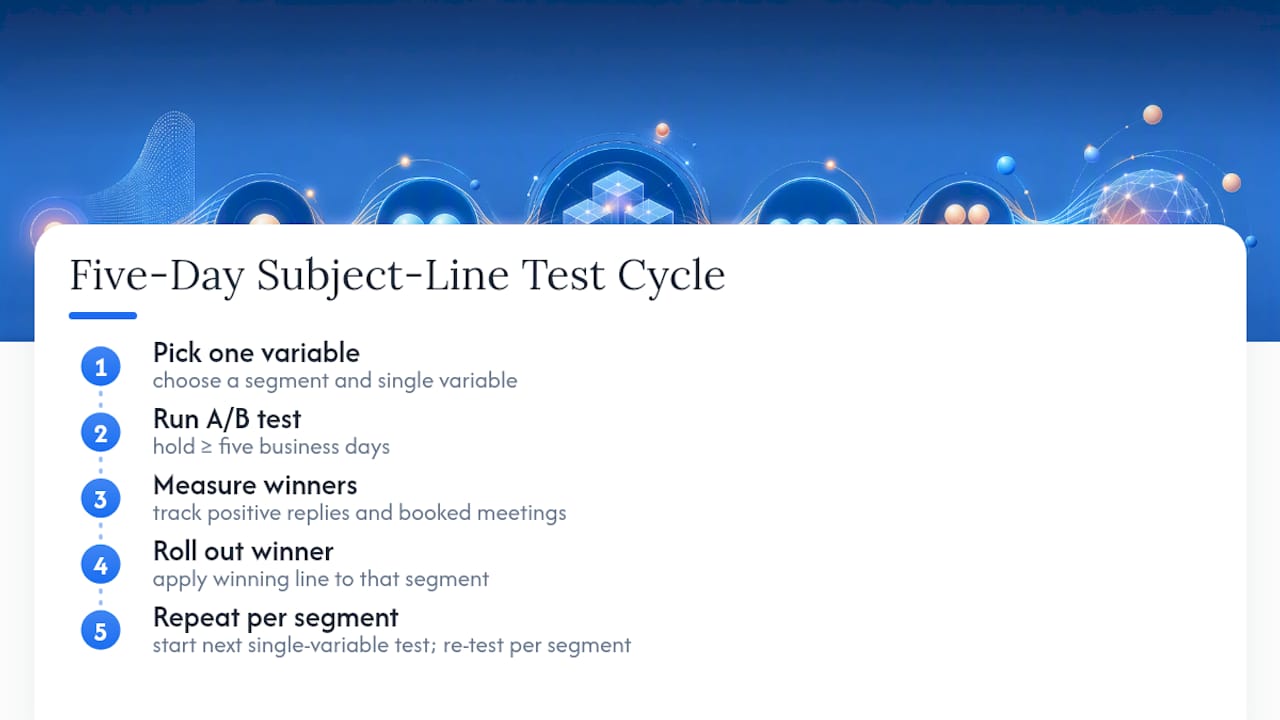
- Test one variable at a time. If you change the length, the personalization token, and the format all in the same test, you'll have a winner but no idea why it won. Isolate a single variable, question versus statement, signal versus generic, five words versus three, per test.
- Check every merge token before sending. A subject line that reads "Hi {{FirstName}}, quick note about {{Company}}" because a field didn't populate isn't just embarrassing. It tells the prospect your list wasn't verified. Run a validation pass on your list before any campaign launches; a clean process here also protects your sender reputation more broadly.
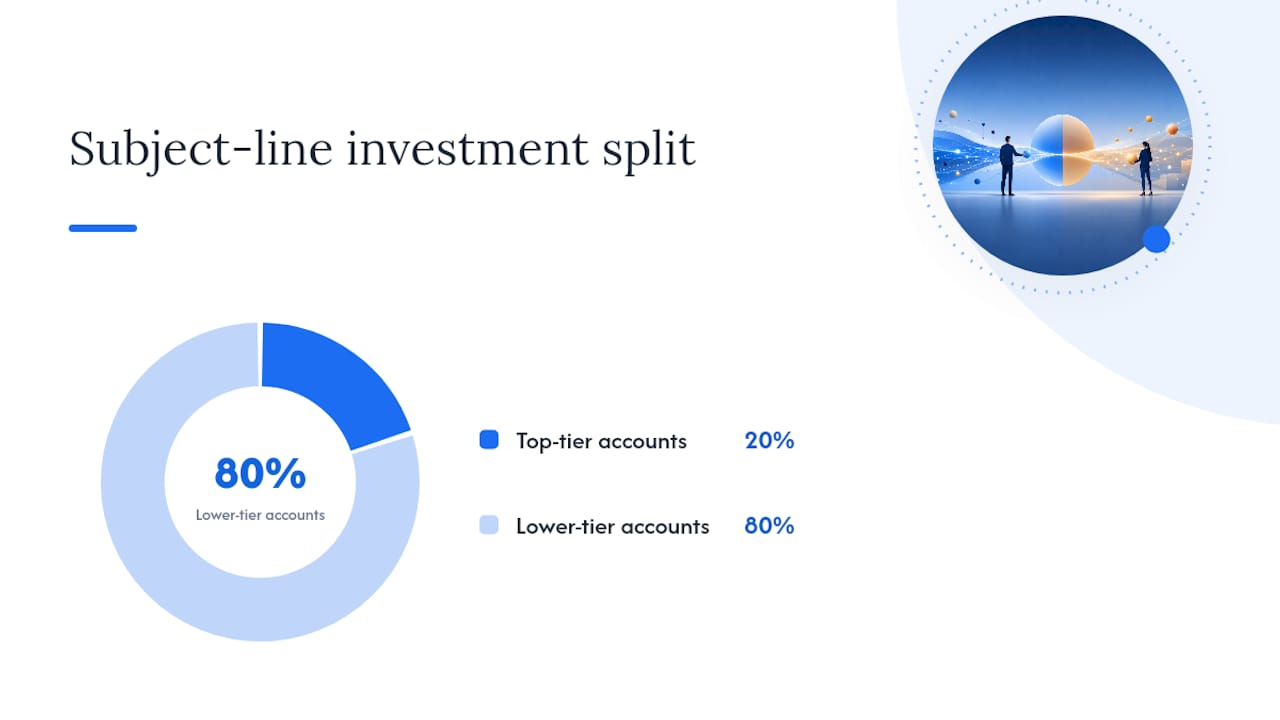
- Match the subject-line type to the account tier. Signal-based, trigger-anchored lines take real research time. They're worth it for your top 20% of target accounts. For lower-tier, higher-volume outreach, a strong templated format like "[Company] + [topic]" is the more efficient trade-off.
- Time sends around business rhythm, not personal preference. A subject line promising urgency ("Need this by Friday?") sent on a Friday afternoon reads differently than the same line sent Tuesday morning. Cadence and timing shape how a subject line is interpreted as much as the words themselves.
- Build in a deliverability guardrail before scaling volume. Warm up new sending domains gradually, keep spam-trigger words out of subject lines (free, guarantee, act now), and monitor bounce and complaint rates weekly, not monthly.
Pro Tip: Keep a running swipe file organized by trigger type (funding, hiring, product launch, leadership change) instead of by industry. When a prospect account shows a new signal, you'll pull a proven subject-line shape in seconds instead of writing from scratch under deadline pressure.
The decision between a signal-based line and a template isn't binary. It's a resource allocation question. Signal-based personalization requires someone, a rep, an SDR, or an AI research tool, to actually look up what's happening at the account. That's expensive at scale. Templates are cheap and fast but decay in performance as more reps in your market use the same ones. The right move is usually a blend: reserve custom signal lines for your named accounts and top-tier prospects, and run tested template formulas for everything below that tier. Tools that automate account research can help close that gap without requiring a researcher on every single email, letting reps apply signal-based personalization at a volume that manual research alone can't support.
One more guardrail worth building into your QA process: never let a subject line promise something the email body doesn't deliver. "3 ideas for your Q3 pipeline" needs to actually contain three ideas. Mismatch between subject line and content is one of the fastest ways to train a prospect to stop opening your emails at all, no matter how clever the next subject line is.
Categorized Subject-Line Examples You Can Copy And Personalize
Below is a working bank organized by the stage of outreach where each line does its best work. Swap in the bracketed details for your actual prospect data before sending.
Cold openers need to prove relevance in the first glance, without pretending to know more than they do.
- "[Company] + Q3 hiring" (company plus topic, the highest-performing cold formula in large-scale testing)
- "Noticed your team's expansion"
- "Quick thought on [Company]'s stack"
- "[First name], worth 2 minutes?"
- "Saw the [Company] announcement"
Trigger and signal-based lines work because they reference something concrete and time-bound, a funding round, a leadership change, a hiring surge, that a generic template can't replicate.
- "Congrats on the Series B, [First name]"
- "Saw [Company] is hiring 12 AEs"
- "New VP of Sales at [Company]?"
- "[Company]'s expansion into [market]"
- "Following [Company]'s product launch"
These work because they're checkable. A prospect can glance at the subject line and confirm instantly that you did real homework, which is precisely why signal-based personalization outperforms generic tokens on reply rate, not just open rate, based on findings from Autobound's dataset.
Referral lines borrow existing trust, which is why they tend to post some of the highest open rates of any category, even above trigger-based lines, when the connection is genuine.
- "[Mutual connection] suggested I reach out"
- "[First name] from [Company] pointed me here"
- "A mutual friend, [Name], mentioned you"
- "Following up on [Referrer]'s intro"
A referral subject line only works if the reference is real and specific. A vague "someone suggested I reach out" reads as a bluff the moment a skeptical prospect starts asking who, exactly.
Meeting request lines need a defined time ask baked in, not an open-ended invitation that requires back-and-forth just to schedule.
- "15 min Thursday to discuss [topic]?"
- "Open for a quick call Tuesday?"
- "Worth 10 minutes next week?"
- "Free for a 20-min chat on [date]?"
Specificity does double duty here. It reduces the friction of scheduling and signals you respect the prospect's calendar enough to propose an actual window instead of a vague "sometime soon."
Follow-up lines need a new angle each time, not a repeat of the first message with "following up" bolted on the front.
- "3 ideas for [Company]'s [pain point]"
- "One more thought on [topic]"
- "Case study: how [Similar Company] solved [problem]"
- "Different angle on [topic]"
- "[Video] made this for you, [First name]"
That last format deserves a callout. Genuinely personalized video subject lines can increase reply rates two to three times compared to plain text, but only when the video itself is truly custom, per Sendspark's research. Send a generic screen recording with a personalized subject line and you'll underdeliver on the promise, sometimes badly enough to trigger unsubscribes.
Breakup and closing lines give the prospect a low-friction way to say no, which paradoxically increases replies from people who were quietly ignoring the thread.
- "Should I close your file?"
- "Wrong person?"
- "Permission to stop emailing?"
- "Last note from me, [First name]"
- "Closing the loop on this"
"Wrong person?" in particular does surprise work as a bump line mid-sequence, not just at the close. It reframes a follow-up as a routing question instead of a nag, and it's short enough to survive any mobile preview window intact.
How Subject Lines Should Change Across Your Sequence
A subject line has a different job at each stage of a sequence. Treat every touch with the same subject-line style and you'll flatten your reply rate by the third or fourth email, because prospects who didn't respond to the first framing won't suddenly respond to a copy of it.
- Day 1, the signal opener. The job here is earning permission to be read at all. Use an account signal ("[Company]'s Series B") or the company-plus-topic formula that tested at the top of large-scale benchmarks. This is the highest-effort, highest-payoff subject line in the sequence, reserve your best research for it.
- Day 3 to 5, the new-angle email. The prospect already saw your name once. Repeating the same subject line reads as spam; shifting the angle reads as persistence with substance. Try a three-item value format ("3 ideas for [Company]'s onboarding") or a short case reference ("How [Similar Company] cut ramp time").
- Day 7 to 12, the defined ask. By now, vague curiosity hooks have run their course. Get concrete: "Worth 10 min?" or a specific calendar proposal. This is also the stage where bump lines like "Wrong person?" do real work, they reframe silence as a routing problem rather than a rejection, which lowers the psychological barrier to a reply.
- Closing and cleanup. The final one or two touches exist to clear your pipeline of dead threads without burning the relationship. "Permission to close your file?" or "Last note from me" gives the prospect an easy exit, and counterintuitively, this stage often produces a small but real bump in replies from people who'd been meaning to respond but never had a reason to prioritize it.
This progression, signal, value, ask, routing, close, mirrors the structure recommended by outbound operators who track subject lines by job rather than by cleverness, based on Reachly's sequencing framework. The subject line isn't a static asset you write once. It's a moving part that should match exactly what that specific email in the sequence is trying to accomplish.
Testing Subject Lines And Measuring What Actually Matters
Running a proper A/B test on subject lines is one of the highest-leverage, lowest-effort moves in outbound sales, and most teams still skip it in favor of gut instinct. Testing improves open rates by roughly 49% on average when it's run correctly, according to OptinMonster's benchmark data, which is a large enough swing that skipping tests amounts to leaving real pipeline on the table.
The KPI mistake is just as common as the skipped test. Open rate is not the metric that should decide a winner. Apple's Mail Privacy Protection and similar features distort open tracking by preloading images regardless of whether a human ever saw the message, which means open-rate data alone can flatly lie to you, a point operator guides increasingly stress when recommending replies as the primary KPI. Track positive replies and booked meetings instead. That's the number that reflects whether your subject line attracted the right kind of attention, not just a mail server's automated prefetch.
Hold every test for at least five business days before calling a winner, long enough to smooth out day-of-week noise in open and reply timing, a minimum that lines up with testing guidance from OptinMonster. Once you have a statistically meaningful sample and a clear winner on reply rate, roll it out as the new default for that segment, then start your next single-variable test immediately. Winners don't transfer automatically across segments, though; a signal-based line that crushes it with venture-backed startups might fall flat with enterprise procurement teams, so re-test per segment rather than assuming one winner rules everywhere.
Deliverability Mistakes That Quietly Kill Reply Rates
The fastest way to sabotage a good subject line is to pair it with a deliverability mistake that never lets the prospect see it in the first place.
- Deceptive prefixes like a fake "Re:" or "Fwd:" on a cold email generate spam complaints once prospects realize the trick, which damages sender reputation for every message after it.
- Hype words (free, guaranteed, act now, limited time) trip spam filters and read as low-effort marketing rather than a peer-to-peer note.
- Broken merge tokens, a subject line that renders "{{FirstName}}" literally, signal an unvalidated list and erode trust instantly.
- ALL CAPS or stacked exclamation points get flagged by filters and by human recipients as spam, often before the message even reaches the inbox.
- Skipping list validation before a send raises your bounce rate, which search-and-filter algorithms read as a deliverability red flag for your entire domain going forward.
Running a clean list validation process before every campaign catches broken tokens and dead addresses before they become a deliverability problem instead of after.
What A 90-Day Deliverability Pilot Actually Showed
A structured 90-day cold email pilot focused on deliverability found that reply rates in the 5% to 7% range are achievable for cold B2B outreach when subject lines, list hygiene, and sending infrastructure are all handled correctly together, a fuller breakdown of that pilot's setup and results lives in this 90-day deliverability case study. The subject line mattered, but it was never the whole story; it worked in tandem with domain warm-up, list validation, and a defined follow-up cadence.
The practical lesson from that pilot: merge-hygiene checks and a consistent, staged cadence template did more heavy lifting over 90 days than any single clever subject-line trick. Teams that want to replicate a similar test should start with the cadence structure described in the sequencing section above and layer subject-line testing on top of it, not instead of it. A brilliant subject line sent from a poorly warmed domain to an unvalidated list still lands in spam. Fix the infrastructure first, then optimize the words.
When Subject-Line Testing Is Worth The Time (And When It Isn't)
Subject-line testing pays off fastest when your list quality and offer are already solid, because a better subject line just gets more of the right people to see a message that was going to convert anyway. If your reply rate is stuck in the low single digits, the honest diagnosis is rarely the subject line. It's usually a stale list, a mismatched offer, or an audience that never had the problem you're solving.
I'd tell any sales leader to run the list-quality and offer diagnostic first. Fix bounces, fix targeting, sharpen the value proposition. Only then does subject-line testing start returning real pipeline instead of just prettier open-rate charts. Once those fundamentals are solid, subject-line work becomes one of the cheapest, fastest levers in the entire outbound playbook, a few hours of testing against a well-targeted list beats weeks of chasing marginal gains on a broken one.
— Chad
How Chadburmeister Helps You Build A Sequence That Actually Converts
Most sales teams don't have a subject-line problem. They have a systems problem, no repeatable testing process, no cadence structure, no way to train a full team on what actually works instead of what sounds clever in a Slack thread. Workshops and speaking engagements can provide frameworks covering signal-based personalization, cadence sequencing, and A/B testing discipline that hold up at scale.
If your team is writing subject lines by gut feel and wondering why reply rates have stalled, a workshop is the fastest way to fix that, not another blog post, but a structured session your SDRs and AEs can apply the same week. Explore speaking and workshop options to bring this playbook directly to your team, or check out the ongoing Be Extraordinary Groups for teams that want continued coaching beyond a single session on Chadburmeister. Book a session and put a real testing cadence in place before your next quarter starts.
Sources
For deeper data on subject-line performance, review the B2B email guide to subject-line variation and the 2026 cold email formula study. For follow-up cadence tactics, see automated follow-ups that win clients back, and for testing methodology, the A/B testing guide from Summit Signal.
- B2B Email Guide to subject-line variation (Autobound)
- Cold Email Subject Line Formulas That Work in 2026 (WarmySender)
- Cold email subject lines: the 2026 operator guide (Reachly)
- Sales Email Subject Lines That Get Replies | Sendspark
FAQ
What Is The Ideal Length For A Sales Email Subject Line?
Aim for two to six words, ideally under 40 characters so it doesn't truncate on mobile previews. Data from analyses covering 130 million-plus B2B emails shows short, specific subject lines consistently outperform longer alternatives.
Should I Use "Re:" Or "Fwd:" On A Cold Email To Boost Opens?
No. Adding a fake "Re:" or "Fwd:" to an email that isn't actually a reply is a deceptive tactic that generates spam complaints once prospects notice, and it damages your sender reputation for every future send.
What Metric Should I Track Instead Of Open Rate?
Track positive replies and booked meetings, not raw opens. Privacy features like Apple Mail Privacy Protection distort open tracking, so operator guides recommend treating replies as the primary KPI for subject-line tests.
How Long Should I Run An A/B Test On Subject Lines?
Hold each test for a minimum of five business days before declaring a winner, long enough to smooth out day-of-week variation. Proper testing can lift open rates by roughly 49% on average, according to OptinMonster's benchmark.
Does Chadburmeister Offer Training On Cold Email And Subject-Line Strategy?
Yes. Chadburmeister offers workshops and speaking engagements that cover outbound sequencing, personalization, and subject-line testing frameworks; pricing is available on request through the books and workshops page.