
Remote SDR management is a hireable, in-demand leadership function right now, not a shrinking one. Job seekers should move fast on saved searches across LinkedIn, Indeed, and Built In while building proof of a repeatable 30/60/90 onboarding system. Hiring managers should set up a candidate scorecard and a KPI dashboard before the first interview, not after the first hire.
TL;DR:
- Remote SDR management roles typically involve overseeing a team of 10 to 15 reps at larger companies or smaller, part-time teams around five to eight at startups, with responsibilities including hiring, coaching, and forecasting.
- Employers prioritize candidates with concrete experience in CRM administration, outbound operations, and remote leadership skills, often testing for ability to build onboarding plans and manage KPIs digitally.
- Compensation generally relies more on base salary with variable pay tied to team performance, requiring a 60 to 90-day ramp period before full team output stabilizes.
- A streamlined tech stack should include a CRM, sales engagement platform, verified contacts, and a communication tool, with additional tools like conversation intelligence added at scale.
- Legal compliance involves careful management of multi-state wage laws, international worker classification, and data privacy regulations to avoid costly violations.
Table of Contents
- Where To Find Remote SDR Management Jobs
- What Does A Remote SDR Manager Actually Do?
- What Employers Look For When Hiring a Remote SDR Manager
- Remote SDR Manager Compensation and Ramp Timelines
- The Lean Tech Stack for Managing Remote SDRs
- Building a 0–90 Day Onboarding Plan for Remote SDRs
- Coaching Remote SDRs Without Micromanaging Them
- Legal and Compliance Considerations for Remote SDR Teams
- What Twenty-Five Years On The Front Line Teaches About Remote Leadership
- How Chad Burmeister Helps You Build or Run a Remote SDR Team
- Sources
Where To Find Remote SDR Management Jobs
The listings are out there, but most job seekers search the wrong way and miss half of them. Indeed alone lists hundreds of active postings for SDR manager roles tagged remote, and that volume holds steady across LinkedIn, Built In, and company career pages that don't always syndicate to aggregators.
Cast a wide net, but filter hard once you're in it:
- Set saved searches on LinkedIn and Indeed for "SDR manager," "BDR manager," and "sales development manager," with remote filters on and alerts set to daily.
- Check Built In's remote sales category weekly. It skews toward venture-backed tech companies that hire managers before they hire full teams.
- Follow niche sales communities and podcasts (Pavilion, RevGenius, sales-specific Slack groups) where roles get posted before they hit job boards.
- Go straight to company career pages for the 15 to 20 companies you'd actually want to work for. Fast-growing startups often post there first.
Vet the listing before you apply. A legitimate remote management role names a team size, a reporting structure, and specific KPIs. A vague one that talks only about "driving results" or bundles the manager role with individual quota is usually a warning sign that the company hasn't defined the job yet.
What Does A Remote SDR Manager Actually Do?
Titles vary more than the job itself. Whether the posting says SDR manager, BDR manager, or director of sales development, the core mandate is the same: build a pipeline engine and keep it running without being in the same room as the people running it.
Core responsibilities typically include:
- Hiring and onboarding reps, including writing job descriptions that attract remote-capable talent.
- Coaching call quality, sequence design, and objection handling on a weekly cadence.
- Owning the outbound playbook and updating it as market response changes.
- Forecasting pipeline contribution and reporting it to sales leadership or the CRO.
- Managing performance issues and terminations without the benefit of hallway feedback loops.
Title differences matter more than they seem. A "fractional SDR manager" role usually means part-time oversight for a smaller team, often 5 to 8 reps, with less hiring authority. A full-time SDR manager at a 200-person company might own 10 to 15 reps and a full budget. At smaller companies, remote managers often do more hands-on prospecting themselves; at larger ones, the job shifts almost entirely to coaching and systems.
What Employers Look For When Hiring a Remote SDR Manager
Hiring managers screening resumes for this role tend to look past generic leadership language and dig for specific operational proof. Candidates who walk in with artifacts, not adjectives, win the room.
On the hard-skill side, employers want fluency in CRM administration (not just usage), sequence design in a sales engagement platform, comfort reading pipeline analytics, and a track record running outbound operations at scale. On the soft-skill side, they're testing for remote-specific leadership: can this person coach someone they've never met in person, communicate clearly async, and run a coaching framework that doesn't depend on physically walking the floor.
Interview prompts that actually reveal fit:
- Ask the candidate to walk through a 30/60/90 onboarding plan they've built or would build, with specific milestones attached.
- Request a screenshot or mock-up of a KPI dashboard they'd use to manage a remote team, and ask what triggers a coaching conversation.
- Ask for a sample recorded call review, even a hypothetical one, to see how they diagnose a rep's skill gaps.
- Probe a real story about managing an underperformer remotely, specifically how they knew, when they intervened, and what changed.
Candidates who can't produce anything concrete for these prompts usually haven't managed a distributed team before, no matter what the resume says.
Remote SDR Manager Compensation and Ramp Timelines
Compensation for this role varies by company size and market, but a few patterns hold across most postings. Base-to-variable mix skews heavier on base than a typical SDR carries, since managers are measured on team output over months, not individual calls this week.
Comp structure worth knowing: Total on-target earnings for remote SDR managers generally scale with team size and company stage. Smaller, earlier-stage companies tend to lean toward higher base salary and lower variable pay to reduce churn risk while the team is still finding its rhythm, according to guidance on structuring SDR compensation plans that actually work. Larger, more established teams often shift toward heavier variable tied to team quota attainment.
A few things to build into any offer or negotiation:
- Tie variable pay to team-level leading indicators (meetings booked, sequences completed) as well as lagging ones (pipeline generated, deals closed).
- Expect a 60 to 90 day ramp for the manager themselves before full team output stabilizes, even if individual reps ramp faster.
- Watch for misaligned quotas set before lead flow or data quality gets validated. That mismatch is one of the most common causes of early ramp failure.
- Ask about team incentive structures (spiffs, contests) separate from individual comp, since remote teams often need more deliberate morale mechanics.
The Lean Tech Stack for Managing Remote SDRs
You don't need a dozen tools to run a remote team well. You need four that talk to each other and one manager willing to actually look at the data every day.
The minimum viable stack: a CRM as the system of record, a sales engagement platform or dialer for outbound volume, a verified data provider for contact accuracy, and a communication tool like Slack or Teams for daily coordination. Practical guidance on building virtual sales teams recommends holding off on pricier layers like conversation intelligence platforms until the team crosses roughly ten reps, since the cost rarely justifies itself below that scale.
Once you're past that threshold, add:
- Conversation intelligence (Gong, Chorus, or similar) for coaching triggers and call review at volume.
- A lightweight LMS or content hub for onboarding materials reps can revisit on their own time.
- Sales analytics dashboards that surface leading indicators, not just closed-deal totals.
Data hygiene matters more remotely than in-office, because a manager can't glance over a shoulder to catch a rep skipping CRM updates. Build mandatory fields and automated data checks into the CRM itself rather than relying on reminders.
Pro Tip: Before buying any new tool, ask whether the problem is really a tooling gap or a process gap. Most remote teams over-invest in software before their hiring and onboarding process is solid, and that order rarely fixes itself in reverse.
Building a 0–90 Day Onboarding Plan for Remote SDRs
A structured ramp is the single biggest lever a remote SDR manager has, because it replaces the informal osmosis of an in-office floor with something deliberate and measurable.
A workable sequence, adapted from a one-page SDR onboarding template, breaks into three phases:
- Days 1 to 30: Account setup, CRM training, data hygiene basics, and heavy shadowing. The rep listens to calls, reviews recordings, and starts paired dialing with a senior teammate.
- Days 31 to 60: The rep runs independent sequences with weekly sampled call reviews. The manager checks activity volume and early conversion signals, not just calls made.
- Days 61 to 90: Full ownership of a book of accounts, with a target meeting-per-week number set relative to product and market, plus a formal ramp review against the original hiring scorecard.
| Milestone | Manager checkpoint | What to measure |
|---|---|---|
| Day 30 | Shadowing complete, first solo calls made | Call volume, CRM logging accuracy |
| Day 60 | Independent sequencing underway | Connect rate, meetings booked, talk time |
| Day 90 | Full quota ownership | Meetings-to-opportunity conversion, pipeline generated |
The manager's job at each checkpoint isn't just tracking numbers. It's deciding whether to extend ramp, adjust territory, or flag a mismatch between the hire and the role early enough to fix it.
Coaching Remote SDRs Without Micromanaging Them
The instinct to watch every keystroke is the fastest way to burn out a remote team and lose its best people. Effective remote coaching runs on triggers and sampling, not surveillance.
Set up automated coaching triggers around talk-to-listen ratio, missed qualification questions, and sentiment shifts inside calls, so the manager gets flagged toward the calls that actually need attention. HubSpot's approach to remote SDR coaching recommends exactly this kind of conversation intelligence layered with coaching triggers to make feedback timely instead of reactive weeks later.
Short recorded feedback often works better than long live coaching sessions. A 2 to 4 minute Loom walking through one call moment gives a rep something to rewatch, and it scales a manager's attention across more reps than back to back one-on-ones ever could.
Build in peer rituals deliberately:
- Weekly call sampling reviewed as a small group, not just one-on-one with the manager.
- Virtual power hours where reps dial together on video, recreating the energy of an in-office bullpen. Scheduled collaborative calling sessions help remote teams rebuild that sales-floor osmosis that's otherwise lost.
- Rotate coaching focus toward your middle performers. Practitioner guidance suggests spending roughly 60% of coaching time there, since top performers need less intervention and bottom performers often need a different conversation entirely.
Pro Tip: If a coaching cadence depends on the manager remembering to check in, it will fail within a quarter. Build the trigger into the tool, not the calendar.
A Virtual Team Leadership study found that leadership behavior strongly predicts virtual sales team performance (β = 0.584), largely because strong leaders build both team cohesion and technology fluency, together explaining nearly two-thirds of the variance in team output. Coaching systems that lean on real tools, not willpower, are the mechanism behind that number.
Legal and Compliance Considerations for Remote SDR Teams
Hiring remote SDRs across state lines or country borders isn't just a management question, it's a legal one, and it trips up more employers than most articles admit.
Within the United States, employers hiring remote SDRs in different states need to track state-specific wage and hour rules, since commission structures and overtime exemptions vary by jurisdiction. A comp plan that's fully compliant in one state can create liability in another, particularly around when commissions must be paid out after a deal closes.
Hiring internationally raises the stakes further. Classifying a remote SDR as an independent contractor when they function like an employee, set hours, exclusive engagement, company equipment, is one of the most common compliance failures in distributed sales teams. Misclassification can trigger back taxes, penalties, and benefits liability in the worker's home jurisdiction.
Employers hiring across borders typically need either a local entity, an employer of record service, or a carefully structured contractor agreement reviewed by counsel familiar with that specific country's labor law. Data privacy adds another layer. If SDRs handle contact data on prospects in the European Union or other regulated markets, GDPR and similar frameworks impose rules on how that data gets stored and processed, regardless of where the SDR sits.
None of this should scare a manager away from building a distributed team. It should push them to loop in HR or employment counsel before the offer goes out, not after the first payroll cycle exposes a gap.

What Twenty-Five Years On The Front Line Teaches About Remote Leadership
Most advice about managing remote SDRs treats it as a technology problem: buy the right dashboard, automate the right alert, and performance follows. That's backwards. Technology only amplifies leadership that's already working, and it exposes leadership that isn't.
The clearest example I've seen of this play out was a client whose remote team looked broken on paper, low activity, missed quota, high turnover, but the actual problem was a comp plan that paid variable pay on a 45-day lag while reps needed to see the connection between effort and reward within a week to stay motivated. Rebuilding the plan around weekly leading-indicator payouts, tied to meetings booked rather than closed revenue three months out, fixed retention before it fixed pipeline. Pipeline followed once people stopped leaving.
That's the pattern worth internalizing: fix the incentive structure and the ramp sequence before you fix the tech stack. Chad's SDR onboarding template and compensation framework both exist because managers kept asking for the same fix in different words.
— Chad
How Chad Burmeister Helps You Build or Run a Remote SDR Team
If you're a CEO, CRO, or founder who needs this fixed now rather than researched further, expert consulting can close this gap. Experienced sales leadership brings hands-on guidance to organizations that need a remote SDR function built, repaired, or scaled without months of trial and error.
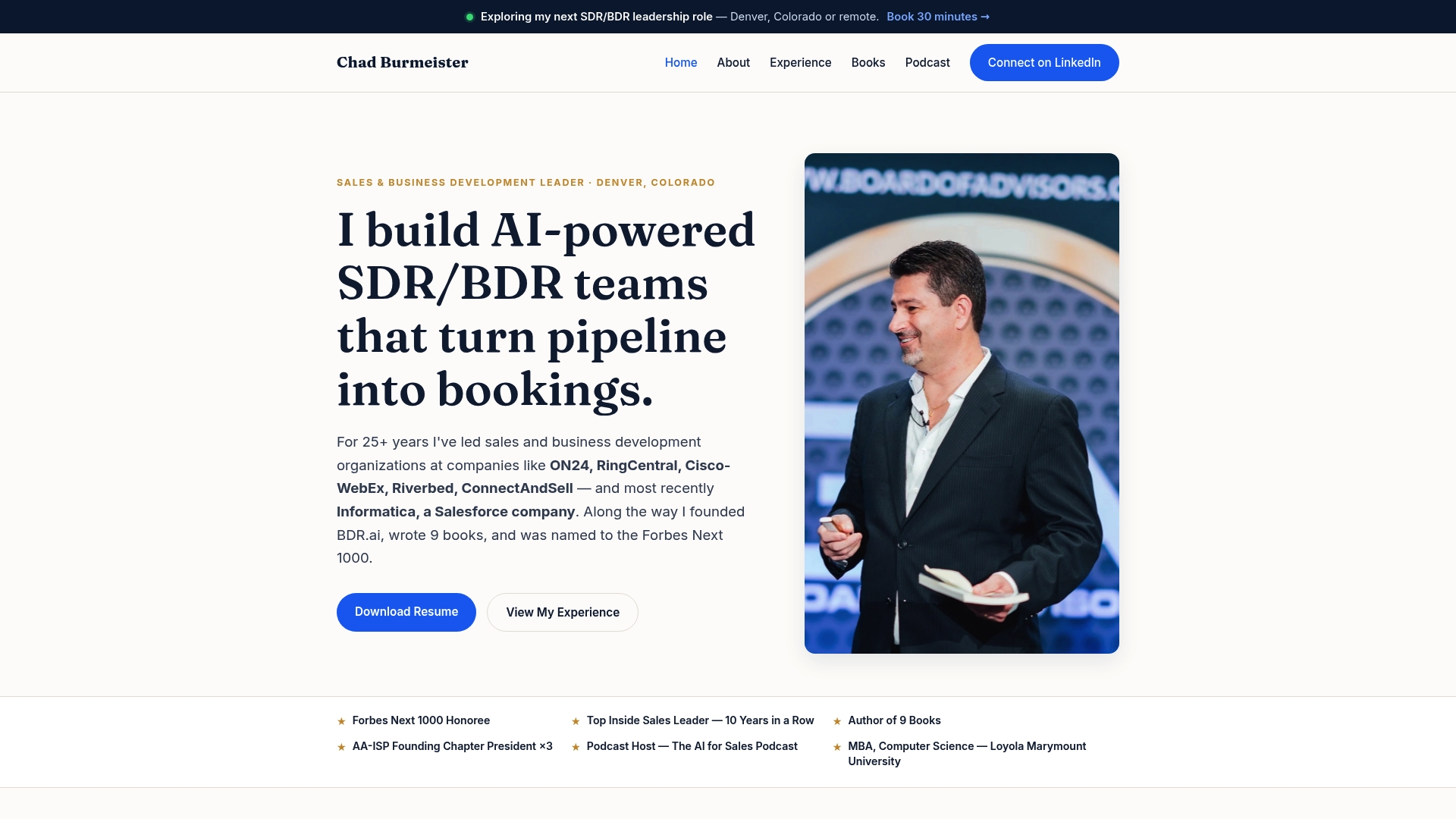
Engagements can include fractional sales leadership to full consulting on hiring, onboarding, and compensation design. For teams that want deeper material before booking a call, Chad's books on AI-driven sales and B2B lead generation walk through the same frameworks in more depth, and The AI for Sales Podcast features ongoing conversations with practitioners solving these problems in real time.
If your remote SDR team needs a leader who has already run this playbook, visit Chad Burmeister's site to see current engagement options and book a conversation.
Sources
A few resources back the specifics in this guide and go deeper than the space here allows: