Use a signal-driven, multichannel sequence, 8 to 12 touches with strict exit rules, that prioritizes prospect relevance over send volume. Skip that, and every other tactic in this article is wasted effort on the wrong list. Below you'll find sequence skeletons, timing windows, channel mix ratios, measurement benchmarks, and copy-ready templates you can put into your CRM this week.
TL;DR:
- Using a signal-driven, multichannel sequence of 8 to 12 touches over 21 to 28 days significantly improves reply and engagement rates compared to email-only outreach.
- Prioritize list hygiene by verifying deliverability, confirming role accuracy, removing duplicates, and tagging prospects by temperature to prevent wasted effort and improve targeting.
- Design sequence skeletons around four core jobs: land, provide value, ask for a meeting, and signal break-up, adjusting timing and touches based on prospect temperature.
- Match channel mix and timing to the buyer's role and behavior, front-loading early touches and spacing out later ones, with email, LinkedIn, and phone as the main channels.
- Focus on targeting and sequence architecture first, including exit rules and signal gating, as they have greater impact on reply rates than template personalization or copy polish.
Table of Contents
- What Is an Outbound Sequence Strategy?
- Foundations: ICP, Signals, and List Quality
- Sequence Architecture and Sample Skeletons
- Channel Mix and Timing: Email, LinkedIn, Phone, and Video
- Personalization, AI, and Signal Routing
- Measure and Optimize: Metrics, Branching, and Testing Cadence
- Deliverability and Compliance Rules That Protect Reputation
- Author Playbook and Quick Templates From Chad Burmeister
- Aligning Sequences With Sales and Marketing Strategy
- Common Challenges and How to Fix Them
- Examples of Sequences That Actually Convert
- The Playbook Advice Everyone Gets Wrong
- Sources
What Is an Outbound Sequence Strategy?
An outbound sequence is a scheduled series of touches, email, LinkedIn, phone, video, sent to a prospect over a defined window with a specific goal at each step. The strategy part is the decision layer sitting on top of it: who gets contacted, why now, through which channels, in what order, and when the system pulls them out.
Most reps confuse the tactic (the email template) with the strategy (the targeting logic and architecture that decides whether the template ever gets read). A 2026 standard sequence runs 8 to 12 touches across 4 to 5 channels over 21 to 28 days, and multichannel sequences routinely substantially increase the reply rates compared to email-only outreach. That single fact should reshape how you build every sequence from here forward: channel diversity isn't a nice-to-have, it's the difference between a campaign that gets ignored and one that gets replies.
The job of a good sequence is narrow: get a qualified prospect to respond, book a meeting, or self-select out, without burning your domain reputation or wasting reps' time on people who were never going to buy. Everything else, including this article, exists to serve that one job.
Foundations: ICP, Signals, and List Quality
Sequence architecture is the easy part. The hard part is ensuring the list feeds the right prospects at the right moment.
Your ideal customer profile (ICP) defines who to target: company size, industry, tech stack, org structure. Intent signals help determine the best timing to target them. For example, a VP of Sales at a company shortly after a significant event such as a funding announcement is a better target, a new hire in the role that owns your budget line, or a product launch that creates a new pain point your solution addresses. Signal-driven targeting means gating your sequence triggers on events like these instead of firing outreach the moment a name lands in your database.
List hygiene determines whether any of that targeting work survives contact with reality. Run through this before a single email goes out:
- Verify deliverability. Bounce rates above roughly 2 to 3% start damaging domain reputation; scrub the list through a verification tool first.
- Confirm role accuracy. Titles change faster than most databases update; a quick LinkedIn cross-check saves you from pitching a former decision-maker.
- Dedupe aggressively. Duplicate records across lists create the "why did I get three of the same email" complaint that kills reply rates and trust simultaneously.
- Separate corporate from personal handling. Gatekeeper-heavy corporate emails often need a different opening move than a founder's direct inbox.
- Tag temperature. Someone who downloaded a whitepaper is warm; someone pulled from a cold list build is not, and treating them the same is the single most common sequence failure.
Prospect temperature should change the sequence itself, not just the tone. A warm lead who engaged with content in the last 30 days can handle a shorter sequence (5 to 7 touches) with a direct meeting ask by touch two or three. A cold, unsolicited-outreach prospect needs more runway, more value delivered before the ask, and a longer sequence to earn the right to request time. Treating both groups identically is why so many reps see a strong list underperform: the list quality was fine, the sequence design ignored temperature.
Sequence Architecture and Sample Skeletons

Before you write a single line of copy, decide what job each step in the sequence is doing. Architecture decides whether touches happen; content decides whether they land, and conflating the two is why so many "high-effort" sequences still flop. Design the skeleton first. Write the words second.
Four step jobs cover almost every touch you'll ever need:
- Land. Introduce yourself and establish relevance, usually tied to a signal or trigger event. No ask yet.
- Value drop. Share something useful, a stat, a resource, a specific observation about their business, with no expectation of a reply.
- Ask. Make the direct request: a 15 minute call, a specific question, a yes/no.
- Break-up. Signal this is the last touch, which counterintuitively often produces the highest reply rate of the entire sequence because it removes pressure.
Each job exists because prospects respond to different psychological cues at different points. Landing too hard with an ask on touch one reads as presumptuous. Never asking reads as passive and gets ignored. The break-up step works because "this is my last email" triggers a completely different reaction than "just following up."
Here are three skeletons built around common buyer situations:
Skeleton A: VP/Director-level, cold, signal-triggered (10 touches, 24 days)
| Day | Channel | Step job |
|---|---|---|
| 1 | Land | |
| 2 | LinkedIn connection + note | Land |
| 4 | Value drop | |
| 5 | Phone | Ask |
| 8 | Value drop | |
| 10 | LinkedIn message | Ask |
| 15 | Video (Loom) | Value drop |
| 18 | Phone | Ask |
| 24 | Ask | |
| 24 | Break-up |
Skeleton B: Individual contributor/SDR-level buyer, cold (8 touches, 18 days)
| Day | Channel | Step job |
|---|---|---|
| 1 | Land | |
| 3 | Land | |
| 5 | Value drop | |
| 7 | Phone | Ask |
| 10 | Ask | |
| 12 | Value drop | |
| 18 | Ask | |
| 18 | Break-up |
Skeleton C: Warm re-entry (previously engaged, 6 touches, 12 days)
- Day 1, Email: reference the prior interaction directly, ask a specific question.
- Day 3, Phone: quick call attempt referencing the same context.
- Day 6, LinkedIn: share something relevant to what they previously engaged with.
- Day 9, Email: direct meeting ask.
- Day 12, Email: break-up, low pressure, keep the door open.
Notice the front-load pattern across all three: touches cluster tightly in the first week, then space widens. That's deliberate. Front-loading three touches into the first five days establishes presence before attention fades, and spacing out afterward avoids looking automated.
Touch count should scale with two variables: rep capacity and prospect value. A named-account, high-ACV target justifies 10 to 12 touches and manual customization at each step. A broader ICP sweep with lower per-deal value should stay closer to 8 touches, leaning on templated personalization at scale so reps aren't spending 20 minutes per prospect on a $5,000 deal.
Channel Mix and Timing: Email, LinkedIn, Phone, and Video
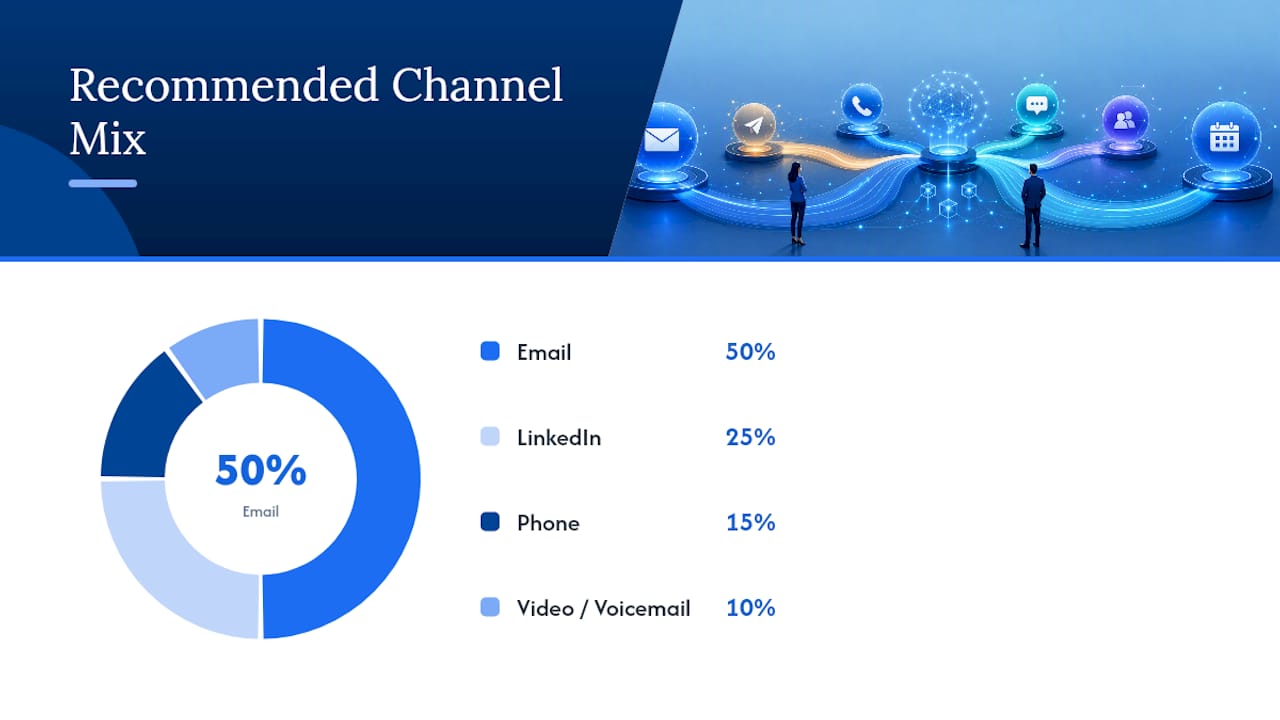
Channel selection isn't about picking your favorite, it's about matching the channel to where your specific persona actually pays attention. A reasonable starting allocation across a full sequence looks like 50% email, 25% LinkedIn, 15% phone, and 10% video or voicemail, though the exact split should shift based on who you're targeting.
Email remains the workhorse because it's asynchronous, scalable, and gives you the most room to include specifics. LinkedIn works best for warming a connection before an ask lands in the inbox, particularly with senior buyers who check LinkedIn more consistently than they check a cluttered inbox. Phone still converts at the highest rate per attempt when you reach a live person, but connect rates keep falling, which is why it should be positioned mid-sequence rather than as the opening move.
A few timing rules worth locking in:
- Front-load hard. Front-loading multiple touches early in a sequence builds presence, while spacing them out keeps engagement without seeming automated.
- Space out afterward. Move from 2 to 3 day gaps early to 4 to 6 day gaps by the back half of the sequence.
- Tuesday through Thursday outperforms Monday and Friday for email opens and calls, though this varies by industry and time zone.
- C-suite prospects respond better to fewer, higher-effort touches (a personalized video, a direct phone attempt) than to a high volume of templated emails.
- Individual contributors tolerate more touches and more channels since the stakes of an unwanted email are lower for them than for a VP fielding dozens of vendor pitches a week.
Differentiation channels earn their place mid-sequence, not at the open. A short Loom video referencing something specific to the prospect's business, a recent product launch, a job posting, a LinkedIn post, cuts through in a way a fifth templated email never will. Direct mail works for high-value named accounts where the cost per touch (often $10 to $50) is justified by deal size; it's a poor fit for a broad SDR sweep. Voicemail should be short (under 20 seconds) and always paired with a same-day email referencing the call, since voicemail alone rarely gets a callback.
For reps building out the phone leg of a sequence, data-backed cold call openers consistently outperform generic scripts, and the same logic applies to LinkedIn outreach: a connection note tied to a specific signal beats a generic invite every time.
Personalization, AI, and Signal Routing
AI has changed what's possible in outbound, but it's changed the wrong things for a lot of teams. Used well, AI drafts first-line openers from public signals and aggregates trigger events, funding rounds, hiring patterns, product launches, at a scale no rep could match manually. Combined with intent-based routing, sending sequences preferentially to accounts already showing buying signals, this can lift reply rates 2 to 3 times without adding a single extra send.

What AI shouldn't do unsupervised is decide tone, craft the offer, or send anything without a human reviewing it first. The tell of an AI-written cold email isn't bad grammar anymore, it's an eerie specificity that reads as automated rather than personal. "I noticed you recently hired a VP of Marketing" lands fine. "I saw you hired Sarah Chen as VP of Marketing on March 3rd" reads like a bot has been watching someone's LinkedIn, and it depresses reply rates instead of lifting them.
If more than one in ten feels like it was clearly written by a machine, tighten your prompt and re-run the batch before it goes live.*
Route sequences based on intent data wherever you have it: website visits, content downloads, hiring signals, technology changes. An account showing three or more intent signals in a 30-day window deserves a shorter, more direct sequence than a cold ICP match with zero signals. AI is an accelerant here, not a substitute for judgment. The teams getting the biggest gains combine AI drafting speed with a human doing final polish before anything reaches a prospect's inbox, and tools designed for AI-assisted cold email make that workflow considerably faster to run at scale.
Measure and Optimize: Metrics, Branching, and Testing Cadence
Track four numbers religiously: reply rate, positive-reply rate (replies that aren't a flat no), meetings booked per 100 prospects, and bounce/unsubscribe rate. Reply rate tells you if the sequence is being noticed. Positive-reply rate tells you if the offer is landing. Meetings booked is the number that actually matters to revenue. Bounce and unsubscribe rates are your early warning system for deliverability trouble before it tanks the whole domain.
Simple branching logic goes a long way: split prospects into engaged (opened, clicked, replied to anything) versus unengaged after touch four, and route each group into a different remaining path. Engaged prospects get a more direct ask sooner; unengaged prospects get one more value-focused touch before the break-up.
What to test, in priority order:
- Subject lines first. Cheapest test, fastest signal, biggest swing in open rates.
- First-line personalization second. This is where reply rate differences usually show up.
- Step job and sequence order third. Bigger lift, but requires more sample size to trust the result.
High-performing teams review sequence performance at least every six months, and the sharpest ones run lighter tests weekly rather than waiting for a big quarterly overhaul. When a sequence underperforms, diagnose in order: list quality first, offer relevance second, sequence architecture last. Most reps reach straight for step three and start rewriting emails, when the actual problem was a bad list or an offer that never matched what the prospect needed.
Deliverability and Compliance Rules That Protect Reputation
Exit rules aren't optional polish, they're the mechanism that keeps your domain sendable. Every sequence needs automatic removal triggers for reply, meeting booked, opt-out request, and hard bounce, and skipping this step is one of the most common mistakes teams make when building sequences themselves.
If a list keeps underperforming after a full sequence run, retire it or move those accounts to a slower nurture track instead of running the same touches again.
Author Playbook and Quick Templates From Chad Burmeister
Launch sprint: research your ICP and signals, pilot on 200 prospects, measure reply and meeting rates, then iterate before scaling.
- Opener 1: "Saw [company] just [signal, hire/launch/funding]. Teams in that spot usually hit [specific pain] within the first 90 days, curious if that's on your radar?"
- Opener 2: "Quick one, [specific observation about their business]. Worth 15 minutes to see if [outcome] is relevant right now?"
- Break-up line: "Haven't heard back, so I'll assume timing's off. Door's open if that changes."
Drop proprietary win-rate data or client results here once available.
Aligning Sequences With Sales and Marketing Strategy
An outbound sequence built in isolation from marketing is a sequence fighting itself. If marketing is running a paid campaign or content push targeting the same accounts your SDRs are cold-emailing that week, the prospect gets hit from two directions with two different messages, and it reads as disorganized rather than persistent.
The fix is shared account lists and a shared calendar. Marketing's intent signals, webinar attendees, content downloaders, ad engagers, should feed directly into which accounts get prioritized for outbound and how warm the opening touch can be. Conversely, outbound's qualification insights, what objections keep coming up, which messaging actually gets replies, should flow back to marketing to sharpen ad copy and landing pages. Sequences work best as one instrument in a coordinated set, not a standalone SDR activity running parallel to everything else.
This also means agreeing on definitions before scaling anything: what counts as a qualified lead, what counts as a "engaged" account, and who owns follow-up when marketing generates a reply outside a formal sequence. Misalignment here shows up months later as duplicate outreach, conflicting messaging, and reps unsure whether an account is already being worked. Fix the handoff rules once, in writing, and both teams stop stepping on each other.
Common Challenges and How to Fix Them
The most common failure isn't a bad template, it's skipping the exit rules and letting prospects sit in a sequence after they've already replied or booked. That single gap creates the "why are you still emailing me" complaints that damage trust and, at scale, domain reputation.
The second challenge is treating every prospect identically regardless of temperature or seniority. A cold list run through the same aggressive 12-touch sequence built for warm leads burns goodwill fast. Segment before you send, not after you notice the reply rate cratering.
Deliverability decay is the third recurring problem: a domain that worked fine at 200 sends a day starts bouncing at 1,000 because nobody adjusted throttling as volume scaled. Monitor bounce rate weekly, not quarterly, and pull back the moment it drifts upward.
Finally, teams often rewrite sequence copy when the real problem sits upstream in list quality or offer fit. Diagnosing in the wrong order, architecture before offer list, wastes weeks of testing on the wrong variable. Fix list and offer first; architecture tweaks matter far less than most reps assume.
Examples of Sequences That Actually Convert
A signal-triggered sequence targeting VPs at companies that just closed a funding round, opening with a reference to the raise and a specific pain tied to scaling, consistently outperforms a generic cold sequence sent to the same title with no trigger. The difference isn't the copy quality, it's that the prospect has a live, current reason to care.
A re-engagement sequence aimed at closed-lost opportunities from 6 to 12 months prior, referencing the specific reason the deal stalled and what's changed since, tends to book meetings faster than fresh cold outreach because the relationship groundwork already exists. Skip the land step entirely and go straight to value drop and ask.
A short, phone-heavy sequence for enterprise named accounts, where a rep does manual research on each prospect and leads with a specific observation rather than a template, converts at a meaningfully higher rate per prospect than a high-volume email sequence, even though it reaches far fewer people. The lesson across all three: relevance to a specific, current situation beats volume every time, and the sequence skeleton should flex to match how much relevance you can credibly deliver.
The Playbook Advice Everyone Gets Wrong
Most outbound advice still treats sequences like a set-and-forget email chain: write ten templates, load them into a tool, and let volume do the work. That's the exact model 2026's best-performing teams have abandoned. The research is clear that structure, not copy polish, drives most of the reply-rate difference between sequences, and yet most reps still spend their limited time rewriting subject lines instead of fixing the exit rules or the targeting signal that decides who gets contacted in the first place.
The conventional wisdom oversells personalization at the sentence level and undersells personalization at the targeting level. A generic-sounding email sent to someone who just triggered three intent signals will outperform a hyper-personalized email sent to someone with zero signals and no real reason to respond right now.
If you take one thing from this and change it this week, don't rewrite your templates. Build your exit rules and your signal-gating logic first. Everything downstream of that, channel mix, timing, AI-assisted drafts, works better once the sequence is only reaching people who were worth contacting in the first place.
— Chad
Ready to build a sequence architecture custom to your pipeline instead of retrofitting a template? Chad Burmeister works directly with sales leaders on executive-level SDR and BDR team leadership to build these systems from the ground up, backed by frameworks detailed in his books on AI-driven sales and B2B lead generation. For deeper practitioner conversations on what's working right now, the archive of The AI for Sales Podcast is worth a listen.
Sources
- Outbound Sales Sequencing: The Complete 2026 Cadence Framework | Nimitai
- Sales sequence best practices (HubSpot)
- The Science of Sales Sequences: Optimal Timing, Channels, and Cadence | Prospectory Blog
- Outbound Sequences: How to Design One | Real Good GTM