Lead scoring assigns point values to prospects based on fit and behavior, so sales teams know which leads to call first. If you're starting from zero, build a point-based or tiered model this week, not a predictive one. Predictive and relational models outperform simple rules only after you have volume and clean, labeled outcome data to train them on.
Here's what justifies skipping straight to something more advanced:
- You're processing hundreds of qualified leads a month, not dozens.
- You have at least six to twelve months of closed-won and closed-lost data tagged accurately in your CRM.
- Your current rules model has stalled: reps ignore the score, or the "hot" leads aren't converting any better than the "cold" ones.
- You need to detect signals across multiple contacts at an account, not just one form-fill.
Absent those conditions, a well-built point system will outperform a rushed predictive model almost every time.
Key Takeaways
Lead scoring models work when they combine a simple, backtested point structure with strict decay, negative scoring, and a routing SLA that sales actually honors.
| Point | Details |
|---|---|
| Start with point-based or tiered scoring | Predictive and relational models only pay off once you have volume and clean outcome history. |
| Split fit from intent | Track fit and intent as separate subscores so strong and weak signals don't cancel each other out. |
| Cap, decay, and disqualify | Cap repeatable actions, decay stale behavior after 60 to 90 days, and subtract points for disqualifying traits. |
| Backtest before routing live | Retro-score closed-won and closed-lost deals to confirm higher bands actually convert better. |
| Get an outside audit when trust breaks down | Chad Burmeister offers model design and scoring audits when reps stop trusting the current MQL definition. |
Table of Contents
- Lead Scoring Models Explained: Scoring vs. Qualification
- The Main Types of Lead Scoring Models and Who Should Use Each
- How to Build a Working Lead Scoring Model in Six Steps
- Choosing Signals, Setting Decay, and Weighting Accounts Correctly
- Backtesting Your Model: Proving It Actually Predicts Revenue
- Operationalizing Scores: Routing, SLAs, and CRM Writeback
- When Rules-Based Scoring Stops Being Enough
- Practitioner Notes: Adoption, Governance, and Common Pitfalls
- My Recommended Minimum Viable Scoring Setup
- Get Hands-On Help Designing or Auditing Your Model
- Frequently Asked Questions
- Sources
Lead Scoring Models Explained: Scoring vs. Qualification
Lead scoring and lead qualification get used interchangeably, and that's a mistake that causes real friction between marketing and sales. Scoring is the mechanical part: a number, generated automatically, that ranks a lead against your criteria. Lead qualification is the broader decision, made by a person or a rule engine, about whether to actually pursue that lead. A high score doesn't guarantee qualification. It just means the lead deserves a look.
Most functioning models run on a 0 to 100 scale, split into two subscores that get tracked separately before they're combined:
- Fit score — how closely the account matches your ideal customer profile (industry, size, role, geography).
- Intent score — how the person is behaving right now (pricing page visits, demo requests, content downloads, email engagement).
Keeping these separate matters more than most teams realize. A perfect-fit account that's gone quiet looks identical, on a blended score, to a terrible-fit account that just downloaded three whitepapers in an afternoon. Split subscores let you catch that difference and route accordingly, feeding directly into your MQL and SQL definitions and who owns the follow-up.
The Main Types of Lead Scoring Models and Who Should Use Each
Five approaches dominate B2B lead qualification frameworks, and picking the wrong one for your data maturity is the single most common setup mistake.
Point-based scoring assigns fixed values to actions and attributes, then sums them. It's the fastest to build and the easiest to explain to a sales team that doesn't trust a black box. The downside: it treats every signal as additive, so a lead can rack up points from low-value repeat actions (opening the same email five times) and look hotter than they are.
Tiered or matrix scoring plots fit on one axis and intent on the other, producing a grid instead of a single number. This solves the cancellation problem point systems create, where great fit and weak intent (or vice versa) average out to a mediocre score that hides the real story. A matrix keeps a high-fit, low-intent account visible as a nurture target instead of burying it under a blended 45 out of 100.
Predictive scoring uses machine learning trained on your historical conversions to weight signals automatically, often finding patterns humans miss. It needs volume and clean outcome labels to work. Feed it messy or sparse data and it will confidently produce garbage.
Intent-based scoring layers in third-party signals, tracking when accounts research competitor products or relevant topics across the web, not just on your own site. This catches in-market buyers before they ever fill out a form, which is why pairing it with B2B intent data providers has become standard for teams selling into longer sales cycles.
Relational scoring goes a step further, reading connected data across CRM, billing, and product usage tables to catch patterns like a colleague signal (multiple people at the same account engaging) or a content-sequence signal (the specific order someone consumes your material). Relational models can achieve a 5 to 8x lift over random at the top decile, compared to 3 to 5x for predictive models built on flat CRM tables.
Most teams don't need the last two on day one. Practitioner guidance consistently recommends starting with point-based or tiered scoring, then graduating once you've outgrown what rules can capture.
How to Build a Working Lead Scoring Model in Six Steps
You don't need a data science team to launch a credible model. You need discipline about what counts as a conversion and the patience to test before you route.
1. Define your conversion event and ideal customer profile. Decide, in writing, what a "won" outcome actually means: a closed deal, a qualified opportunity, a paid trial start. Then define your ICP using firmographic traits your best customers actually share, not the ones you assumed mattered.

2. Choose five to ten high-signal criteria. Resist the urge to score everything. A 100-point template that works well splits the total into fit (40 points), intent (40 points), and recency or account activity (20 points). Pick criteria within each bucket that actually correlate with your ICP, not every field in your form.
3. Set point values and define bands. Assign heavier weight to your strongest predictors. Then set score bands that map to action: 0 to 39 stays in nurture, 40 to 69 becomes a marketing-qualified lead, 70 to 100 routes straight to sales as sales-qualified.
4. Build in negative rules from day one. Competitor domains, students, job seekers, and disposable email addresses should subtract points or trigger automatic disqualification. Skipping this step is one of the most common reasons scores drift upward without meaning anything.

5. Retro-score your historical leads. Before you go live, run the model against six to twelve months of closed deals. Check whether leads that scored high actually closed at a higher rate than leads that scored low. If they didn't, your weights are wrong, and you'll find out now instead of three months into production.
6. Run in parallel, then cut over. Let the new score run alongside your old process (or no process) for two to four weeks. Track SLA acceptance rates and conversion by band before you shut off the old system. Iterate weights based on what you see, then repeat the audit quarterly.
Pro Tip: Build your first model in a spreadsheet before you touch your marketing automation platform. It's far faster to test ten weighting scenarios in Excel or Google Sheets than to rebuild workflow logic in HubSpot or Salesforce every time you want to try a new threshold.
Choosing Signals, Setting Decay, and Weighting Accounts Correctly
The criteria you pick determine everything downstream, and most teams get the balance wrong in predictable ways.
Fit signals describe who the lead is: industry, company size, job title, tech stack, geography. These come from firmographic data and rarely change week to week, so they don't need decay. Behavior signals describe what the lead does: pricing page visits, demo requests, product usage, email clicks. These need decay, because a demo request from eight months ago tells you almost nothing about intent today.
- Cap any single repeatable action (like opening the same email) so it can't be farmed for points.
- Apply decay windows to behavioral points, typically zeroing them out after 60 to 90 days of inactivity.
- Use negative scoring aggressively for disqualifying traits, not just low scores for them.
- Apply an account-level multiplier when three or more contacts at the same company engage independently. That's often a stronger buying signal than any single action.
Common failure modes in lead scoring trace back to skipping exactly these controls: no caps lead to score inflation, no negative scoring lets bad-fit leads through, and no decay lets stale signals linger indefinitely.
| Signal type | Example | Decay applied? |
|---|---|---|
| Firmographic fit | Company size, industry, role | No |
| Behavioral intent | Pricing page visit, demo request | Yes, 60 to 90 days |
| Negative/disqualifying | Competitor domain, student email | No (permanent subtraction) |
| Account engagement | Multiple contacts active | Multiplier, not decay |
Backtesting Your Model: Proving It Actually Predicts Revenue
A model that hasn't been backtested is a guess with extra decimal places. The only way to know if your scoring criteria mean anything is to retro-score historical leads and see whether your top band actually closed at a meaningfully higher rate than your bottom band.
Run this audit against six to twelve months of closed-won and closed-lost records. If leads scoring 80 to 100 converted at roughly the same rate as leads scoring 20 to 40, your weights aren't finding signal. That's common on a first pass and not a reason to panic. It's a reason to adjust.
Track these KPIs on a recurring cadence, not just at launch:
- MQL to SQL conversion rate, broken out by score band.
- SQL to opportunity rate, to check whether sales agrees the scored leads are actually worth working.
- Average deal size and cycle length by band, since a "hot" lead that takes twice as long to close isn't as hot as it looks.
- Score distribution drift over time, since a model that quietly starts scoring everyone above 70 has stopped discriminating between leads at all.
Set a review cadence of once per quarter at minimum, with a trigger review any time the sales team starts complaining that MQLs are junk. That complaint is usually accurate and usually means your model needs reweighting, not that sales is being difficult.
Operationalizing Scores: Routing, SLAs, and CRM Writeback
A perfect score means nothing if it sits unused in a dashboard. Turning the number into revenue requires operational plumbing that most teams underbuild.
- Assign explicit owners. Marketing owns leads below the MQL threshold. Sales development owns MQLs. Account executives own SQLs. Write this down; don't leave it to Slack culture.
- Set acceptance SLAs by band. A lead scoring 90+ with a demo request should get a callback attempt within five minutes. A standard MQL might carry a same-day SLA. Missed SLAs should be visible in a dashboard, not discovered anecdotally.
- Pass a complete handoff payload. Every routed lead needs its fit score, intent score, top three triggering actions, and the last touch point, not just a name and a number.
- Write the score back into the CRM. Reps need to see it inside Salesforce or HubSpot where they already work. Without reliable CRM writeback, even an accurate model gets ignored, because nobody's going to check a separate dashboard before every call.
- Build a manual review path for borderline leads. Scores sitting right at a threshold boundary (say, 68 to 72 on a 70-point cutoff) deserve a human glance rather than an automatic routing decision either way.
When Rules-Based Scoring Stops Being Enough
Upgrading to predictive or relational scoring is an infrastructure decision, not a feature toggle you flip because a vendor pitched it well.
- You need real volume, generally hundreds of scored leads a month, plus six months or more of clean, accurately labeled outcome data.
- Your data has to be trustworthy. Predictive models trained on inconsistent CRM hygiene will confidently learn the wrong patterns.
- You're seeing multi-contact accounts where colleague signals and content sequencing genuinely change the buying picture. That's the specific case where relational models earn their engineering cost.
- Your team can support the writeback integrations and periodic retraining a predictive model demands, which usually means involving data engineering, not just marketing ops.
Practitioner Notes: Adoption, Governance, and Common Pitfalls
Building the model is the easy half. Getting sales to trust it and actually act on it is where most rollouts quietly fail.
Explainability beats accuracy in the first ninety days. A rep who can see exactly why a lead scored 85, three demo visits, a director title, a 500-person company, will trust and act on that score. A rep handed an opaque predictive number with no rationale will simply revert to gut instinct, no matter how statistically sound the model is underneath.
Assign one named person as the scoring model's owner, with authority to adjust weights and a standing quarterly review on the calendar. Watch for three specific failure signs: score inflation from uncapped repeatable actions, stale behavioral signals that never decay, and an ownership gap where nobody notices the model has drifted until a sales leader complains.
My Recommended Minimum Viable Scoring Setup
If I were building this from scratch tomorrow, I'd keep it embarrassingly simple at first. Five point-based signals, split into a fit subscore and an intent subscore, tracked separately rather than blended into one number. Nothing predictive, nothing relational, not yet.
Run it quietly for one week without routing anything live, just to catch obvious weighting errors. Then backtest against ninety days of closed deals before you let a single lead route to sales off the new score. Name one owner for the model and report acceptance and conversion numbers weekly during that rollout window. Once the numbers hold up for a full quarter, that's when it's worth discussing whether predictive scoring earns its complexity.
Get Hands-On Help Designing or Auditing Your Model
Reading a build guide gets you most of the way there. What it can't do is catch the specific weighting mistakes and data gaps unique to your CRM, your sales cycle, and your team's actual behavior once a score goes live. That's the gap a short, focused engagement closes fast.
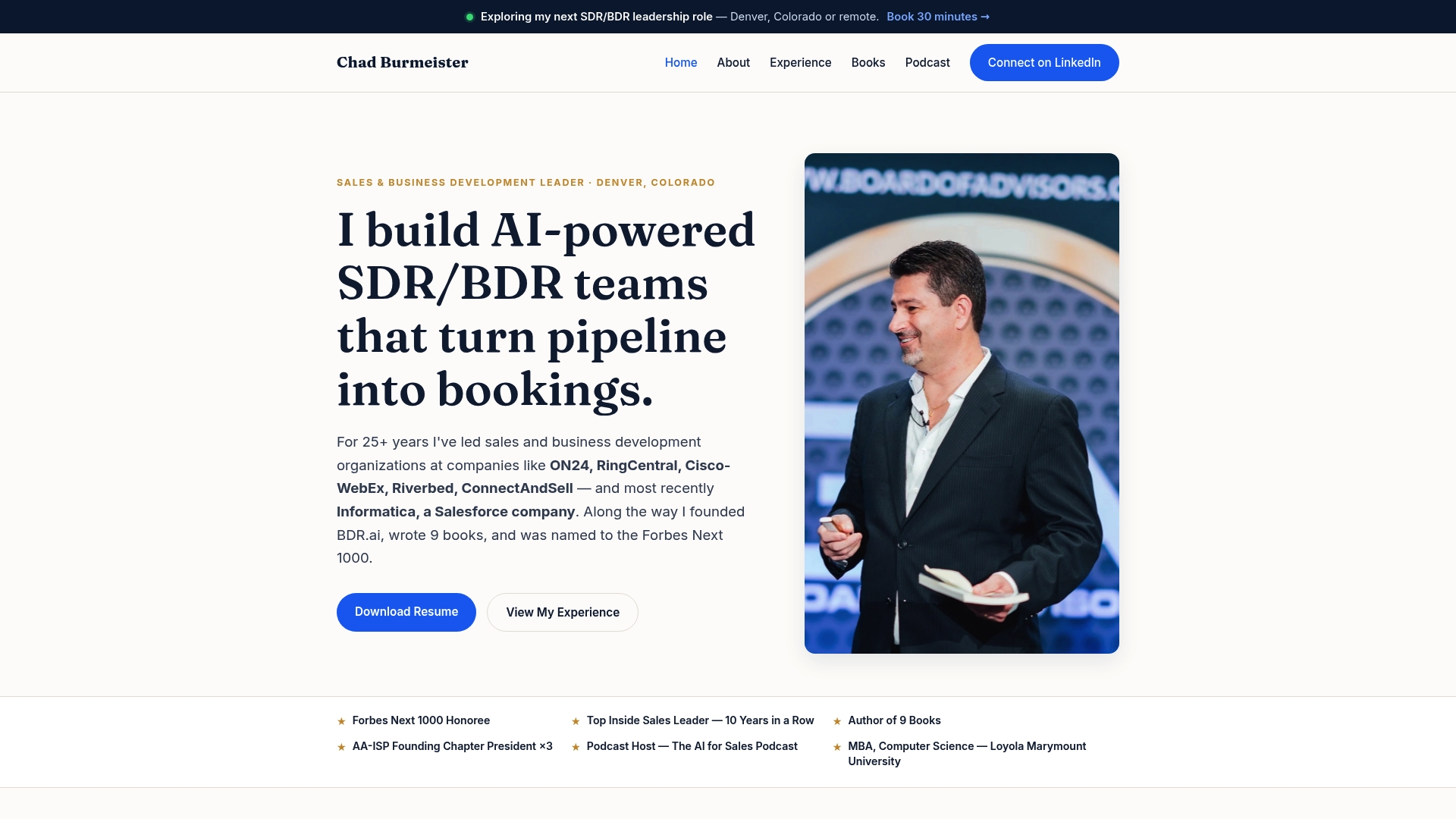
Chad Burmeister works directly with sales and marketing leaders on model design, scoring audits, and pilot rollout playbooks, the same steps outlined above, but applied to your actual pipeline data instead of a hypothetical one. A short engagement typically covers reviewing your current criteria and weights, retro-scoring a sample of your closed deals to find where the model breaks, and building the SLA and handoff structure your sales team will actually use. If your reps have stopped trusting your current MQL definition, that's usually the clearest sign it's time for an outside audit rather than another internal tweak. Teams looking to scale this further alongside a broader automation buildout can also look at how marketing automation platforms support lead routing at scale. Visit Chadburmeister to book a working session, or pick up the playbooks in Chad's books for a deeper self-guided build.
Frequently Asked Questions
What is a good lead scoring example for a small B2B team? A basic model might award 20 points for matching your ICP industry and size, 15 points for a demo request, 10 points for a pricing page visit, and negative 25 points for a competitor email domain, with anything above 60 routing to sales.
How is behavioral lead scoring different from firmographic scoring? Behavioral lead scoring tracks actions, like page visits and email clicks, that decay over time, while firmographic scoring tracks static traits like company size and industry that don't need decay rules.
What lead qualification criteria matter most for B2B teams? Industry fit, company size, job title or seniority, and buying-stage behavior like demo requests consistently show up as the highest-weighted criteria in point-based B2B lead qualification frameworks.
How often should we recalibrate our lead scoring model? Review it quarterly at minimum, and trigger an off-cycle review any time sales starts flagging that MQLs feel low quality, since that's usually a sign the weights have drifted from what's actually converting.
Do we need a data science team to build a predictive lead scoring model? Not to start. Most teams should build and validate a point-based model first, since it produces value quickly and generates the labeled data a predictive model would need to train on later.
Sources
Several practitioner guides informed the frameworks above, and each is worth reading directly if you're building your first model or auditing an existing one.
- Kumo
- Lead Scoring Models: How to Build Your First One (2026) | Leadanic
- B2B Lead Scoring Model: 100-Point Template (2026)
- How to Build a Lead Scoring Model That Actually Predicts Conversions | Pecan AI