Faith-driven leadership means leading from a biblical worldview that governs your actual decisions, not just your vocabulary, so mission and character carry as much weight as quarterly results. It draws on frameworks like Regent University's Four Cs and shows up in how you hire, how you handle a missed quota, and how you define a win. Done right, it builds teams that outlast market pressure because people trust the person leading them.
TL;DR:
- Faith-driven leadership requires decisions that honor both results and people, guiding behavior even under pressure to meet quotas or goals.
- The Four Cs framework emphasizes calling and competence first, with character and confidence developing through faithful practice over time.
- Leaders should regularly assess whether their actions reflect their core values, balancing faithfulness to process and people with KPIs.
- Inclusive teams thrive when values like integrity and dignity are practiced universally, without requiring shared beliefs or religious participation.
- Genuine faithfulness builds trust that endures market downturns, but leaders must avoid compartmentalizing faith and treating it as only a Sunday activity.
Table of Contents
- What Faith-Driven Leadership Means in Practice
- The Four Cs and Five Marks Every Leader Needs
- Turning Belief Into Daily Leadership Habits
- Coaching, Workshops, and Mentoring: Choosing the Right Path
- What This Looks Like in Sales Leadership
- The Pitfalls That Quietly Undermine Faith-Driven Leadership
- Where This Framework Actually Comes From
- Faith-Driven Leadership and Inclusive Teams
- The Long Game on Faith-Driven Leadership
- How Chad Burmeister Helps Leaders Build This
- Sources
What Faith-Driven Leadership Means in Practice
A lot of leaders say they run a "faith-based" organization because they open meetings with a devotional or hang a Bible verse in the lobby. That's faith language. Faith-driven leadership is different: it's a biblical worldview that actually governs decisions, from who gets promoted to how a layoff gets handled. Anchor University's explainer draws exactly this distinction, arguing that the real marker is whether faith shapes decision-making, team health, and how you define success, not whether it shapes your office decor.

Outcome-only leadership asks one question before every decision: did it move the number? Faith-driven leadership asks a second question that sits alongside the first: did it honor the people involved? Sometimes those answers align. Sometimes they don't, and that tension is where the leadership actually happens.
This shows up across very different settings:
- Ministry organizations, where the mission is explicit and faith-driven leadership is the baseline expectation.
- Nonprofits, where mission and funding pressure often collide, and faith provides the tiebreaker.
- Business and sales teams, where faith-driven leadership is less common and often the hardest to sustain under quota pressure.
The King's University frames this well: faith-driven leaders often have to trust revealed truth precisely when they can't verify the outcome in advance. That's not a comfortable position. It's also the position every leader eventually finds themselves in, faith-driven or not.
The Four Cs and Five Marks Every Leader Needs
Regent University built a framework worth stealing for your own development plan: the Four Cs of Christian leadership, sequenced deliberately rather than randomly.
- Calling. Before anything else, is this person actually suited to lead here, or are they filling a seat? Calling comes first because it filters everyone else out.
- Competence. Once calling is established, train for skill. Good intentions without competence produce well-meaning failure.
- Confidence. Coach the leader to trust their training under pressure. Confidence built on competence is durable; confidence built on charisma alone isn't.
- Character. Character comes fourth in the sequence, not because it matters least, but because Regent's framework argues you shouldn't let character assumptions substitute for actually vetting calling and skill first.
Alongside the Four Cs, a recurring set of five marks distinguishes leaders people actually trust: a servant heart, spiritual integrity, visionary faith, a multiplication mindset (developing other leaders, not just followers), and resilient perseverance. A sales VP with a servant heart still meets performance goals, but she gets there by removing obstacles for her reps instead of pressuring them.
Run this checklist on yourself once a quarter: Do I know my calling here, or am I just occupying the role? Am I still growing in competence, or coasting? Does my confidence come from preparation or performance? Would my team describe my character the same way I would?
Pro Tip: Score yourself 1 to 5 on each of the five marks every ninety days. The score matters less than watching which number refuses to move.
Turning Belief Into Daily Leadership Habits
Faith that only shows up in a Sunday devotional isn't faith-driven leadership. It has to survive Tuesday's budget meeting.
Before a major decision, ask questions rooted in something bigger than the P&L: Does this decision treat people as ends in themselves or only as means to a number? Would I be comfortable if this choice were made public? Am I acting out of fear of missing a target, or out of conviction about what's right?
Team rhythms help make this durable rather than occasional:
- A brief, optional reflection or prayer at the start of a leadership meeting, framed so no one feels excluded for their beliefs.
- Regular one-on-one mentoring that addresses character and skill, not just pipeline numbers.
- A monthly review that asks "did we treat people well" alongside "did we hit the number."
On measurement: KPIs still matter, but faith-driven leaders track a second column. Anchor University's research points to defining success by faithfulness to process and people, not results alone. That means tracking things like how many difficult conversations you had honestly, not just how many deals closed.
On pluralistic teams, don't require shared belief. Require shared behavior. You can build a culture of integrity, service, and dignity that a team member of any faith or no faith can fully participate in.
Pro Tip: If a team ritual only works for people who share your exact theology, it's not a leadership rhythm. It's a filter. Redesign it.
Coaching, Workshops, and Mentoring: Choosing the Right Path
Not every leader needs the same development path. A first-time manager usually needs mentoring more than a workshop. A leadership team wrestling with culture drift usually needs a facilitated cohort more than one-on-one coaching.
- One-on-one coaching fits leaders who need accountability on a specific blind spot, especially around the character and confidence stages of the Four Cs.
- Workshops work well for onboarding a whole team to a shared vocabulary, fast.
- Cohort programs suit leaders who learn best alongside peers facing the same pressures, and who need ongoing accountability past a single event.
- Embedded, longer-term support, like the embedded leadership programs from Solano Advisory Group, fits organizations that want structured accountability built into daily operations rather than an occasional session.
Whichever format you pick, vet the coach or program the same way you'd vet a hire: ask what framework they use, whether they've led under real pressure, and whether their idea of success matches yours. A coach who's faith-aligned in language but not in method will create more confusion than clarity, since values misalignment tends to fracture a team's sense of shared mission rather than strengthen it.
What This Looks Like in Sales Leadership
Faith-driven leadership sounds cleanest in a mission statement and hardest in a sales floor with a quota on the wall. That's exactly where it gets tested. Sales leaders who reconcile faith with a number to hit tend to lean on two things: consistent personal spiritual discipline, and a decision to treat selling as service rather than extraction. The Denver Institute for Faith & Work's coverage of quota-driven sales leaders captures this directly: prayer as a daily discipline, paired with a genuine focus on the dignity of the client and the rep, not just the close.
Chad Burmeister has spent 25-plus years building and leading sales and business development teams at companies including Informatica, RingCentral, and Cisco WebEx, and that experience shapes how he coaches leaders to hire for calling before skill, and to build teams where the KPI and the character review get equal airtime.
Reframing the sale as service to the buyer, rather than pressure applied to a prospect, changes how a rep opens a call and how a leader measures the month.
A workable 90-day checklist for any leader trying to start this shift: identify one non-negotiable value you'll enforce even when it costs revenue. Run one weekly one-on-one focused purely on character and growth, no pipeline talk. Track one faithfulness metric alongside your KPI. Ask your team, at day 90, whether they trust you more than they did on day one.
The Pitfalls That Quietly Undermine Faith-Driven Leadership
The most common failure isn't hypocrisy. It's compartmentalization, treating faith as a Sunday activity that never touches Monday's decisions. Leaders who split their lives this way tend to burn out faster, because they're managing two identities instead of integrating one; treating work itself as a form of service tends to reduce that internal conflict rather than add another obligation on top of it.
A second pitfall: using faith language as a shield against accountability. "Trust the process, trust God" can become a way to avoid admitting a strategy failed. Faith-driven leadership doesn't exempt you from honest performance reviews. It should make those reviews more honest, not less.
A third: alienating team members who don't share your beliefs. A leader who assumes shared faith creates an in-group and an out-group without meaning to, and that quietly erodes trust across the whole team.
A fourth: sequencing character before competence in hiring, which sounds virtuous but often backfires. A well-meaning hire who can't do the job doesn't help anyone, which is exactly why the Four Cs framework puts calling and competence ahead of character in the development sequence.
The fix for most of these isn't a new program. It's a regular, honest audit: ask a trusted peer or mentor whether your stated values and your actual decisions from the last month match. Most leaders who drift do so slowly enough that they don't notice without outside input.
Where This Framework Actually Comes From
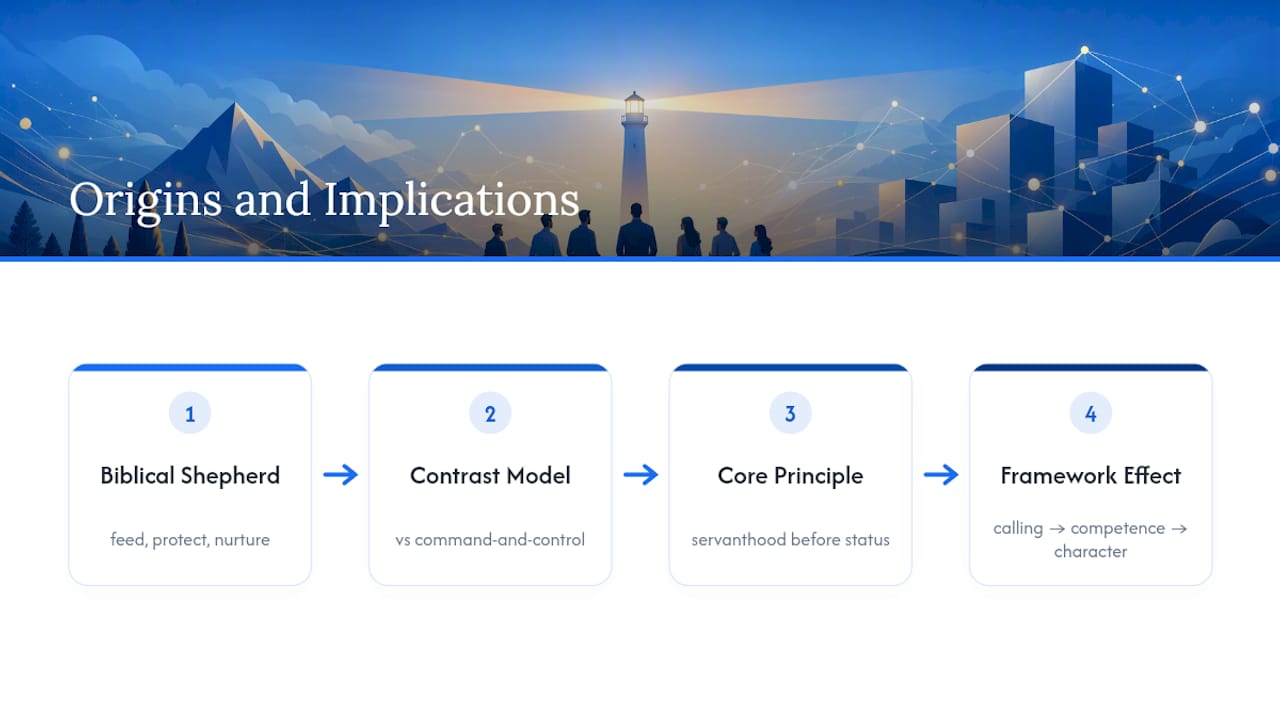
Faith-driven leadership isn't a modern branding exercise. Its language draws on the shepherd model that runs through both the Old and New Testaments, where a leader's job is described as feeding, protecting, and nurturing those in their care, a picture that shows up repeatedly in Christian leadership literature as the counterpoint to a command-and-control model of authority.
That framing matters because it defines success differently from the start. A shepherd isn't judged by how fast the flock moves. A shepherd is judged by whether the flock is safe, fed, and intact at the end of the season. Applied to leadership, that means the measure of a good quarter includes whether your people are healthier at the end of it, not just whether the number landed.
The theological throughline is servanthood before status, a reversal of the typical leadership hierarchy where authority flows downward and service is what subordinates owe the leader. Faith-driven leadership inverts that: the leader serves first, and authority follows from trust earned rather than title assigned.
This history explains why the Four Cs sequence calling before competence. A calling implies a leader answers to something beyond the org chart, which is a fundamentally different foundation than ambition or opportunity. It also explains why character sits fourth rather than first: historically, character was understood as something formed over years of tested leadership, not a starting credential you either have or don't. The framework treats character as an outcome of faithful practice, not a prerequisite you list on a resume.
Faith-Driven Leadership and Inclusive Teams
Here's the tension leaders avoid naming: faith-driven leadership is rooted in a specific worldview, and most modern teams include people who don't share it. That's not a flaw to work around. It's a design constraint, and faith-driven leaders who handle it well treat the two as compatible rather than competing.
The move that works is separating belief from behavior. You don't need a Muslim, atheist, or secular team member to share your theology to benefit from a leader who practices servanthood, integrity, and dignity toward every person on the roster. Those values are the output of a faith-driven approach, not exclusive property of it, and a team member of any background can recognize and trust a leader who lives them consistently.
Where this breaks down is when leaders confuse personal conviction with organizational policy, requiring participation in explicitly religious practices as a condition of belonging or advancement. That's the fastest way to turn a values-based culture into an exclusionary one, and it usually happens gradually, through small defaults, like who gets invited to informal gatherings, rather than a single deliberate decision.
The better standard: hold your convictions privately and firmly, and hold your team's dignity publicly and universally. A faith-driven leader who does both builds a culture where people of any background can say honestly that they're treated fairly, mentored seriously, and judged on their work. That's a harder standard than simply hiring people who think like you, and it's the one that actually holds up under scrutiny.
The Long Game on Faith-Driven Leadership
Faithfulness compounds slower than metrics but outlasts them. It builds the kind of trust a team draws on when the market turns. The honest caveat: on pluralistic teams, faith-driven values sometimes create friction with pure results-first pressure, and pretending otherwise helps no one. Start with one habit. Let it hold under pressure before adding a second.
— Chad
How Chad Burmeister Helps Leaders Build This
If you're trying to sequence your own development the way the Four Cs framework suggests, calling, then competence, then confidence, then character, the fastest path is learning from someone who's already led sales teams through that exact tension between quota and conviction.
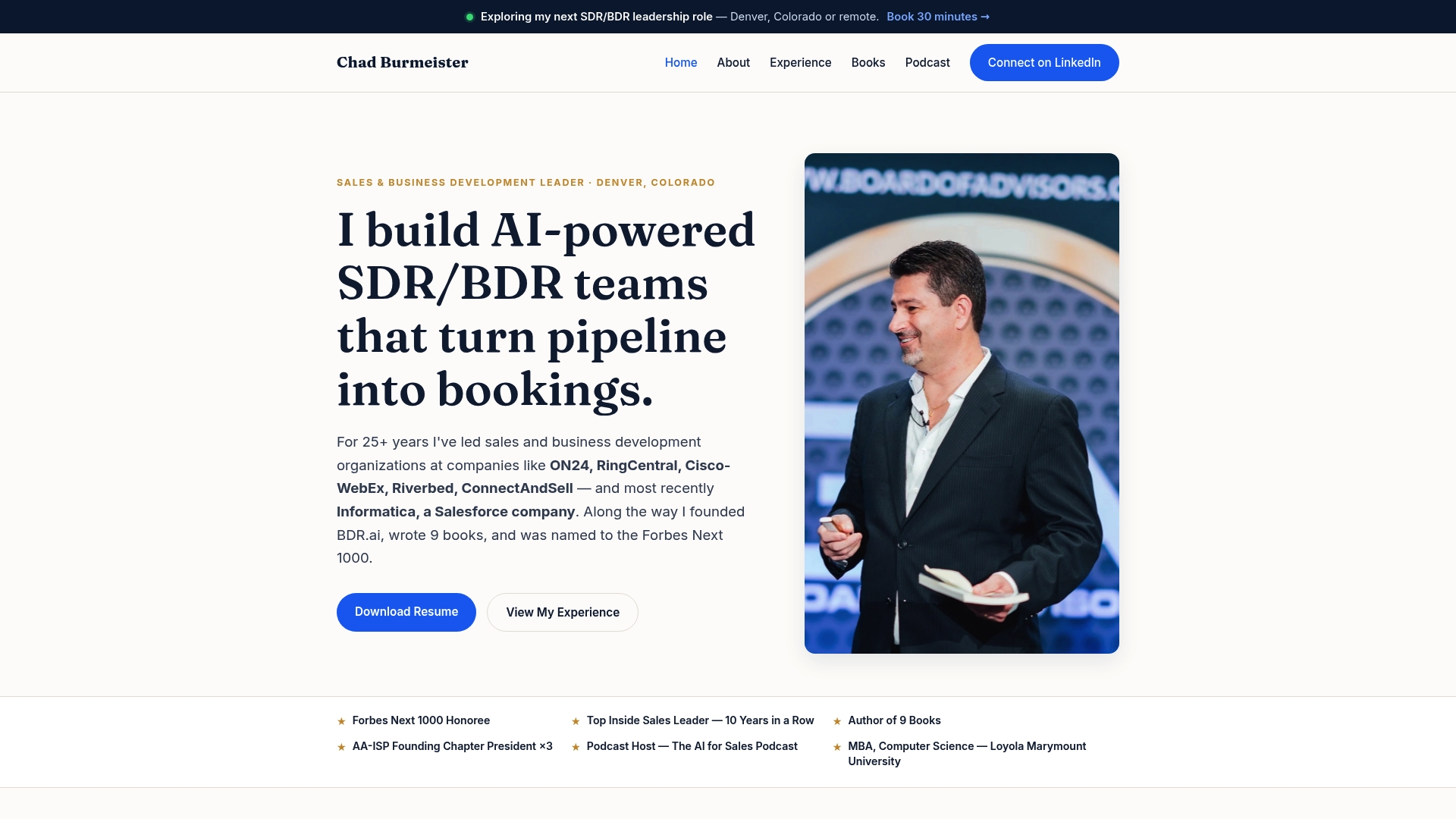
Chad Burmeister brings 25-plus years leading sales and business development teams at companies like Informatica, RingCentral, and Cisco WebEx, and translates that into coaching for leaders who want their numbers and their values pointed the same direction. His books on sales strategy and leadership work well for self-study if you'd rather absorb the frameworks on your own schedule, and The AI for Sales Podcast puts you inside real conversations with practitioners wrestling with these same questions in live sales organizations. If you're building or hiring a leadership team and want that guidance applied directly to your organization, visit Chadburmeister to see coaching, speaking, and consulting options and find the format that fits where your team is right now.
Sources
- The Four Cs of Christian Leadership | Regent University
- What Is Faith-Driven Leadership and Why Does It Matter Today? | Anchor University
- Faith-Driven Leadership: Vision and culture explained | The King's University
- Re-Release: How To Trust God When You Have A Quota To Meet | Denver Institute for Faith & Work