A validated prospect list isn't just an email file that's technically deliverable. It's a set of contacts that passed your ICP hard gates, carries the enrichment fields your reps actually need, and cleared email verification with a projected bounce rate under 2%.
That's the operational bar. Anything less gets your domain flagged and wastes SDR hours chasing accounts that were never going to buy.
Minimum gates before any list touches an outbound sequence:
- ICP hard gates applied and documented (not "roughly fits")
- Required enrichment fields populated: title, direct contact method, technographic signal, revenue band
- Verification pass with projected bounce under 2%
- Owner assigned with a documented SLA for refresh and remediation
If you're a CRO reading this because your outbound numbers look soft, the first move isn't a new tool. It's assigning ownership of this process to one person and scheduling your first provider bake-off this week.
Key Takeaways
A validated prospect list requires enforced ICP hard gates, waterfall enrichment on decision-relevant fields, and pre-send verification under a 2% projected bounce rate to be outreach-ready.
| Point | Details |
|---|---|
| Set hard ICP gates | Pull 20 to 30 closed-won deals and extract 3 to 5 recurring attributes as saved filter templates. |
| Overpull raw lists | Source 20% to 30% above target volume to absorb verification loss and decay. |
| Run a real bake-off | Test the same 100 to 300 sample accounts across enrichment providers before committing to one. |
| Verify before every send | Target projected bounce under 2% and suppress or reroute high-risk addresses. |
| Assign permanent ownership | SalesOps or RevOps owns refresh SLAs; sales leadership owns outcome metrics. |
| Get hands-on execution | Chad Burmeister's executive leadership and consulting engagements implement this SOP directly, including provider bake-offs and enrichment ownership. |
Table of Contents
- What Is the Email List Validation Process in a Sales Context?
- Define Your ICP and Convert It Into Hard Gates
- Sourcing and Building the Raw Prospect List
- Enrichment: Required Fields and the Waterfall Pattern
- Verification: Email Checks and Sender Protection
- Segmentation, Scoring, and Fast-Disqualify Gates
- Human Review, Ownership, and Pre-Activation Checks
- CRM Sync, Deduplication, and Activation Checklist
- Measure, Monitor, and Refresh on a Fixed Cadence
- Common Challenges in the Email List Validation Process
- Tools and Software Recommendations for Email List Validation
- Best Practices for Maintaining List Hygiene Beyond Initial Validation
- Chad Burmeister: Executive Checklist and Practical Red Flags
- How Chad Burmeister's Services Help You Run This Process
- Sources
What Is the Email List Validation Process in a Sales Context?
For an outbound sales organization, the email list validation process is not spam filtering or SMTP checking. It's the discipline of qualifying every contact against your ideal customer profile, enriching the fields that change how reps message and route, and confirming deliverability before a single email goes out. Sales operations teams sometimes call this "list qualification" or "pre-send data hygiene," but the mechanics are identical: gate, enrich, verify, segment, activate.
Skip any one of these steps and you get what most SDR teams actually experience: lists that look full but convert at half the rate they should, reps burning cycles on accounts that were never in-market, and sender reputations that erode quietly until reply rates crater.

Define Your ICP and Convert It Into Hard Gates
Most companies have an ICP slide deck. Few have an ICP that functions as an actual filter. The difference matters enormously to your bounce and reply metrics.
Start by pulling 20 to 30 closed-won deals from the last two quarters and extracting the 3 to 5 attributes that show up again and again. Usually it's some combination of:
- Company size (employee count or revenue band)
- Buyer role and seniority level
- A specific technology or tool already in their stack
- Industry vertical or sub-vertical
- Revenue band tied to deal size viability
Once you've isolated those attributes, save them as named filter templates in your contact database or Sales Navigator so every list pull starts from the same gate, not a fresh judgment call by whoever's building the list that week.
Pro Tip: Name your saved filters with a version number ("ICP_v3_mid-market-saas") so when win rates shift, you can trace which gate definition produced which pipeline.
Sourcing and Building the Raw Prospect List
Your raw list quality depends on where it comes from, and provenance tracking matters more than most teams realize until they're six months in and can't tell which source is producing qualified pipeline versus noise.
Primary sources typically break into three categories: commercial contact databases, saved searches in platforms like Sales Navigator, and discovery-first sourcing for segments that skew toward local operators or businesses underrepresented on LinkedIn.
Verification loss, natural list decay, and ICP mismatches will shrink the raw pull before it's outreach-ready.
Every raw export needs these fields at minimum:
- Company name and verified domain
- Contact name and current title
- Source tag (critical for later bounce and reply attribution)
Skip the source tag and you lose the ability to ever answer the question "which vendor is actually worth the subscription."
Enrichment: Required Fields and the Waterfall Pattern
Enrichment is where most lists either become genuinely useful or become expensive noise. The distinction between enrichment and verification matters here: enrichment adds data, verification confirms it's real, and treating them as one step is a common failure point.
Prioritize fields that actually change what a rep does, not fields that just look complete on a dashboard:
- Title and seniority — determines messaging angle and whether the contact can approve spend
- Direct mobile or verified email — for segments like local operators, a direct mobile often matters more than a company switchboard line
- Technographic flag — confirms the tech-stack signal from your ICP gate is actually present
- Revenue band — filters out accounts too small or too large for your deal economics
The waterfall pattern solves the coverage problem no single provider fixes alone: query provider A first, fall back to provider B for unmatched records, then provider C, stopping once a record hits your confidence threshold. Running the same 100 to 300 sample accounts through each provider and comparing what actually comes back is the only way to know true coverage for your specific ICP, since vendor-supplied samples are consistently biased toward their own strengths.
Pro Tip: *Track bounce and reply rate by enrichment source, not just by campaign.
Verification: Email Checks and Sender Protection
Verification is the gate that protects your domain reputation, and it's the step most outbound teams either skip or run inconsistently. Every contact should clear five checks before entering a sequence: syntax validity, domain and MX record confirmation, catch-all domain risk, disposable email provider detection, and known role-based address flags (info@, sales@, and similar addresses that rarely reach a human decision-maker).
The target: projected bounce under 2% before any campaign launches. Teams that verify before every send rather than relying on a one-time list cleanse consistently protect sender reputation better than teams that verify quarterly and hope nothing decayed in between.
- High-risk addresses get suppressed entirely, not sent to at reduced volume
- Catch-all domains route to LinkedIn-only sequences instead of email, preserving deliverability
- Role-based addresses get flagged for manual review rather than automatic inclusion
Skipping this step to hit a list-size target is the single fastest way to land a warm domain on a blocklist.
Segmentation, Scoring, and Fast-Disqualify Gates
A verified list still needs a scoring layer before it's ready for tiered outreach. Firmographic fit, behavioral intent, engagement recency, and negative signals each carry different predictive weight, and treating all four as equal inputs flattens the signal you're trying to capture.
Behavioral signals often outperform firmographic fit alone. Engagement data like content views or video watch time predicts conversion better than a raw form fill in many outbound programs, which is why scoring models that ignore behavior tend to underperform ones that weight it heavily.
Structure sequences by tier:
- Tier 1: highest personalization variables, manual review before send, reserved for high-fit accounts
- Tier 2: moderate personalization, semi-automated sequencing
- Tier 3: low-touch nurture, fully automated
Before any first touch, run a fast-disqualify checklist: wrong company size, no budget authority in the contact's role, active contract with a competitor, or a hard negative signal like a recent layoff announcement. Three or four criteria, checked every time, catches the accounts that waste rep time regardless of how clean the data looks.
Human Review, Ownership, and Pre-Activation Checks
Automation handles volume. It doesn't handle judgment, and pretending otherwise is where enterprise pipelines get quietly damaged.
Require human review for enterprise targets, any enrichment field returning below a defined confidence score, and high-ACV accounts where a wrong assumption costs a real opportunity, not just a wasted email.
- Attach field-level confidence scores so reviewers know exactly what to check first
- Flag metadata (source, enrichment date, provider) directly in the review queue
- SalesOps or RevOps owns the enrichment SLA end to end
- Sales leadership owns the outcome metrics: bounce, reply, and qualified meetings booked
Pro Tip: If your enterprise segment shows the same bounce rate as your SMB segment, someone skipped human review. Enterprise data is messier by nature and should show more manual touches, not fewer.
CRM Sync, Deduplication, and Activation Checklist
Getting a clean list into the CRM without corrupting existing records takes deliberate rules, not a default import setting.
- Set match rules on domain plus name, and define whether new enrichment data overwrites existing fields or only fills blanks
- Map every verification metadata field (verification date, confidence score, source) into the CRM so any record can be audited back to its origin
- Run the final activation checklist before sequences fire: suppression list applied, sending domain warmed appropriately, projected bounce confirmed under your 2% threshold
Skipping the audit trail in step two is the reason most teams can't explain six months later why a segment underperformed.
Measure, Monitor, and Refresh on a Fixed Cadence
A list that's clean today decays by next quarter. The metrics that actually tell you whether the pipeline is healthy: bounce rate, reply rate, call-connect rate, ICP match rate, and reply quality measured as qualified meetings, not just replies.
Refresh on a fixed schedule, not "when it feels stale." Re-verify before every outbound sequence, refresh contact-level data monthly, and refresh firmographic fields quarterly — that cadence is what prevents pipeline decay from becoming invisible until reply rates have already dropped.
- Run bake-offs on a fixed sample set, not ad hoc
- Compare coverage, bounce, and reply rate across providers on identical accounts
- Retire any source that underperforms two cycles running
Common Challenges in the Email List Validation Process
The same failure patterns show up across nearly every outbound program that skips a step in this process, and most of them are fixable with a rule, not a new tool.
Enriching before deduplicating is the most expensive mistake teams make. Running enrichment against duplicate records multiplies vendor spend and produces conflicting data on the same account, since enrichment applied to unclean data compounds the mess rather than fixing it. Dedupe first, always.
Treating enrichment and verification as the same step creates a false sense of readiness. A record can be fully enriched with a title, revenue band, and technographic flag while carrying an email address that bounces on the first send. Skipping the dedicated verification pass before campaign launch is one of the most common causes of poor outbound results, and it's avoidable with a single added checkpoint.
Letting one person own list-building without a documented SLA means the process lives in someone's head. When that person leaves or gets pulled onto another priority, the whole pipeline quality slips without anyone noticing until bounce rates spike a month later.
Ignoring source-level attribution means you can't tell which vendor, search, or list source is actually producing pipeline versus noise. Teams that skip the source tag on raw exports end up renewing underperforming subscriptions because nobody can prove which one is failing.
Over-trusting vendor sample accuracy leads to enrichment providers being selected on a demo instead of your own data. A provider's sample list is curated to look good. Your own 100 to 300 account bake-off is the only test that reflects your actual ICP.
Tools and Software Recommendations for Email List Validation
The right stack depends on list volume and how technical your ops team is, but a few categories consistently matter more than the specific vendor inside them.
For sourcing, commercial contact databases and Sales Navigator saved searches remain the backbone for most B2B outbound programs, and pairing them with a well-chosen contact database gives reps a repeatable starting point instead of ad hoc list pulls.
For enrichment, a waterfall setup across two or three providers consistently beats a single vendor on coverage. Comparing options against your own bake-off data, not vendor marketing, is the deciding factor, and a closer look at current enrichment tool options helps frame what a fair bake-off should test for.
For verification, dedicated email-checking tools that flag syntax, domain, and catch-all risk before send are non-negotiable at any meaningful send volume. This is the layer teams most often try to skip to save budget, and it's the one that costs the most when skipped.
For CRM and activation, the tool matters less than the dedupe rules and field mapping configured inside it. A CRM hygiene playbook built around match rules and overwrite policies will outperform a more expensive platform with no governance behind it.
For sequencing, once a list is verified and segmented, the sales engagement platform you route it into should support tiered personalization, not just bulk send volume.
Best Practices for Maintaining List Hygiene Beyond Initial Validation
Validating a list once is table stakes. Keeping it clean is the part most teams underinvest in, and it's where the real competitive gap opens up.
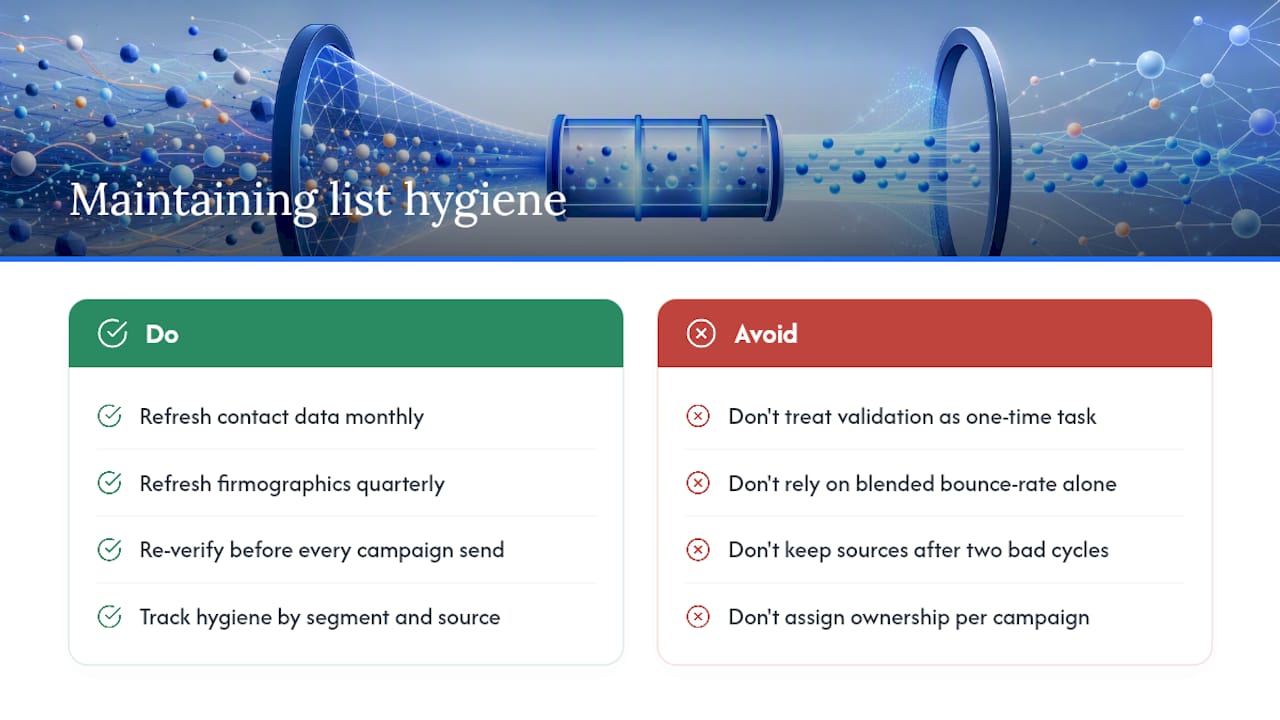
Build refresh cadence into the calendar, not into memory. Contact-level data goes stale fastest, so a monthly refresh on active segments catches job changes and role shifts before a rep sends to someone who left the company two months ago. Firmographic data moves slower, so quarterly refresh cycles are usually sufficient.
Re-verify immediately before every campaign send, no exceptions. A list verified in January is not verified in April. Domains expire, mailboxes close, and catch-all configurations change without warning.
Track hygiene metrics by segment, not just in aggregate. A blended bounce rate can hide a segment quietly failing inside a portfolio that otherwise looks healthy. Break metrics down by source, industry vertical, and list age to catch decay early.
Retire sources that consistently underperform. If a data source produces above-target bounce rates for two consecutive campaign cycles, cut it rather than continuing to patch around it with more verification passes.
Assign hygiene ownership permanently, not per campaign. Ownership assigned to SalesOps or RevOps with a documented SLA prevents the process from degrading the moment attention shifts to the next quarter's priorities. This is the single highest-leverage practice on this entire list, and it's the one most companies skip because it feels like overhead rather than pipeline protection.
Consider routing a portion of segmented, verified contacts to LinkedIn-based outreach when email risk is elevated but the account is too valuable to suppress entirely. It keeps high-value accounts in motion without risking domain reputation on a channel that's already showing risk signals.
Chad Burmeister: Executive Checklist and Practical Red Flags
When I step into an outbound program, I ask three questions before anything else: who owns the refresh SLA, what's the projected bounce rate on the last list that went live, and when was the last provider bake-off actually run. If any answer is vague, the data problem is really an ownership problem.
Numbers looking clean on a dashboard while meetings booked stay flat is the clearest red flag I see. That gap usually means enrichment happened without human review on the accounts that actually matter, enterprise and high-ACV targets specifically. Automation can't judge whether a title change signals real buying authority. A person has to.
If your metrics look fine but outcomes don't, audit backwards: source tag, then enrichment confidence score, then verification date. The break is almost always in one of those three places.
— Chad
How Chad Burmeister's Services Help You Run This Process
Building this SOP is one thing. Running it consistently across a growing SDR team while also carrying quota pressure is another problem entirely, and it's the reason most in-house attempts stall around month three.
Chad Burmeister's executive sales leadership engagements and fractional consulting exist specifically to close that gap. Whether you need someone to own the enrichment SLA directly, run the provider bake-off your team keeps postponing, or lead a workshop that trains your ops function on fast-disqualify criteria, this is hands-on delivery, not a framework handed off and left unimplemented. An engaged executive short-circuits the ownership vacuum and the skipped-verification mistakes covered above, because someone with 25-plus years scaling teams at companies like Informatica and Cisco-WebEx is the one accountable for the SLA, not a rotating cast of junior hires.
Visit Chad Burmeister's site to see current engagement options, or check the published playbooks if you want to start with the frameworks before booking a consulting conversation.
Sources
- How to build a lead qualification process that scales | Highspot blog
- B2B lead qualification frameworks explained | Sendspark blog
- Lead enrichment workflow for outbound teams — Bitscale
- B2B contact data CRM enrichment: Fix pipeline decay | SparkDBI